


“Just use a microfiber cloth” is some of the most dangerous guitar-care advice because it leaves out the part that matters: the cloth's condition, the finish under it, and what was used on it before. A clean microfiber guitar cloth can lift fingerprints and dust with very little abrasion. A contaminated one can carry grit, polish residue, silicone, or oily debris across an expensive finish.
The material isn't a guarantee of safety. Good results come from matching a clean cloth and gentle technique to the instrument's finish, then knowing when wiping should stop. Martin warns that solvents such as alcohol and citric acid can mar sensitive finishes, while Taylor distinguishes between products suitable for gloss surfaces and those that can make satin finishes look splotchy. Martin's care guidance and Taylor's finish guidance both support a more careful approach than treating every guitar the same.
Why Microfiber Guitar Cloths Actually Work
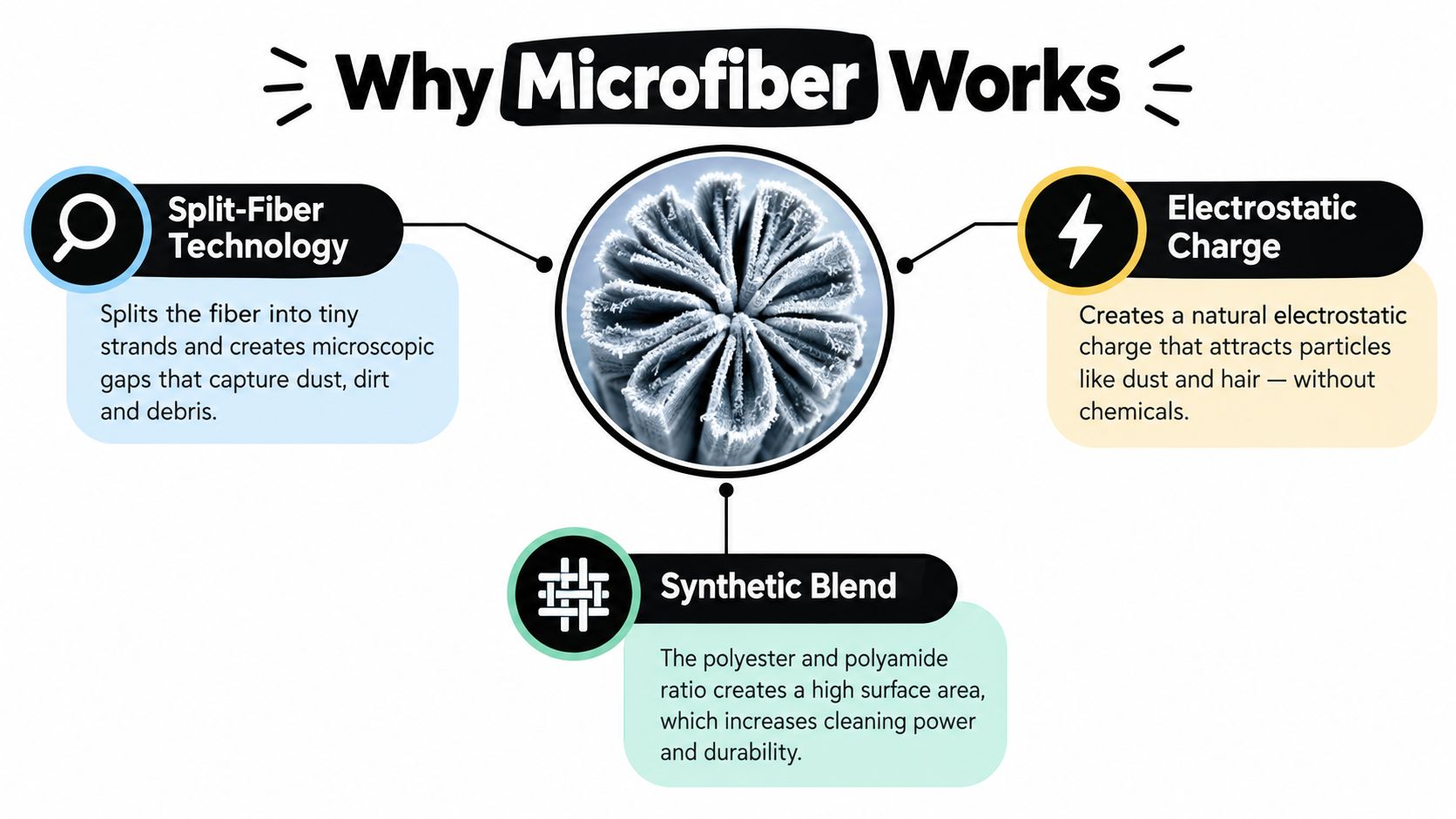
Softness is only part of the reason microfiber works. Advantage comes from engineered fiber fineness and surface structure, which is also why a microfiber guitar cloth can become unsafe when it captures abrasive particles.
Microfiber technology developed from ultrafine synthetic-fiber research in the late 1950s and 1960s. Commercially useful products emerged in the late 1980s and early 1990s, after manufacturers solved the difficulty of producing continuous filaments finer than conventional textile fibers. Modern cleaning cloths commonly use split, conjugated filaments made from polyester and polyamide, also called nylon. Splitting increases the number of fiber edges and creates a dense surface that can trap dust, oils, and fine particles rather than just pushing them across the finish. The material history and construction are discussed in this textile-fiber review.
The structure matters more than the label
Published textile measurements report polyester fibers around 12.16 µm in diameter and nylon fibers around 12.70 µm, as described in the referenced textile study. Finer filaments create more contact points per area and can reach shallow surface irregularities, helping lift fingerprints, dust, skin oils, and light residue.
That gives microfiber an advantage over a coarse cotton rag or paper towel. Cotton may absorb moisture, but it can be less effective at gathering fine contamination. Paper towels can shed fibers, drag debris, or leave a rougher contact pattern. Microfiber's benefit is capture, not merely absorbency.
Practical rule: A microfiber guitar cloth is safe only while its contact surface is clean. The cloth itself usually isn't the scratch source. Grit trapped inside it is.
Synthetic fibers also explain why microfiber belongs to a much larger materials industry rather than an isolated accessory category. Global textile-fiber production reached approximately 124 million tonnes in 2023, including about 84 million tonnes of synthetic fibers, while polyester represented roughly 57% of total fiber production, or about 71 million tonnes, according to the textile review linked above. Those figures provide context for the technology, but they don't make every synthetic cloth suitable for guitar care.
Choosing the Right Microfiber for Your Guitar
The product label tells you less than the construction. A cloth marketed for cars, glass, jewelry, or household cleaning may use a useful fiber blend, but it may also carry edge stitching, loose lint, finishing chemicals, or residues from an earlier job. For guitars, inspect the cloth as a tool, not as a disposable square of fabric.
What to inspect before buying
Run your fingertips over both sides. A suitable cloth should feel smooth and consistent, without hard specks, stiff seams, or loose threads. Hold it against a dark surface and shake it gently. Excess lint or visible shedding is a warning, especially for black gloss finishes where stray fibers stand out immediately.
The weave should feel dense without becoming stiff. Split-fiber construction is useful because it increases the available edges for lifting residue, but the label alone doesn't prove that the cloth uses it. A tight, even weave generally gives better control than a loose towel with long loops that can catch on hardware or fret ends.
GSM, or grams per square meter, can help compare products, but it isn't a safety rating. A lighter cloth can offer precise control around bridges, pickups, and binding. A thicker cloth can hold more residue and feel more cushioned, but bulk can tempt you to apply too much pressure. For delicate finishes, handling and cleanliness matter more than chasing a particular weight.
| Feature | What it can tell you | What it can't guarantee |
|---|---|---|
| Dense weave | More consistent contact and less loose lint | That the cloth is free from grit |
| Soft, finished edge | Lower risk of a stiff seam dragging on the finish | That the edge won't collect residue |
| Color coding | A useful way to assign cloths to body, strings, and hardware | That the dye or fabric is guitar-safe |
| High or low GSM | How much material and absorbency the cloth may provide | Whether it suits a particular finish |
A cheap cloth often fails through lint, uneven edges, or contamination rather than obvious roughness. Keep separate cloths for the guitar body, strings, and hardware. That small organizational habit prevents metal dust, string residue, and polish from moving onto the finish.
Finish-Specific Cleaning Protocols
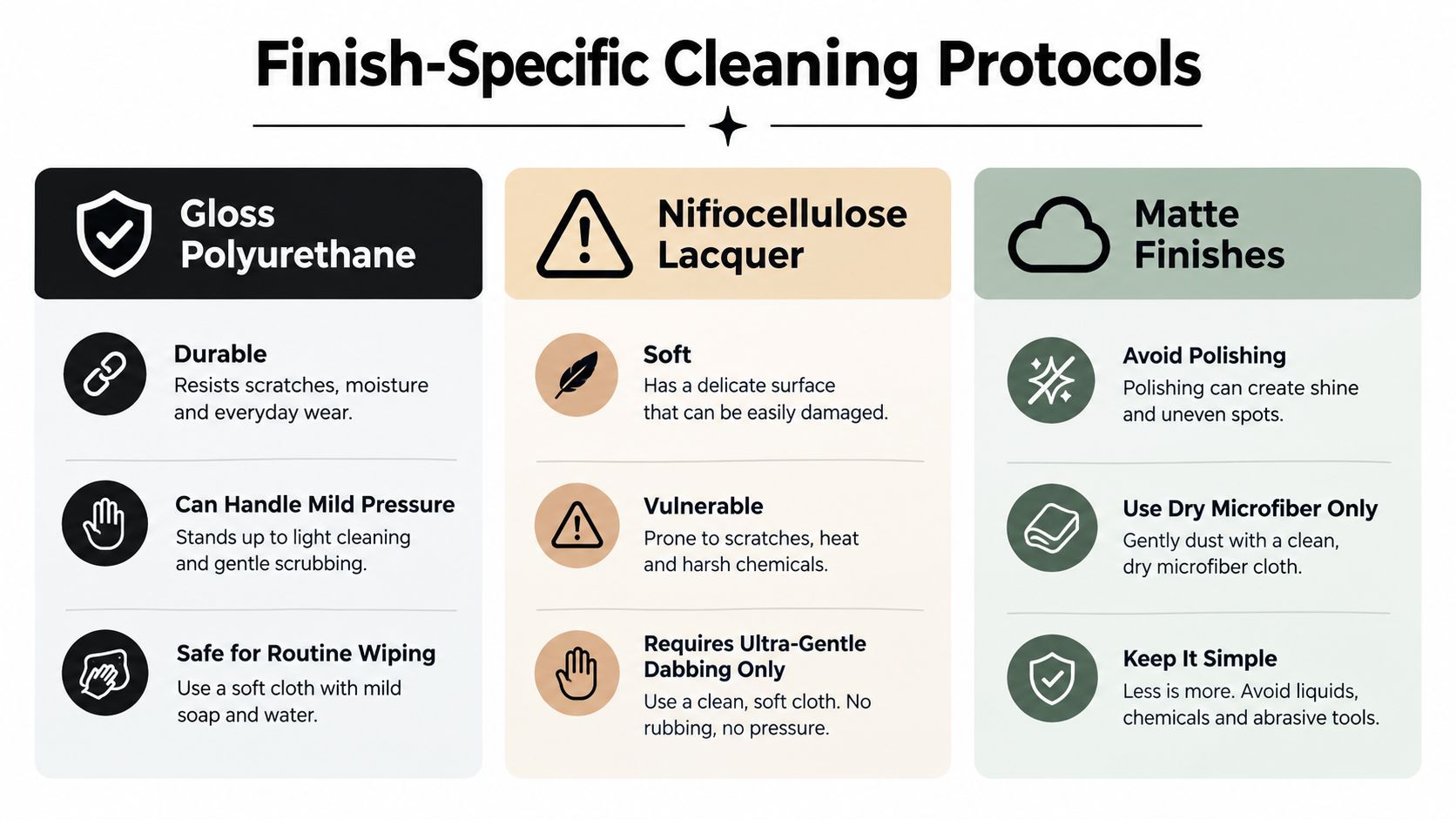
A microfiber guitar cloth isn't universally safe across guitar finishes. The same pressure and product that works on a modern gloss body can leave a satin surface blotchy or harm a vulnerable lacquer. Finish identification should come before cleaning.
Use the least aggressive option first
For ordinary dust and fresh fingerprints, start with a clean, dry cloth. Fold it so you have an uncontaminated section available, then make light passes without grinding residue into the surface. If visible residue remains, a barely damp cloth may be appropriate for some finishes, but it shouldn't be wet enough to leave moisture around bridges, seams, controls, or soundholes.
Martin advises wiping instruments with a warm, damp cloth for routine cleaning and recommends a soft, dry cloth for removing skin oils. Its guidance also warns that solvents, including alcohol and citric acid, can damage sensitive finishes and prohibits silicone-containing products. That makes household glass cleaner, disinfectant wipes, and unapproved automotive products poor choices for an unknown guitar finish.
Taylor's gloss and satin distinction is equally important. A finish-specific polish can suit a gloss surface, but thicker polish can make satin finishes look uneven or splotchy. Never assume that restoring shine is an improvement. Satin and matte finishes are designed to look different from gloss, and polishing can permanently alter that appearance.
A practical finish decision guide
- Gloss polyurethane: Begin with dry wiping. If residue persists, use a product approved for the finish and apply it to the cloth, not directly to the guitar. Keep pressure light.
- Nitrocellulose lacquer: Treat the surface as vulnerable. Use a clean, dry cloth with gentle dabbing or short, light passes. Avoid solvents, silicone, and unapproved polish.
- Satin or matte finish: Use a dry microfiber guitar cloth for routine dust and oil removal. Avoid gloss-restoring products unless the manufacturer specifically approves them.
- Unfinished wood: Don't treat it like a finished body. Fingerboards and other open wood areas may require a separate, manufacturer-approved care method and a dedicated cloth.
- Finished maple: Keep the cloth clean and dry for routine wiping, paying attention to residue around frets and hardware. Use finish-specific guidance before applying any liquid.
If you don't know the finish, stop at a dry wipe and check the manufacturer's care instructions. Testing an unfamiliar product in an inconspicuous area is safer than committing it to the entire instrument.
Safe Cleaning Techniques That Prevent Scratches
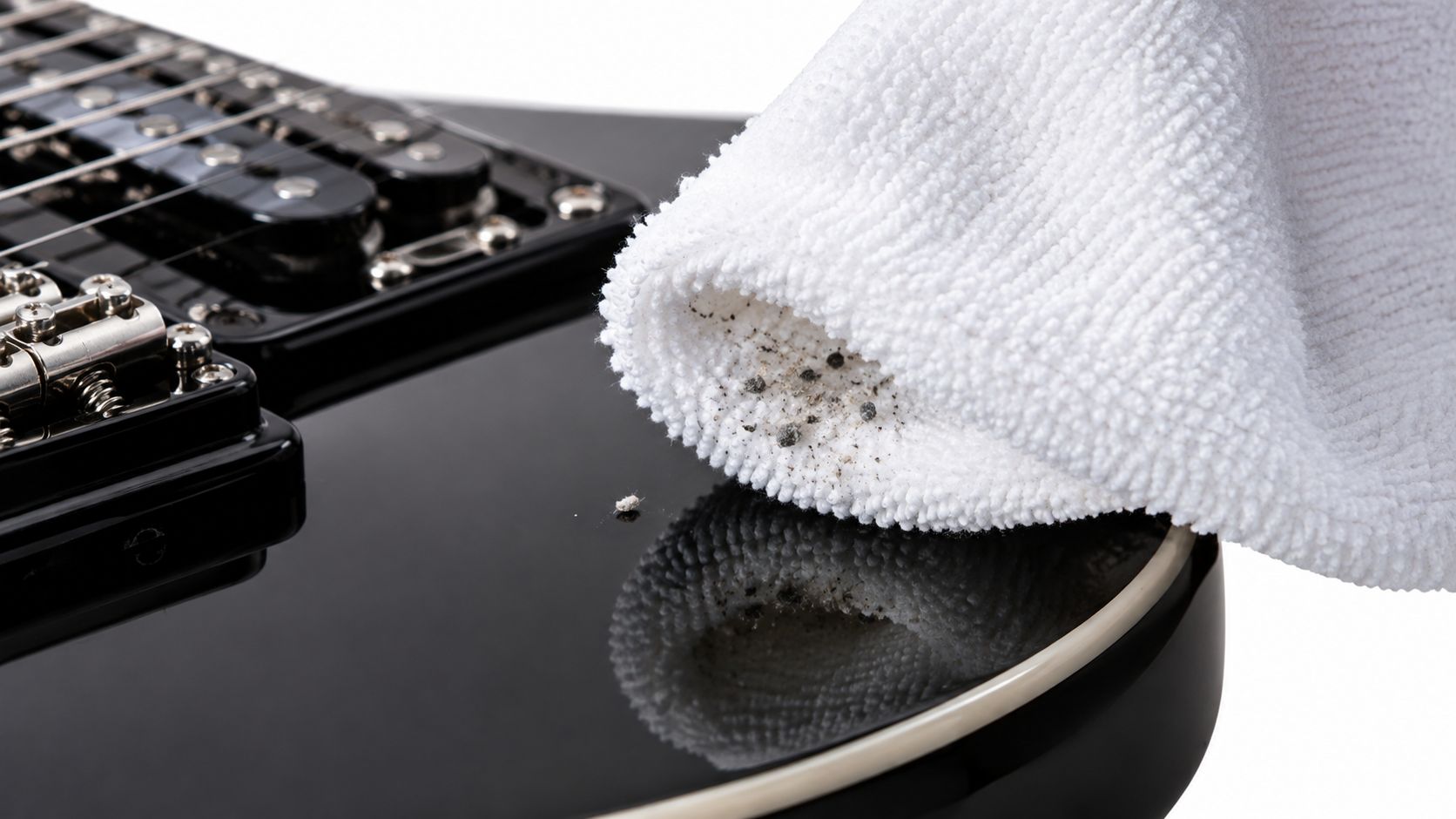
The most important scratch-prevention step happens before the cloth touches the guitar. Turn it inside out, inspect it under strong light, and feel for grit between your fingers. Captured abrasive particles, not microfiber fibers alone, can create micro-scratches during repeated rubbing.
A safer wiping sequence
- Inspect first. Reject any cloth that feels gritty, looks oily, or contains hard particles. Don't try to rescue a questionable cloth by rubbing harder.
- Separate the tasks. Use one clean section for the body, another for strings, and a different cloth for hardware. Metal residue and string grime don't belong on a lacquered surface.
- Lift instead of grind. Lay the cloth flat and use light, straight passes. Refold frequently so the same contaminated area doesn't keep contacting the finish.
- Control pressure. Let the fibers do the work. Heavy pressure can press grit into the finish and spread residue across a wider area.
- Stop when the surface is clean. Repeated polishing passes after the residue is gone add friction without adding protection.
Circular rubbing is a poor default on a delicate finish because it can distribute a particle through a larger path and make it harder to identify where damage occurred. Straight, controlled passes make it easier to monitor the cloth and keep contamination localized.
A cloth should remove residue, not become part of the abrasion process.
For players who maintain several instruments or need durable textiles for different jobs, Custom Mark's custom towels for cars can be a useful reference for comparing microfiber towel construction and assigning separate cloths to separate tasks. A car towel still isn't automatically appropriate for a guitar, but the same principle applies: dedicate each cloth to a clean, defined use.
Replace or isolate the cloth when it leaves streaks, feels stiff, smells strongly after washing, or shows embedded debris. Cross-contamination is easy to miss because the cloth may still feel soft while carrying material that can mark a finish.
Beyond Wiping, Cloth Care and Maintenance
A microfiber guitar cloth can only protect a finish when its fibers remain open and clean. Fabric softener, silicone-treated products, and oily household items can coat the microscopic spaces that capture dust and oils. Washing a guitar cloth with greasy shop rags defeats the purpose before the next wipe.
Launder for cleanliness, not fragrance
Wash guitar cloths separately from household laundry whenever possible. Use a mild detergent without fabric softener, avoid products that leave a waxy or silicone-like coating, and follow the cloth manufacturer's care instructions. Heat and harsh chemicals can change the texture or edge condition, so choose the gentlest suitable drying method and keep the cloth away from lint-producing materials.
Store clean cloths in a closed, dry container. Don't leave them on a workbench beside metal filings, polishing compounds, strings, or oily tools. A simple color system helps, but physical separation matters more than color.
Discard a cloth when it has a gritty feel, keeps leaving streaks after washing, retains an odor, or has absorbed a product you can't identify. Laundering removes some contamination, but it doesn't guarantee that every abrasive particle or chemical residue has disappeared.
For broader material-care habits, this guide to cleaning cloths for gold jewelry reinforces the same principle: delicate surfaces need clean, purpose-specific textiles rather than one cloth used for everything.
Microfiber also can't prevent finish checking, wood movement, or structural problems caused by an unstable environment. Martin recommends approximately 45–55% relative humidity and 72–77°F, as stated in its care guide. A clean cloth handles surface maintenance. Humidity monitoring and sensible storage protect the instrument beneath that surface.
The Complete Guitar Care Ecosystem
A microfiber guitar cloth is a surface-maintenance tool, not climate control. It can remove fresh sweat and dust, but it can't stop wood from responding to dry or damp conditions, and it can't repair finish checking once it appears.
Use a cloth as part of a wider routine:
- After sweaty playing: Wipe the strings and accessible finish with clean, dry textiles before putting the instrument away.
- During storage: Keep the guitar protected from unnecessary dust, temperature swings, and unstable humidity.
- Before deeper cleaning: Identify the finish and select a product approved for that surface.
- When something looks wrong: Stop rubbing. Inspect clouding, cracks, lifting finish, loose binding, or unusual movement before applying anything else.
Humidity deserves the same attention as wiping. Martin's recommended range of approximately 45–55% relative humidity and 72–77°F gives owners a practical environmental target, but a cloth can't measure or maintain those conditions. Use an appropriate hygrometer and follow the instrument maker's storage recommendations rather than relying on appearance alone.
If wiping doesn't improve the surface, more wiping may be the wrong treatment.
Players who maintain several kinds of gear may also appreciate OohYeah's Gitfresh tools as an example of a broader maintenance mindset. The useful lesson isn't to add products indiscriminately. It's to organize care around the material, contamination risk, and job at hand.
Real-World Scenarios for Guitar Care Success
A touring player finishes a sweaty set and doesn't reach for a household wipe. They use a clean, dry microfiber guitar cloth for the strings and body, inspect it between instruments, then isolate it when it starts carrying residue. That routine removes fresh oils without spreading unknown chemicals.
A collector with a vintage nitrocellulose-finished guitar takes an even narrower approach. They use gentle dry contact, avoid unapproved polish, and stop when a mark doesn't lift easily. A technician can then assess the finish instead of inheriting damage caused by increasingly aggressive cleaning.
A beginner can build the right habit immediately: separate body, string, and hardware cloths, wash them without softener, and wipe after practice when sweat is present. Players who want structured practice time can pair that routine with focused resources such as Isolate Audio's guitar practice backing tracks, while keeping instrument care simple and repeatable.
Evo Dyne Products offers practical care solutions for household, jewelry, automotive, and everyday maintenance needs, with an emphasis on reliable formulas and responsive support. If you want to build a cleaner, more deliberate care routine around your instruments and other valuable surfaces, visit Evo Dyne Products and explore the available solutions.