


Best overall for general-purpose CNC flood machining: a machine-approved water-soluble coolant. Best for localized drilling and tapping: consider Evo Dyne Cutting Fluid after checking compatibility. Best for oil-fed, lubrication-heavy operations: a dedicated straight cutting oil. This 2026 guide explains which fluid type fits your operation—and which choices to reject.
- The best cutting oil for CNC machining depends on your machine, alloy, operation, and delivery system.
- Evodyne cutting oil belongs on the shortlist for localized drilling and tapping, not automatically for flood-coolant systems.
- Water-soluble coolants suit general-purpose flood machining; straight cutting oils prioritize lubrication.
- Choose the fluid class first, then verify material compatibility, operating instructions, and safety documentation.
Why this matters
The phrase cutting oil covers products that do different jobs. A neat oil applied at a drill is not interchangeable with a water-mixed coolant circulating through a CNC machine.
Choose the wrong fluid class and the rest of the comparison stops mattering. Your machine's delivery system, the workpiece material, and the cutting operation determine what belongs on your shortlist.
For a 2026 purchase, start with the machine manual rather than the bottle label. Then check the fluid manufacturer's technical data and safety data sheet. A product described for drilling, tapping, and milling still needs confirmation before you put it into a recirculating sump or through-spindle system.
What makes the best cutting oil for CNC machining?
Use these criteria before comparing products. They separate a suitable machining fluid from a convenient bottle that does not fit the job.
- Machine approval: The fluid must suit the machine's seals, pumps, delivery system, and operating instructions. Through-spindle delivery deserves a separate compatibility check.
- Material compatibility: Match the formula to the actual alloy. Steel, stainless steel, aluminum, and copper alloys do not share every fluid requirement.
- Cooling versus lubrication: High heat removal and heavy boundary lubrication are different priorities. Choose the balance your operation requires.
- Delivery method: Manual application, flood coolant, and minimum-quantity lubrication require different product properties. Do not substitute between them without approval.
- Maintenance requirements: Water-mixed fluids need concentration and condition monitoring. Straight oils need controls for contamination, mist, and fire hazards.
- Documentation: Clear mixing, handling, compatibility, and disposal instructions matter more than an unsupported claim about longer tool life.
No universal formula wins all six criteria. The best choice is the fluid your machine permits that addresses your operation's main constraint.
CNC cutting fluids at a glance
The ranking below assigns each option a distinct job. It compares fluid classes rather than inventing a leaderboard of named products with unverified specifications.
| Ranked option | Best for | Standout characteristic | Key limitation |
|---|---|---|---|
| Evo Dyne Cutting Fluid | Localized drilling and tapping | Named multipurpose metal cutting oil with drilling, tapping, and milling uses | CNC sump and delivery-system compatibility require confirmation |
| Water-soluble oil coolant | General-purpose CNC flood machining | Combines water-based cooling with an oil-containing emulsion | Needs correct mixing and ongoing sump care |
| Semi-synthetic coolant | Mixed-operation recirculating CNC work | Combines oil-containing and synthetic components | Performance and compatibility vary by formulation |
| Synthetic coolant | Cooling-led machining with tool-zone visibility | Contains no mineral oil in the concentrate; often forms a clear solution | Not automatically the right choice for lubrication-heavy cuts |
| Dedicated straight cutting oil | Oil-approved, lubrication-heavy tapping and cutting | Used without water dilution | Requires attention to mist, fire risk, and machine approval |
1. Evo Dyne Cutting Fluid: best for localized drilling and tapping
Evo Dyne Cutting Fluid, Made in USA - Multipurpose Metal Cutting Oil is a named product for metal cutting, including drilling, tapping, and milling. That makes it a relevant starting point for a DIY machinist selecting a cutting oil for those operations.
Evodyne cutting oil is best considered for localized drilling and tapping, not assumed to be a CNC sump coolant. Keep that distinction clear: the stated application does not establish compatibility with every CNC machine, alloy, pump, or coolant circuit.
Before using it on CNC equipment, confirm the application method with both the machine instructions and the product documentation. Do not add water or pour it into an existing coolant mixture unless the instructions expressly permit it.
Evo Dyne Cutting Fluid pros:
- Made in the USA, as stated in the product name.
- Identified for drilling, tapping, and milling applications.
- Provides a concrete product to assess rather than an unnamed fluid category.
Evo Dyne Cutting Fluid cons:
- The stated uses do not establish recirculating-sump approval.
- Material-specific suitability and delivery-system compatibility need confirmation.
Best for: A home or small-workshop user evaluating a named cutting oil for localized metal drilling or tapping.
Verdict: Hold until the documentation confirms your machine, material, and application method.
2. Water-soluble oil coolant: best for general-purpose flood machining
Water-soluble oil coolants form an emulsion when mixed with water according to their instructions. The water carries much of the cooling load, while the formulation supplies lubrication and other machining-fluid functions.
This is the default fluid class to assess for general-purpose CNC flood machining in 2026 when the machine supports it. The actual product still needs to match your workpiece materials and operating conditions.
Do not treat concentration as an optional detail. A refractometer reading must be interpreted using that product's instructions and correction factor; the displayed reading is not universally identical to the actual concentration.
Water-soluble oil coolant pros:
- Combines cooling and lubrication in a flood-delivery system.
- Offers a practical starting category for general-purpose machining.
- Supports recirculating use when the particular formula and machine permit it.
Water-soluble oil coolant cons:
- Requires controlled mixing and concentration monitoring.
- Can become contaminated with tramp oil, chips, and microorganisms.
- Emulsion appearance can make the cutting zone harder to see.
Best for: A CNC owner selecting an approved flood coolant for routine work rather than a manually applied cutting oil.
Verdict: Buy a machine-approved formulation when general-purpose flood machining is the requirement. Reject products whose mixing or material instructions are unclear.
3. Semi-synthetic coolant: best for mixed-operation CNC work
Semi-synthetic coolants combine an oil-containing component with synthetic constituents. They sit between soluble-oil emulsions and fully synthetic fluids, but the category name alone does not tell you how a particular formula performs.
Put this category on your shortlist when one recirculating system handles different operations and materials. Then compare documented material compatibility, lubrication characteristics, foam control, and water-quality requirements.
Do not assume that moving to a semi-synthetic eliminates coolant maintenance. It remains a water-mixed fluid, so concentration, contamination, and sump condition still need attention. A broad compatibility statement also does not replace checking the specific alloys you machine.
Semi-synthetic coolant pros:
- Provides a middle-ground formulation category to evaluate.
- Combines water-based cooling with oil-containing lubrication.
- Offers a useful shortlist for a mixed-operation recirculating system.
Semi-synthetic coolant cons:
- Needs the same disciplined water-mixed-fluid maintenance approach.
- The label does not guarantee suitability for every metal or operation.
- Foam behavior depends on the formula and system conditions.
Best for: A workshop choosing a documented fluid for varied machining in one compatible CNC coolant system.
Verdict: Buy only after the supplier confirms your material mix and delivery conditions. Skip a formulation that cannot address those requirements clearly.
4. Synthetic coolant: best for cooling-led work and visibility
Synthetic metalworking fluids contain no mineral oil in the concentrate. Many form transparent solutions when mixed, making this category useful to assess when visibility around the cutting zone matters.
Start here when cooling is the leading requirement, then verify that the particular formula supplies enough lubrication for the cut. Clear appearance is not proof of low contamination or correct concentration.
For your 2026 shortlist, distinguish a synthetic flood coolant from an oil designed for minimum-quantity lubrication. Both descriptions concern fluid selection, but they do not identify interchangeable products or delivery methods.
Synthetic coolant pros:
- Provides a water-based option for cooling-focused machining.
- Often offers better tool-zone visibility than an opaque emulsion.
- Does not contain mineral oil in the concentrate.
Synthetic coolant cons:
- Lubrication performance remains formulation-specific.
- Water quality, concentration, corrosion control, and contamination still matter.
- Clear fluid can look acceptable even when its condition needs attention.
Best for: A machinist prioritizing cooling and visibility in a machine approved for the selected synthetic formulation.
Verdict: Buy when the technical data matches your operation. Skip selection based only on clarity or the word synthetic.
5. Dedicated straight cutting oil: best for lubrication-heavy operations
Straight cutting oils are used without water dilution. Their formulations vary, including oils with additives intended for demanding cutting conditions.
Assess this category for lubrication-heavy operations such as tapping when the machine is designed or approved for oil use. Additive chemistry matters: some sulfur-containing formulations can stain copper alloys, so confirm compatibility instead of treating every straight oil as interchangeable.
Straight oil is not the default replacement for a water-mixed CNC coolant. Its different cooling behavior, combustibility, and potential for oil mist require an application-specific assessment and appropriate controls.
Dedicated straight cutting oil pros:
- Avoids water-mixing and dilution-ratio management.
- Provides an oil-based option for lubrication-led operations.
- Allows selection of documented additive chemistry for the intended material.
Dedicated straight cutting oil cons:
- Does not provide the same water-based heat-removal characteristics.
- Requires attention to mist exposure and fire hazards.
- Some additive packages are unsuitable for particular nonferrous metals.
Best for: An oil-approved machine performing operations where lubrication takes priority over water-based cooling.
Verdict: Buy only for an approved oil application. Skip it as an undocumented substitute in a flood-coolant sump.
How to choose your fluid without guessing
Use this sequence before ordering or changing fluids in 2026. It keeps the decision tied to the machine instead of a generic best-oil claim.
- Machine approval: Identify whether your equipment permits water-mixed coolant, straight oil, or a specific delivery arrangement. Resolve restrictions first.
- Material match: Record the actual workpiece alloy and tool material. Ask the fluid supplier about compatibility and staining concerns.
- Delivery check: Confirm flood, through-spindle, manual, or minimum-quantity delivery suitability. A compatible material does not guarantee a compatible delivery system.
- Fluid instructions: Read the technical and safety documentation for preparation, handling, maintenance, and disposal.
- Controlled trial: Evaluate the approved fluid under controlled machining conditions before adopting it across unrelated work.
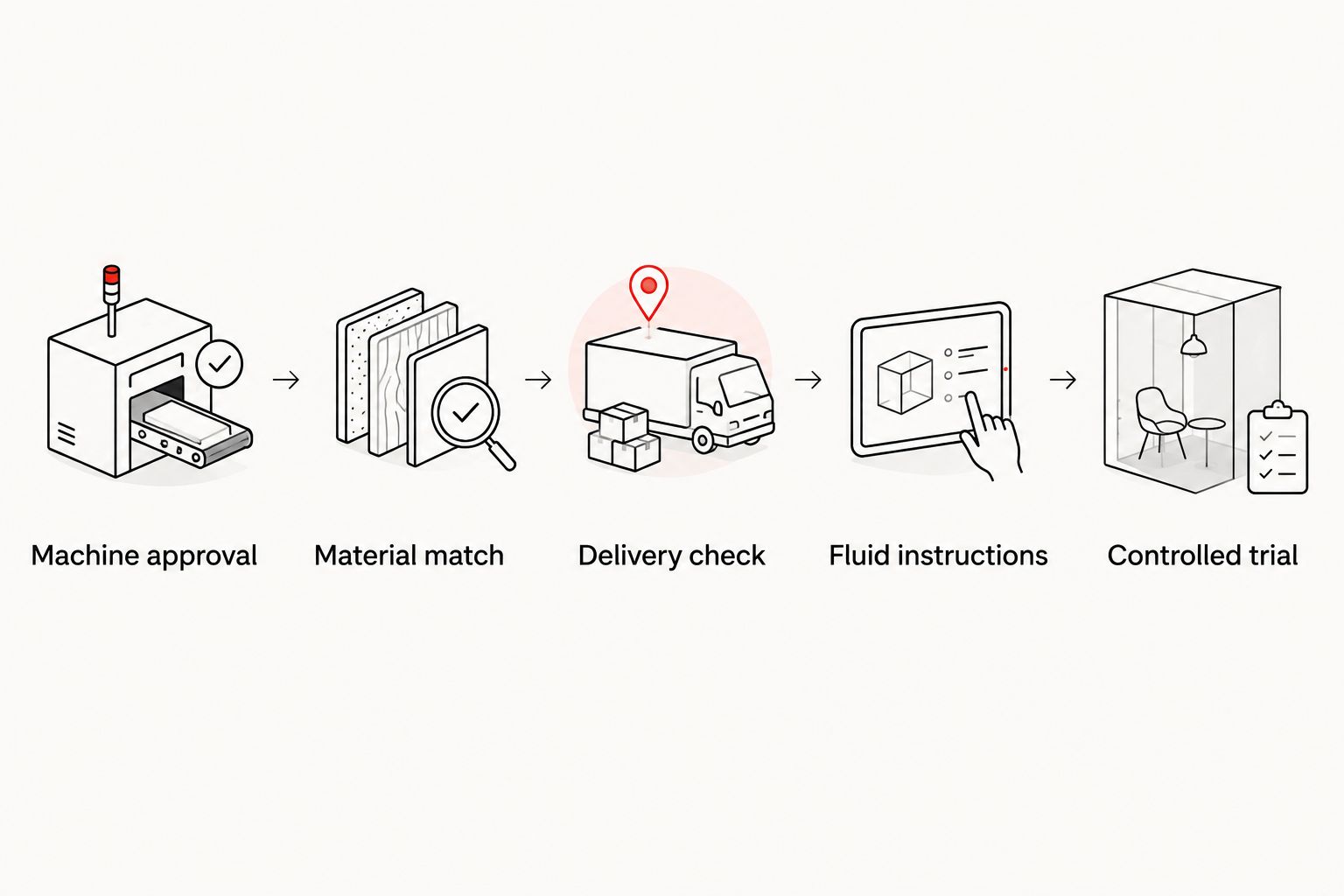
For the controlled trial, keep 1 workpiece alloy and 1 tool geometry fixed. Assess 3 checks: surface finish, chip evacuation, and tool condition. These are comparison instructions, not promised performance results; keep speeds, feeds, and depth of cut consistent so the fluid is the variable you are assessing.
Do not deliberately run a tool to failure to prove a bottle's claim. Use your normal safe inspection procedure and stop if the cut becomes unstable.
How these options are ranked
The ranking follows machine suitability, material compatibility, cooling versus lubrication, delivery method, maintenance, and documentation. It is a use-case guide, not a claim of measured superiority between formulas.
The named Evodyne product comes first because localized metal drilling and tapping fits its stated purpose and the brand's DIY audience. For a conventional flood-coolant selection, the water-soluble category remains the default starting point—not an automatic endorsement of any particular bottle.
Which CNC cutting fluid should you choose?
Choose a machine-approved water-soluble coolant for general-purpose flood machining unless your operation requires another documented fluid class. Assess semi-synthetic coolant for mixed work, synthetic coolant for cooling-led work and visibility, and straight oil for approved lubrication-heavy applications.
For localized drilling or tapping, evaluate Evodyne cutting oil against the same compatibility checks. Its stated applications make it relevant; they do not bypass the machine manual.
The decisive 2026 buying question is simple: does this exact formula suit this machine, this alloy, and this delivery method? If the answer is not documented, hold the purchase.
FAQ
What's the best cutting oil for CNC machining?
The best cutting oil for CNC machining is the formula approved for your machine, workpiece material, operation, and delivery system. For general-purpose flood machining, start by assessing a water-soluble coolant; for oil-approved lubrication-heavy work, assess a straight cutting oil.
Can I use Evo Dyne Cutting Fluid in a CNC machine?
Use Evo Dyne Cutting Fluid in CNC equipment only after confirming machine, material, and delivery-system compatibility. Its stated drilling, tapping, and milling applications do not establish approval for every sump or through-spindle system.
Is cutting oil the same as CNC coolant?
Cutting oil and CNC coolant are not interchangeable terms. Straight cutting oil is used without water dilution, while many CNC flood coolants are formulated to be mixed with water.
Is straight cutting oil better than water-soluble coolant?
Straight cutting oil is not universally better than water-soluble coolant. Assess straight oil for approved lubrication-heavy applications and water-soluble coolant when water-based cooling and flood delivery fit the machine.
Can I mix different cutting fluids together?
Do not mix different cutting fluids unless their manufacturers explicitly confirm compatibility. An unapproved mixture can change fluid behavior and complicate concentration monitoring, corrosion control, and maintenance.
What's the right coolant concentration for CNC machining?
The right coolant concentration is the range specified for the exact formula and operation. Use the manufacturer's mixing instructions and refractometer correction factor rather than applying a universal ratio.
What should I compare when testing a new CNC cutting fluid?
Compare surface finish, chip evacuation, and tool condition under consistent machining conditions. Keep the alloy, tool geometry, speeds, feeds, and depth of cut fixed so unrelated changes do not distort the comparison.
One last thing
A refractometer cannot identify an unknown fluid or certify that a mixture is safe for your machine. It helps you monitor a known product when you apply that product's instructions.
Keep the fluid's identity, preparation instructions, and maintenance record together. That simple habit makes troubleshooting more useful than comparing bottles after the sump already contains an undocumented mixture.