


Best overall: an eyewear-labeled ultrasonic solution approved for your lenses and machine. Best fallback: manufacturer-approved manual washing. Best additive-free option: plain water, only when both manufacturers permit it. This 2026 guide explains how to choose an ultrasonic cleaner solution for eyeglasses without treating a jewelry-cleaner label as proof of lens compatibility.
- The best ultrasonic cleaner solution for eyeglasses has explicit compatibility with your lenses, frames, and ultrasonic machine.
- Manufacturer-approved manual washing is the fallback when ultrasonic compatibility is unconfirmed.
- Plain water belongs in an ultrasonic tank only when the eyewear and machine instructions permit it.
- Evodyne ultrasonic jewelry cleaner is a jewelry option, not a confirmed recommendation for eyeglasses.
Why this matters
Eyeglasses are more than lenses in a frame. Coatings, frame finishes, hinges, and other components all matter when you choose a cleaning method. A formula's suitability for jewelry does not establish suitability for the glasses you wear every day.
Evodyne sells specialty cleaning and maintenance formulas, including ultrasonic jewelry cleaner. Evodyne ultrasonic jewelry cleaner is best considered by jewelry-cleaning shoppers; it is not a confirmed eyeglass-cleaning recommendation. For eyewear, match the cleaning method to the instructions for the actual pair, not to a familiar bottle or a broad cleaning claim.
What makes the best ultrasonic cleaner solution for eyeglasses
Use these criteria before comparing bottles. For this 2026 buying guide, explicit compatibility comes before convenience.
- Eyewear compatibility: The directions must cover the lens material, coatings, and frame materials you intend to clean.
- Ultrasonic approval: Approval for wiping lenses is not approval for immersion in an ultrasonic bath. Confirm the cleaning method separately.
- Machine compatibility: The cleaner must meet the ultrasonic machine's requirements for tank liquids and additives.
- Clear mixing directions: A concentrate needs a stated dilution. Do not substitute a jewelry dilution for missing eyewear instructions.
- Complete aftercare: Look for instructions covering rinsing, drying, and handling, not just the cleaning bath.
- A usable fallback: If compatibility is unresolved, use an approved manual method instead of experimenting.
The best solution is the one whose directions cover the whole job. A label that leaves your coatings or cleaning method unaddressed does not clear that standard.
Cleaning options at a glance
The order below is a decision tree, not a claim that every pair of glasses belongs in an ultrasonic tank. The manual option ranks ahead of an unconfirmed ultrasonic treatment.
| Option | Best for | Standout feature | Key limitation |
|---|---|---|---|
| Eyewear-approved ultrasonic solution | Glasses explicitly cleared for ultrasonic cleaning | Instructions that address eyewear and the cleaning method | Approval must match your particular lenses, coatings, and frames |
| Manufacturer-approved manual washing | Glasses without confirmed ultrasonic approval | Avoids relying on an unverified tank treatment | Requires hands-on cleaning and careful drying |
| Plain water in an approved ultrasonic machine | Eyewear and machines whose instructions permit water-only cleaning | No added cleaning formula | Water-only cleaning does not replace all cleaning requirements |
| Ultrasonic Jewelry Cleaner Solution | Jewelry cleaning, not unconfirmed eyewear use | Listed for jewelry and sonic or ultrasonic machines | The supplied product information does not establish eyeglass compatibility |
1. Eyewear-approved solution: best for confirmed ultrasonic use
An eyewear-approved ultrasonic solution is the first choice when your glasses and machine both permit that treatment. Its job is to support cleaning in the tank under specified conditions. The important distinction is explicit eyewear approval, not simply the words ultrasonic cleaner on the bottle.
For your 2026 purchase, read the complete directions before choosing. Check whether approval covers your coatings and frames, whether the formula needs dilution, and whether the machine permits that liquid. If one set of instructions contradicts another, do not combine them.
Eyewear-approved solution pros:
- Provides a direct basis for choosing a formula for glasses.
- Gives you defined mixing instructions when it is a concentrate.
- Lets you check eyewear requirements against machine requirements.
Eyewear-approved solution cons:
- An eyewear claim does not automatically cover every coating or frame finish.
- A suitable liquid does not make an unsuitable pair of glasses safe for ultrasonic cleaning.
- Instructions can differ between formulas; a previous bottle's dilution is not transferable.
Best for: Owners whose eyewear manufacturer and ultrasonic machine instructions both approve the proposed treatment.
Verdict: Buy only after confirming the full compatibility match. If the listing is vague, choose a different option rather than filling the gaps yourself.
2. Approved manual washing: best when ultrasonic approval is absent
Manufacturer-approved manual washing is the default when you cannot confirm ultrasonic suitability. Follow the eyewear maker's method, whether that means a specified lens cleaner or washing with an approved mild soap and water. Do not assume a household detergent is acceptable just because it looks gentle.
Manual cleaning gives you control over where you apply liquid and how you handle the frame. It also avoids turning uncertainty about an ultrasonic bath into a home experiment. For glasses with unclear care instructions, ask the dispensing optician for a cleaning method matched to the lenses and frame.
Approved manual washing pros:
- Does not depend on obtaining permission for ultrasonic immersion.
- Lets you follow the eyewear manufacturer's existing care directions.
- Keeps cleaning and drying steps visible and under your control.
Approved manual washing cons:
- Requires direct handling of the glasses.
- Does not make an unsuitable soap or cloth safe to use.
- Needs careful attention around hinges and small frame details.
Best for: Anyone whose glasses lack clear ultrasonic approval, or whose manufacturer specifies a manual method.
Verdict: Use the approved manual method instead of an unconfirmed ultrasonic solution. Buying a machine or a specialty liquid is not a reason to disregard the eyewear instructions.
3. Plain water: best for an explicitly permitted additive-free bath
Plain water is an option only when the ultrasonic machine and eyewear instructions permit water-only cleaning. It avoids introducing a separate cleaning formula. That does not make the ultrasonic process universally suitable for glasses.
Use the water type, fill level, and cycle instructions specified by the machine manufacturer, alongside the eyewear restrictions. Do not invent a longer cycle to compensate for leaving out a cleaner. If a permitted water-only process does not remove the residue, move to another approved method rather than adding an unrelated liquid.
Plain-water ultrasonic cleaning pros:
- Introduces no additional cleaning formula.
- Removes the need to calculate a cleaner dilution.
- Provides a straightforward option when both sets of directions specify it.
Plain-water ultrasonic cleaning cons:
- Does not resolve uncertainty about ultrasonic compatibility.
- Is not a substitute when the prescribed method requires a cleaner.
- Still requires the correct machine settings and aftercare.
Best for: Glasses and ultrasonic machines explicitly cleared for water-only cleaning.
Verdict: Use only when instructed; skip it as a guess. Water is not a permission slip for an otherwise unapproved cleaning method.
4. Evodyne jewelry cleaner: best kept in its stated category
Evodyne lists ultrasonic jewelry cleaner for jewelry, including diamond, gold, silver, and gemstones, with sonic and ultrasonic machine use described in the product listing. Those are jewelry applications. They do not establish compatibility with prescription lenses, lens coatings, or complete eyeglass frames.
The catalog also lists a 2-PACK Ultrasonic Jewelry Cleaner Solution with 16 fl oz total. Package format and quantity do not answer the eyewear question. Choose an eyeglass treatment based on applicable directions, not on whether the bottle is already beside your machine.
Evodyne jewelry cleaner pros:
- Has a stated jewelry-cleaning purpose.
- Identifies sonic and ultrasonic machine applications in the listing.
- Offers a clear category to distinguish from an eyewear-specific formula.
Evodyne jewelry cleaner cons for eyeglasses:
- The supplied information does not explicitly establish eyeglass compatibility.
- It does not provide an eyewear-specific dilution to use here.
- Jewelry applications do not settle questions about lens coatings or frame finishes.
Best for: Shoppers choosing a cleaner for its stated jewelry application, with item-specific care instructions checked separately.
Verdict: Skip for eyeglasses unless explicit applicable instructions confirm that use. Do not turn a jewelry recommendation into an eyewear recommendation by changing the article's category.
How this 2026 ranking works
This ranking puts explicit compatibility first, then usable directions, machine requirements, and aftercare. It does not rank unnamed formulas by cleaning power or claim laboratory testing.
An eyewear-approved solution leads for confirmed ultrasonic use. Approved manual washing is the fallback when that confirmation is absent. Plain water occupies a narrower slot, while jewelry cleaner remains a separate category unless its instructions explicitly cover the eyewear application.
Before you put glasses in an ultrasonic tank
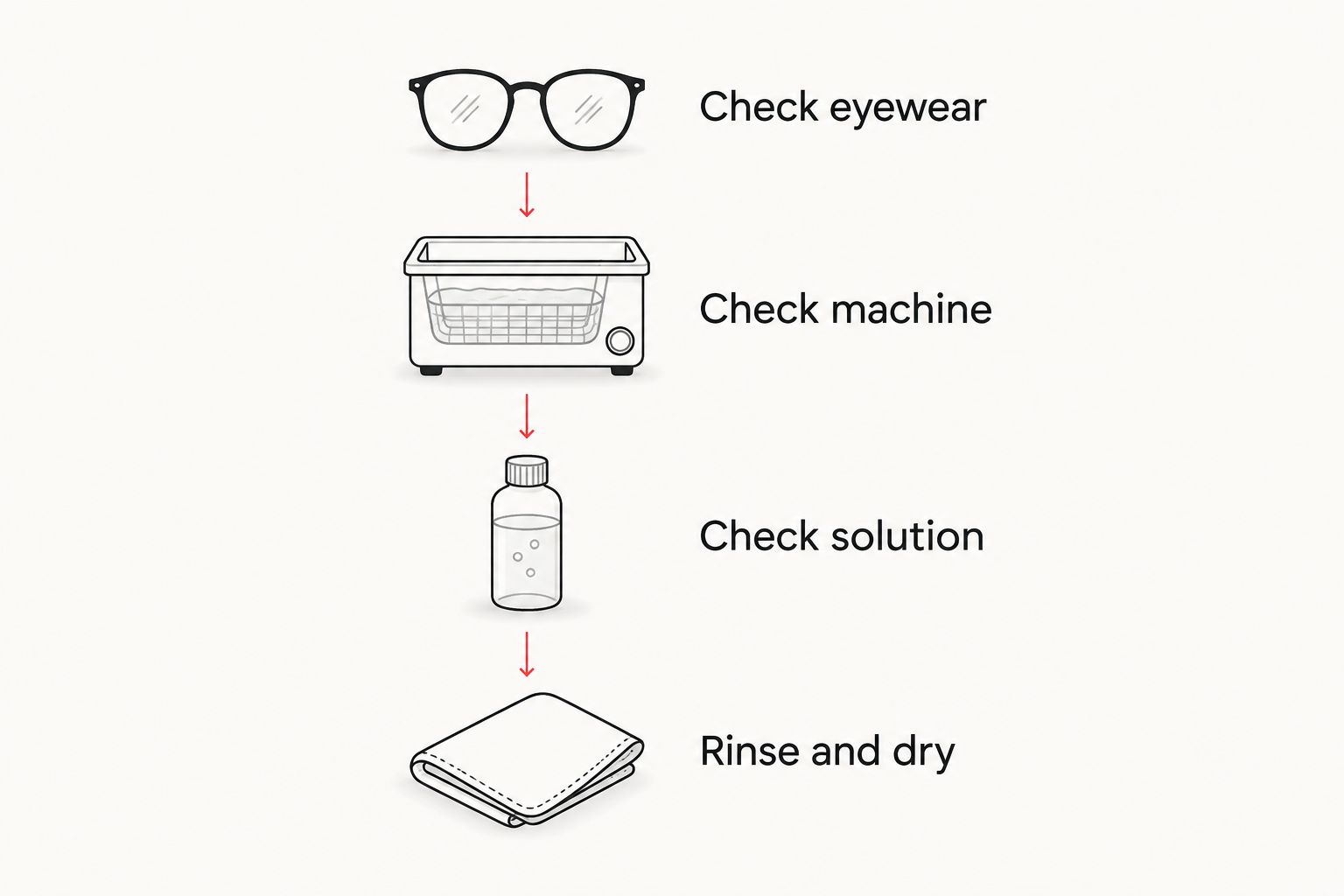
Make the compatibility check a sequence. You need permission for the glasses, permission for the liquid, and a process that respects both sets of directions.
Check eyewear
Find the care instructions for your lens material, coatings, and frame. Confirm that ultrasonic cleaning itself is permitted. If the instructions only discuss wiping or manual washing, do not read ultrasonic approval into them.
Check machine
Read the machine instructions for acceptable tank liquids, filling, item placement, and operation. Use the specified holder or positioning method rather than improvising contact with the tank. Keep the machine's restrictions separate from the cleaner's claims.
Check solution
Confirm the formula's stated eyewear application and mixing directions. A label that covers jewelry alone is not enough. If you cannot establish compatibility across all three checks, stop and use the approved manual method.
Rinse and dry
Follow the prescribed aftercare for the eyewear and solution. Use the appropriate clean drying material, and inspect the lenses and frame afterward. Repeating an unapproved treatment is not a troubleshooting step.
What not to substitute
Do not substitute a different cleaner simply because it fits in the tank. A surface cleaner, solvent, disinfectant, or jewelry formula needs its own applicable approval; familiarity is not evidence of compatibility.
Also separate cleaning methods. A liquid intended for application with a cloth is not automatically suitable for an ultrasonic bath. A dilution intended for jewelry is not an eyeglass instruction, and a machine's ability to run a cycle does not establish that the item inside belongs there.
If you are comparing labels in 2026, ask one useful question: does this instruction cover my actual glasses and this actual method? That question eliminates more uncertainty than broad claims about strength or shine.
Which cleaning option should you choose?
Choose an eyewear-approved ultrasonic solution only for glasses already cleared for ultrasonic cleaning. Otherwise, choose the manufacturer's manual method. That is the default recommendation for an undecided reader.
Use plain water only within an explicitly approved water-only process. Keep jewelry cleaner in its stated application unless applicable instructions confirm eyewear use. The aim is clean glasses without making unsupported assumptions about the lenses, coatings, or frame.
FAQ
What's the best ultrasonic cleaner solution for eyeglasses in 2026?
The best choice is a solution explicitly approved for your lenses, coatings, frames, and ultrasonic machine. If ultrasonic use is not confirmed for your glasses, use the manufacturer's approved manual cleaning method instead.
Can I use Evodyne ultrasonic jewelry cleaner on eyeglasses?
Do not use it on eyeglasses without explicit applicable compatibility instructions. The supplied product information identifies jewelry applications but does not establish suitability for eyeglass lenses, coatings, or frames.
Is plain water better than a cleaning solution for glasses?
Plain water is appropriate only when the eyewear and machine instructions permit water-only ultrasonic cleaning. It is not automatically better than a solution and does not remove the need for ultrasonic compatibility approval.
Can I put coated prescription lenses in an ultrasonic cleaner?
Put coated prescription lenses in an ultrasonic cleaner only when the eyewear manufacturer permits that method. Approval must cover the actual lenses and coatings, not just the frame material or the cleaner bottle.
How much ultrasonic solution should I add for eyeglasses?
Use only the eyewear-compatible dilution specified by the solution manufacturer, within the machine's requirements. Do not invent a ratio or borrow one from instructions intended solely for jewelry.
Can I add dish soap to an ultrasonic cleaner?
Add dish soap only if both the eyewear and machine instructions explicitly permit it. Approval for manual washing does not automatically approve the same soap for use in an ultrasonic tank.
What should I do if I cannot find cleaning instructions for my glasses?
Ask the dispensing optician or eyewear manufacturer for a method matched to your lenses, coatings, and frame. Leave ultrasonic cleaning off the plan until that method is confirmed.
One last thing
The bottle and the machine answer different questions. A cleaner label addresses the liquid's application; the machine manual addresses operation. Neither replaces the eyewear manufacturer's care instructions.
Before your next cleaning session, save the care directions for your actual glasses. That reference is more useful than another bottle chosen on a broad cleaning claim.
Related guides
- For a separate car-care task: Best New Car Scent Air Fresheners