
You open the car door, and the sour smell is back. You've wiped the seat, taken out the rubbish, and sprayed something fresh, but after an afternoon in the sun, the cabin smells like the spill all over again. The problem isn't necessarily that you need a stronger car odor eliminator spray. You may need a different kind, applied where the odor begins.
Table of Contents
- Why Car Odors Linger and What a Spray Can Do
- Matching the Spray Mechanism to Your Odor
- Ventilation, Heat and Safe Use
- Surface Check and Step-by-Step Application
- Persistent Odors, Their Causes and Fixes
- Reading Labels and Judging the Result
Why Car Odors Linger and What a Spray Can Do
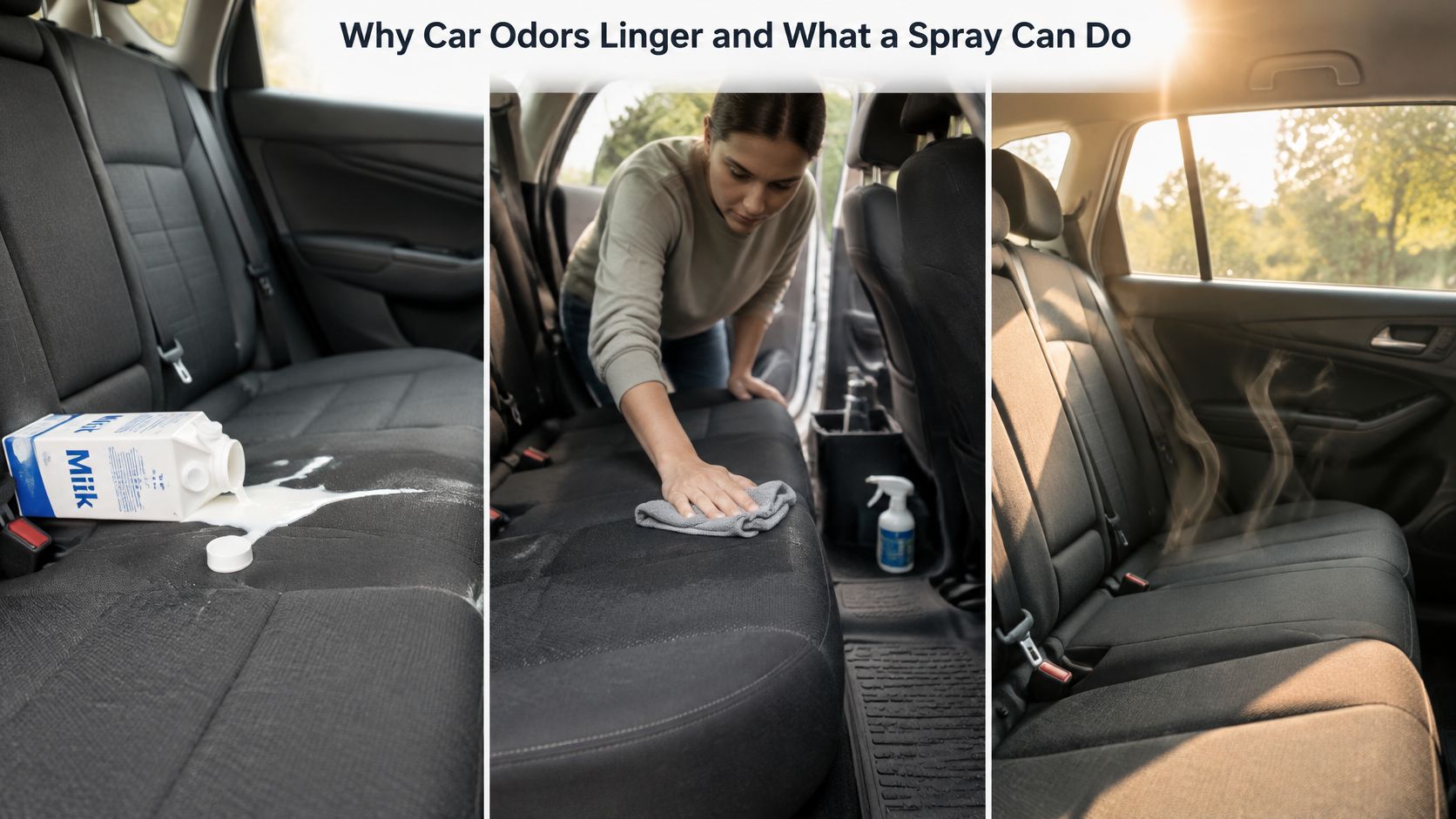
A milk carton tips over on the back seat. You blot the upholstery until it looks clean, yet a sour smell returns whenever the car gets warm. The visible stain and the odor source aren't always in the same place, especially when liquid has soaked beneath the fabric.
This sequence shows why cleanup matters more than the final burst of fragrance.
The Layers Behind a Cabin Smell
Think about cabin odor in terms of the source, the materials, and the trapped air.
- The source might be spilled milk, food beneath a seat, pet residue, or smoke deposits.
- The materials include plastics, adhesives, foam, textiles, coatings, and leather. These can release volatile organic compounds, or VOCs, into the cabin.
- The trapped air holds those smells inside when the vehicle stays closed.
The material layer matters even in a spotless vehicle. In a 2024 study of a new vehicle's cabin, 15 of 40 formaldehyde measurements, or 37.5%, exceeded China's in-cabin limit of 100 micrograms per cubic meter, according to the study published in PNAS Nexus. That finding concerns a particular vehicle under summer conditions, not every car, but it illustrates why a pleasant smell isn't proof of clean cabin air.
What a Spray Can Change
A fragrance can work like a sticky note placed over a warning light. It changes what you notice without fixing what caused the warning. A suitable treatment may break down accessible residue, but it can't stop interior materials from continuing to emit compounds.
Sprays generally fall into masking, neutralizing, and enzymatic categories. Before choosing one, ask whether the smell is sweet or sour and organic, sharp and smoky, or chemical and new-car-like. Those descriptions are clues, not a diagnosis, but they help narrow the search.
Heat and ventilation also change what you notice. A car can smell mild in the morning, stronger after parking in direct sun, and less intense once fresh air circulates.
Practical rule: Identify which layer is producing the odor before choosing what to spray.
Matching the Spray Mechanism to Your Odor
Spray Types by Mechanism, Use and Limit
| Type | How It Works | Best For | Main Limit |
|---|---|---|---|
| Masking fragrance | Adds a stronger scent that overrides the odor | Light, short-term smells before a drive | Doesn't remove the source; scent fades |
| Neutralizing | Reacts with or binds odor molecules | Smoke, cooking odors, and stale air | Needs contact time; overuse can leave residue |
| Enzymatic | Enzymes break down targeted organic matter into less odorous compounds | Milk, food, sweat, and pet residue | Needs moisture and dwell time; not for chemical emissions |
The word eliminator on a bottle doesn't tell you how its contents work. Read the description for an actual mechanism, then check whether the product is intended for the residue and surface you're treating. Some formulas combine approaches, so these categories aren't always separate products.
For a plain-language distinction between perfume and source treatment, Nanak Car Wash's explanation of masking smells versus removing odors provides useful context. The important buying question is what remains after the added scent has faded.
When Fragrance Is Enough
A fragrance-only spray is reasonable when you want a pleasant scent before a drive and there's no unresolved spill, dampness, or embedded contamination. It's a preference product, not a cleaning step.
Look for descriptions centered on scent notes and freshness without explaining odor removal. Words such as fresh or long-lasting describe the experience, not a mechanism. There's nothing wrong with choosing fragrance, provided you don't mistake it for source treatment.
If the original smell disappears immediately and then returns as the perfume weakens, masking is a plausible explanation. Timing alone doesn't prove the chemistry, though. An inaccessible source can also make an otherwise suitable treatment seem short-lived.
When Neutralizing Makes Sense
Neutralizing products act on odor molecules rather than competing with them. Formulations differ, so don't assume every neutralizer handles every kind of smoke or cooking residue.
Say you carried takeaway food home and the cabin still smells after removing the packaging. Cleaning the greasy contact surfaces comes first. A compatible neutralizer can then help with remaining odor on treated fabric.
Look for wording such as odor neutralizer, odor-binding, or an explanation of the compounds the formula targets. Improvement after the stated contact time is more useful than the strength of the opening fragrance.
When Enzymatic Treatment Fits
Milk, food, sweat, and pet contamination can leave organic residue in absorbent surfaces. An enzymatic product is a sensible candidate when its formula targets that material and can reach it.
Enzymes need appropriate moisture and contact time to work. That doesn't mean soaking the seat. It means using the amount and dwell conditions specified for the product, rather than misting once and immediately wiping everything dry.
Our Evo Dyne New Car Smell Spray is an enzymatic option designed to eliminate existing odors and reduce new ones. It comes in a 16 oz, Made in USA can priced at $14.99, and contains no harsh chemicals, no masking fragrances, and no harmful ingredients. It doesn't replace source cleaning, ventilation, or attention to heat-driven material emissions.
Gradual improvement after treating accessible organic residue is consistent with enzymatic action, but it isn't a reliable home chemistry test. Buy according to the stated mechanism, not a guessed response time: identify the odor, clean the source, and choose the matched spray.
Ventilation, Heat and Safe Use
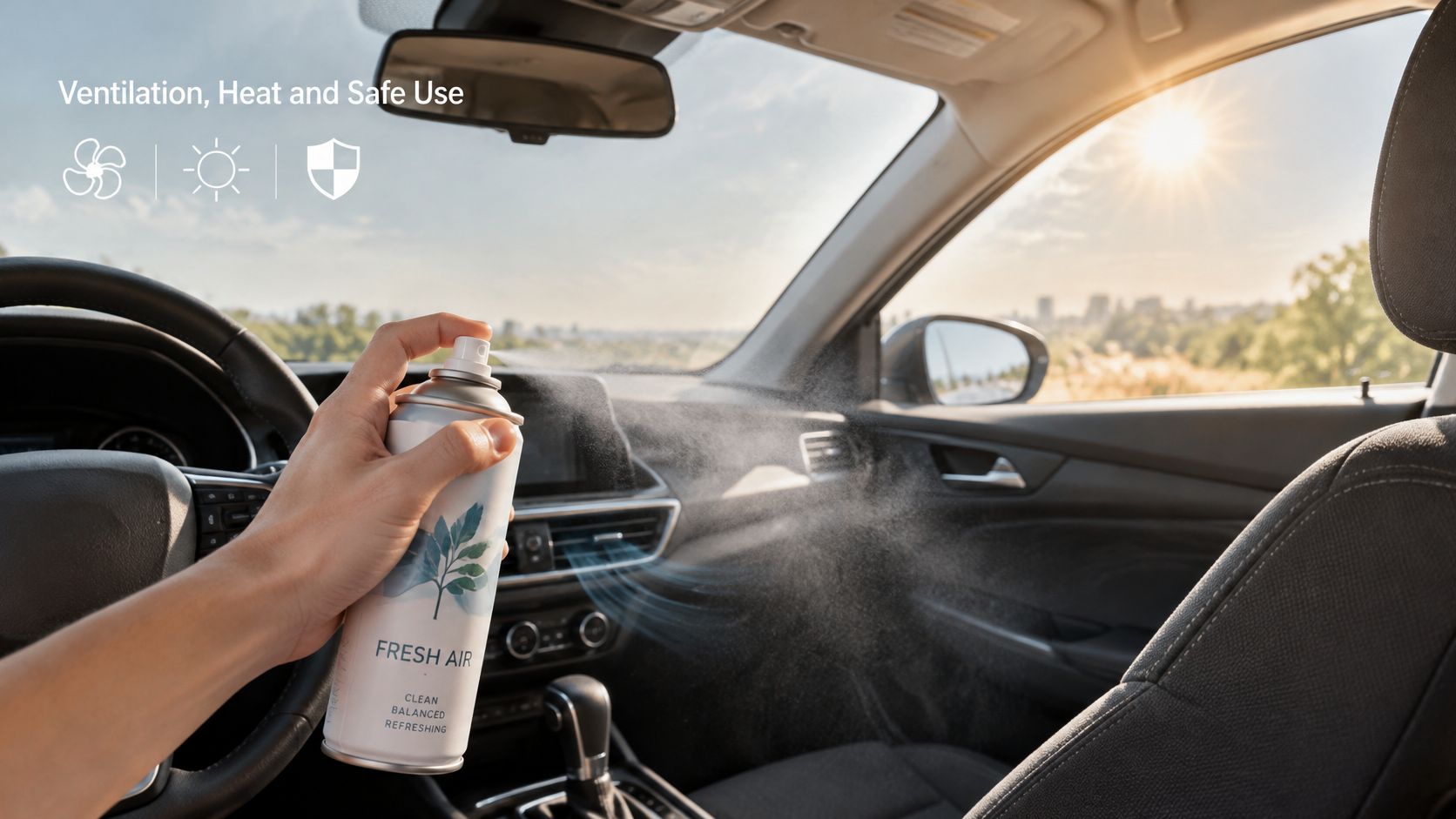
The windows are up, the seats are hot, and you're holding a fresh can. Open the vehicle and let it cool before treating anything. A sealed, sun-heated cabin is a poor place to apply an airborne product.
Aim for controlled application with open doors, rather than filling the interior with mist.
Keep Exposure Low
Spraying puts droplets into the air, and some formulations also introduce volatile ingredients. Ventilate during application and afterward, even if the product smells mild.
- Work in moving air. Treat the car outdoors with doors open, not inside a sealed cabin or enclosed garage.
- Keep the nozzle away from faces. Don't spray toward your breathing area, another person, or an animal.
- Keep passengers outside. Children and pets should stay out until treated surfaces are dry and the cabin has aired.
- Use products separately. Don't mix odor sprays with other cleaners. Incompatible combinations can produce hazardous fumes.
- Store aerosol cans away from heat. Avoid direct sunlight and a hot glovebox. Heat raises pressure inside pressurized containers.
- Read emergency instructions first. Know the label's first-aid directions before you need them.
People with asthma, fragrance sensitivity, or other respiratory conditions shouldn't use a drive as their first exposure test. If you choose to try a product, begin with minimal application, thorough ventilation, and no direct inhalation. Stop using it if symptoms appear, and seek medical advice when appropriate.
The video below offers an additional visual reference for in-car spray use; the product's own warnings remain the controlling instructions.
Understand What Low VOC Means
VOCs are compounds that can evaporate into the air. Check the safety data sheet for disclosed ingredients, VOC information, handling precautions, and storage requirements. A low-VOC description doesn't mean you should inhale the spray or skip ventilation.
Keep the container in its original packaging, away from children, and follow local disposal requirements for empty aerosols. Don't puncture or burn a pressurized can. A car odor eliminator spray is a targeted treatment, not a substitute for airing out the cabin.
Surface Check and Step-by-Step Application
Surface Suitability for Car Odor Eliminator Sprays
| Surface | Spray Suitability | Precaution |
|---|---|---|
| Carpets and floor mats | Yes, light even mist when approved | Dry fully before closing the doors |
| Cloth seats and under-seat fabric | Yes, after a spot test | Target the source area and avoid soaking |
| Headliner fabric | Test first, only if approved | Avoid saturating the adhesive |
| Leather seats | Test first, only if approved | Coated leather can discolor or feel tacky |
| Air vents | Light mist only when expressly permitted | Never direct a blast into vent openings |
| Plastic, painted or hard trim | No direct spray | Staining is possible; use a cloth and a compatible cleaner instead |
| Electrical components and screens | No | Keep spray away from electronics |
The surface restrictions on your particular product take priority over general suitability. A formula approved for carpet isn't automatically appropriate for leather, a headliner, or dashboard trim. A hidden-area test checks appearance and feel, but it doesn't override an explicit prohibition.
Use this surface guide to plan a restrained application.
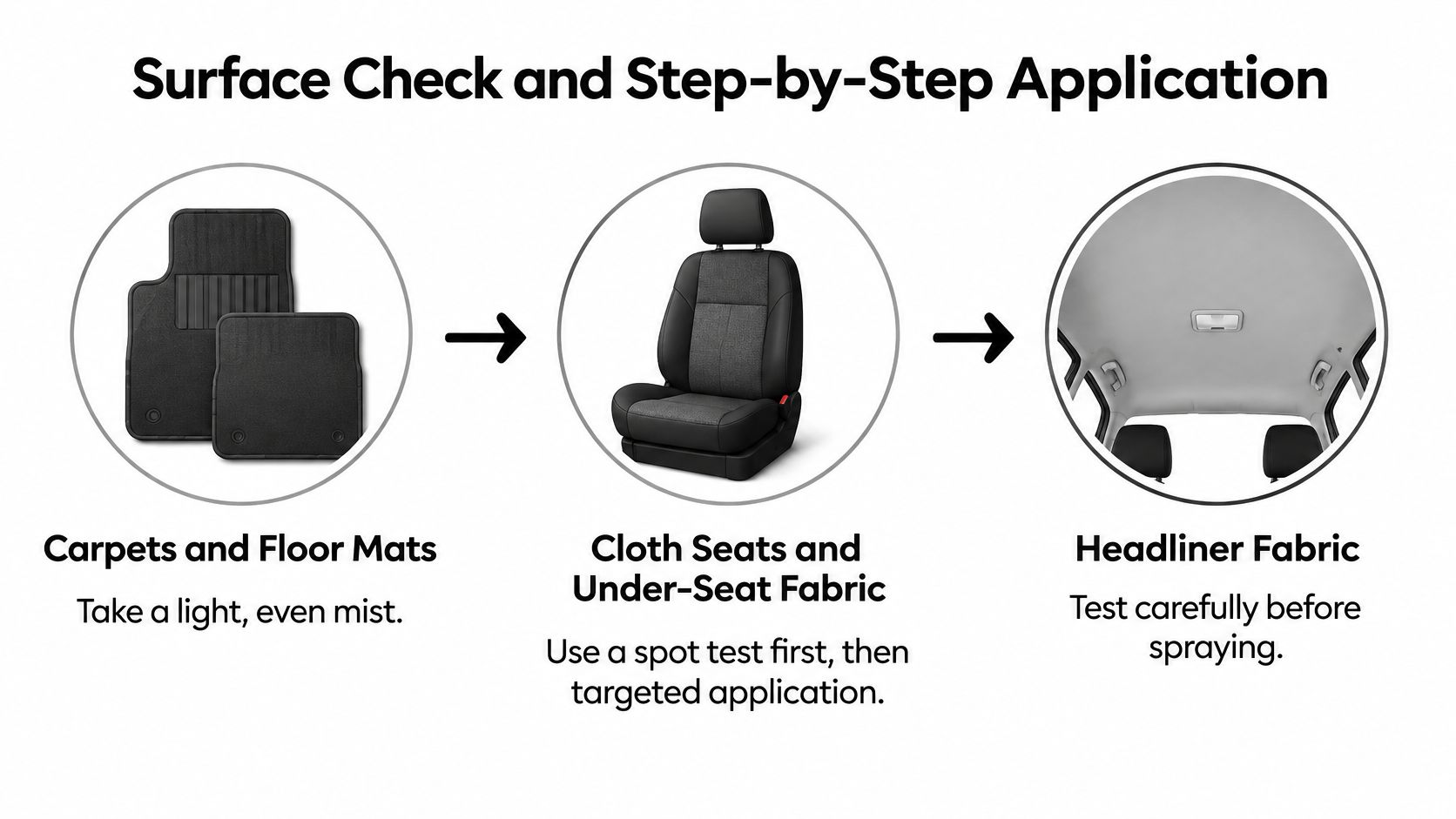
Prepare Before You Spray
Gather a vacuum with a crevice tool, clean microfiber cloths, absorbent towels, and any surface-compatible cleaner needed for the original mess. For a wet spill, use liquid-rated extraction equipment rather than an ordinary dry vacuum.
For separating cleaning tasks from deodorizing tasks, our interior car cleaner guide can help you plan the initial cleanup. Removing dirt and residue lets the odor treatment reach the intended area instead of coating loose debris.
- Locate the source. Check beneath seats, under removable mats, around seat tracks, and inside the trunk. If the odor appears mainly when the fan runs, inspect the cabin filter and arrange a ventilation-system check rather than spraying blindly into ducts.
- Remove debris and contamination. Take out old food, vacuum crumbs and pet hair, and clean visible stains. Blot liquid instead of rubbing it outward. If contamination has reached padding, surface wiping alone won't remove it.
- Shake the can well. Do this before use so the contents are prepared as intended. Keep the nozzle pointed away from yourself while checking its orientation.
- Test a concealed approved surface. Apply a small amount at a carpet edge or hidden upholstery area. Let it dry, then check for color change, a visible ring, stiffness, or tackiness before treating a larger area.
- Apply a light, even mist. Target approved fabric where the odor originates, rather than spraying the whole cabin heavily. Don't spray plastic, painted surfaces, or other hard trim with a product that prohibits those uses. For trim cleaning, dampen a cloth with a separately approved cleaner.
- Protect electronics and allow drying. Keep liquid away from seat wiring, switches, screens, and electrical connectors. Don't reinstall damp mats or cover treated upholstery with blankets or seat covers.
- Air the vehicle thoroughly. Open the doors where safe, or use fresh-air ventilation rather than recirculation. Continue until surfaces are dry and airborne mist and concentrated product odor have cleared.
Check the Interior After It Warms Again
Material temperature deserves attention. A controlled vehicle-cabin study found that material surface temperature was a stronger driver of VOC behavior than cabin air temperature. A cool breeze through the door doesn't necessarily mean the dashboard, seat foam, and trim have cooled.
In a chamber study of vehicle-interior materials, VOC emission strengths increased roughly 3–36 times between 25°C and 60°C, with the increase differing by material and compound, according to the publication archived by EPFL. That's a reason to avoid judging performance solely by the smell immediately after spraying.
More product isn't a substitute for reaching the contamination. If the source is beneath the fabric, a heavier surface coating may only add moisture.
Let a sun-baked interior cool before application. After treatment and complete drying, assess the cabin during ordinary use without deliberately heating the aerosol can or saturating materials for a stronger result.
Persistent Odors, Their Causes and Fixes
The car smelled fresh after the weekend cleanup, but the unpleasant odor has returned. Before reaching for the can again, notice when it returns and where it's strongest. A smell that follows sunshine calls for a different response from one concentrated beneath a damp floor mat.
Persistent Odor Symptoms, Causes and Fixes
| Symptom | Likely Cause | Fix |
|---|---|---|
| Smell returns each afternoon in the sun | Heat-driven emissions from trim and foam | Park in shade and ventilate before driving; treat only a separate, identified residue after cooling |
| Sour or milky smell after a spill | Residue left in carpet padding | Remove the residue, use a suitable enzymatic product, and dry fully |
| Smoke or stale air after smoking | Odor deposits in fabric and headliner | Clean affected surfaces, use a compatible neutralizer, and consider professional cleaning |
| Damp, musty smell | Moisture in carpet or floor mats | Dry the area, check for leaks, then treat remaining contamination |
| Added scent fades and the original odor returns | Masking-only treatment on an unresolved source | Choose a source-matched neutralizing or enzymatic treatment after cleaning |
| Chemical new-car smell persists | Emissions from new interior parts | Ventilate; a spray may change perception but doesn't stop material emissions |
Follow the Pattern Rather Than the Perfume
A sun-related smell isn't a reason to keep layering fragrance onto warm trim. Try shaded parking and fresh-air ventilation, then determine whether a separate spill or dirty surface also needs attention. Don't treat a chemical odor as an organic stain just because both get stronger in warm weather.
A sour patch after a milk spill deserves a closer look beneath the removable mat and along the carpet edge. If the surface feels clean but the smell remains concentrated there, ask a detailer about extraction and padding inspection. Repeated surface misting can miss the contaminated layer entirely.
With mustiness, drying comes before deodorizing. Check for wet mats, damp carpet edges, and water entering around seals or drains. If you find visible mold or persistent water intrusion, arrange proper remediation rather than concealing it with scent.
Know When Cleaning Needs to Go Deeper
Smoke contamination often involves more than the seats. The headliner, other fabric, and ventilation-related components may need attention, but aggressive soaking can damage delicate materials. Our guide to getting smoke odor out of a car helps organize the cleaning tasks.
For a broader look at how specialists address stubborn smells in used cars, AVOTTO Mobile discusses professional treatment options. Ozone isn't a casual occupied-car treatment, and any specialist service should explain exposure controls and safe re-entry.
Escalation point: When correctly matched cleaning and treatment keep failing, inspect deeper instead of increasing the dose.
Persistent odor may originate inside foam, beneath carpet, or within the ventilation system. A professional inspection is more useful than another can when you can't reach the source. Fuel, burning, or exhaust-like odors warrant mechanical attention, not deodorizing.
Reading Labels and Judging the Result
Read the functional description before the scent name. Enzyme wording can identify an enzymatic formula, but bio-based alone doesn't prove that enzymes are present. For neutralizers, look for odor-binding or odor-reacting language and a clear description of intended uses.
A fragrance-only product may describe nothing beyond its scent and freshness. That's enough information to buy perfume for the cabin, but not enough to expect residue removal. Also check approved surfaces, application quantity, dwell requirements, and drying instructions.
Make a Short Buying Checklist
- Match the target. Choose a product that names the contamination you're dealing with, not merely a broad promise of freshness.
- Check compatibility. Confirm that the intended carpet, upholstery, leather, or other material is approved.
- Read safety information. Review warnings and the safety data sheet for exposure guidance, VOC information, and first aid.
- Separate scent from performance. A strong fragrance isn't evidence that the original contamination has gone.
Judge the Cabin After Drying
Use a simple observation routine rather than sniffing immediately after application. Once everything is dry and the car has aired, note the odor when you first open the door, during your next ordinary drive, and after a naturally warm afternoon.
Write down the original odor separately from the product scent. Also note its location, whether the fan changes it, and whether dampness remains. These observations help distinguish an incomplete cleanup from a material-emission or ventilation problem.
A neutral-smelling cabin after normal warm-weather use is a useful practical result, but it doesn't prove that VOC concentrations are low or that cabin air is safe. Ventilation can reduce airborne concentrations; a general odor spray shouldn't be assumed to stop emissions from new interior parts.
Choose the mechanism that fits the source, confirm surface compatibility, and judge the result after drying rather than during the fragrance burst. The aim is a cabin that doesn't need its original smell covered.
Evo Dyne Products offers automotive sprays, including an enzymatic New Car Smell Spray for unwanted vehicle odors. Visit Evo Dyne Products to review the options and application guidance, then choose a treatment that matches your odor source and approved interior surfaces.