

Your engagement ring looks clean until you hold it near a window. The metal shines, but the stone looks dull, and there's a faint film of lotion, skin oil, and dust tucked beneath the prongs. Brushing the top hasn't reached it.
A portable ultrasonic jewelry cleaner can help with that hidden buildup. But before you put the ring in a tank, you need to know what the stone is, whether it's been treated, and whether its setting is sound. Those checks matter more than the machine's price or cleaning modes.
Table of Contents
- What a Portable Ultrasonic Jewelry Cleaner Does
- Which Jewelry Is Safe to Clean Ultrasonically
- Portable Models Compared by Price and Tank Type
- Solution and Settings That Change Cleaning Results
- How to Clean Jewelry Safely, Step by Step
- Maintenance and Fixes for Common Problems
- Decide Whether a Portable Cleaner Fits Your Collection
What a Portable Ultrasonic Jewelry Cleaner Does
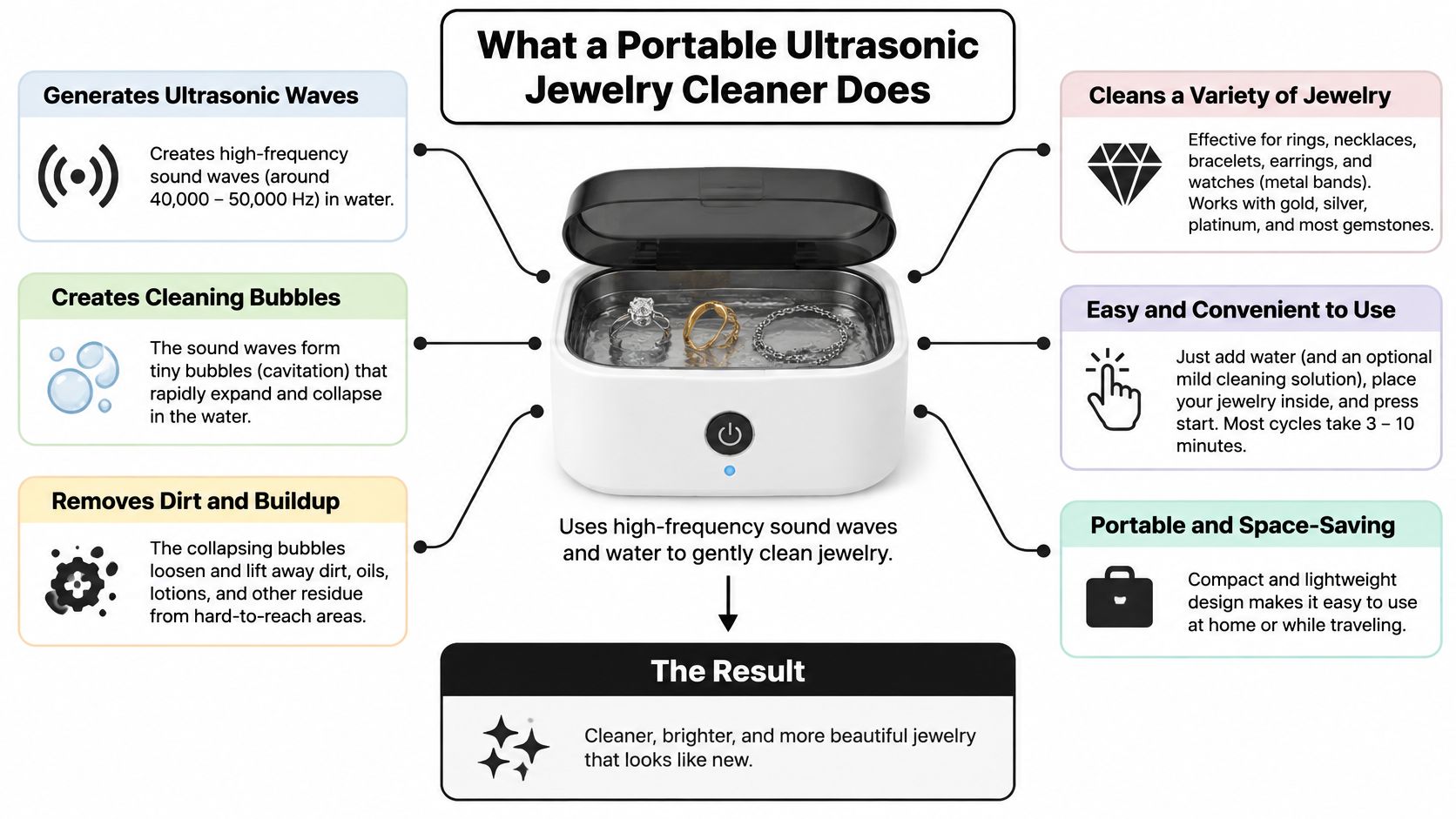
An ultrasonic cleaner sends high-frequency sound through a liquid bath. The changing pressure makes microscopic bubbles form, grow, and collapse, a process called cavitation. Near a surface, that collapse creates small, fast movements of liquid that dislodge contamination.
The NIST-hosted Branson operator manual describes this mechanism in equipment using 40 kHz transducers, a frequency commonly associated with compact cleaners. Think of tiny scrubbers switching on and off throughout the accessible crevices, rather than a brush reaching only the exposed surface.
For the dull ring, the useful action happens behind the stone and around the prong gaps. Liquid can also carry loosened oil and dust out of chain links and recessed details. The jewelry must be compatible with that action, though, and the liquid needs access to the dirty surfaces.
This diagram shows how the bath, basket, and cleaning action work together.
Cleaning isn't repair
A cleaner can lift contamination, but it won't:
- Repair worn prongs or restore missing metal.
- Polish scratches out of a band.
- Change a gemstone treatment or make an unstable treatment safe.
- Secure a loose stone before vibration begins.
Portable devices are an established category. According to Dataintelo's ultrasonic jewelry cleaner market report, they represented 37.5% of the global ultrasonic jewelry cleaner market in 2025.
Popularity doesn't establish suitability for your collection. The useful decisions are which pieces can enter the bath, which machine gives you appropriate control, and which routine removes grime without unnecessary exposure.
Which Jewelry Is Safe to Clean Ultrasonically
| Jewelry or gem | Ultrasonic use | Reason |
|---|---|---|
| Pearls, coral, ivory, amber | Avoid | Porous organic materials can be harmed by heat, vibration, and chemicals |
| Opal, turquoise, tanzanite, kunzite, malachite, moonstone | Avoid unless identified and professionally cleared | Identification alone doesn't remove their heat-sensitivity or treatment risks |
| Fracture-filled, oil-, resin-, or wax-treated, coated gems | Avoid | Vibration can damage fillings and treatments |
| Loose stones, worn or fragile settings | Inspect first, and repair before use | Vibration can loosen stones or chip girdles |
| Sound diamonds, gold, platinum, and silver without treatment | Generally suitable after inspection | Check prongs and stones before and after |
| Antique, vintage, or unknown-treatment pieces | Hand-clean or ask a jeweler | Treatment history and structural condition may be unknown |
The metal alone doesn't decide safety. A gold pendant with a pearl and a plain gold wedding band shouldn't receive the same cleaning treatment. The most vulnerable component determines how you care for the whole piece.
The Gemological Institute of America's jewelry-care guidance advises against ultrasonic cleaning for organic gems, fracture-filled stones, coated or impregnated gems, and many heat-sensitive or treated materials. Its warnings include the stones listed above, along with fluorite, lapis lazuli, and some treated rubies or sapphires.
Check the treatment and the mounting
Hardness isn't a complete safety test. A stone can resist scratching yet still have fractures, cleavage, or an enhancement that makes ultrasonic cleaning unsuitable.
Vibration can loosen stones in vulnerable mountings or chip adjacent gemstone edges, called girdles, when they contact one another. Look for bent prongs, missing tips, cracks, or a stone that appears tilted. Don't push on a stone to test it.
For example, a sapphire necklace with a pear-shaped centerpiece from Astro West illustrates why a gemstone name isn't enough information. Before cleaning a comparable necklace, establish the sapphire's treatment history and inspect the centerpiece, surrounding stones, and their mountings.
Practical rule: If you can't identify the material, treatment, and condition, don't use the machine to find out whether it's safe.
Our cleaner-use precaution is to avoid pearls, opals, and soft or porous stones unless tested first. That precaution isn't permission to test ultrasonic vibration on a valuable piece yourself; solution compatibility and ultrasonic compatibility are separate questions.
For collection-level decisions, our guide to whether an ultrasonic cleaner can be used on all jewelry offers additional context. When the history is unknown, use material-appropriate hand-cleaning or have a jeweler assess the piece before choosing a method.
Portable Models Compared by Price and Tank Type
| Option | Listed price range | Best for | Check before buying |
|---|---|---|---|
| Basic portable cleaner | $30–$150, as listed in Dataintelo's digital ultrasonic jewelry cleaner report | Compatible everyday rings, earrings, and chains | Tank size and timer |
| Higher-end portable machine | $150–$450, as listed in Dataintelo's jewelry-cleaning machine report | Frequent cleaning or a mixed collection of compatible pieces | Heater, cycle control, and stated frequency |
| Brush and solution kit, no ultrasonic action | Not covered by the market reports; cost depends on the brush and solution you choose | Pieces that need material-appropriate manual care | Soft brush and a compatible mild solution |
The listed price bands describe market-report categories, not tested performance tiers. They meet at their boundary, and a higher price does not establish that a machine cleans better or treats gemstones more gently.
A basic portable cleaner may suit a sound everyday ring or a chain cleaned separately. A higher-end machine may offer more control or working space, but its price and heater do not make an unsuitable stone safe.
A manual kit uses a different cleaning method. For a pearl necklace, even a soft brush and soaking solution may be inappropriate; a gentle wipe or professional care can be a better choice.
Compare the working tank, not the outer shell
The tank holds the liquid, while a removable basket supports the jewelry and keeps it from resting directly on the tank floor. Check the basket's usable space, not just the machine's exterior dimensions.
Compare these specifications side by side:
- Usable capacity: Confirm that a ring or pendant can sit fully submerged in the basket without crowding.
- Timer control: Look for a clearly stated cycle length and an easy way to stop early. Repeatable settings are more useful than vague cleaning-mode names.
- Heating: Check whether heating is optional and whether the controls distinguish heater operation from ultrasonic operation.
- Stated frequency: Look for a manufacturer-stated operating frequency rather than relying only on terms such as “deep clean” or “professional power.”
Consider how you will empty the tank, too. A removable container or manageable body shape can make draining less awkward. Keep electrical parts dry with either design.
Buy for the jewelry you wear most, not the biggest number on the box. Extra capacity helps only if you have compatible pieces to clean without stacking them.
Solution and Settings That Change Cleaning Results
A greasy film, light tarnish, and dried residue respond differently to cleaning. The liquid and machine settings affect how well each comes away, so match them to the jewelry and the soil rather than lengthening the cycle.
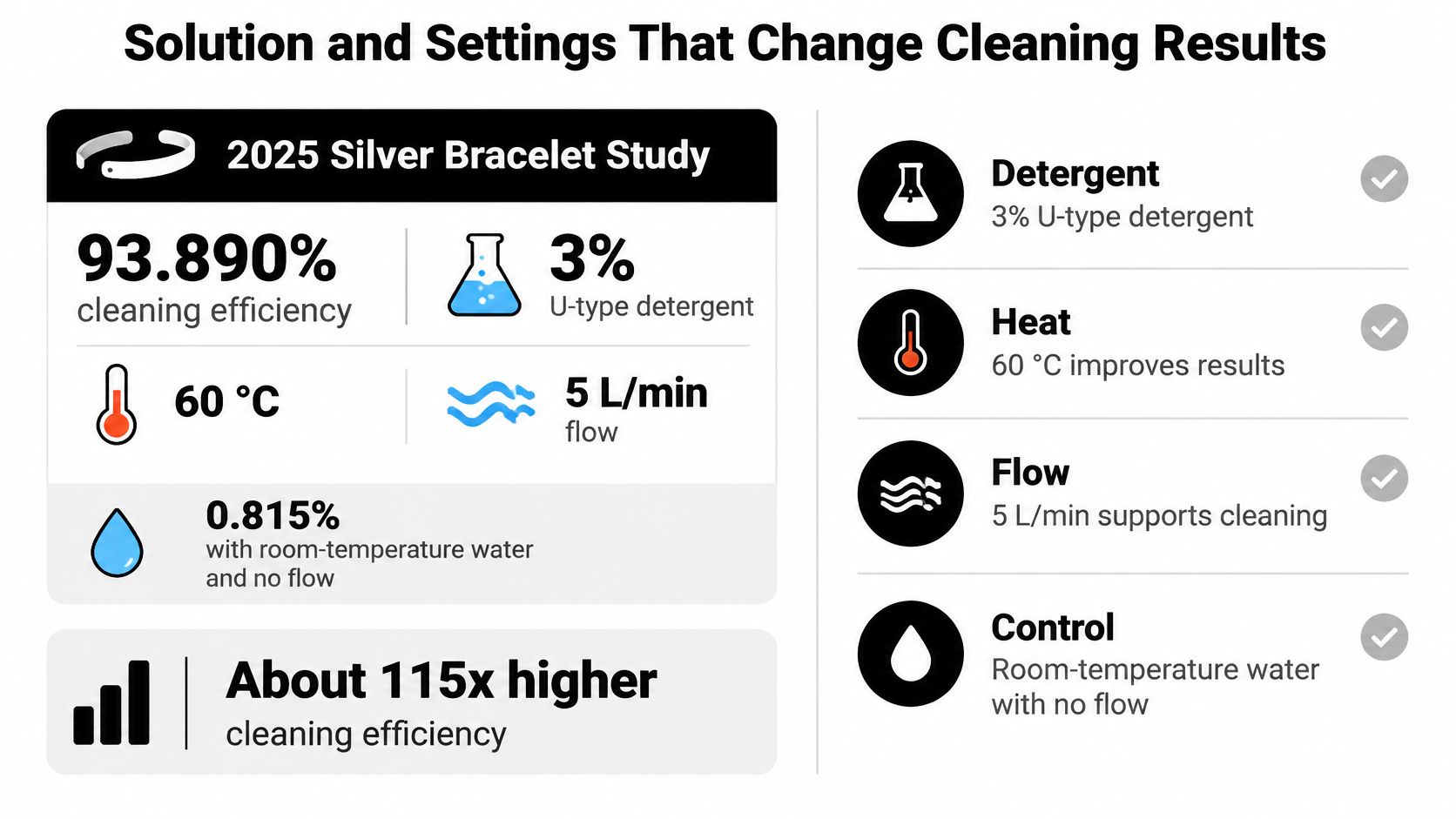
A silver-bracelet study published in Applied System Innovation reported 93.890% cleaning efficiency with 3% U-type detergent at 60 °C and 5 L/min flow, compared with 0.815% using room-temperature water and no flow. Under the study's measurement method, the first result was about 115 times higher.
The comparison below summarizes those experimental conditions, not a home gemstone-cleaning recipe.
What the experiment means at home
The researchers cleaned a silver bracelet without gemstones. The results don't predict how a diamond ring, treated sapphire, or household cleaning liquid will respond.
The broader lesson is that cleaning depends on more than frequency. The liquid, temperature, flow, and how the piece is positioned all affect the result.
- Detergent strength: A suitable detergent helps loosen oily contamination. Use the recommended dilution; adding extra concentrate is not a reliable shortcut.
- Warmth: Heat can soften contaminants, but it can also expose jewelry to thermal stress. Don't treat the study's heated conditions as a default setting.
- Flow: Circulation can carry loosened material away. A portable tank without a pump does not reproduce a controlled circulating system.
- Placement: Keep the piece submerged and give liquid access to its surfaces. Intertwined chains and stacked rings can block that access.
Freshly prepared liquid may also need degassing, which lets dissolved gases escape before cleaning. Use the machine's degas function if available, or follow its preparation instructions with the jewelry out of the tank.
Industrial test conditions are not a recipe for unidentified gemstones. Check the material and setting before choosing a solution or temperature.
Choose a solution for the task
For compatible, sound metal and diamonds, a mild dish-soap mixture may be suitable if the machine's instructions permit it. Avoid strongly fragranced, abrasive, or additive-heavy household cleaners.
A concentrate formulated for ultrasonic machines provides a defined option for the bath. Evo Dyne's ultrasonic jewelry cleaner solution is unscented, non-toxic, and extra concentrated. It contains a chelating agent that binds to metal ions in jewelry, and a small capful is enough per use. The guide to choosing and preparing ultrasonic jewelry cleaner solution explains the product and its use.
Don't mix cleaning products. Rinse the basket before switching formulations, and remember that a suitable liquid does not make an unsuitable gemstone safe for ultrasonic cleaning.
This video provides an additional visual reference for the cleaning process.
Match the response to the residue
A light lotion film may come away with a short cycle and fresh solution. Heavy tarnish may take multiple cleaning cycles, and ultrasonic cleaning does not replace every tarnish-removal or polishing method.
If a compatible piece remains dull, inspect it before trying another brief cycle. Scratches, surface wear, or persistent tarnish may need a different approach; repeated cycles won't fix them.
Let visible buildup and the jewelry's condition guide when you clean. Replace dirty liquid rather than topping it up, since adding water or concentrate leaves removed oil and debris in the bath.
How to Clean Jewelry Safely, Step by Step
Start only after the piece passes the compatibility check. Put unsuitable jewelry somewhere separate before preparing the machine, so it can't accidentally join the batch.
The GIA gemstone-durability guide warns that ultrasonic action produces heat and that exposure beyond a few minutes can put even otherwise suitable stones at risk. Extended vibration can worsen fractures or activate cleavage that wasn't obvious beforehand.
Use this visual checklist alongside the detailed steps.
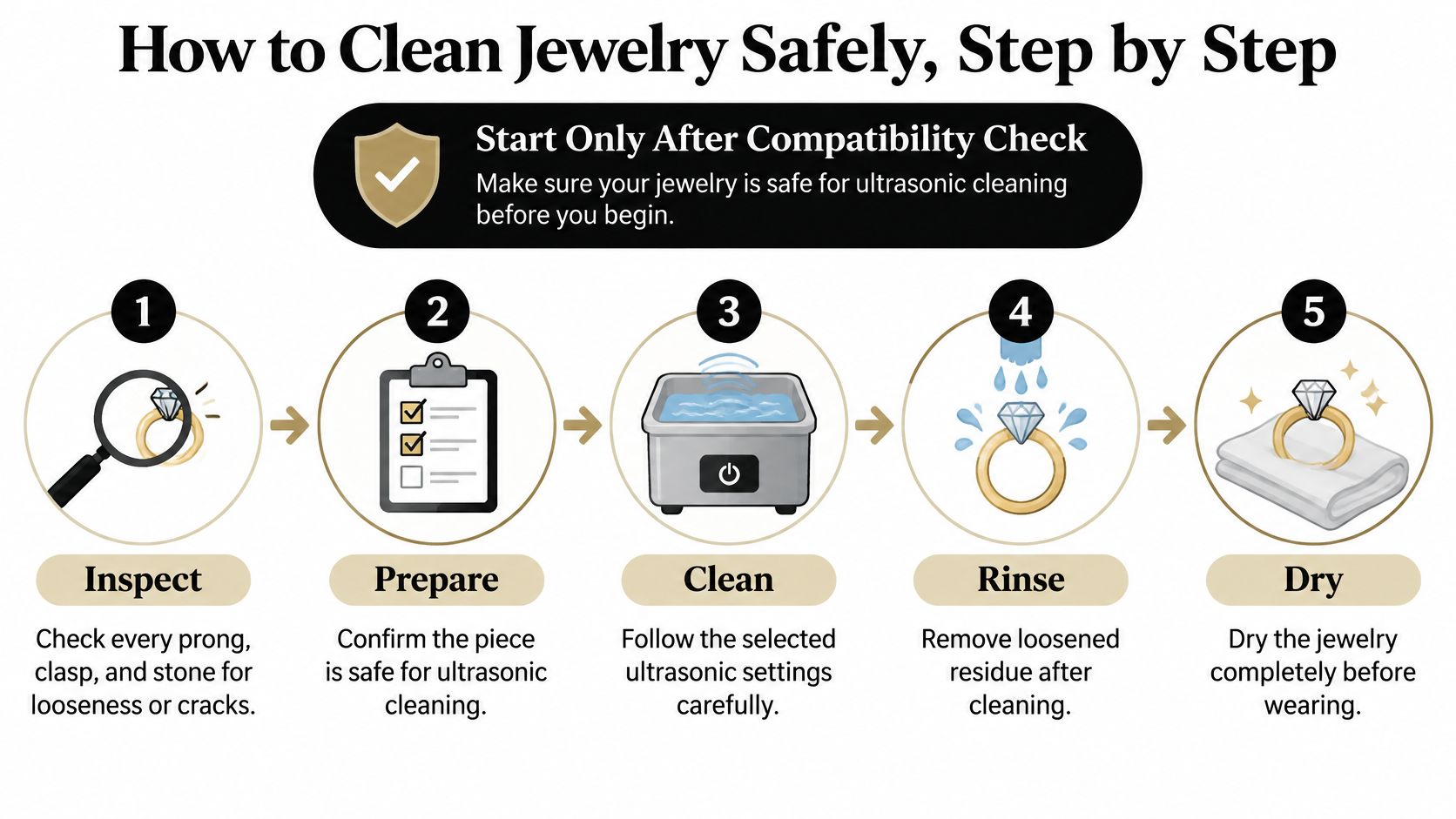
- Inspect before preparing the bath. Under good light, examine every prong, clasp, and stone for visible looseness, damage, or cracks. Set aside anything questionable rather than assuming cleaning will make it easier to assess safely.
- Prepare fresh solution at the correct fill level. Add water and the prescribed concentrate amount without exceeding the tank's fill line. For our concentrate, only a small capful is needed per use; extra concentrate isn't a shortcut to better cleaning.
- Arrange the jewelry in the basket. Fully submerge it, with pieces spread apart rather than touching or stacked. Keep chains open enough for liquid to reach their links, and don't rest jewelry directly on the tank floor.
- Select a short, timed cycle. Most compatible jewelry can be cleaned in 3–5 minutes, but that's a working range, not a requirement to finish the longest setting. Choose the shortest appropriate cycle permitted by the device and the piece's care guidance.
- Stop early if conditions change. If the liquid becomes hot, warms rapidly, or a piece shifts into contact with another item, stop the machine. Don't reach into an operating bath; switch it off before adjusting the basket.
- Rinse and dry carefully. Lift the basket, rinse the jewelry in clean water, and pat it dry with a lint-free cloth. Use a bowl rather than handling small pieces over an open drain.
- Inspect the result before wearing it. Confirm that the stones remain seated and that no prong, clasp, or surface looks different. If you notice movement, cloudiness, or a chip, set the piece aside for professional assessment.
Keep the manual option simple
Without a machine, a compatible piece can receive a short soak followed by gentle cleaning with a soft-bristled brush. Work around accessible recesses without forcing bristles beneath fragile settings, then rinse and dry.
Manual cleaning still requires material judgment. Unknown jewelry isn't automatically safe to soak, and organic or porous materials may need a different care method altogether.
Maintenance and Fixes for Common Problems
| Symptom | Likely cause | Fix |
|---|---|---|
| Dull film remains after a cycle | Old or diluted solution, or heavy tarnish | Use fresh solution; repeat a short cycle only if the piece remains suitable |
| No bubbles or activity in the tank | Low liquid or unit not seated correctly, if the design requires seating | Refill to the fill line and check placement and power |
| Liquid heats quickly | Long cycle or small tank | Shorten cycles and let the liquid cool before the next run |
| Stone looks loose, cloudy, or chipped | Vibration in a weak setting or unsafe treatment | Stop use and have a jeweler check the setting and stone |
| Cloudy liquid or residue in the tank | Oil buildup from repeated cycles | Drain, rinse, and refill with fresh solution |
Visible bubbles aren't a reliable test of cleaning performance. Cavitation happens on a microscopic scale, so a bath that isn't visibly bubbling may still be operating. Don't add detergent to create foam or run the machine dry to check whether it works.
If the controls respond but cleaning has deteriorated, check the setup before assuming the transducer has failed. Confirm the fill level, basket placement, solution preparation, and any degassing procedure specified in the manual.
Clean the equipment after the batch
Switch off and unplug the unit before draining or wiping it. Pour out used solution in the direction specified by the manufacturer, keeping liquid away from controls, sockets, and vents.
Wipe the tank and basket with a soft cloth, rinse away residue where the design permits, and dry thoroughly. Leave the lid open while the tank dries, then store the basket without jewelry inside.
- Record the piece: Note which ring, chain, or earrings you cleaned.
- Record the setup: Include the solution used, selected cycle, and whether heating was enabled.
- Record the result: Describe remaining film or any unexpected change before trying another method.
Stop-and-refer threshold: A changed gemstone or mounting needs a jeweler, not a stronger solution.
Fresh liquid and corrected loading may resolve routine residue during the same cleaning session. Persistent poor performance with a correctly prepared bath belongs with the equipment manufacturer's troubleshooting process.
A cloudy stone is different. Don't assume it's soap residue and keep cycling it; the appearance change could involve a treatment or damage that home troubleshooting can't establish.
Decide Whether a Portable Cleaner Fits Your Collection
A portable ultrasonic jewelry cleaner makes sense for identified, sound everyday jewelry that benefits from cleaning in recessed areas. It's a poor purchase if most of your collection consists of pearls, opals, fragile antiques, or pieces with unknown treatment histories.
Choose based on what you can clean, not what you hope the machine will handle. A collection with only a few compatible pieces may be better served by careful manual care and occasional professional cleaning.
Make the purchase decision in order
- List your regular pieces: Include the material, known treatments, and any repair concerns.
- Sort before shopping: Separate suitable pieces from those needing inspection or a different method.
- Choose controls that fit your routine: Prioritize usable basket space, a dependable timer, and accessible stop controls.
- Prepare for the first run: Use an identified, sound everyday piece rather than starting with your most valuable item.
When comparing models, Tech Today's guide to where to find trustworthy reviews can help frame your evaluation. Favor reviews that explain testing methods and limitations rather than repeating product-page promises.
For the solution, our 2-Pack Ultrasonic Jewelry Cleaner Solution, 16 fl oz total, costs $15.99 and is specifically formulated for ultrasonic machines. The concentrate allows up to approximately 36 cleaning sessions per bottle; those formulation details don't override a piece's material restrictions.
Today's useful decision is simple: sort your collection and select a sound everyday piece for a first test. If none qualifies confidently, arrange an inspection before buying a machine.
Evo Dyne Products offers concentrated ultrasonic jewelry cleaner solution for use with compatible jewelry and cleaning machines. Visit Evo Dyne Products to review the solution options and choose one for the pieces you've confirmed are suitable for your cleaning routine.