
You mopped the hallway last night and it looked glossy under the lamp. This morning the same boards look cloudy, and your socks slide a little when you turn the corner. That shine was never the finish. It was a film the bottle left behind.
A best wood floor cleaner polish is the one that dries clear on the coating you already have, not the one that looks brightest on day one. A sealed oak floor, an oiled maple floor, and an old waxed pine floor each want a different bottle. The wrong one leaves haze, tack, or a slick path through the kitchen.
Before you buy a gallon, name the finish on the boards. The dry residue, more than the scent or the word shine, decides whether the product protects the floor or slowly harms it.
Table of Contents
- Quick Picks by Floor Finish and Home Type
- pH, Base and Ingredients to Avoid
- Judging Durability, Shine and Safety for Pets and Kids
- How to Clean and Polish Wood Floors Step by Step
- Hazy, Sticky or Slippery Floors and How to Fix Them
- Pick Your Cleaner for Your Home Before You Buy
Quick Picks by Floor Finish and Home Type
The right cleaner depends on the finish on the boards, not on the shine promised on the label.
Spend one minute on a water check in a closet corner. A glossy surface that beads water is usually a sealed finish such as polyurethane or aluminum oxide. A surface that absorbs water and looks matte or dry often points to an oil finish or a wax finish. That single drop keeps you from treating a factory film like bare wood.
| Floor finish | Quick pick | Avoid | Why |
|---|---|---|---|
| Sealed (polyurethane or aluminum oxide) | pH-neutral, water-based cleaner labelled for sealed wood | Oil soaps, wax polishes, silicone sprays | Film finishes resist water, while oils and wax build up on top of them |
| Oil-finished (penetrating or hardwax oil) | Cleaner labelled for oiled floors, applied very lightly | Acidic cleaners, alkaline degreasers, standing water | Harsh chemicals strip the oil and leave cloudy patches |
| Waxed | Wax-compatible cleaner or the wax the manufacturer specifies | Water-based sprays, self-polishing acrylic waxes | Mixing wax types causes uneven, hazy areas |
| Unfinished or raw wood | Seal or finish the wood before any cleaner-polish | Any polish or wax | With no protective surface, polish soaks in and stains the wood |
For sealed floors, the default is a pH-neutral, water-based cleaner labelled for sealed wood. The factory film already resists water. Oils and wax sit on top of it and collect dust. Say you have prefinished oak in a busy kitchen. A light mist of that neutral cleaner is the whole job. A "restorer" is extra film you will later have to remove.
Unfinished raw wood sits outside cleaner-polish shopping. Seal it first. Any polish on bare boards soaks in and stains the grain.
Most of the wood going into homes is already coated at the factory. In 2025, hardwood flooring sales at the first point of distribution totaled approximately $1.774 billion, with shipments of 630 million square feet, and prefinished flooring accounted for about 82% of domestic wood-flooring sales, according to Floor Covering News. Residential replacement represented 69.4% of wood-flooring sales, up from 66.4% in 2024. Those floors arrive with a wear layer, so the bottle should say sealed or finished wood, name surfaces that need a different product, and state how often to use it.
Confirm the finish in the installer's paperwork or the manufacturer's care sheet. If neither exists, test a closet corner with a small amount before you buy in bulk. The table is the starting point. The chemistry below is why each pick works.
pH, Base and Ingredients to Avoid
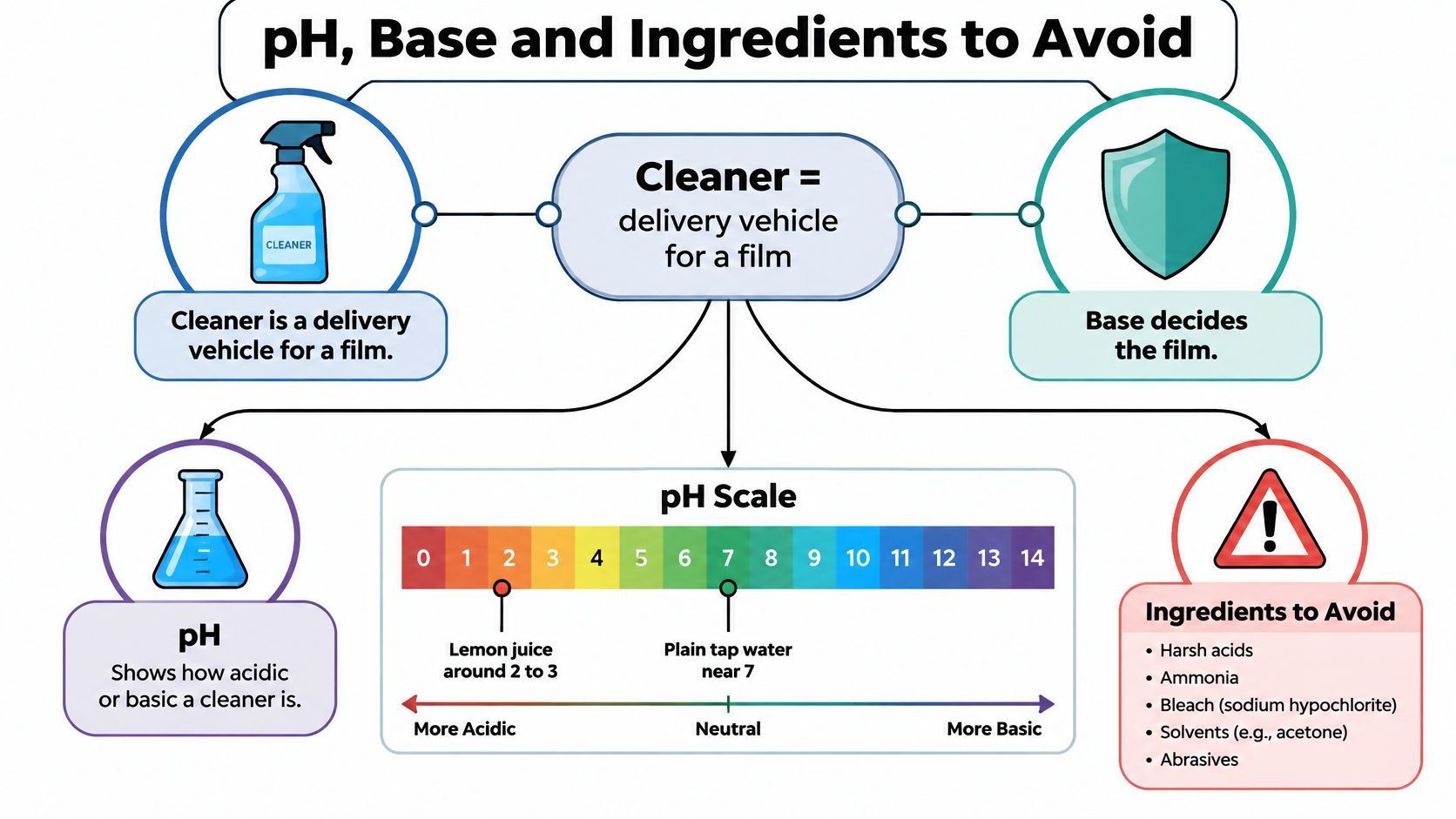
Think of a cleaner as a delivery vehicle for a film. The base decides what that film is after the water is gone.
Where the bottle sits on the scale
Plain tap water sits near 7. Lemon juice is around 2 to 3. Oven cleaner sits above 12. Those three anchors make a label easier to read.
Neutral water-based cleaners, roughly 6 to 8, are the everyday choice. They lift soil without laying down a new coat. Alkaline degreasers, about 9 to 11 and higher, cut kitchen grease, then dull a finish if you leave them behind. Acidic and vinegar-based cleaners, roughly 2 to 4, are common under the sink and they dull factory finishes with repeated use, so keep them for tile.
Oil and wax polishes are coatings, closer to a layer of salad dressing than to a rinse. They feed the surface, grab dust, and turn slippery under socks.
| Product type | Typical pH | Residue after drying | Best use | Main risk |
|---|---|---|---|---|
| Neutral water-based cleaner | About 6 to 8 | Minimal when used lightly | Routine cleaning of sealed floors | Weak on greasy build-up, so dust first |
| Alkaline degreaser | About 9 to 11 | Can dull finish if not fully rinsed | Spot cleaning heavy kitchen grease | Dulls or damages many finishes |
| Acidic or vinegar-based cleaner | About 2 to 4 | Can etch or dull some finishes | Rarely recommended for factory finishes | Gradual dulling with frequent use |
| Oil-based cleaner or polish | Not stated on most labels | High, oil film builds up | Oiled floors only, per the manufacturer | Slippery, attracts dust, blocks recoating |
| Wax or acrylic polish | Usually unlisted on the label | High film build-up | Waxed floors only | Slippery, dull over time, must be stripped |
Practical rule: If the dried patch looks brighter than the rest of the room and feels slightly tacky, you bought a film, not a cleaner.
Words on the label that mean film
The National Wood Flooring Association installation guidelines say to use only products recommended for the specific flooring or finish. Non-recommended cleaners can damage the intended appearance, leave contaminants that interfere with future recoating, and create adhesion problems. NWFA specifically cautions against products marketed to restore, rejuvenate, add shine, polish, or renovate wood floors unless the finish manufacturer approves them.
Those verbs usually mean acrylic, wax, oil, or another film-forming material. The gloss shows up today. Before a later recoat, someone has to strip that film, which adds labor and more chemistry. Prioritize a residue-free cleaner labelled for the installed finish, whether that is polyurethane, aluminum oxide, oil, or wax.
Ingredients to skip on most finished floors
- Ammonia and bleach: They strip finishes and can discolor the wood.
- Trisodium phosphate and strong alkalis: They dull sealed surfaces when residue stays.
- High-alcohol mixtures: They can cloud some factory coatings.
- Silicone and petroleum distillates: They leave a slippery film that is hard to remove.
- Cooking oils such as linseed or olive: They go sticky and hold grit.
- Heavy fragrance or essential-oil blends: They leave residue and can bother pets who walk the floor.
Use only enough solution to lightly dampen a microfiber pad. Never wet-mop. Wipe spills promptly. Excessive moisture can damage both finish and wood, and steam can penetrate wood fibers and cause irreversible damage. A bright bottle is not a reason to flood the boards.
Judging Durability, Shine and Safety for Pets and Kids
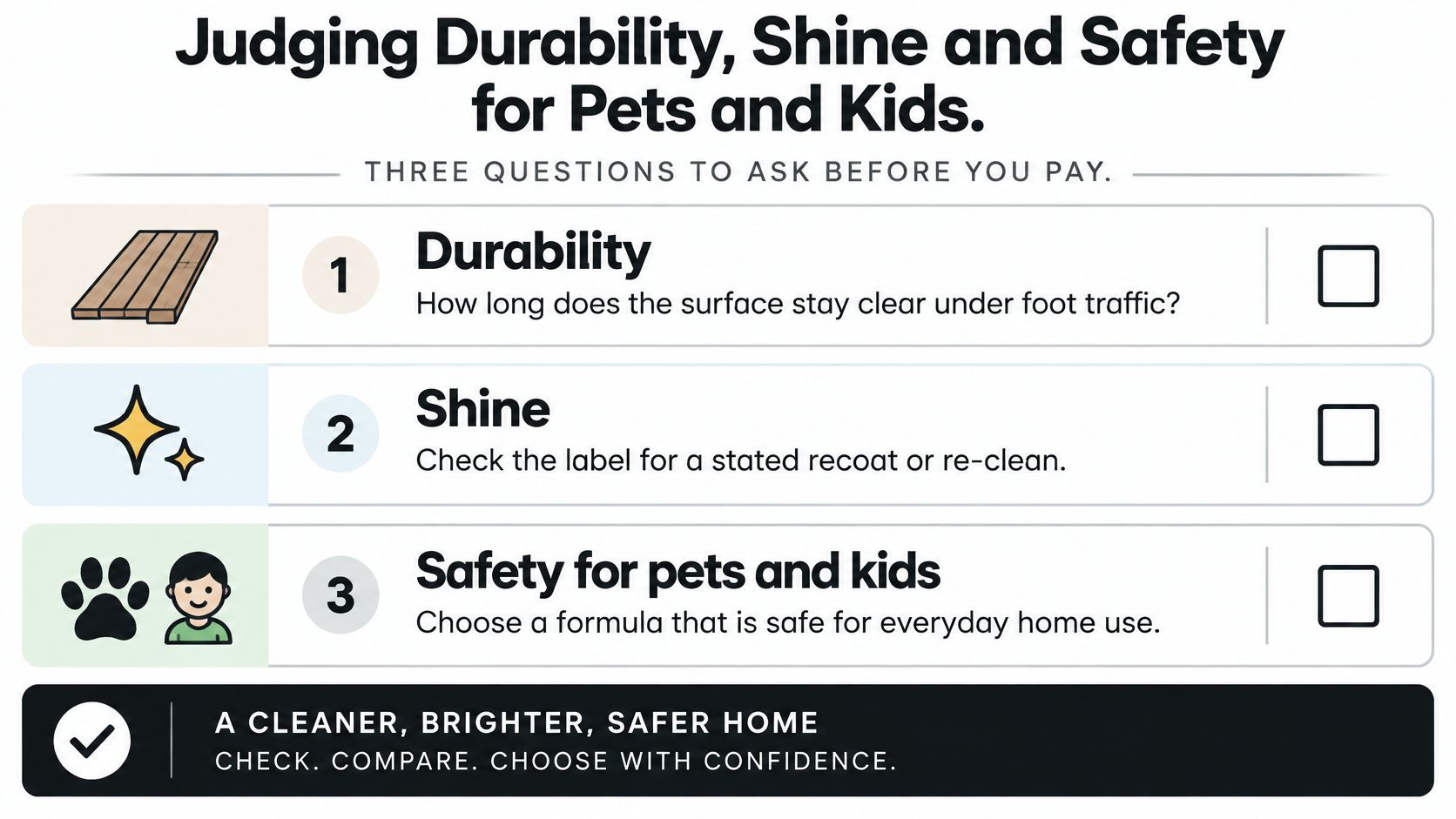
Answer three questions before you pay. Each one has a home test you can finish without special gear.
Durability under real feet
Durability asks how long the surface stays clear under foot traffic. Read the label for a stated re-clean interval, then run a two-week hallway test. Note haze or tack after muddy shoes and the dog's afternoon loop. A product that looks fine on a closet shelf and cloudy in the hall has already failed.
Shine that is finish, not film
Shine is easy to fake. A satin or matte look from a clean finish is healthy. A bright gloss that disappears after one day is usually a temporary film. View the test patch at an angle under a lamp. If the patch is a spotlight and the boards beside it are quiet, you are seeing residue, not restored wood.
What pets and kids actually touch
Pets lick paws and children crawl, so the test is what remains after drying. Lay a clean cloth on the dried patch, rub a paw-sized area, and check for tack or smell. Walk the same patch in socks. Reject anything that feels slick. Words like natural or non-toxic are marketing, not a standard. A published safety data sheet and a clear dilution instruction matter more than the front label. If you are comparing gentler formulas for a house with animals, start with a short list of pet-safe cleaning products and still run the cloth test on your own floor.
| Criterion | Home test | Pass if |
|---|---|---|
| Durability | Two-week hallway test, following the label recoat or re-clean interval | Surface stays clear, with no haze or tack |
| Shine | View the test patch at an angle under a lamp | Satin or matte look, not a bright gloss that fades in a day |
| Pet and child safety | Rub a clean cloth on the dried, paw-sized patch | Cloth stays clean, with no tack or smell |
| Slip resistance | Walk across the dried patch in socks | Feels grippy, not slick |
| Label transparency | Check the manufacturer site and label | Safety data sheet and dilution instruction are both published |
A fragrance-free bottle with a published sheet and a grippy dry patch beats a scented "shine" spray every time.
Buy the smallest size until the hallway test passes. A gallon of the wrong film is expensive to undo.
How to Clean and Polish Wood Floors Step by Step
The benchmark is simple. Controlled soil removal, with minimal moisture and no persistent film, means the routine is working. Initial gloss is not the score.
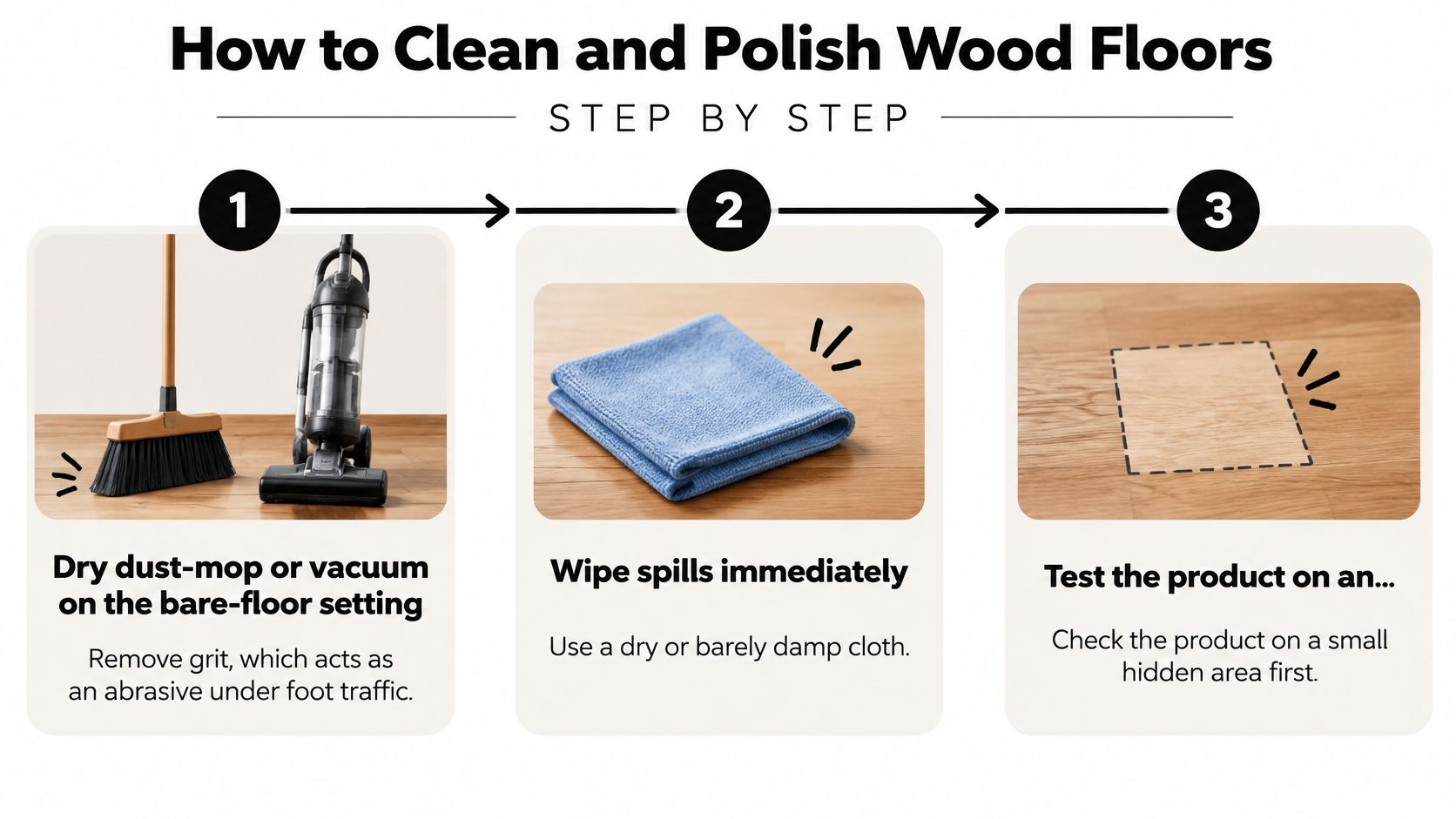
- Dry dust-mop or vacuum on the bare-floor setting. Grit acts as an abrasive under foot traffic. Wet cleaning should follow particle removal, not replace it. Turn the beater bar off so the head does not scratch the coating.
- Wipe spills immediately with a dry or barely damp cloth. A juice puddle that sits will mark the finish long before your monthly clean.
- Test the product in an inconspicuous area and let it dry fully. A closet board tells you about streaks before the living room does.
- Dilute to the label, pour into a spray bottle, and mist the microfiber pad, not the floor. The lightest effective dose is the right dose.
- Clean in small sections, working along the grain with the pad barely damp. If you see a wet line behind the mop, you used too much.
- Dry-buff each section with a clean dry microfiber cloth so any surface film does not stay.
- Check under angled light for streaks, slipperiness, tackiness, or haze. Those four signs mean stop and change the dose or the product.
- Keep a plain schedule. Dust weekly in high-traffic rooms, damp-clean about monthly or when soil shows, and reserve polish-type products for finishes that call for them.
If dullness persists after proper cleaning, recoating, not repeated polishing, is the renewal route for compatible finished floors. Wood Floors magazine's maintenance guidance also says to skip household furniture polish and self-polishing acrylic waxes, which can make floors dangerously slippery, appear dull quickly, or damage the finish.
A short walk-through of the damp-pad motion helps if you are unsure how little water "barely damp" really is.
Older site-finished boards need the same light hand, with extra care around worn edges. The steps in how to clean an old hardwood floor pair well with a pad you mist instead of a soaking string mop. If you are still choosing the bottle, choose a hardwood-safe floor cleaner by matching it to the finish, then come back to this sequence.
Stop when the soil is gone and the boards look like themselves. Another pass for extra shine is how film starts.
Hazy, Sticky or Slippery Floors and How to Fix Them
Most of these problems come from leftover film, not from the wood itself. Match the symptom to the cause before you buy another bottle that promises to fix the last one.
| Symptom | Likely cause | Fix |
|---|---|---|
| Hazy or cloudy finish | Wax or polish film built up over time | Remove with a remover approved by the finish manufacturer, then clean with a neutral cleaner |
| Sticky patches | Excess cleaner or unrinsed residue | Wipe with a barely damp microfiber cloth, then dry-buff |
| Slippery surface | Wax, oil or self-polishing acrylic left on the floor | Strip the film and stop using slip-causing products |
| Dull after cleaning | Finish worn through in traffic lanes | Recoat following the finish manufacturer's guidance, not more polish |
| White or milky spots | Water or alkaline cleaner trapped under the finish | Let the area dry fully; if the spot stays, consult a flooring professional |
| Streaks | Too much solution or a dirty pad | Switch to a fresh microfiber pad and dampen it more lightly |
How fast the fix should work
A sticky patch from last night's heavy spray can often clear in one session. Use a barely damp microfiber cloth, then dry-buff until the tack is gone. A hazy finish built over months is different. It usually needs a remover the finish manufacturer approves, then a return to a neutral cleaner. Do not stack a new polish on the haze. You will only thicken the film.
Dullness that remains after a proper clean means the finish is worn in the traffic lanes. Recoating, not more polish, is the renewal route for compatible finished floors. More gloss product hides the wear for a day and makes the next recoat harder.
When to stop and call someone
Call a flooring professional for widespread cloudiness, white spots that do not dry, or any problem that showed up right after you switched products. A milky spot that fades as the board dries was trapped moisture. A milky spot that stays may be finish failure, and household removers can make it worse.
Switching to a neutral, residue-free cleaner stops most of the recurring haze, tack, and slip. The floor does not need a new coat every month. It needs the last coat to stay clean.
Pick Your Cleaner for Your Home Before You Buy
Three households show how finish, dry residue, and the safety sheet combine.
A family with two dogs and sealed oak should pick a neutral, fragrance-free, water-based cleaner with a published safety data sheet. Dilute it lightly, dry-buff after each use, and keep a dry microfiber mop by the door for grit. The dogs will track in sand. The cleaner should not add a slick coat on top of that sand.
A couple with oiled maple and no pets should pick a cleaner labelled for oiled floors and skip anything that adds shine. An oil finish wants the lightest touch. A sealed-floor spray can strip the oil in cloudy patches along the sink.
A renter with waxed pine should keep the existing wax routine. Confirm any new product is wax-compatible, and patch-test before switching. Mixing a water-based spray into an old wax often leaves uneven, hazy islands that a landlord will notice at move-out.
In each home the order is the same. Name the finish first. Judge the dry residue second. Read the safety data sheet third. A scented "all floors" bottle fails at least one of those checks.
Do this today. Find the finish in the installer's paperwork or the care sheet. Order the smallest size of the matching cleaner. Run the two-week patch test in the hallway before you buy in bulk. If the patch stays clear, grippy, and free of smell, you have your best wood floor cleaner polish for this house.
Evo Dyne Products offers home cleaning essentials, pet care, and other everyday formulas, with many items made in the USA in certified facilities and a focus on safety and consistent results. The same care you just used on the floor, matching the product to the surface and checking what remains after it dries, is how those household formulas are meant to be chosen. Visit Evo Dyne Products to look through the current lineup and pick the size that fits the job.