
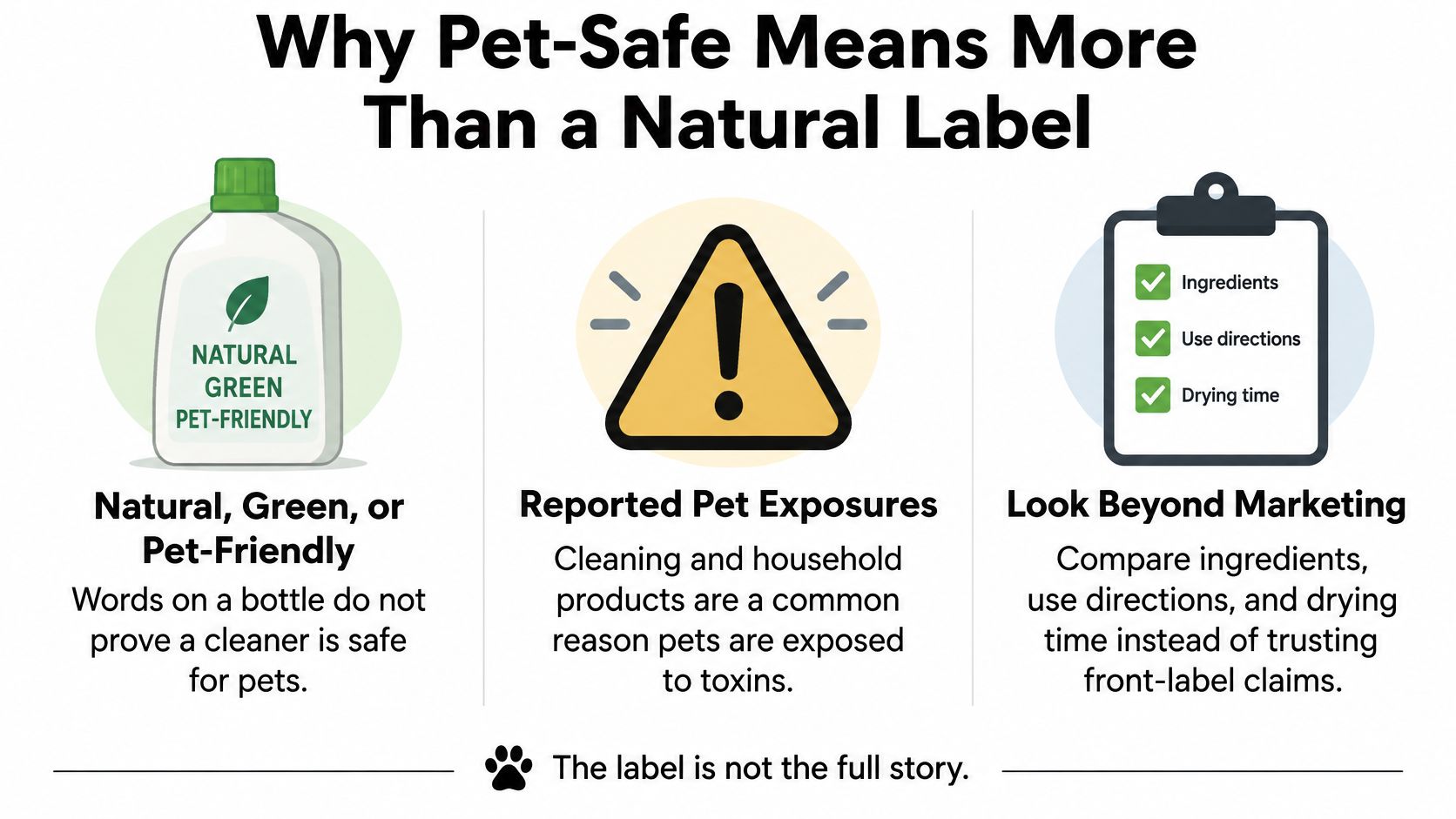
Natural, green, and pet-friendly are descriptions, not proof that a cleaner is safe for every pet or use. A dog may walk across a damp floor, then lick its paws. A cat may groom residue from its coat. The label's front tells you little about either situation, so check the ingredients and directions for the surface you plan to clean.
Exposure reports offer context, but they do not confirm that an animal was poisoned. In 2025, the ASPCA Animal Poison Control Center received reports involving more than 376,000 items pets had been exposed to. Household products ranked eighth among toxin categories and represented 6.4% of reported exposures. Cleaners and paints made up a substantial share of that category, according to the ASPCA's 2025 toxin summary.
A practical choice starts with the formula, the surface, and your pet's habits. A cleaner used on a floor may need different precautions from one used on a countertop your cat can reach. Follow the product directions, and keep pets away until treated surfaces are dry. Scent and reassuring wording cannot answer those questions for you.
Table of Contents
- Why Pet-Safe Means More Than a Natural Label
- Ingredients to Avoid and What to Look For
- Reading Labels and Certifications Without Guesswork
- Safe Use, Storage, and Drying Times at Home
- Surface-by-Surface Cleaning Protocols and Simple DIY Options
- Emergency First Aid for Pet Exposures
- Choosing Your Pet-Safe Cleaning Routine with Evo Dyne
Why Pet-Safe Means More Than a Natural Label
A “natural” label cannot tell you how a cleaner will affect a pet that licks a wet floor, walks through residue, or investigates a sprayed area. Green and pet-friendly are also claims, not a full description of the formula. Ingredients, concentration, surface, and directions give a more useful picture, much like checking a food's ingredients rather than judging it by its packaging.
In 2025, the ASPCA Animal Poison Control Center received reports involving more than 376,000 items pets had been exposed to. Household products ranked eighth among toxin categories and accounted for 6.4% of reported exposures. Cleaners and paints made up a substantial share of that category. These reports describe exposure concerns, not confirmed poisonings or deaths. As noted earlier, they are a reminder to consider product choice alongside use, storage, and drying.
What a pet-safe claim should mean
A useful pet-safe claim should be backed by information you can check: an ingredient list, clear directions for dilution and use, and, where available, a safety benchmark from an independent authority. The label is a starting point, not a guarantee for every animal or situation.
“Safe when used as directed” applies to specific conditions. For example, a disinfectant may need to keep a surface wet for a stated contact time. During that period, keep pets from walking on or licking the treated area. A certification, when present, does not make a product harmless if an animal drinks it or it is used incorrectly.
Consider the surface and the species together. A dog that licks the floor may contact residue differently from a bird kept near a sprayed area. A cat may groom its paws after walking across a treated surface. These are different routes of contact, so a product that suits one cleaning task may not suit another.
Before buying, check what the cleaner is intended for and whether its directions fit the surface and your pet's habits. Choose a product that can do the job, apply it as directed, and keep animals away until the surface is fully dry.
Ingredients to Avoid and What to Look For
A cleaner's risk depends on more than whether its ingredients sound familiar. Chemical class, concentration, contact, and residue all matter. A strong concentrate used as directed is different from the same formula used undiluted, and a cleaner that remains wet on a floor presents a different exposure opportunity from one used on a surface your pet never touches.
Veterinary toxicology sources identify cationic detergents, including benzalkonium chloride and related quaternary ammonium compounds, as capable of causing drooling, vomiting, and ulceration of the mouth and esophagus. Concentrated acids or alkalis can cause corrosive injury. ASPCA guidance on household cleaners and agents is a reason to pay close attention to disinfectant ingredients and products intended for heavy-duty cleaning.
That doesn't mean you need to identify every chemical family by memory. Start with the label. If a product is concentrated, check the dilution instructions; if it's a disinfectant, follow its application and contact-time directions exactly. Don't treat “natural” as a substitute for these checks.
Use the ingredient class as a screening cue
| Ingredient or class | Documented concern for pets | Practical screening step |
|---|---|---|
| Cationic detergents, including benzalkonium chloride and related quaternary ammonium compounds | Can cause drooling, vomiting, and ulceration of the mouth and esophagus | Read the ingredient panel, and avoid concentrated formulas for routine surfaces pets lick or walk across |
| Concentrated acids | Can cause corrosive injury | Check the product's purpose and hazard directions; choose another option for everyday pet-contact surfaces when appropriate |
| Concentrated alkalis | Can cause corrosive injury | Don't use a strong formula casually on a surface your pet may contact; follow the label precisely |
| Diluted cleaners | Risk depends on the product, dilution, and contact with residue | Measure dilution as directed, and keep pets away until surfaces are fully dry |
The table is a screening aid, not a complete product approval list. A label won't tell you everything about what happens if a pet swallows a cleaner, and an ingredient name by itself doesn't explain every exposure scenario. If you're unsure whether a product fits a particular animal or surface, choose a clearer-label option or ask your veterinarian.
Practical rule: Judge the formula by what it contains and how it's used, not by the most reassuring word on the bottle.
Reading Labels and Certifications Without Guesswork
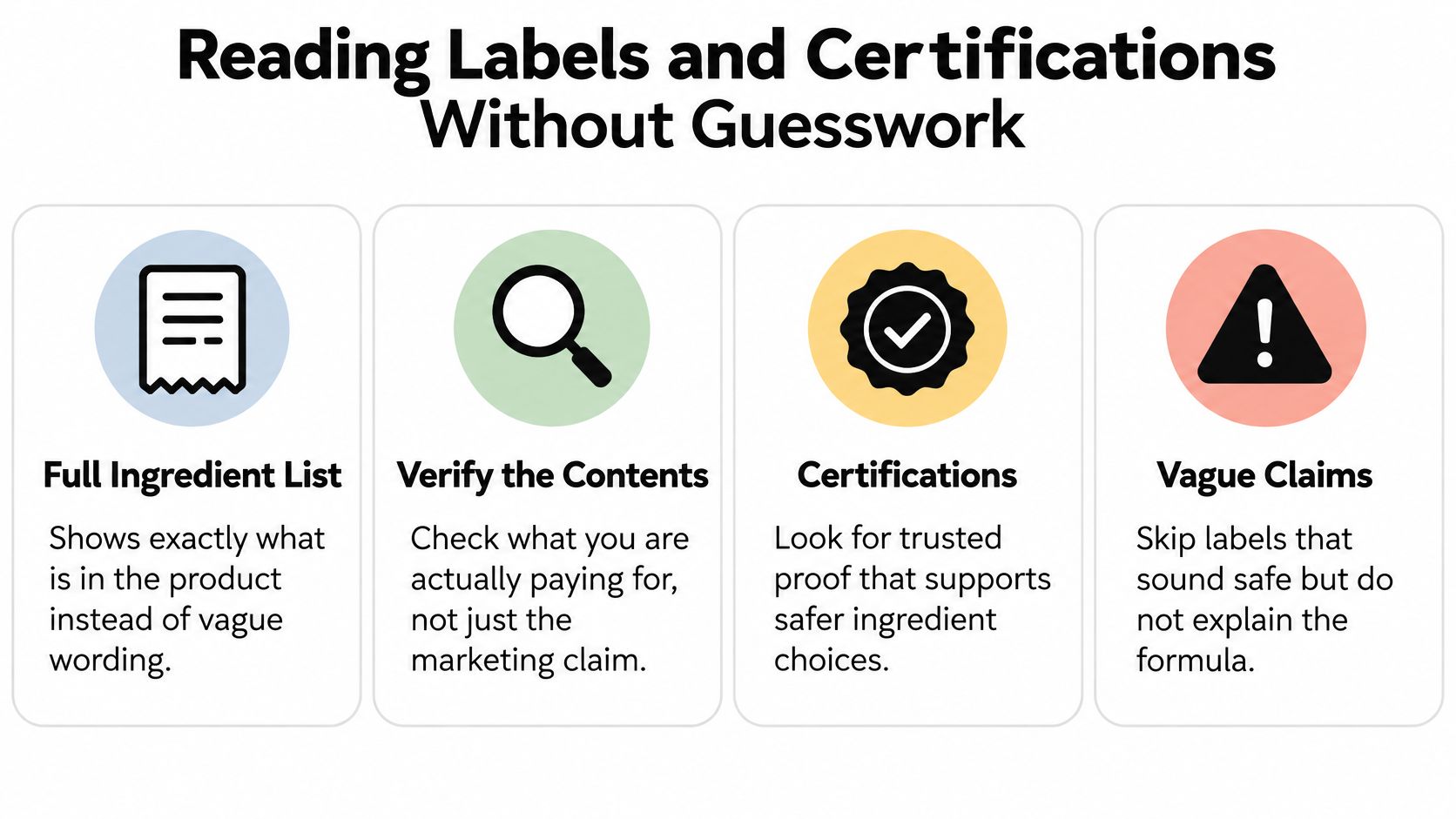
Think of an ingredient list like a receipt. It shows what's in the product more clearly than a slogan does. A front label might say “green” or “gentle,” but those words don't tell you which chemicals are included, how the cleaner should be diluted, or whether it's meant to disinfect.
The EPA's Safer Choice program offers a government-reviewed reference point. Developed in 1997, it evaluates every chemical ingredient in a certified product against human-health and environmental criteria, rather than reviewing only the active ingredient. Since April 2011, products carrying the Safer Choice label have been required to list all ingredients, including fragrances. Details about the program's ingredient review and disclosure requirements can help you understand what a certification is meant to assess.
Separate three different claims
A label may communicate ingredient review, cleaning or disinfecting performance, and conditions for safe use. Those claims aren't interchangeable. Certification can tell you that a product was assessed against a particular set of ingredient criteria, but it doesn't mean the cleaner is harmless if swallowed, or that it kills a particular germ unless the product's label says so.
Check the label in this order:
- Find the full ingredient list. Note whether the formula names its ingredients, including fragrance, rather than relying on a broad claim.
- Look for a certification mark. Confirm what the program reviews; don't assume a symbol means the same thing as pet testing or disinfectant approval.
- Read the intended use. A surface cleaner, a disinfectant, and a product for pet areas can have different directions.
- Check dilution and contact time. If the label gives a ratio or requires the surface to stay wet for a period, use those directions exactly.
- Read precautions and drying instructions. “Safe when used as directed” doesn't mean safe to lick while wet.
If you're weighing plant-derived formulas, a guide to natural cleaning products for the home can help you compare product descriptions. Still, use each product's own ingredient list and directions to assess its suitability around your pets. A certification is a useful piece of evidence, not permission to ignore the label.
Safe Use, Storage, and Drying Times at Home
A product that's suitable for a surface when used correctly can still be a problem if your pet licks it while it's wet. Keep pets away during cleaning and until treated surfaces are fully dry. Don't guess at a drying time from the room's appearance if the label gives specific directions.
The kind of cleaner matters. Veterinary guidance notes that concentrated bleach, acidic cleaners, and alkaline cleaners can cause gastrointestinal injury, burns, eye damage, or respiratory irritation if pets ingest or contact them. Cats are particularly sensitive to some phenols. The American Veterinary Medical Association's household-hazard guidance supports being especially careful with product choice and access around animals.
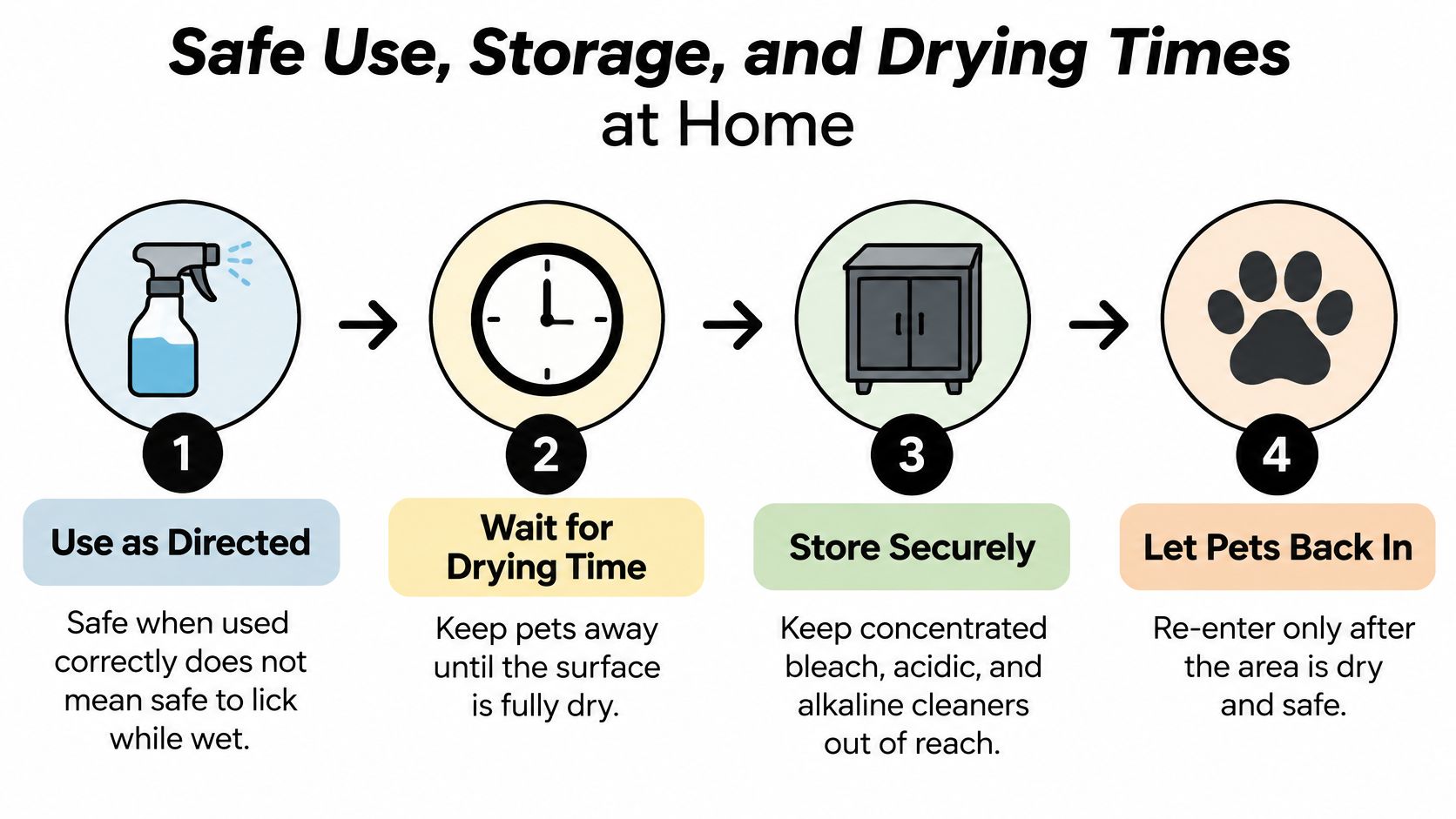
Follow a repeatable routine
Prepare the area. Move pets out of the room before spraying, wiping, or mopping. Open windows or use ventilation as appropriate for the product, and keep food and water bowls away from the work area.
Apply the product as directed. Measure concentrates using the label's directions, rather than estimating. Don't increase the amount to make a cleaner “work better,” and don't shorten a disinfectant's stated contact time.
Wait for the surface to dry. Keep pets out until the treated area is fully dry and any label directions for re-entry have been met. Damp paw pads can pick up residue; later grooming can carry it to the mouth.
Rinse items when the label allows it. For bowls, toys, and cage components, rinse with clean water if the directions permit, then let them air-dry thoroughly before returning them.
Store the bottle securely. Put cleaners out of reach, especially concentrates and products intended for corrosive or heavy-duty cleaning. Keep products in their original containers so you can read the ingredients and directions if you need them. Don't transfer cleaners to unmarked bottles, where someone in the household might mistake them for something else.
Keep the wet stage off limits. A clean-looking surface can still be wet enough for paws and tongues to pick up residue.
Surface-by-Surface Cleaning Protocols and Simple DIY Options
Start with the mess and the surface, not a favourite scent. The same bottle may not suit a kitchen counter, a floor your pet licks, and a food bowl. On every surface, check the product's intended use, directions, and drying instructions before letting pets back into the area.
Kitchen counters: Remove food and bowls before wiping. Use a product labelled for the surface and task, and follow its instructions for dilution and contact time. If you're using a disinfectant, check whether its directions call for rinsing food-contact surfaces; don't assume a quick wipe is enough.
Hard floors: Choose a cleaner intended for the floor material, then measure any concentrate as directed. Keep pets out while mopping and until the floor is fully dry. A damp floor is an easy way for residue to transfer to paws, especially for animals that later groom themselves.
Bowls and toys: Clean these separately from general surfaces. Use a product that's appropriate for the item, and rinse with clean water when the label permits. Let everything air-dry fully before putting food or water back in the bowl.
Bedding and pet areas: For organic messes such as urine, feces, or vomit on washable or treated surfaces, an enzymatic cleaner may be appropriate when its label identifies that use. Keep pets away while it works and until the area is dry and aired out according to the directions. For more on matching an odour product to a pet-related mess, see this guide to pet odour eliminators for the home.
Use DIY mixtures cautiously
A simple homemade solution can still irritate a pet or damage a surface. If you choose one, use a clear recipe from a reliable source, test an inconspicuous area first, and rinse when appropriate. Don't assume that kitchen ingredients are automatically safe for licking or inhaling, and don't make up a dilution ratio.
Never mix cleaning products. Combining products can create hazards, and a homemade mixture doesn't become predictable just because its ingredients are familiar. Store it in a clearly labelled container, keep it away from pets, and use it only on surfaces it's suitable for.
Emergency First Aid for Pet Exposures
If your pet gets into a cleaner, act promptly and keep the product container nearby. Don't wait for symptoms if you know the animal has swallowed a product or had a significant contact exposure. The label can help a veterinarian or poison-control professional identify the ingredients and give advice suited to the product.
Take these steps first
- Move your pet away from the product. Prevent further access to the spill or treated area.
- Stop licking or grooming if you can do so safely. A pet may continue swallowing residue from its paws or coat.
- Keep the original label or container. Be ready to describe the product, its ingredients, how it was diluted, and how the exposure happened.
- Contact a veterinarian or an animal poison-control service promptly. Follow their directions rather than trying a home remedy.
Don't induce vomiting or apply a home treatment unless a veterinary professional tells you to. The right response can depend on the product and how your pet was exposed. If cleaner got on the coat or paws, ask the professional what to do before attempting a cleanup that could spread the product or increase contact.
Drooling, vomiting, difficulty breathing, or visible irritation of the mouth or eyes are warning signs that need urgent veterinary attention. Tell the clinic what the product is and when the exposure happened, and bring the label or container if you go in. If breathing is affected or symptoms are severe, contact an emergency veterinary clinic immediately.
Choosing Your Pet-Safe Cleaning Routine with Evo Dyne
Match each product to its job instead of asking one cleaner to handle every room. A routine surface cleaner is for everyday soil; a floor product needs directions that suit the flooring and the paws that cross it; a product for pet areas should state what messes and surfaces it's intended for. For any disinfectant, check the product's specific claims and contact-time directions rather than assuming that a “natural” label proves it can disinfect.
EPA strengthened the Safer Choice standard in August 2024, including stricter criteria for pet-care products and ingredients intended to be safer for people, pets, and the environment. The EPA's announcement gives households another reason to check certification scope rather than rely on vague front-label language.
Evo Dyne Products offers home cleaning essentials and pet care products. The brand also publishes guidance on choosing enzymatic cleaners for organic pet messes and keeping pets away until treated areas are dry and aired out as directed. Many of its items are made in the USA in certified facilities, but that alone doesn't establish that a specific cleaner is suitable for a particular animal or surface. Check each item's ingredient disclosure and directions before use.
For readers comparing broader cleaning options with an indoor-air focus, cleaning solutions for indoor air quality may be a useful resource alongside careful label reading. It doesn't replace checking whether a product fits your pet, surface, and cleaning task.
Before you buy more, gather the cleaners you already use and check each label for ingredients, dilution, contact time, and drying directions. Evo Dyne Products offers home cleaning essentials and pet care products, so review the details of any item against your household's needs and visit Evo Dyne Products to explore its range.