

Cutting oil is a metalworking fluid used at the tool-workpiece interface during machining. Lubricating oil reduces friction and wear in moving machine components. The choice depends on the fluid's job at the point of work, not viscosity alone.
At the cut, the fluid may need to cool the work, carry chips away, wet a hot edge, and withstand recirculation. A machine oil selected for a component's load, temperature, and viscosity grade may not perform those tasks. Likewise, cutting oil in a machine's lubrication system may not provide the properties that bearings or gears require.
Keep the cabinet label and the application in view. Oil intended for a machine component is not automatically suitable for a spindle, drill, or tap. Using the wrong fluid can contribute to poor finishes, packed flutes, smoke, or avoidable wear. Check the operation and the machine's fluid requirements before using one oil in place of the other.
Table of Contents
- Cutting Oil and Lubricating Oil at a Glance
- What Each Oil Must Do at the Point of Work
- How Formulations and Additives Differ
- Measured Performance in Machining Tests
- Machining Versus General Lubrication in Practice
- Safety, Handling and Maintenance Differences
- Choose Cutting Oil or Lubricating Oil by Operation
Cutting Oil and Lubricating Oil at a Glance
The oil with the right viscosity can still be wrong for the job. Cutting oil is formulated for active machining, such as cutting, drilling, milling, boring, and tapping. Lubricating oil is intended mainly to reduce friction and wear in moving machine components, including bearings, gears, engines, and hydraulic systems. The difference is a process decision: choose the fluid for what it must do where it is used.
A cutting oil is selected for the operation and workpiece material. A lubricating oil is selected for the component's load, operating temperature, and required viscosity grade. Those choices affect more than lubrication. Using the wrong fluid can leave chips in the cut or compromise the oil's performance in a circulating system.
The Comparison That Matters on the Shop Floor
| Criterion | Cutting oil | Lubricating oil |
|---|---|---|
| Primary purpose | Cooling, lubricating and chip removal at the cut | Reducing friction and wear between moving parts |
| Typical uses | Cutting, drilling, milling, tapping, boring, forming | Bearings, gears, engines, hydraulic systems, machine ways |
| Main selection basis | Workpiece alloy, operation, tool material, delivery method | Equipment design, load, temperature range, viscosity grade |
| Typical forms | Neat oil or water-miscible emulsion | Straight mineral or synthetic oil |
| Key additives | Extreme-pressure, anti-corrosion, wetting agents, biocides | Antioxidants, anti-wear, rust inhibitors, detergents, viscosity index improvers |
| Heat removal | Low for neat oil, high for emulsions | Low to moderate, mainly through circulation |
| Chip handling | Flushes chips and fines from the cutting zone | Not designed to evacuate chips |
| Main contamination concern | Tramp oil and bacteria shorten fluid life | Water and particles degrade oil and components |
Metalworking fluids also bring handling and exposure considerations beyond the machine itself. NIOSH guidance states that more than 1 million employees are exposed to metalworking fluids in the United States. That workforce exposure is one reason to treat cutting fluids as process fluids with specific handling and maintenance needs, rather than as interchangeable oils. NIOSH guidance on metalworking fluids
At the cut, fluid may need to lubricate the tool-workpiece interface, carry away heat, clear chips and fines, and protect newly machined surfaces from corrosion. A general lubricant is instead formulated around duties such as maintaining a film in a bearing or gear set, controlling oxidation, and circulating through equipment over time. Those priorities overlap, but they are not the same.
Choose by the job the fluid must perform at its point of use, not by how thick it looks in the container.
Treat the fluids as non-interchangeable unless the product is explicitly specified for both duties. A machine lubricant may perform well in its intended component yet fail to clear chips at the cut. Cutting oil may work in a tapping operation but lack the properties required by a gearbox's circulating oil. The wrong substitution can mean poor process performance and extra fluid or equipment maintenance.
What Each Oil Must Do at the Point of Work
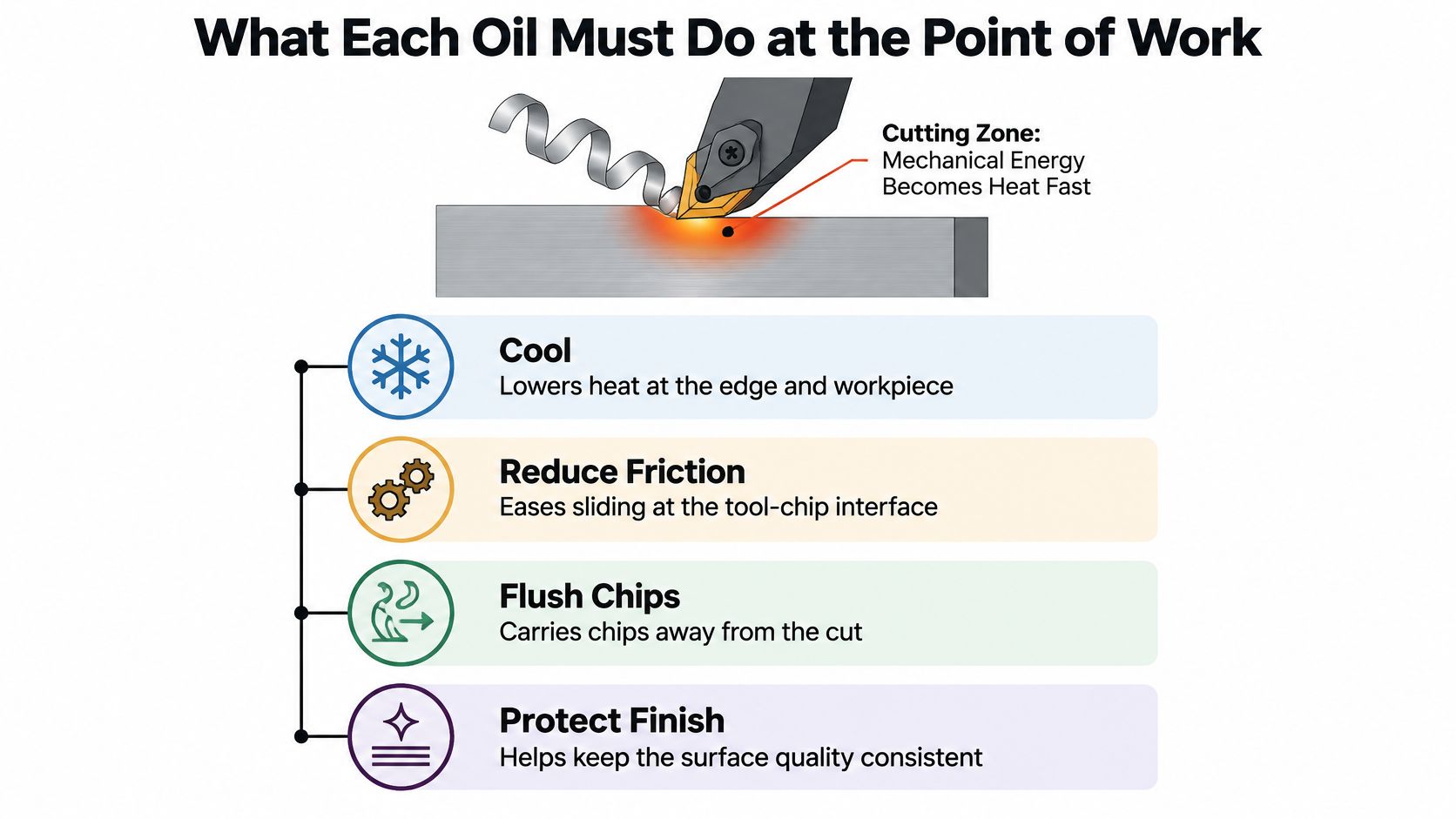
A cutting zone turns mechanical energy into heat very quickly. The tool is forcing its way through metal, the chip is sliding across the face of the tool, and fresh surface is being exposed continuously. Cutting oil has to get into that small, hostile interface and do several jobs before the edge overheats or the chip welds itself to the tool.
The diagram below breaks those jobs into the four functions that matter most during machining.
Four Jobs at the Cutting Edge
- Cool the edge and workpiece: The fluid carries heat away from the tool chip interface so the edge keeps its hardness and the part holds size.
- Reduce friction and adhesion: A boundary film lowers sliding friction and helps prevent built-up edge, where workpiece material sticks to the tool and tears the finish.
- Flush chips and fines: Flow clears debris from the cut so chips aren't recut, dragged across the surface, or packed into drill flutes.
- Protect the fresh surface: Corrosion inhibitors help guard newly machined metal, which has no protective coating and can stain or rust quickly.
Deep drilling shows why flushing isn't a minor feature. Once chips pack into the flutes, they block fresh fluid from reaching the drill tip. Heat rises, torque climbs, the hole wall gets scored, and the drill can wander or break. A fluid that feels slippery between your fingers won't save that hole if it can't move chips out and get back to the tip.
A Different Job Inside the Machine
General lubricating oil usually works in a closed or semi-closed system. Its main tasks are separating moving surfaces, limiting wear, controlling oxidation, and resisting corrosion over a long service interval. Heat is normally carried away by circulation through a reservoir, sump, cooler, or the surrounding housing, not by flooding an open cutting zone.
That design makes sense for a bearing or gearbox. Those components don't produce a stream of sharp metal chips that must be evacuated every second. They need a stable film that remains in place, resists breakdown, and protects surfaces through repeated rotation or sliding.
Use a general lubricant on a cutting job and you'll often get part of the job done. It may reduce friction at first contact, which is why the substitution can look successful for a few minutes. Then the missing functions show up as poor cooling, weak chip flushing, smoke, discoloration, or a rough finish.
Diagnostic check: If your main problems are heat at the edge, chips packing in the cut, or material sticking to the tool, you're not looking at a simple friction problem. You're using a fluid that wasn't built for the full process.
That's the practical difference between cutting oil and lubricating oil at the point of work. One manages a machining process in an open, debris-producing zone. The other protects machine components in a controlled lubrication circuit.
How Formulations and Additives Differ
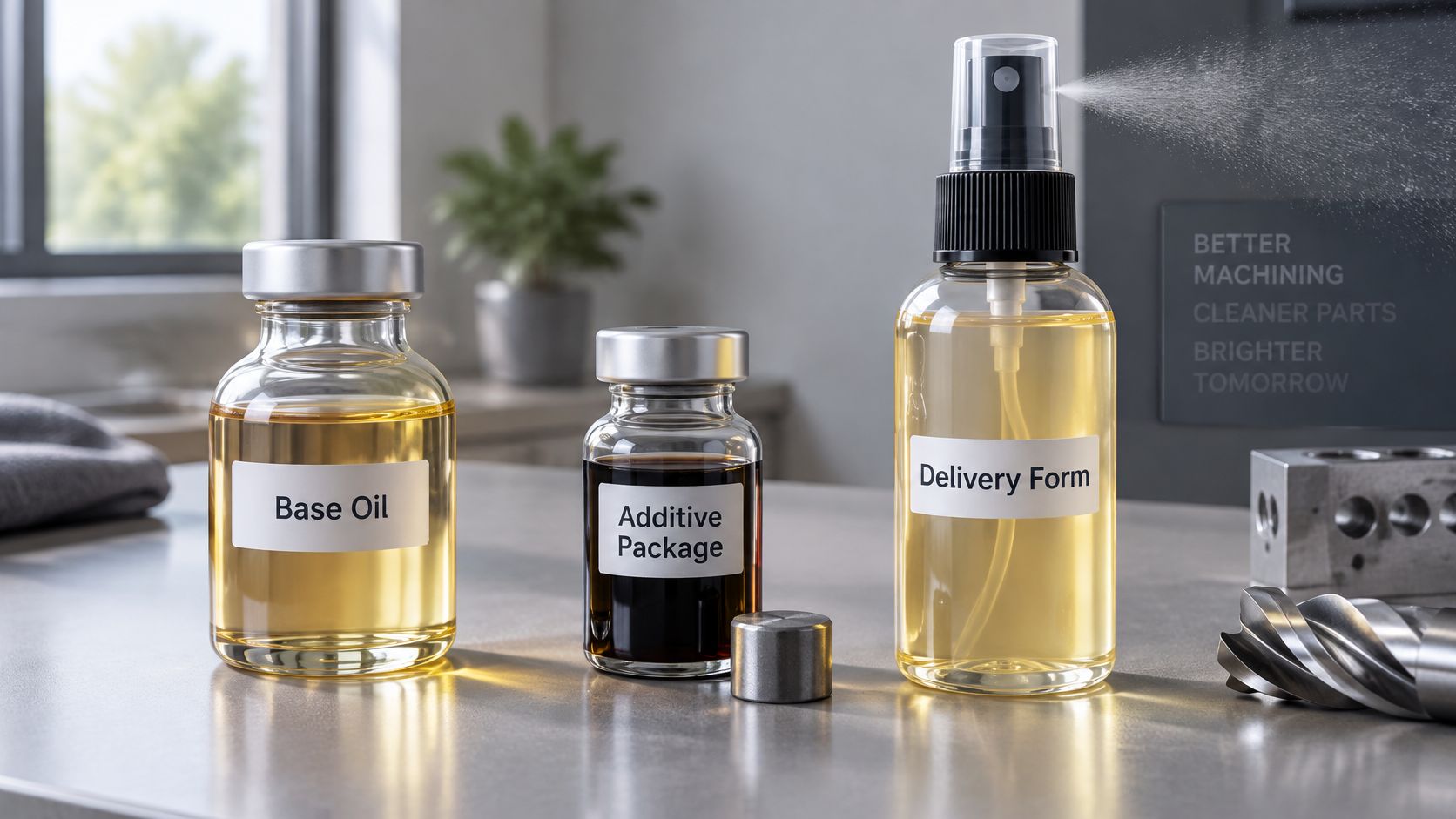
Think of any industrial fluid in three layers. First there's the base, which may be oil, synthetic fluid, water, or a mixture. Second there's the additive package that gives the fluid its working behavior. Third there's the delivery form, such as a neat oil used undiluted or a concentrate mixed with water and flooded onto the cut.
The photograph below is a useful reminder that what's in the container is a formulated system, not just a base oil with a grade printed on the label.
What Goes Into Cutting Oil
Cutting oil is engineered for the metal, tool, and chip interface. Extreme-pressure additives and boundary lubrication additives help maintain protection when contact pressure is high and a simple oil film would be squeezed out. That's especially relevant in tapping, broaching, deep drilling, and machining stainless steel or other difficult alloys.
Wetting agents help the fluid spread over metal and reach the interface instead of beading up or being thrown off. Corrosion inhibitors protect both ferrous and non-ferrous parts after machining. When the product is a water-miscible emulsion, emulsifiers keep oil dispersed in water, and the water provides substantially greater heat-transfer capacity than oil alone.
Emulsions also need biological control. Biocides are used to control bacterial growth in water-based fluids, because a warm sump containing oil, fines, and tramp contaminants can support organisms that break down the fluid and create odor. That maintenance burden is part of the trade-off for stronger cooling.
What Goes Into Lubricating Oil
A machinery lubricant uses a different additive strategy because it's expected to circulate and last. Antioxidants slow oxidation as the oil is heated and exposed to air over time. Anti-wear additives protect rolling and sliding contacts in pumps, bearings, and gears when the film becomes thin.
Engine oils may also use detergents and dispersants to handle combustion contaminants. Many lubricants use viscosity index improvers so the oil doesn't thin excessively when hot or become unmanageably thick when cold. Rust inhibitors protect internal surfaces during shutdowns and storage.
You'll see that equipment-first logic in common grade examples on product labels. For example, an industrial gear oil might be specified in a heavier ISO VG range such as ISO VG 150 to 220, while a hydraulic oil is often specified in a lighter range such as ISO VG 32 to 68. Those are equipment specifications tied to component design, clearances, load, speed, and temperature, not proof that either oil belongs at a sharp tool edge.
Why a Grade Code Isn't Enough
Cutting-fluid evaluation can include emulsion stability, corrosion inhibition, surface tension, contact angle, tribology, and biodegradability tests, and research on deep-hole drilling reports that lower-viscosity fluids with stronger cooling capability can substantially prolong tool life, as described in research on machining fluid evaluation and performance. Contact angle and surface tension matter because the fluid must wet and penetrate the cutting interface, not merely exist nearby.
Delivery conditions also change the result. Flow rate, pressure, nozzle position, and whether fluid reaches the tool through the spindle can affect heat, chip formation, wear, and finish. Two fluids with similar viscosity can therefore behave very differently once their additive packages and delivery forms enter the cut.
That's why you shouldn't select a cutting fluid by matching an SAE or ISO grade from a lubricant shelf. Start with the workpiece alloy, operation, tool material, cutting speed, and cooling method. Use viscosity as one specification among several, not as the decision itself.
Measured Performance in Machining Tests
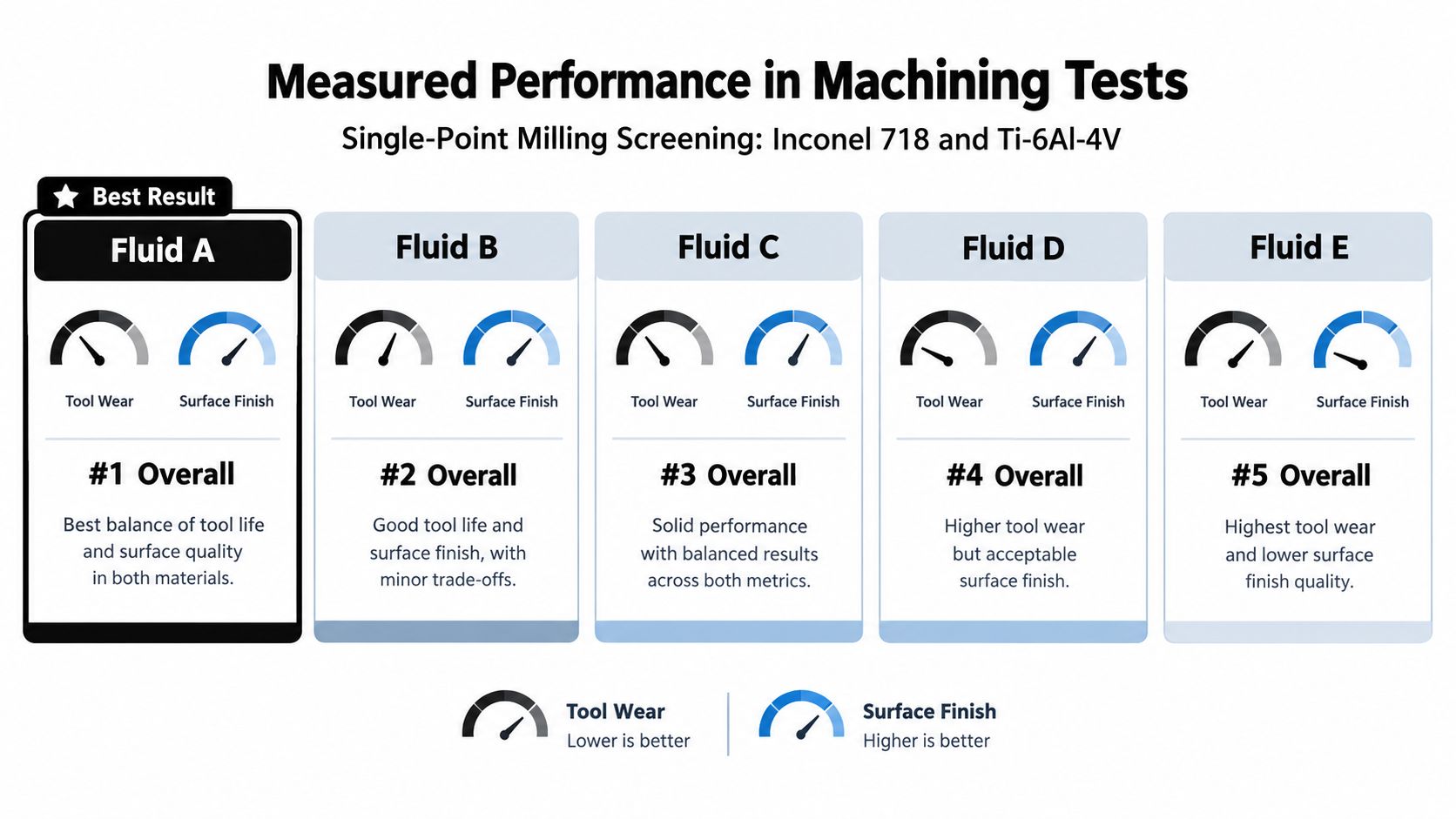
A fluid's label does not predict how it will perform at the cut. In a single-point milling screening study, researchers compared five metalworking fluids while machining the aerospace alloys Inconel 718 and Ti-6Al-4V. The reported results differed across the formulations, including in tool wear and tool life. That comparison evaluates fluids under the study's test conditions, not cutting oils against lubricating oils as broad categories.
What the Test Numbers Show
In the single-point milling screening study, the best-performing fluid recorded an average tool life of 37.1 minutes, while the weakest recorded 24.3 minutes. The difference is about 53% in tool life under that test's conditions. These figures describe the fluids compared in the study, not a universal result for every machine, alloy, or cutting operation.
The test supports a practical point: machining performance depends on the fluid used in the process, and the results can vary between formulations. The reported ranking alone does not establish which individual ingredient caused those differences. It also does not show that every fluid with a lubricating base oil will perform alike.
Contamination is a separate concern in a shop sump. Hydraulic oil that enters cutting fluid as tramp oil changes the mixture in the tank. That can affect how the fluid behaves at the cut and may undermine the performance expected from the chosen cutting fluid. Keeping hydraulic and cutting-fluid systems separate helps avoid an unintended change to the working mixture.
What the Numbers Don't Prove
The study's tool-life results do not predict the same outcome on aluminum, mild steel, a different insert grade, or a machine with different fluid delivery. Alloy, tool geometry, speed, feed, delivery, concentration, and sump condition all affect results. The figures also do not establish that the highest-priced fluid will perform best, or that neat oil will always outperform an emulsion.
Nor do they show that general lubricating oil will fail immediately on every light cut. A general-purpose lubricant may reduce friction enough for a simple job. Sustained machining asks more of the fluid, including cooling and chip removal, as well as performance at the cutting interface.
Practical rule: Before changing fluids for a production job, compare them on your own alloy, tool, and machine settings.
Keep the comparison controlled. Use the same tool, program, material batch where possible, and fluid delivery setup. Record tool life, surface finish, cutting force or spindle load, chip evacuation, and any staining or corrosion after the part sits. Include tool changes, scrap, cleanup, and sump maintenance when assessing the result, not just the cost of the fluid.
A controlled shop trial answers a different question from a published screening test. The study shows that the tested fluids produced different tool-life results in its setup. Your own trial shows whether a particular fluid suits your operation and what the full process cost looks like.
Machining Versus General Lubrication in Practice
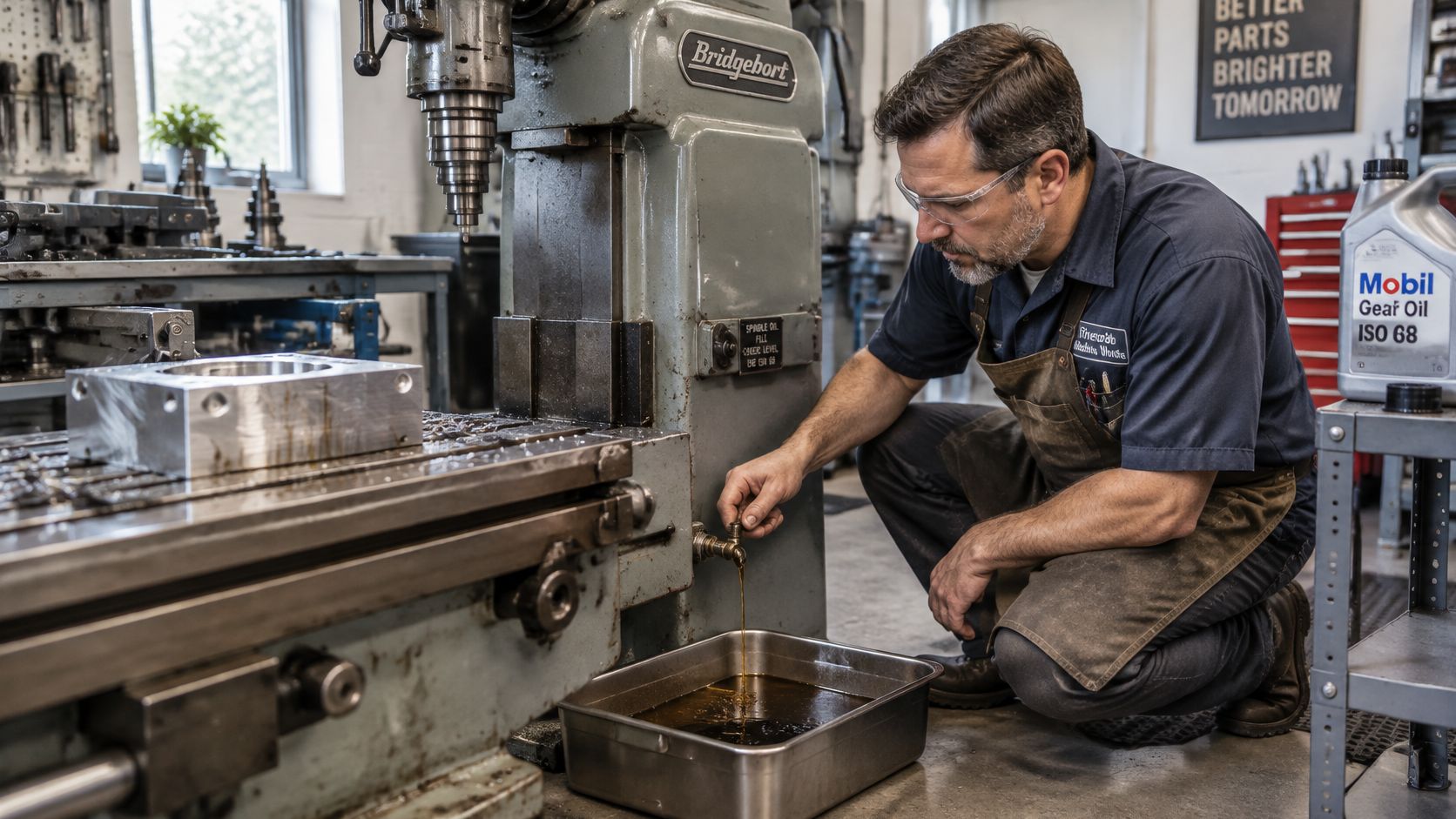
A shop owner drains a milling machine reservoir during a busy week and refills it with a general gear oil because it's clean, available, and close enough in thickness. Nothing breaks that afternoon. Within days, the finish becomes inconsistent, chips stop clearing as they should, and the operator starts compensating by slowing feeds and changing tools earlier. The oil didn't fail as a lubricant in the abstract. It was put into a process it wasn't formulated to manage.
The scene in the image below is familiar in any machine shop: draining and refilling is routine work, but the container you reach for determines whether the next run is routine too.
Matching the Fluid to the Application
| Application | Fluid | Why it fits |
|---|---|---|
| Milling steel or aluminum | Neat cutting oil or semi-synthetic emulsion | Heat removal and chip flushing at the cutting edge |
| Deep drilling stainless steel | High-EP neat cutting oil | High contact pressure and heat at the drill tip |
| Tapping threads | Neat cutting oil | Friction control and prevention of built-up edge |
| Gearbox in a machine tool | Industrial gear oil specified for the gearbox | Sustained film under gear load and temperature |
| Hydraulic power unit | Hydraulic oil specified for the system | Pressure transmission, wear and oxidation control |
| Machine slideways | Way lubricant | Stick-slip control and wear protection on sliding surfaces |
Milling gives you a choice because the heat and chip load vary with the operation. A semi-synthetic emulsion often fits higher-speed work where cooling and washing chips away matter most. A neat cutting oil can fit slower, heavier, or finish-sensitive work where boundary lubrication matters more and the machine can manage the oil film and mist.
Deep drilling stainless steel is less forgiving. The drill tip is buried, contact pressure is high, and chips have a long path out of the hole. A high-EP neat cutting oil, delivered so it reaches the tip, addresses friction under pressure. Tapping is similar in one respect: the tap has a large contact area, reverses direction, and can gall or build up material if the film collapses.
Now move away from the cut. A machine-tool gearbox needs an industrial gear oil that can maintain a sustained film between gear teeth while resisting oxidation during long service. A hydraulic power unit needs hydraulic oil that transmits pressure, protects the pump, releases air appropriately, and remains stable in circulation. Neither component needs chip flushing, and neither should be filled with cutting oil just because it's nearby.
Slideways are their own case. A way lubricant is expected to prevent stick-slip so the table moves smoothly at low speed instead of jumping in small increments. If you're reviewing what belongs in those machine systems, start with the equipment specification and this overview of industrial lubricant use, then check it against the machine manual rather than the cutting-fluid drum.
The Shared Machine Edge Case
A machining center can use one coolant tank for tooling while still having separate spindle, way, and hydraulic lubrication systems. Those systems aren't isolated perfectly. Way oil can wash into the coolant, hydraulic fittings can leak, and spindle lubricant can migrate. Once that tramp oil enters the cutting fluid, it can change wetting, cooling, and biological stability.
Keep the systems conceptually separate even when they're physically close. Label fill points, use dedicated transfer containers, fix leaks promptly, and skim tramp oil before blaming the cutting fluid supplier. Most mystery changes in finish or tool life start with a mundane maintenance cause.
Safety, Handling and Maintenance Differences
The oil in the cabinet is not automatically the oil that belongs at the spindle. Cutting fluid is exposed at the machining point and may become airborne, collect chips, and contact operators during cleaning or sump service. Oil sealed in a gearbox or hydraulic reservoir has a different exposure route and maintenance burden. Choosing by viscosity alone misses those process differences.
NIOSH recommends exposure limits of 0.5 mg/m³ for total metalworking-fluid particulate and 0.4 mg/m³ for thoracic particulate, averaged over a 10-hour workday in a 40-hour workweek. These are recommended limits, not a claim that every shop exceeds them. If exposure measurements show overexposure, control the mist at its source. The NIOSH metalworking fluid exposure guidance on PubMed Central provides the exposure recommendations.
Cutting Fluid Routines That Matter
- Capture mist at the machine: Use enclosures, extraction, and properly aimed nozzles to limit mist in the operator's breathing zone.
- Filter and skim the sump: Remove fines and tramp oil on schedule. Both can interfere with fluid performance, and contamination can support biological growth.
- Check concentration and pH: For emulsions, use a refractometer and routine pH checks to confirm that the working mix remains within the supplier's guidance.
- Manage bacteria deliberately: Follow the supplier's biocide and housekeeping instructions rather than waiting for odor to signal a neglected sump.
- Wear gloves and eye protection: Concentrate handling, filter changes, and sump cleaning create more contact than normal machining.
Maintenance affects the cut, too. A weak emulsion can lose corrosion protection and lubrication. Fines and tramp oil can recirculate through the system, contribute abrasive debris, and destabilize the mix. A change in smell may be noticeable first, but finish or tool life can also suffer.
Lubricating Oil Maintenance Is a Different Routine
For circulating lubricating oil, check oil condition, viscosity, oxidation, water, particles, and filters. The aim is to confirm that the oil still protects its component and to spot wear debris that may signal a machine problem. A closed system usually reduces routine contact, but leaks, hot surfaces, and high-pressure hydraulic failures still require controls.
Use tests suited to the fluid's failure modes. A gearbox oil sample cannot confirm whether cutting-emulsion concentration is correct. A refractometer reading cannot show whether hydraulic oil has oxidized. Matching the test to the system prevents a sound reading in one area from masking a problem in another.
Keep disposal streams separate as well. Never pour either fluid into drains. Store used cutting fluid and used lubricating oil in clearly labeled, separate containers so recycling, treatment, and regulatory handling remain straightforward. Mixing them to save a container can make later handling more difficult and costly.
Choose Cutting Oil or Lubricating Oil by Operation
If the fluid touches the cut, use cutting oil. If it lubricates a machine component, use the lubricating oil the equipment maker specifies. That one line resolves most shelf-level confusion about the difference between cutting oil and lubricating oil.
The selection guide below turns that rule into a quick fill-point check before anyone opens a container.
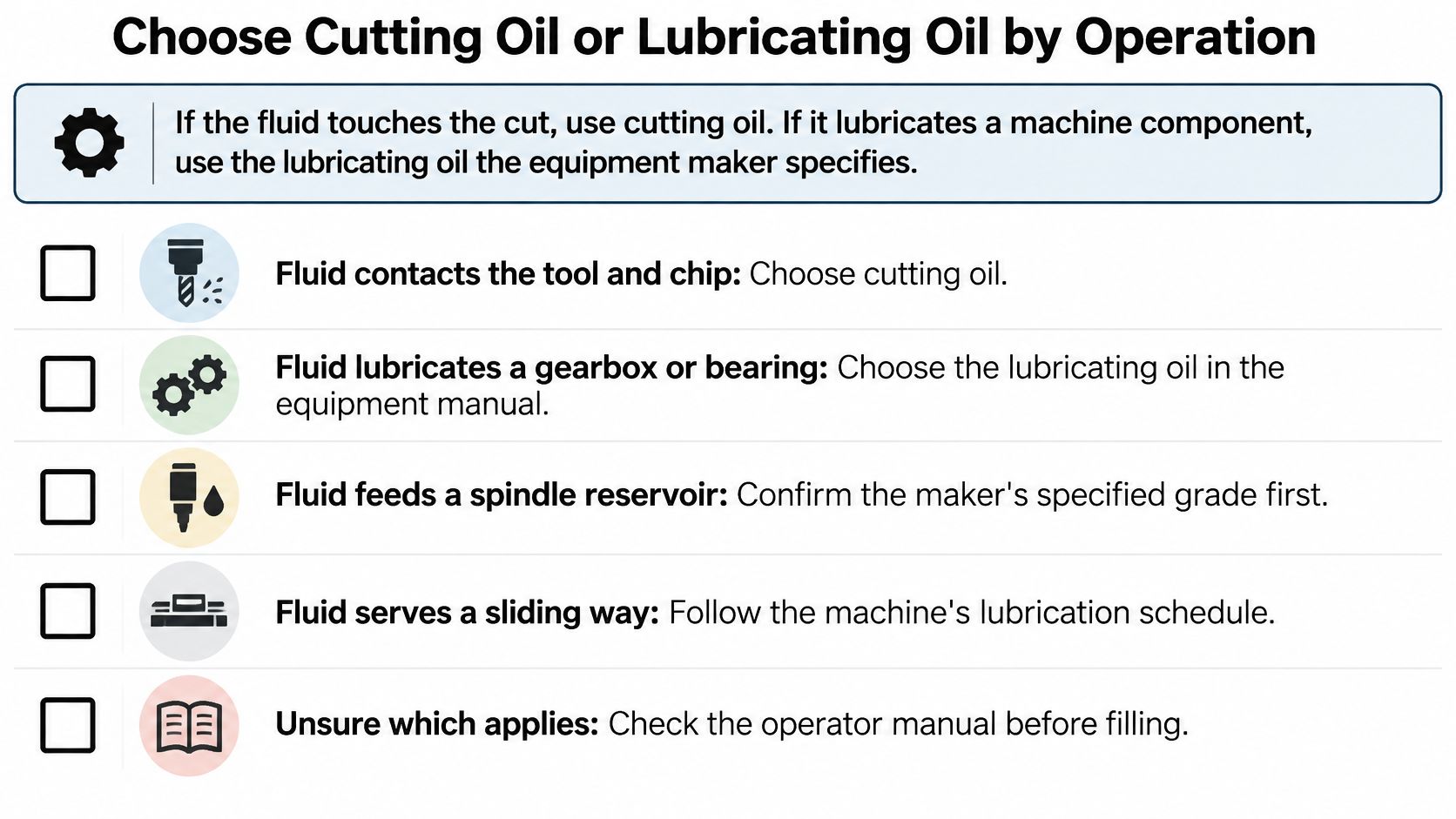
Selection Checklist
- Identify the operation and material: Drilling stainless steel, tapping aluminum, and milling cast iron don't impose the same heat, pressure, or corrosion demands.
- Check tool material and cutting speed: Higher speeds usually push the decision toward stronger cooling, while slow, high-pressure contacts push it toward boundary and EP lubrication.
- Choose neat oil or emulsion by heat load: Consider the machine enclosure and mist control as part of the choice, not after smoke becomes visible.
- Confirm delivery: Flood, through-tool, mist, or manual application changes whether the fluid reaches the interface and clears chips.
- Match additives to the alloy: Stainless steel and titanium often need a stronger EP package, while some non-ferrous work requires attention to staining and corrosion chemistry.
- Verify the OEM specification: For gearboxes, hydraulics, spindles, and ways, the manual names the lubricant type and grade. Don't overrule it with a cutting product.
- Separate storage and sumps: Label containers, funnels, and transfer pumps so the right fluid doesn't become tramp contamination in the wrong system.
Edge cases still require judgment. A light finishing pass on aluminum may run well on a clean, correctly mixed emulsion that cools and washes chips away. Heavy drilling in titanium is a different job and may need neat cutting oil with EP additives and delivery aimed at the buried tool edges.
For drilling-specific selection details, compare your operation against guidance on choosing cutting oil for drilling before you buy in bulk. One option in that category is Evo Dyne Products multipurpose metal cutting oil, intended for drilling, tapping, milling, and thread-cutting applications where the fluid must reduce friction and heat at the tool and workpiece interface.
The short video below is worth watching before a trial because it keeps the focus on application method and operation, which matter as much as the product name.
Your concrete next step is a sample run on the actual alloy. Machine representative parts, record tool life and finish, inspect for staining after the parts sit, and compare the supplier specification sheet against every checklist item. Order production quantities only after the fluid proves itself in your machine, with your delivery system and your operators.
If you're setting up drilling, tapping, milling, or thread-cutting work and need a cutting oil made for the tool and workpiece interface rather than a general machine lubricant, review the industrial fluid options and application guidance from Evo Dyne Products. Choose a sample matched to your alloy and operation, run it against your current fluid, and let recorded tool life, finish, and cleanup decide the production order.