
Smoking just one cigarette in a closed car can push fine particle exposure to levels that overwhelm anything a spray can fix on its own. That single fact changes how you should shop. The best car air freshener for smokers isn't the strongest scent on the shelf. It's the final layer in a process that first removes ash, particles and residue from surfaces, then handles the gases still moving through the cabin. Buy in that order and the fragrance lasts. Reverse it and you'll keep spraying over the same stale base.
Table of Contents
- Quick Picks by Smoke Situation
- Why Smoke Odor Survives Air Fresheners
- How the Main Smoke Odor Approaches Compare
- How to Clean and Freshen a Smoke-Exposed Car
- Fragrance Checklist, Safety Limits and Longevity
- Choose Your Layered Smoke Plan Today
Quick Picks by Smoke Situation
No single product wins for every smoker's car. The right starting point depends on how deep the smoke has penetrated, whether smoking is still happening inside, and who else rides in the cabin.
The reason source control comes first is scale. The U.S. Centers for Disease Control and Prevention fact sheet on smoking in vehicles states that smoking just one cigarette in a vehicle with the windows closed can generate particulate exposure exceeding 100 times the U.S. Environmental Protection Agency's 24-hour recommended limit for fine respirable particles. A fragrance can't offset that load. It can only improve what's left after you clean, ventilate and filter.
Starting Approach by Smoke Situation
| Situation | Start With | Add On | Why It Fits |
|---|---|---|---|
| Used car with faint old smoke | Deep clean and cabin filter replacement | Light fragrance spray | Residue sits in fabric, so masking alone fades |
| Active smoker's daily car | Ashtray and vacuum routine with ventilation | Carbon-based cabin filter and periodic fragrance refresh | New smoke keeps arriving, so source control matters most |
| Family car with children or allergy-prone passengers | Activated-carbon cabin filter | Fragrance-free or low-scent product | Limits the amount of scent passengers breathe |
| Car being sold after years of smoking | Full upholstery and headliner cleaning | Odor neutralizer, then mild fragrance | Buyers sniff first, and reservoirs must be removed |
| Quick refresh between cleanings | Fragrance spray in a minimal amount | Ten minutes of ventilation | Covers residual odor at low cost |
Use the table as a triage tool, not a shopping list. A used car with faint smoke needs surface work first because that's where the odor lives now. An active smoker's car needs a repeatable routine because new contamination arrives daily. A family car flips the priority again, since a heavy perfume can become its own problem for sensitive passengers.
I would start with the cheapest row that matches your situation and only move up if the smell returns after a warm afternoon parked in the sun. Heat is the honest test. If the cabin still smells clean then, your layering is working.
Why Smoke Odor Survives Air Fresheners
Cigarette smoke leaves two different problems behind. Fine particles settle onto glass, plastic and fabric as a sticky film. Gaseous compounds absorb into porous materials and slowly release later. A spray works mainly in the air you smell right now, so it misses both reservoirs.
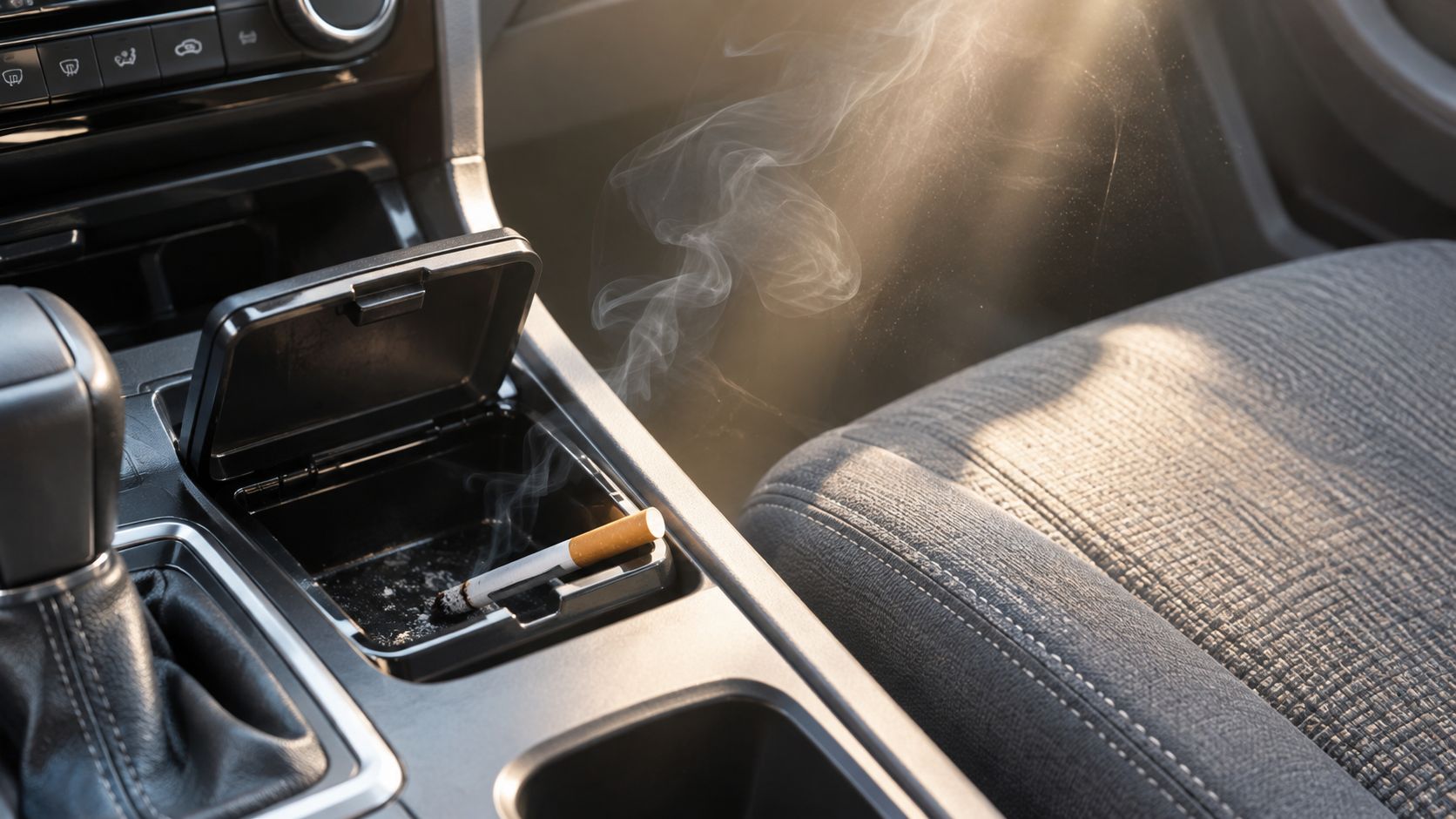
That reservoir effect shows up in measurements. A 2013 California study of 250 vehicles in San Diego County published in Tobacco Control found nicotine in dust, on surfaces and in the air even in a majority of vehicles identified as nonsmoker cars. Older and higher-mileage vehicles had significantly higher thirdhand-smoke contamination in dust and on surfaces at p<0.05, and smoker vehicles had higher nicotine levels on surfaces and in dust than nonsmoker vehicles at p<0.01 and p<0.05 respectively.
Where the Odor Actually Hides
In a car, the main reservoirs are predictable:
- Headliner: Thin fabric over foam sits directly above rising smoke and holds it for a long time.
- Cloth seats and carpets: Pile and padding trap particles below the surface you vacuum.
- Floor mats and trim: Mats collect ash and dust, while textured plastic holds film in its grain.
- Cabin filter: Every pass of air through a loaded filter reintroduces old odor.
Time makes the problem worse, not better. A 2025 University of California, Irvine research summary reports that compounds from cigarette smoke can remain absorbed in indoor surfaces for as long as one year and later re-enter the air or transfer through contact. Ventilation alone may be insufficient for those reservoirs, and physical cleaning is needed to remove them.
Masking changes what you notice for an hour. Cleaning changes what the material can release tomorrow.
Say a buyer picks up a used sedan, sprays a new-car scent through the vents, and drives home pleased. The next afternoon the interior warms in the sun, the headliner and seat foam release what they've stored, and the old smoke pushes through the faded fragrance. Nothing about the spray failed exactly as a perfume. It just never touched the source.
That's why persistence after heat matters more than first-sniff strength when you judge any product. Heat and handling release what fabric holds. If you don't address the material, you're scheduling the odor's return, not preventing it.
How the Main Smoke Odor Approaches Compare
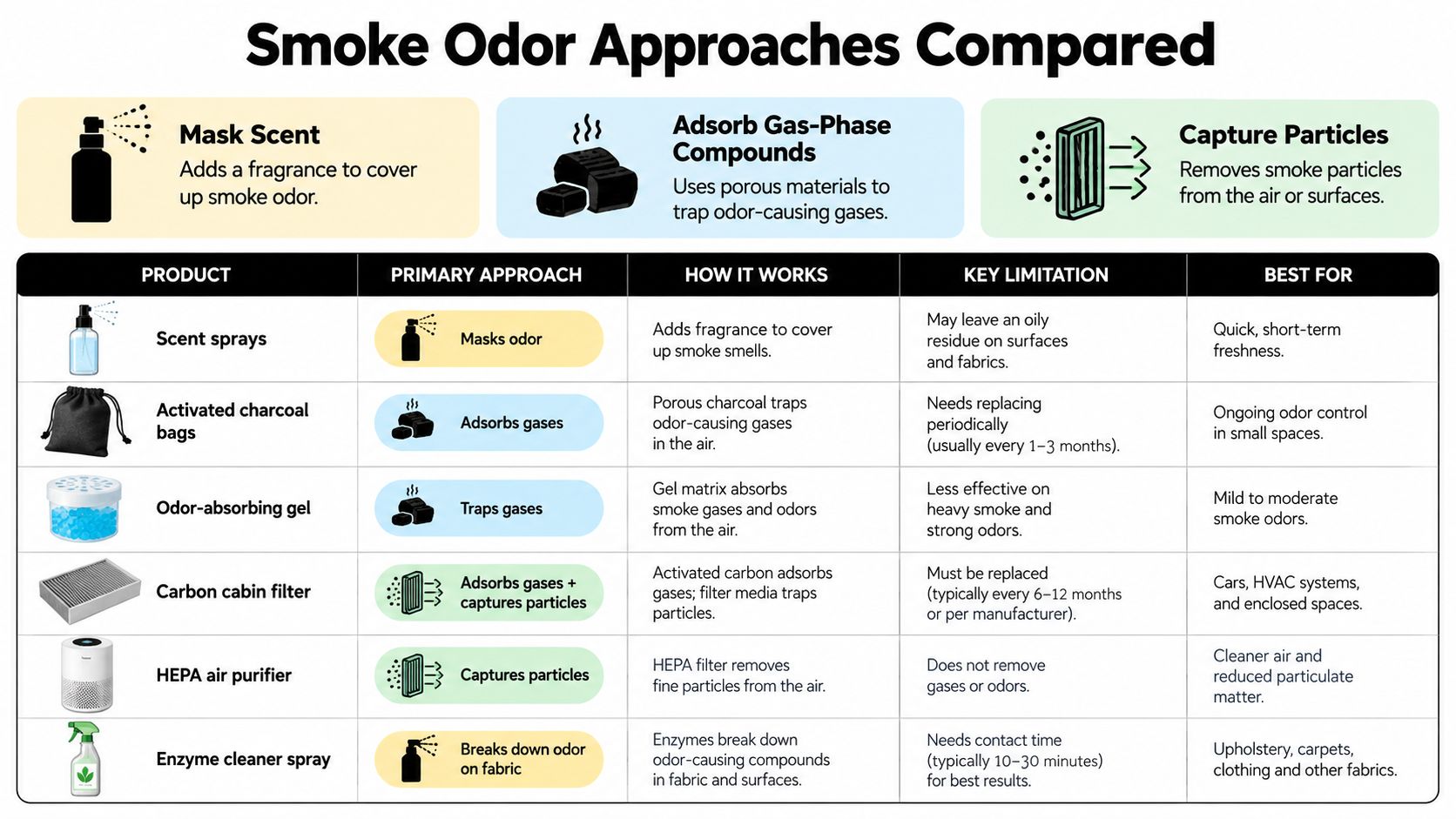
Choose an approach by what it targets, not by how strong it smells. Fragrance masks odor, activated carbon adsorbs gaseous compounds, and particulate filters capture airborne particles. Each handles a different part of the problem, so no single product does all three jobs.
In a vehicle-cabin study published in Atmospheric Environment, smoking increased PM2.5 concentration by approximately 90-fold, while an in-cabin purifier reduced particle-number concentrations by up to 95–99% compared with outdoor readings. That result concerns particles. Fragrance can change the perceived smell, but it does not filter smoke particles.
Smoke Odor Approaches Compared on Target and Risk
| Approach | Primary Target | Main Risk | Use With People Inside |
|---|---|---|---|
| Scent spray | Surface odor masking | Oily film on glass and plastics | Yes, after ventilation |
| Odor neutralizer (enzyme or oxidizing) | Gas-phase and surface odor compounds | Fabric or leather incompatibility | Yes, if the label allows |
| Ozone generator | Gas-phase odor compounds | Lung irritation and material damage | No, use in an empty car only |
| Ionizer | Airborne particles | Ozone output varies by model | Only with low-ozone models; avoid with passengers otherwise |
| Activated carbon (bag or cabin-filter layer) | Gaseous odor compounds by adsorption | Capacity saturates over time | Yes |
| Particulate cabin filter or purifier | Smoke aerosols (PM2.5) | Filter loading, needs replacement | Yes |
Scent sprays work quickly and are usually the simplest masking layer. Their limit is that they cover the smell rather than capture particles or adsorb gas. Heavy application can leave oily residue on glass and glossy plastics, where it smears during cleaning. Apply a low-residue, non-aerosol spray lightly to fabric or mats instead of fogging the cabin.
Odor neutralizers with enzyme or oxidizing chemistry are intended to act on odor compounds rather than merely cover them. They can be useful on fabric and carpets when left in contact as directed. Check compatibility first: a product suitable for polyester seat fabric may leave a mark on dyed leather. Test it on a hidden area.
Air Treatment Tools and Their Limits
Ozone generators react with gas-phase odor compounds and may be used for heavily smoke-affected interiors. Ozone irritates lungs and repeated exposure can damage rubber, foam and some plastics. Run an ozone generator only in an empty car, then ventilate thoroughly before anyone enters. It is a remediation tool, not an everyday freshener.
Ionizers charge airborne particles so they can settle or collect more easily. Performance varies by model, and some ionizers produce ozone as a byproduct. Choose only a low-ozone model for use with passengers; otherwise, keep people out of the car while it runs.
Activated carbon adsorbs gaseous odor compounds onto its porous surface. It can sit in a bag under a seat or form a layer in a cabin filter, providing ongoing treatment until its capacity saturates over time. When a carbon bag stops helping, replace or refresh it according to the maker's directions.
Particulate filters and purifiers capture smoke aerosols, including PM2.5, but carbon alone does not efficiently stop those particles. For air treatment, pair particulate filtration with activated carbon: one targets aerosols, the other gaseous compounds. Neither removes odor stored in interior materials, and fragrance belongs at the end of the process if a particular scent is wanted.
How to Clean and Freshen a Smoke-Exposed Car
Work in order, from loose source material to deep reservoirs to fragrance. Skipping ahead wastes product because each later step depends on the one before it.
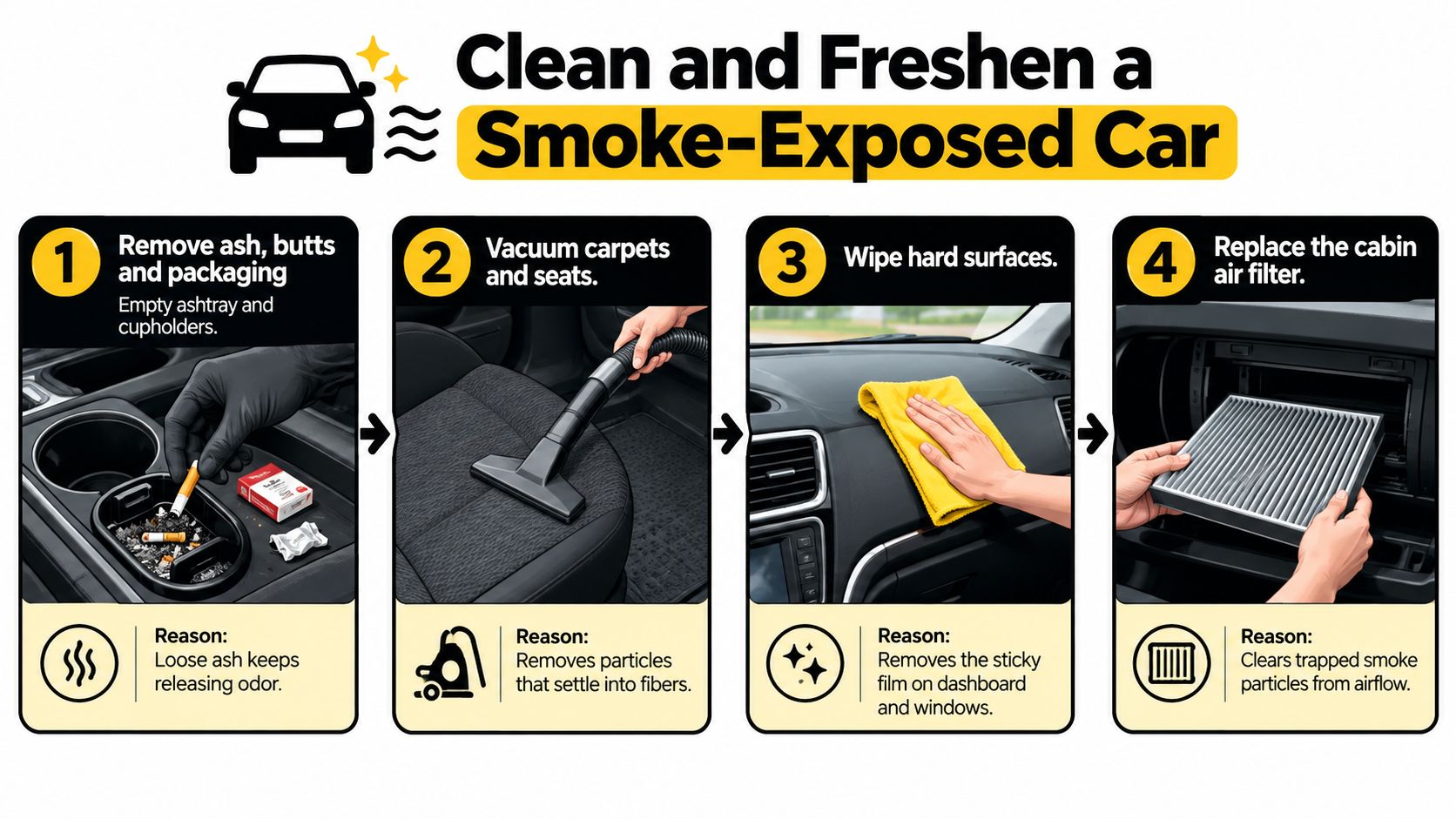
- Remove ash, butts and packaging, then empty and wash the ashtray and cupholders. Loose ash keeps releasing odor between drives, so no spray can outlast a full ashtray.
- Vacuum carpets, seats and crevices, including under the seats. Particles sit deep in carpet pile and seat seams. Use a crevice tool along rails and a brush attachment on cloth to lift dust out instead of pushing it around.
- Clean hard surfaces and glass with a neutral interior cleaner. Smoke film on the windshield and dashboard holds odor and smears light at night. Test textured plastics in a small spot first and use a separate clean microfiber for glass so you don't drag residue back across it.
- Shampoo or extract cloth seats, carpets and floor mats. This is the step that pulls contamination out of porous material instead of perfuming over it. Spot test leather before any liquid cleaner, work in small sections, and let everything dry fully so you don't trade smoke smell for damp smell.
- Replace the cabin air filter with one that has an activated-carbon layer, following your vehicle's interval. A loaded filter recirculates old odor every time the fan runs. Note the airflow direction arrow on the old filter before you remove it.
For a fuller walkthrough that pairs well with these steps, this guide on how to remove car interior odors from Lionheart Detailing covers similar source-first principles, and you can also follow a structured routine for how to deep clean a car interior if the whole cabin needs attention beyond smoke.
- Ventilate with the fan running and a window open about 10 cm. A 2025 review published in the International Journal of Environmental Research and Public Health reported that opening a vehicle window 10 cm while using ventilation reduced measured particulate matter from 964–1,697 μg/m³ to 68.9–139 μg/m³, but did not eliminate exposure. Ventilation helps a lot, and it still isn't a complete fix. If an ozone treatment is used at all, it belongs here, with the car empty and ventilated afterward.
The video below shows the general interior workflow in action, which is useful for judging how much time the cleaning steps take before any fragrance goes in.
- Apply fragrance lightly to fabric or vents once the cabin is dry. Two or three light sprays on mats or cloth beat saturating the headliner. Don't stack multiple scented products at once, because layered perfumes read as chemical clutter over any remaining smoke.
- Recheck after a few hours in the sun and again the next morning. Heat releases stored compounds, so a warm parked car tells you the truth. If the odor returns strongly, repeat the extraction on seats and headliner rather than adding more spray.
Practical rule: If you can still smell smoke with the fan on high after cleaning, fix the filter and fabric before you buy a stronger scent.
Fragrance Checklist, Safety Limits and Longevity
Strongest scent is an inadequate buying criterion. A powerful perfume over dirty upholstery gives you a powerful mixed smell, not a clean car. Judge the final fragrance layer with a checklist instead, the same way you'd judge any cleaner you plan to breathe around.
What to Check Before You Spray
- Masking versus eliminating language: Read whether the label says it masks odor or eliminates odor, and be skeptical of elimination claims on a simple fragrance.
- Ingredient and fragrance disclosure: Prefer products that disclose ingredients and fragrance profile instead of hiding behind vague terms.
- Fragrance-free option: A brand that offers a fragrance-free or low-scent version gives sensitive passengers an alternative.
- Application format: Choose a cloth-applied spray for targeted fabric work or a fine mist for vents. Format controls where the product lands.
- Surface safety: Confirm it's safe on leather, touchscreens and clear plastics before broad use.
- Heat behavior: Check that it holds its character in a hot cabin rather than turning sharp by afternoon.
Run a patch test on a hidden area of upholstery first and wait for it to dry. That two-minute check prevents the most common self-inflicted damage, a pale spot or stiff patch on visible fabric. For more on application technique, see this overview of how to use car air freshener correctly.
Format shapes results more than brand names do. Hanging clips and gels add scent continuously without treating cabin air or surfaces, so they're maintenance layers for an already clean car. Sprays act fastest and let you dose on demand, but they carry the highest film risk if you overshoot onto glass. In-house options such as Evo Dyne's Leather Scent and New Car Smell sprays belong in that final fragrance layer and should pass the same checklist on disclosure, surface safety and heat behavior as any competitor.
Why Less Fragrance Is Usually Better
Adding scent to a smoker's car isn't automatically better than improving air quality. A 2025 study of everyday volatile-organic-compound exposure found that exposure to household goods was associated with a 22.2% higher likelihood of multiple sinus infections, while fuel emissions were associated with a 16.4% increase. Those associations don't prove that a particular car freshener causes illness. They do argue against continually layering fragrances in a small sealed cabin.
Use the minimum effective amount, ventilate after spraying, and don't stack a spray, a gel and a vent clip at once. Keep ozone treatments out of occupied cars entirely. Keep children and people with asthma away from fresh spray until the cabin has aired, and check labels instead of assuming an odor eliminator is safer than a heavily scented freshener. Neither category earns a safety claim without reading what's in it.
Longevity follows the reservoirs, not the calendar. Fragrance fades faster in high-mileage cabins where contamination remains in foam and carpet padding, so reapply when the odor returns rather than on a fixed weekly schedule that ignores conditions. Follow the manufacturer's cabin filter interval for the same reason, because a saturated carbon layer stops adsorbing odor and quietly turns your filtration layer into a bypass. When scent seems to die faster each month, that's diagnostic information. The cabin is telling you the source work isn't finished.
Choose Your Layered Smoke Plan Today
The best car air freshener for smokers is a layered setup, not one spray. Pick your tier by how the car smells after a warm afternoon, not by how it smells right after cleaning.
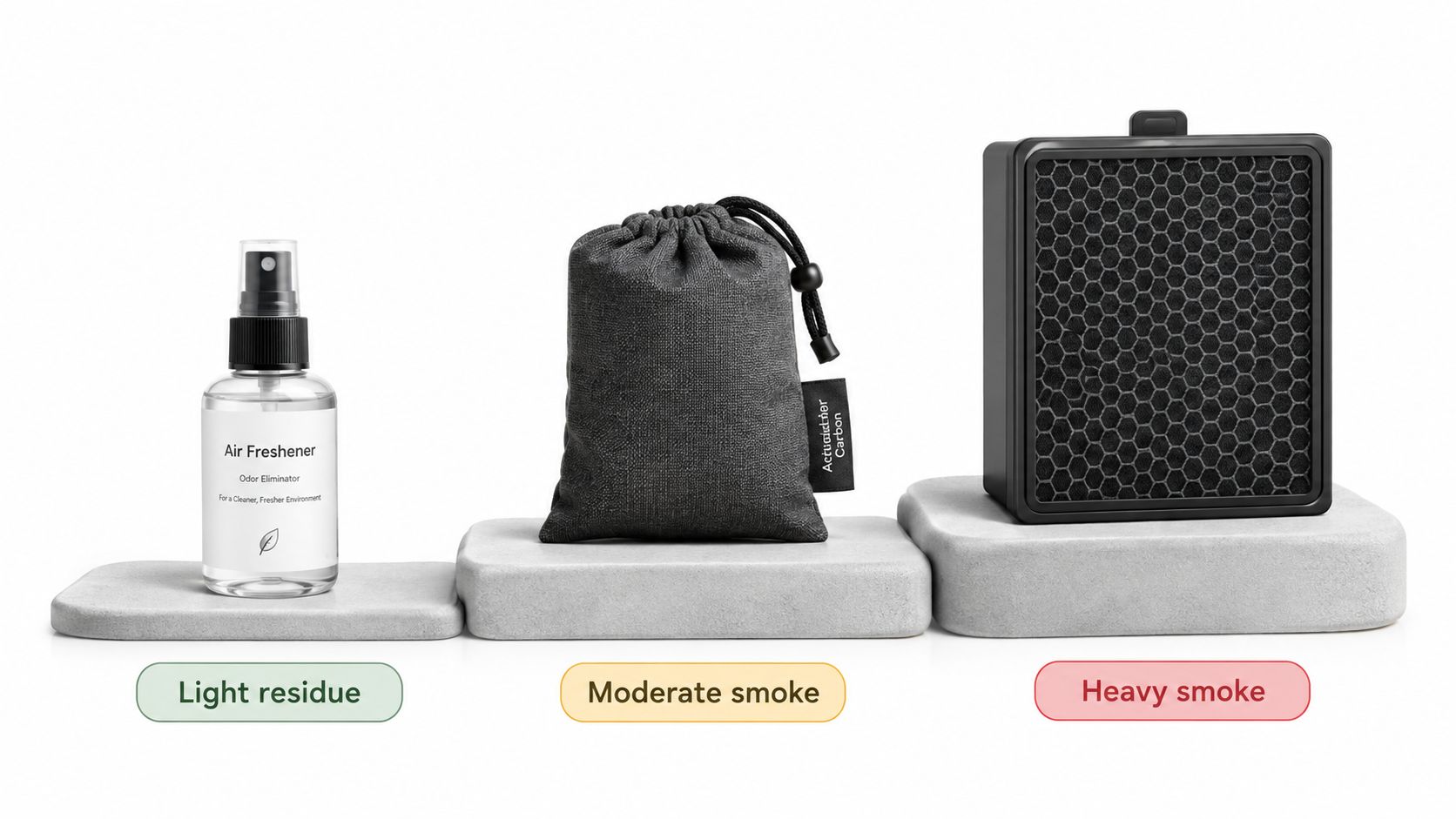
Light residue calls for the basic routine. Empty and wash the ashtray, vacuum thoroughly, wipe hard surfaces and glass, and extract mats and cloth where needed. Then add a fragrance spray that passes the checklist. Most faint used-car smoke ends here.
Persistent smoke that returns after cleaning means reservoirs are still active. Add an activated-carbon cabin filter or a particulate purifier, and repeat the deep clean on the headliner and seats. Don't answer returning odor with heavier perfume. Answer it with more extraction and better filtration.
Heavy smoke, a long-term smoker's car, or a car being sold justifies full remediation. That can include professional detailing with an ozone treatment done while the car is empty, followed by ventilation and only then a light fragrance as the final layer. Buyers open the door and decide within seconds, so the neutral result matters more than a distinctive scent.
This weekend, do the unglamorous part first. Empty, vacuum, clean, replace the cabin filter and ventilate. Then decide whether a leather scent or new car smell spray is still needed at all, and check its label against the criteria you've just read. You'll spend less on fragrance and get a cabin that stays fresh between drives.
If you're ready for that final fragrance layer after the cleaning work is done, Evo Dyne Products offers car air freshener sprays including Leather Scent and New Car Smell options you can evaluate against the checklist in this guide. Visit the store to compare formats, read the labels, and pick the lightest scent that finishes the job your cleaning started.