
You open the cabinet looking for something to clean the kitchen counters and find a crowded shelf of half-used bottles instead. One smells strongly of citrus, another claims to handle every surface, and a third is labeled disinfectant but never seems to stay wet long enough to work. The problem isn't a lack of products. It's buying cleaners by scent, packaging, or broad promises instead of matching each formula to a specific task.
The best cleaning products for home use form a compact, purposeful kit. You need a cleaner that lifts everyday soil, a formula for glass, a bathroom product for mineral buildup, a degreaser for cooking residue, a suitable floor cleaner, and a disinfectant for situations that call for one. Add specialty products only when you have a specific need, such as jewelry, upholstery, or automotive care. The right choice depends on the surface, the mess, the ventilation, and the people and pets sharing the space.
Table of Contents
- Why Your Cleaning Cabinet Probably Needs a Reset
- The Core Cleaning Product Categories and What Each One Does
- Cleaning vs Sanitizing vs Disinfecting and Why It Matters
- Key Ingredients to Look For and Avoid on the Label
- Matching Products to Pets, Kids, Jewelry, and Cars
- Safe Use, Ventilation, and Storage Essentials
- Eco-Friendly and Fragrance-Free Options That Actually Work
- Your Starter Kit, Buying Checklist, and Common Questions
Why Your Cleaning Cabinet Probably Needs a Reset
A crowded cabinet creates two practical problems. First, you forget which bottle is safe for stone, wood, glass, painted surfaces, or food-contact areas. Second, you reach for the strongest product because it feels more capable, even when a mild detergent would remove the soil with less residue and less airborne exposure.
A better cabinet has fewer products, clearer jobs, and labels you can understand. An all-purpose cleaner handles routine grime on compatible hard surfaces. A glass cleaner reduces streaking on mirrors and windows. A bathroom descaler dissolves mineral deposits, while a degreaser tackles cooking oils that a mild spray may leave behind. A disinfectant belongs in the kit for defined situations, not as the default answer to every dirty surface.
Practical rule: Buy for the mess you actually have, then check surface compatibility before you check scent.
Build around tasks, not marketing claims
Start by walking through your home and listing the surfaces that need regular attention. Kitchens usually need a detergent-based surface cleaner and a degreaser. Bathrooms benefit from a mineral-deposit remover and a product designed for soap scum. Floors need a formula that won't leave a sticky film or damage the finish. Windows and mirrors deserve either a glass cleaner or a reusable microfiber system.
Safety belongs in the selection process from the beginning. The EPA reports that indoor concentrations of approximately a dozen common organic pollutants can be 2 to 5 times higher than outdoor concentrations, including in homes in rural or industrial areas, and that product use can create indoor levels that persist after cleaning according to its indoor-air guidance. That doesn't mean every conventional cleaner is unsuitable. It does mean unnecessary fragrance, overapplication, and poor ventilation deserve the same attention as cleaning power.
A curated kit also makes routines faster. You know which bottle to grab, which cloth to use, and when rinsing is required. That clarity beats a cabinet full of products that promise to do everything but give you no confidence about where they belong.
The Core Cleaning Product Categories and What Each One Does
The label “multi-surface” doesn't make a product universal. Every formula has limits, and the active ingredients determine which messes it can lift without damaging the surface.
Start with everyday soil
All-purpose cleaners usually rely on water, surfactants, solvents, and sometimes mild builders. They loosen fingerprints, dust, food residue, and light grease from sealed counters, painted surfaces, washable furniture, and other compatible areas. They shouldn't be your automatic choice for natural stone, unfinished wood, delicate finishes, or electronics unless the label specifically approves those surfaces. For a useful example of how a general household formula is positioned, see this all-purpose household cleaner guide.
Glass cleaners are formulated to evaporate cleanly and limit streaks. Use them on windows, mirrors, and glass doors, but don't assume they're suitable for screens, coated lenses, or stone surrounds. A damp microfiber cloth followed by a dry polishing cloth can often handle light glass soil without any spray.
Bathroom cleaners divide into two useful groups. Acidic formulas work on limescale, soap scum, and mineral deposits, while detergent-based products handle body oils and everyday residue. Never apply an acidic product to acid-sensitive stone, and use a dedicated guide if you need to safely remove sink mineral deposits.
Kitchen degreasers use stronger surfactants, solvents, or alkaline builders to break down oil around cooktops, range hoods, backsplashes, and cabinet hardware. Test first on painted or coated surfaces because powerful degreasers can dull finishes.
Add targeted products only when needed
Floor cleaners should match the flooring. Wood, laminate, tile, vinyl, and stone each have different tolerance for water, acidity, and residue. The best floor product is the one that cleans with the least liquid and leaves no tacky film.
Disinfectants are for pathogen control under label-defined conditions, not routine dust removal. Their target organisms, approved surfaces, and required wet contact time matter more than an impressive scent.
Specialty products cover jobs outside ordinary household soil. Ultrasonic solutions are designed for items placed in an ultrasonic cleaner, while cutting and lubrication fluids belong with machining and metalworking tools, not kitchen surfaces.
| Category | Best For | Standout Feature |
|---|---|---|
| All-purpose cleaner | Everyday sealed hard surfaces | Balanced soil removal |
| Glass cleaner | Mirrors and windows | Fast, low-residue evaporation |
| Bathroom cleaner | Soap scum and mineral buildup | Acidic or detergent-specific action |
| Kitchen degreaser | Cooking oil and greasy residue | Stronger grease-cutting chemistry |
| Floor cleaner | Finished flooring | Low residue and surface compatibility |
| Disinfectant | Defined pathogen-control tasks | Labelled organisms and contact time |
| Specialty solution | Jewelry, tools, and unusual materials | Designed for one controlled application |
Cleaning vs Sanitizing vs Disinfecting and Why It Matters
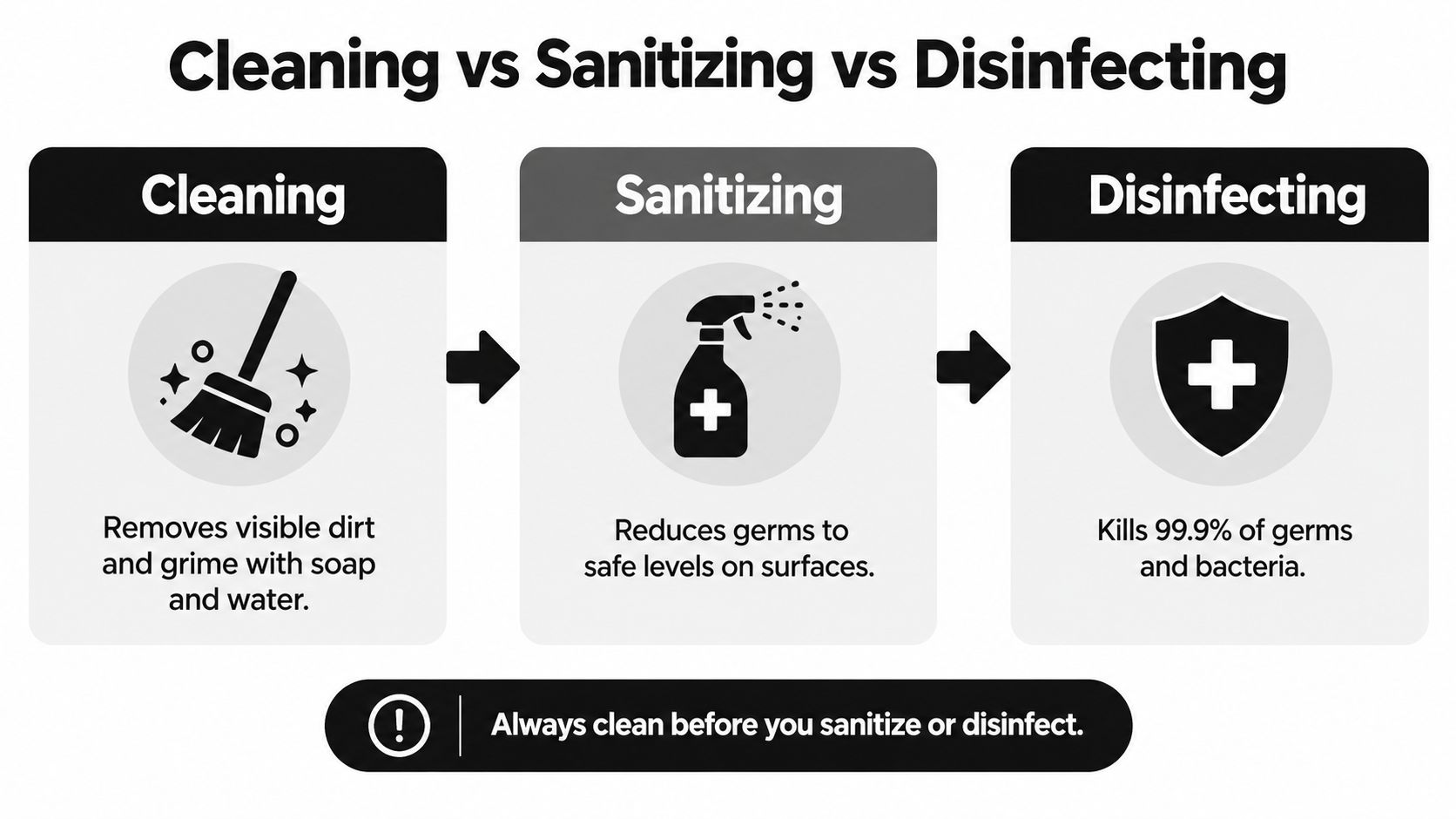
A surface can look clean without being disinfected. Cleaning removes visible soil and lowers the amount of contamination. Sanitizing reduces germs to a level considered acceptable for the product's labeled use. Disinfecting uses a registered product under specified conditions to inactivate listed pathogens.
For routine household soil, use soap or detergent before a disinfectant. Organic matter can interfere with disinfection, and a dirty surface can prevent the product from contacting the material evenly. Ordinary cleaning is usually the sensible choice for dust, fingerprints, crumbs, and general grime. Reserve disinfecting for situations such as illness-related cleaning, certain bathroom tasks, or surfaces that need specific pathogen claims.
Contact time controls the result
An EPA-registered disinfectant only works as labeled when the treated surface remains visibly wet for the full stated contact time. The CDC explains that if the surface dries early, you need to reapply the product following its household cleaning guidance.
That requirement changes how you use sprays and wipes. A light mist may evaporate before the label's required time, especially on porous or warm surfaces. Apply enough product for complete wet coverage, keep the area undisturbed, and check the label for target organisms and compatible materials. If you can't maintain the required wetness, choose a product with instructions you can realistically follow.
For a broader routine built around removing soil before escalating to stronger chemistry, find routine cleaning tips. The practical sequence is simple: remove debris, clean the surface, rinse when required, then disinfect only when the task calls for it.
Key Ingredients to Look For and Avoid on the Label
A cleaner should match the mess and the surface. Reject products that hide behind fragrance or give no clear instructions for dilution, ventilation, or material compatibility.
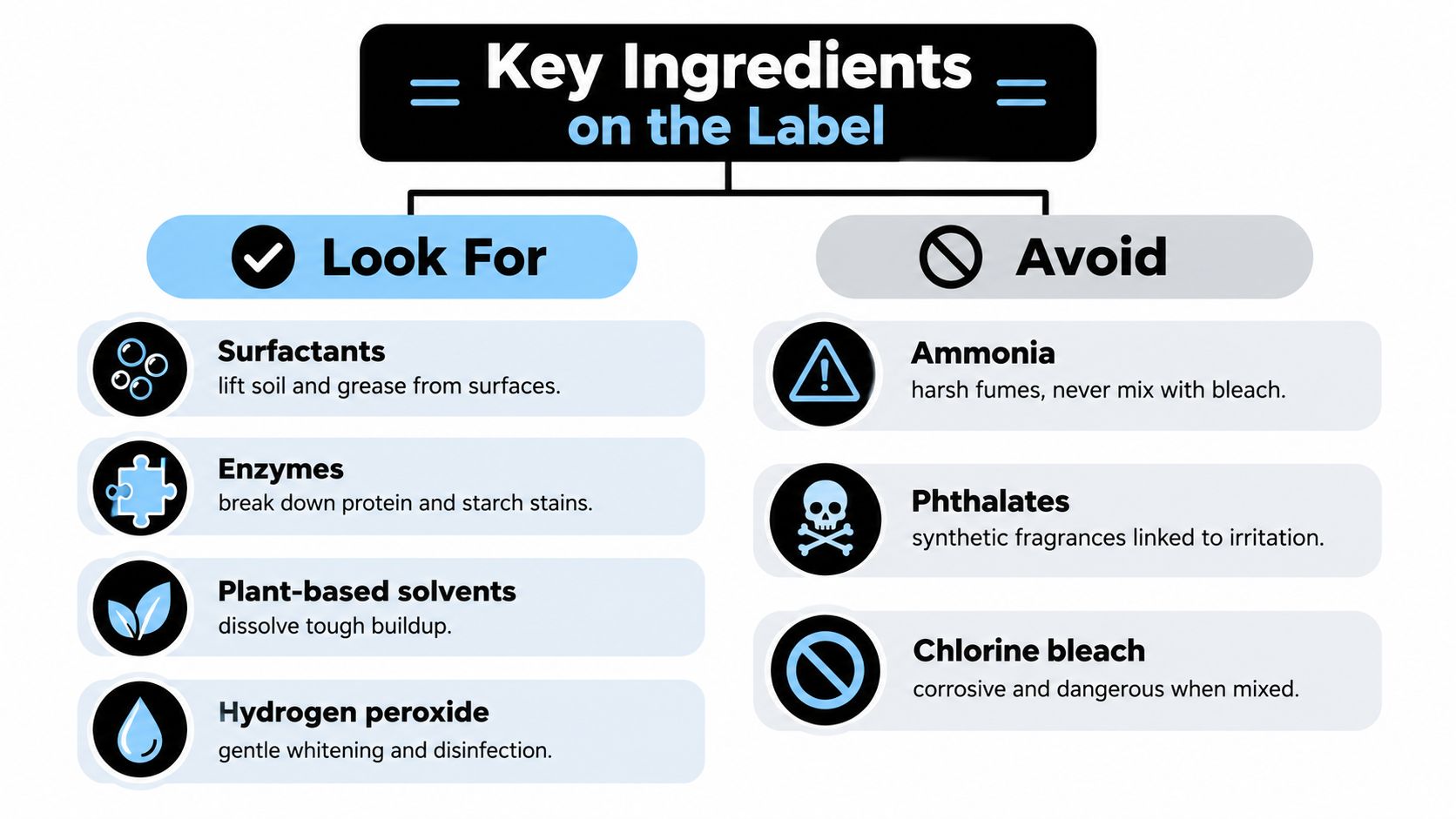
Surfactants loosen soil and help water spread across a surface, making them the workhorses of everyday cleaners. Enzymes target organic residues, including protein, starch, and fat-based stains. Acids, such as citric or other purpose-formulated acids, dissolve mineral deposits. Alkaline builders and solvents help break down grease.
Hydrogen peroxide and properly labeled bleach solutions can support oxidation and disinfection, but they are not interchangeable. Check the label for the active ingredient, intended surface, concentration, application method, and safety directions. A strong ingredient is useful only when the product tells you how to use it safely.
Read the caution language too
Fragrance is optional chemistry, not proof that a cleaner works. Synthetic fragrance can add volatile compounds to indoor air, so fragrance-free formulas are the better default for frequent cleaning, bedrooms, nurseries, and homes with sensitive occupants. Quaternary ammonium compounds, often called quats, can serve as disinfecting actives, but they add no value to every routine wipe-down.
Treat broad claims such as “natural,” “green,” and “non-toxic” as prompts to inspect the label, not as safety evidence. Choose products that disclose active ingredients, provide dilution directions, name compatible surfaces, and state whether they clean, sanitize, or disinfect. Good labeling should also tell you what to do after application, including whether rinsing is required.
If a label lists only “surfactants and fragrance” without identifying the cleaning system, keep shopping. A degreaser should name its builder or solvent, and a disinfectant should identify its registered active. Match the formula to the task first, then choose the lowest-odor option that gives clear instructions and suits the surface.
Matching Products to Pets, Kids, Jewelry, and Cars
The same cleaner doesn't belong in every room. A household with a dog, a toddler, jewelry, and a car needs different levels of residue control, material protection, and odor management.
Pets and children
For pet areas, choose a detergent-based cleaner that rinses clean and is labeled for the surface you're treating. Remove food and water bowls before cleaning, wipe away residue when the directions require it, and keep animals away until the area is dry. Odor control should address the source, not cover it with fragrance alone.
Homes with young children need products that tolerate frequent wiping and don't leave unnecessary residue on reachable surfaces. Fragrance-free formulas are a practical starting point, but “gentle” never replaces label compliance. Store every chemical in a secured location, and don't use a kitchen-counter cleaner on toys or food-contact areas unless its label permits that use.
Recommendation: Choose a fragrance-free, surface-specific cleaner for daily pet and child areas, then rinse wherever the label instructs.
Jewelry and small items
Jewelry, eyeglasses, waterproof watches, and dental retainers may benefit from an ultrasonic cleaner, but material compatibility comes first. Soft gemstones, glued settings, porous materials, and damaged pieces can require professional advice. Use an ultrasonic solution made for the machine and item, not a random household spray.
Evo Dyne Products offers an ultrasonic jewelry cleaning solution with a fragrance-free formulation and a chelating agent for use with suitable small items. Follow the jewelry maker's care instructions before placing anything in an ultrasonic bath.
Recommendation: Use an ultrasonic-specific solution only after confirming that the item and setting can tolerate ultrasonic cleaning.
Cars and workshop tools
Vehicle interiors need low-residue products matched to vinyl, plastic, fabric, leather, or coated screens. Wipes are convenient for touch points, while a dedicated interior cleaner gives you more control over overspray. Air fresheners should remain an optional odor-control step, not a substitute for cleaning upholstery or removing spills.
Machinists and metalworkers need a different category altogether. Cutting and lubrication oils support tool contact and heat management during demanding work, but they shouldn't be repurposed for household cleaning. Keep workshop fluids segregated, clearly labeled, and away from food-preparation spaces.
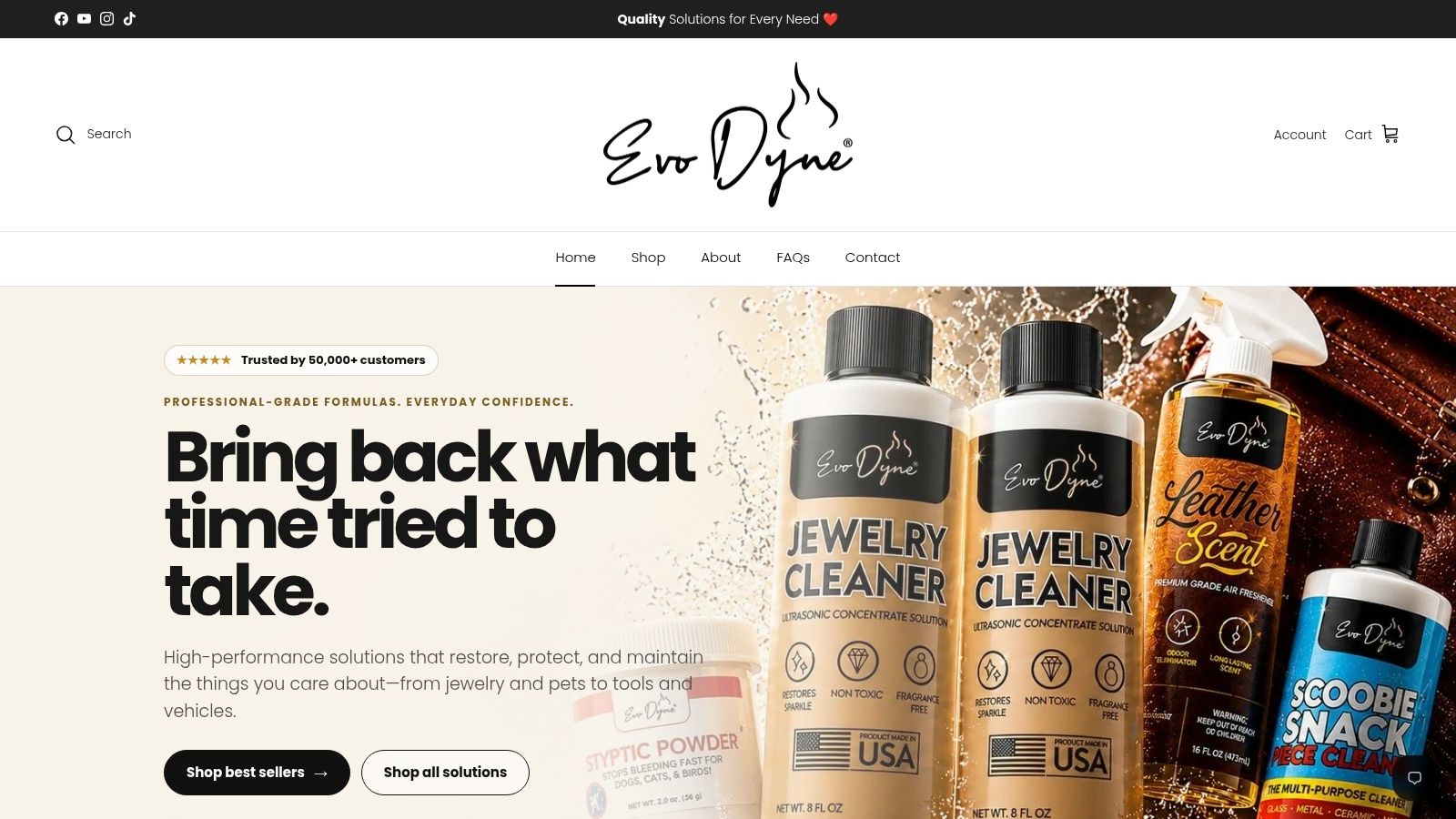
Recommendation: Keep an automotive interior cleaner and optional air freshener in the car, and reserve cutting oils for tools and metalwork.
Safe Use, Ventilation, and Storage Essentials
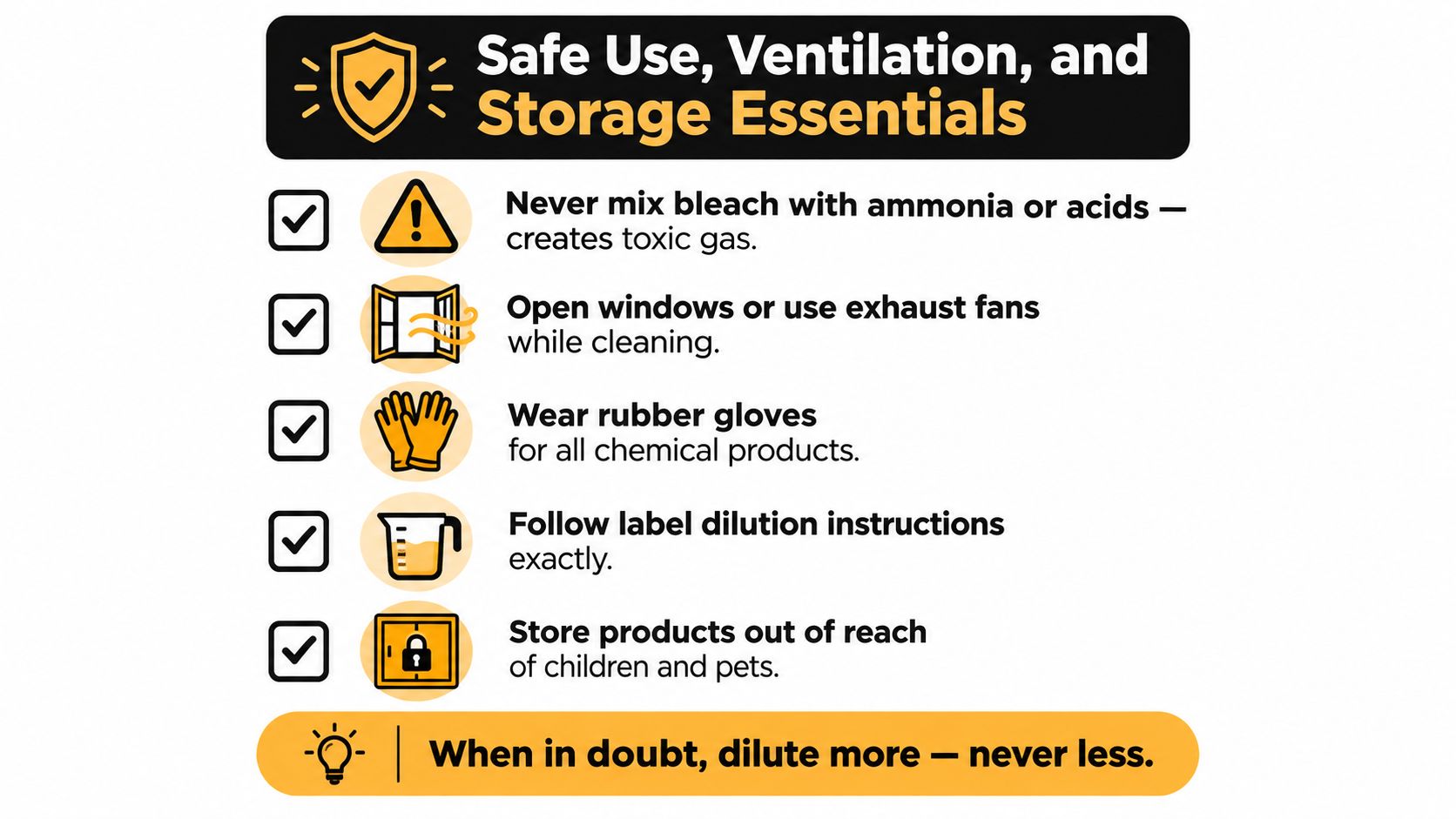
Cleaning products become risky when people improvise. Don't mix bleach with ammonia, acids, or other cleaners. Don't apply household cleaners to skin or food unless the label specifically authorizes that use. Don't transfer chemicals into drink bottles or unmarked containers.
The CDC's June 2020 survey of 502 adults found that 39% reported using household cleaning or disinfectant products in ways not recommended for preventing SARS-CoV-2 transmission, including applying bleach to food, using cleaners on skin, or inhaling vapors. People reporting at least one risky practice were more than twice as likely to report a subsequent health problem, 39% compared with 16%, according to the CDC report.
Make safe use automatic
Use room-temperature water for dilution unless the label says otherwise. Measure carefully, ventilate during and after use, and wear gloves when the product label recommends them or when prolonged contact could irritate your skin. Spray onto a cloth for small areas when the label permits it, rather than filling the room with airborne mist.
Keep caps closed and store products upright in a cool, appropriate location away from children, pets, heat, and direct sunlight. Bleach solutions lose effectiveness after dilution, so prepare only what you can use within the period stated by the instructions. Never store a diluted chemical in an unlabeled container.
Use this short checklist inside the utility cupboard:
- Read first: Check the surface, dilution, contact time, ventilation, and first-aid instructions.
- Separate chemicals: Keep bleach away from ammonia, acids, and other cleaners.
- Protect yourself: Use gloves and eye protection when the label calls for them.
- Control the air: Open windows or use an exhaust fan during strong-product use.
- Secure storage: Lock products away from children and pets, with original labels visible.
Eco-Friendly and Fragrance-Free Options That Actually Work
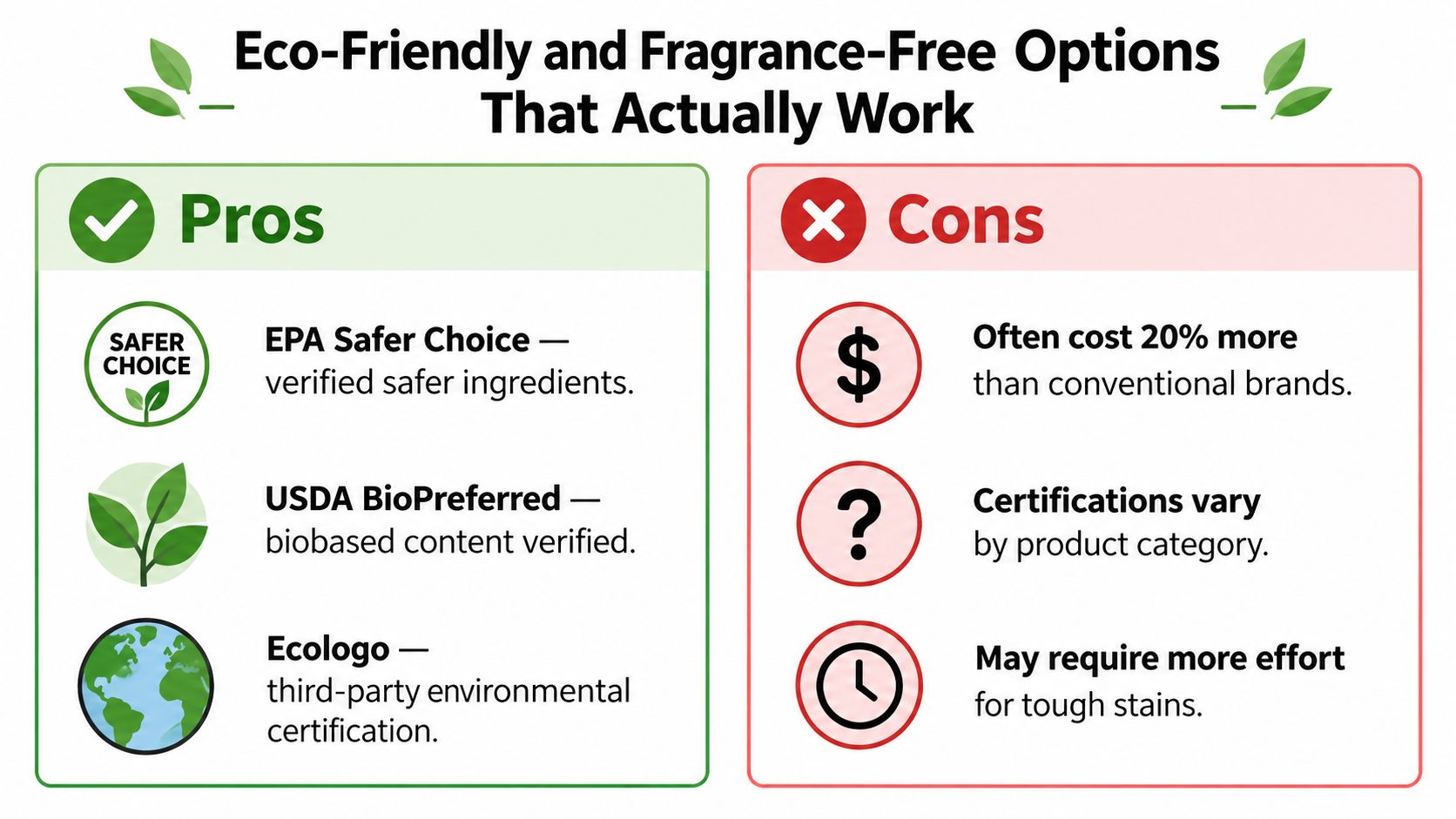
A lower-impact cleaner should still remove the soil you bought it to handle. Plant-based surfactants, enzyme formulas, concentrated refills, and fragrance-free products can all make sense, but they don't automatically disinfect or outperform a conventional formula on every mess.
Treat certification as more useful than a vague green claim. EPA Safer Choice, USDA BioPreferred, and Ecologo can provide stronger signals because certification systems evaluate defined criteria. Still, check the individual product label. A certified everyday cleaner may be a poor choice for illness-related disinfection if it doesn't carry the necessary registered claims.
Make fragrance optional
A strong scent signals fragrance, not cleanliness. Purdue University researchers reported in 2025 that fragrance compounds from air fresheners, floor cleaners, and similar household products can react with indoor ozone and rapidly form nanoscale airborne particles capable of reaching deep into the lungs, while the health effects remain under investigation in their report on indoor air chemistry.
That finding supports a straightforward routine. Use unscented products for frequent cleaning, ventilate while you work, and reserve fragrance for optional odor control. Avoid aerosolizing cleaners unnecessarily, and choose brands that disclose ingredients instead of treating “fresh” as a performance claim.
For textiles and floor coverings, low-moisture methods and task-matched products can reduce residue and overapplication. These eco-conscious rug care tips for homeowners are a useful complement when you want to protect fibers while limiting unnecessary chemical use. For more ingredient-focused household ideas, compare this guide to natural cleaning products for home.
Your Starter Kit, Buying Checklist, and Common Questions
A working cleaning kit starts with the job and surface, not the scent or the number of bottles. Keep an all-purpose cleaner for sealed hard surfaces, a glass cleaner or reusable glass cloth, a bathroom descaler, a kitchen degreaser, a floor product suited to your flooring, and a properly labeled disinfectant. Add microfiber cloths, a non-scratch scrub pad, gloves, and a small bucket. This set covers routine cleaning without filling the cabinet with overlapping formulas.
Shop by label, not by promise
Check these points before buying:
- Surface compatibility: Confirm that the product suits stone, wood, laminate, glass, metal, painted finishes, or food-contact surfaces.
- Task definition: Choose based on the job, whether that means cleaning, sanitizing, stain removal, odor control, or disinfection.
- Directions: Check dilution instructions, ventilation requirements, rinsing guidance, and contact time.
- Ingredient disclosure: Prefer clearly listed active ingredients. Treat vague “fresh” or “natural” wording as marketing, not proof of performance.
- Container practicality: Buy a size you can use before the formula degrades, particularly with products that require dilution.
Match every purchase to a defined task. A disinfectant for a bathroom touch point is not automatically the right choice for a stone counter, wood floor, or jewelry item.
How often should I replace a cleaning bottle? Replace it after the labeled shelf life, or sooner if its appearance or smell changes, its instructions are missing, or its trigger or cap is damaged. Never combine remnants from different bottles.
Do microfiber cloths need detergent? Wash them separately on warm with a teaspoon of detergent. Skip fabric softener because it coats the fibers and reduces absorbency. Air-dry them or tumble-dry on low so they retain the static charge that helps with glass work.
When are wipes better than sprays? Wipes suit car touch points, door handles, and other small contained jobs. Sprays work better across a full countertop when the surface must stay wet for the label's contact time, though spraying can create more airborne mist. Follow the product directions for either format.
How should I handle mold versus mildew? Clean small areas of surface growth only when you can control moisture and ventilation, and follow the product directions. Fix the leak, condensation, or humidity source first. For extensive or recurring growth, or growth embedded in porous materials, hire a qualified remediation professional instead of repeatedly applying stronger chemicals.
Visit Evo Dyne Products for task-specific options such as ultrasonic jewelry cleaning solutions, automotive air fresheners, and industrial cutting and lubrication fluids. Choose only products that fit the materials and jobs in your home.