

You've just finished breakfast, but the kitchen still tells the story: a sticky countertop, fingerprints on the stainless-steel fridge, and a dark ring around the bathroom faucet. One spray bottle promises to handle all three. Sometimes it does. Sometimes it leaves streaks, dulls a finish, or struggles with grime that needs a more specialized tool.
That's why choosing an all purpose household cleaner isn't a matter of picking the strongest formula. The better question is whether the cleaner's ingredients, pH, surface compatibility, and safety profile match the job in front of you.
What an All Purpose Household Cleaner Actually Does
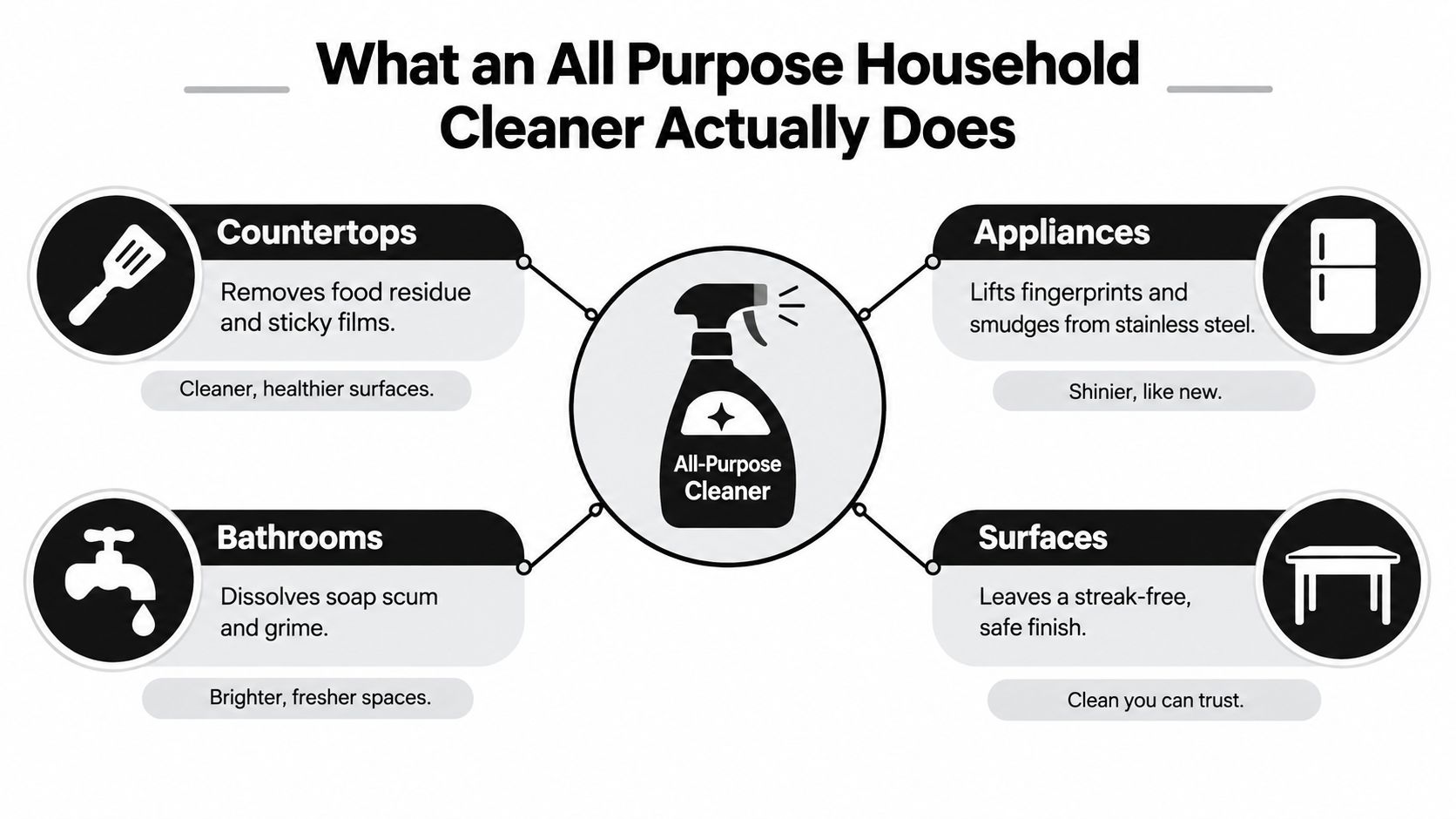
An all purpose household cleaner is a liquid spray, concentrate, or wipe designed to remove light to moderate soil from several sealed household surfaces. Typical messes include food films, fingerprints, dust, light grease, soap residue, and everyday grime. The formula usually combines water with surfactants, water-softening or sequestering agents, and sometimes mild solvents.
The three jobs inside the spray bottle
Every effective multipurpose cleaner performs three basic jobs:
- It wets the soil. Water alone tends to bead on oily or dry surfaces. Surfactants help the liquid spread across the mess instead.
- It loosens the soil. One part of a surfactant interacts with water while another interacts with oily grime. This helps separate the residue from the countertop, tile, or appliance.
- It carries the soil away. A cloth lifts the loosened material, while the cleaner helps keep particles suspended so they're less likely to settle back onto the surface. This basic surfactant action is described in this chemistry overview of all-purpose cleaning products/21:_Household_Chemicals/21.04:_All-Purpose_and_Special_Purpose_Cleaning_Products).
Think of the cleaner as a small cleanup crew. Water provides the transport, surfactants grab the greasy material, and builders help the crew work efficiently in mineral-rich water.
What it doesn't do
A multipurpose spray isn't automatically a disinfectant, heavy-duty degreaser, glass polish, marble-safe cleaner, or jewelry solution. A disinfectant must meet its own label directions and contact-time requirements. A strong degreaser may use substantially higher alkalinity, while a natural-stone product needs chemistry that won't attack a sensitive mineral surface.
Practical rule: Use an all purpose cleaner for routine soil on compatible, sealed surfaces. Change products when the problem is heavy grease, mineral scale, delicate material, or a specific hygiene requirement.
The category is already substantial rather than niche. One industry estimate places the U.S. all-purpose home cleaners market at about $7.2 billion to $8.8 billion in 2026, with roughly 1.4 billion to 1.6 billion units sold annually and average household use of 10 to 14 units per year, as reported by IndexBox's U.S. market analysis. That buying frequency explains why the right everyday formula matters, but it also explains why one bottle shouldn't be forced to handle every surface and every kind of soil.
How Modern Cleaners Evolved from Soap to Synthetic Formulas
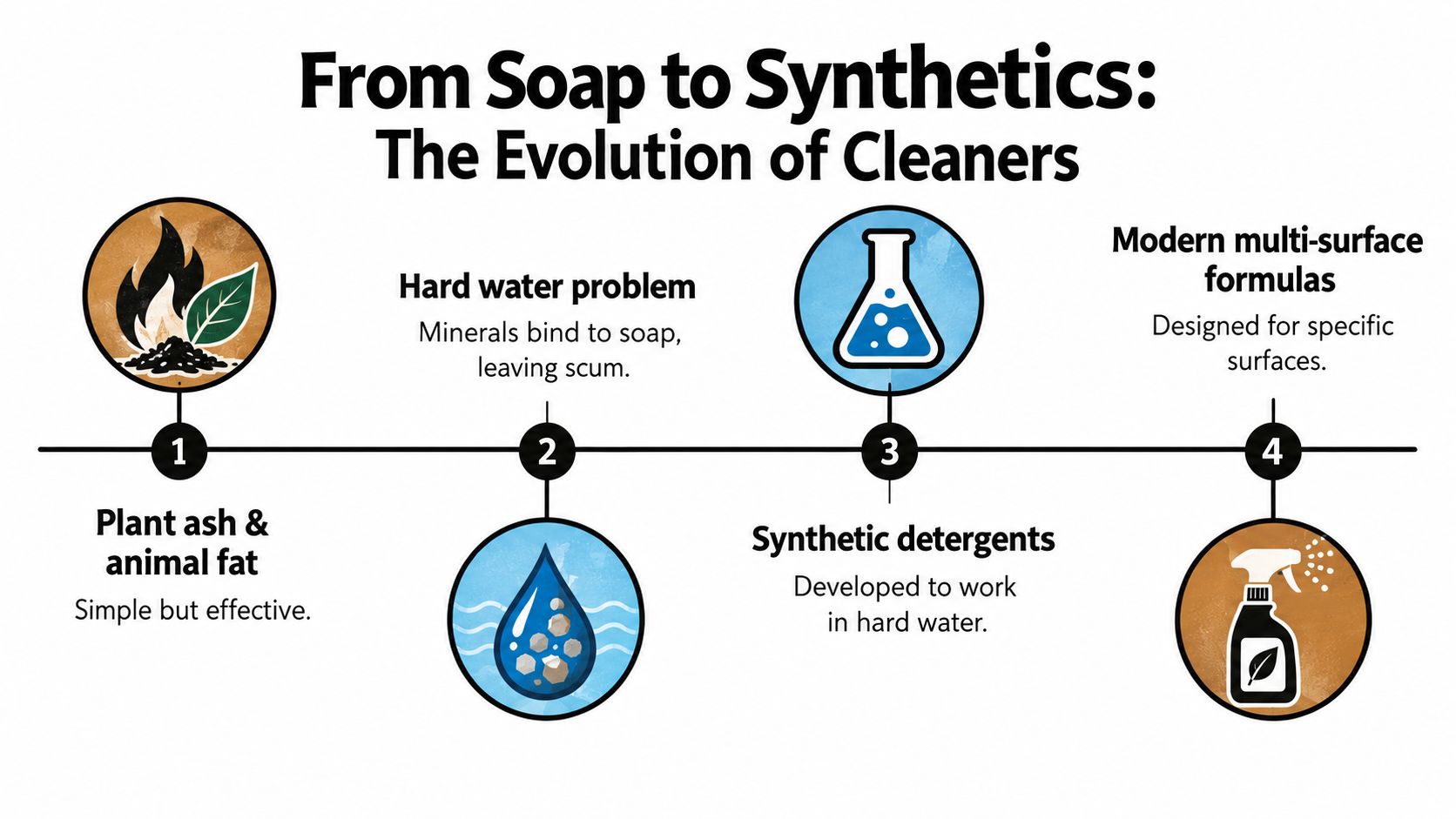
Early soap came from a simple combination of plant ash or another alkaline material with animal or vegetable fat. It worked well for many basic cleaning tasks, but hard water exposed its weakness. Calcium and magnesium minerals can react with soap's fatty-acid components, producing a sticky deposit instead of a clean rinse. The familiar bathtub ring is a visible reminder of that chemistry.
Why synthetic detergents changed household cleaning
Synthetic detergents solved a practical problem by using engineered surfactants that work more reliably in hard water and cold water. Historical accounts identify the first synthetic detergent as having been developed in Germany in 1916, during World War I, when shortages of fats made soap production difficult. In 1946, the United States saw the introduction of a built detergent that combined surfactants with builders, a formula structure that helped shape modern cleaning products. These milestones are summarized in this history of household cleaning products.
The important lesson isn't the date on the bottle. It's the design principle. Modern cleaners are engineered to separate soil from a surface and keep that soil dispersed long enough for wiping or rinsing to remove it.
The builder problem
Postwar detergents commonly used phosphate builders to improve cleaning performance. Phosphates helped control hard-water minerals, but their release into waterways contributed to environmental problems. Manufacturers and regulators later encouraged alternatives such as citrates and zeolites, which support cleaning without relying on the same phosphate-heavy approach.
That history helps explain why labels now distinguish between surfactants, builders, preservatives, solvents, fragrances, and pH adjusters. Each ingredient exists to solve a particular limitation. A cleaner that rinses well in mineral-rich water, for example, may depend on a sequestering agent rather than on soap chemistry.
Today's all purpose household cleaner is the descendant of this engineering shift. It isn't liquid soap in a spray bottle. It's usually a carefully balanced detergent system intended to wet, lift, suspend, and remove everyday soil while leaving an acceptable finish on selected surfaces.
The Ingredients Inside and How They Work
Read a cleaner's label as a list of jobs rather than a list of intimidating chemical names. Most ingredients fit into a small number of functional groups, and each group affects how the product handles grease, food residue, mineral-rich water, drying, scent, and storage stability.
Four main cleaning functions
Surfactants are the pickup team. Anionic and nonionic surfactants have a water-friendly end and an oil-friendly end. The oil-friendly side interacts with greasy soil, while the water-friendly side helps move that soil into the cleaning solution. When you wipe, the cloth removes the suspended grime instead of merely spreading it.
Builders are performance boosters. Water softeners and sequestering agents tie up minerals that might otherwise interfere with surfactants. They're similar to a booster added to laundry detergent. The builder doesn't necessarily remove the stain by itself, but it helps the primary cleaner work more consistently.
Alkalinity changes the kind of soil the product can handle. Mildly alkaline formulas can help loosen food residue and greasy films. Stronger alkalinity improves heavy degreasing, but it also increases the chance of damaging delicate finishes. Guidance from Nouryon on alkaline cleaning notes that grease removal and particle dispersion generally improve above pH 11, while some all-purpose products reach pH 12 to 13. Those stronger formulas need careful dilution and surface selection.
Solvents help with films and drying. Ethanol or isopropyl alcohol can dissolve light oily residues and help a surface dry more quickly. They can also make a spray feel less tacky, although solvent compatibility still depends on the finish.
| Ingredient Type | Common Example | What It Does |
|---|---|---|
| Surfactant | Anionic or nonionic surfactant | Spreads across soil, loosens oily material, and helps suspend grime |
| Builder or sequestering agent | Citrate or another water-softening agent | Reduces mineral interference and supports surfactant performance |
| Alkalinity adjuster | Alkaline salts or pH adjusters | Helps loosen greasy and food-based residue |
| Solvent | Ethanol or isopropyl alcohol | Dissolves light films and can speed drying |
| Preservative | Product-specific preservative system | Helps prevent microbial growth inside the bottle |
| Fragrance or dye | Fragrance blend or colorant | Adds scent or visual identity, but doesn't provide core cleaning power |
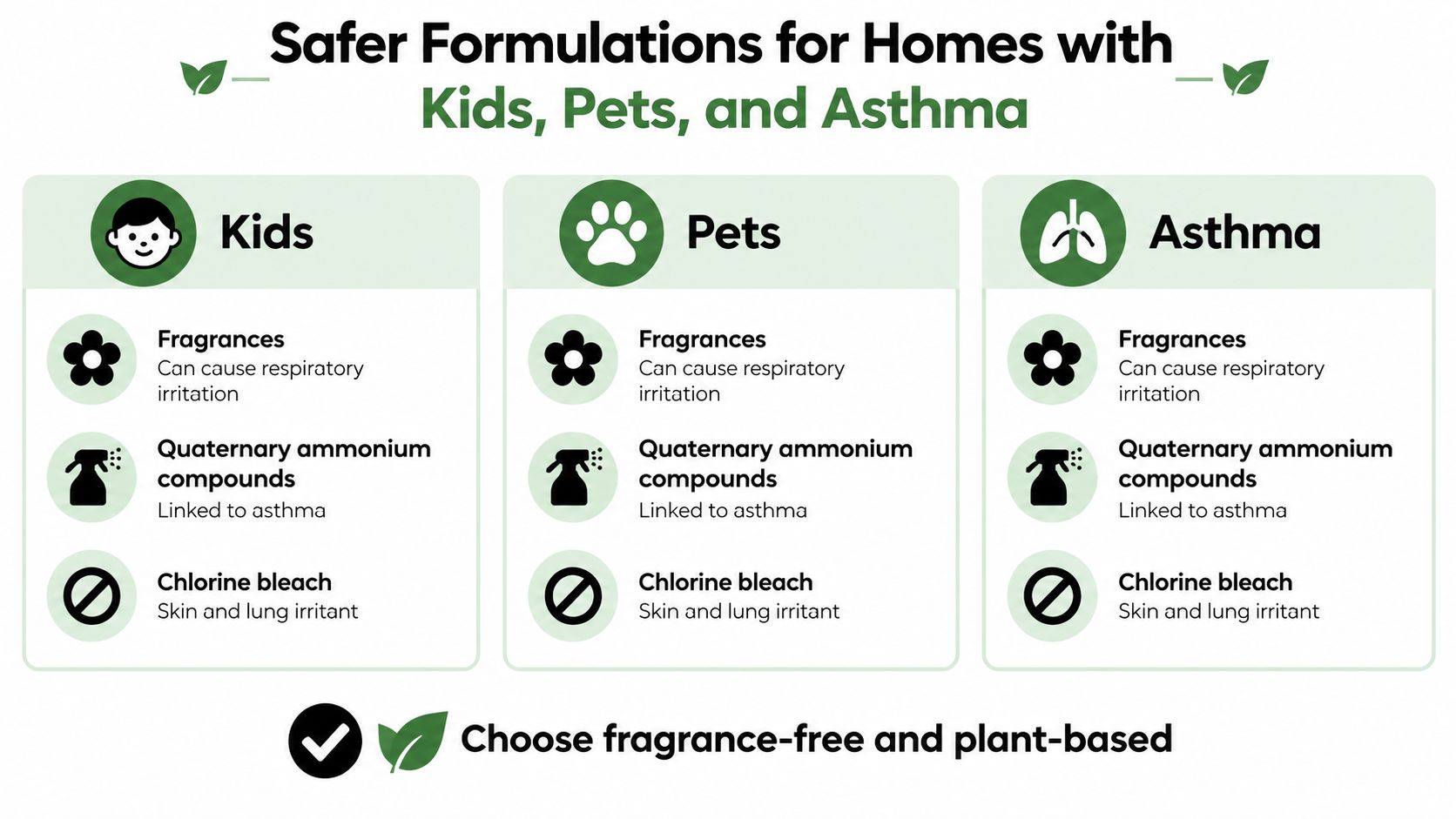
Fragrance, dye, and preservatives are supporting ingredients, not the reason a cleaner removes soil. Some people tolerate them without difficulty, while others experience skin sensitivity or respiratory irritation. Independent ingredient assessments cited in Mordor Intelligence's cleaning-products market discussion report that 53% of assessed cleaning products contain ingredients known to harm the lungs, and 22% contain chemicals reported to trigger asthma in otherwise healthy people. Quaternary ammonium compounds, including benzalkonium chloride, are among the flagged concerns.
The practical takeaway is simple. A strong scent doesn't prove strong cleaning, and a powerful pH doesn't prove a better everyday choice. Match the formula to the soil and surface, then choose the mildest product that can complete the task.
Surfaces Where All Purpose Cleaners Shine and Where They Fail
A cleaner can be excellent on one surface and unsuitable on another. The safest starting point is the manufacturer's label, followed by a small test in a hidden area. Spray the cloth rather than the surface when possible, wipe gently, and follow with a clean damp cloth if the label recommends rinsing.
Good candidates for routine use
Sealed laminate counters, glazed tile, stainless steel, many bathroom fixtures, and other nonporous finished surfaces usually tolerate a mild multipurpose cleaner. These materials don't readily absorb the solution, and their finishes generally handle light surfactant cleaning.
Stainless steel still needs technique. Wipe in the direction of the grain, use a clean microfiber cloth, and buff away leftover moisture to reduce streaks. Glass can also work well, but a formula with too much surfactant or fragrance may leave a film, so a dedicated glass cleaner can produce a cleaner finish.
Materials that need caution
| Surface | All Purpose Cleaner Safe? | Notes |
|---|---|---|
| Sealed laminate | Usually | Test first and wipe away residue |
| Glazed tile | Usually | Avoid leaving cleaner in grout lines |
| Stainless steel | Often | Wipe with the grain and dry afterward |
| Finished or waxed wood | Caution | Excess moisture or alkalinity may affect the finish |
| Marble and travertine | Generally avoid unless labeled safe | Acidic or unsuitable formulas can etch natural stone |
| Unsealed grout | Caution | Porosity can trap residue and moisture |
| Aluminum | Caution | Some alkaline formulas may discolor or dull it |
| Electronics screens | Avoid direct spraying | Use a manufacturer-approved method |
| Painted walls | Spot-test | Friction and cleaner can remove or soften paint |
| Pet walking zones | Use cautiously | Follow label directions and rinse if residue could remain |
Natural stone deserves special attention. Marble and travertine contain minerals that can react with unsuitable acids and aggressive cleaners, leaving dull spots or etching that wiping won't reverse. Finished wood and waxed surfaces can also lose their appearance when exposed to excess liquid, repeated rubbing, or a formula that's too alkaline.
Jewelry, screens, and pet areas
Don't use a general household spray as a jewelry cleaner by default. Silver and gold may tolerate different products, plated pieces can lose their finish, costume jewelry may contain adhesives or coatings, and porous gemstones can absorb liquid. For grime lodged around prongs, a purpose-built ultrasonic cycle may be more appropriate, provided the jewelry and setting are confirmed ultrasonic-safe.
Electronics screens need even less liquid. Keep spray away from openings, apply an approved cleaner to a cloth only when the device maker permits it, and never assume that a cleaner safe for glass is safe for a screen coating. In pet zones, residue matters because animals walk across floors and then groom their paws. Use the smallest effective amount and rinse when the label or surface calls for it.
Safer Formulations for Homes with Kids, Pets, and Asthma
A cleaner that removes grime quickly is not automatically the right choice for every room. In a home with children, pets, or asthma, the better question is what the task requires and how much product will remain in the air or on a surface. Routine fingerprints and food splashes usually call for less chemistry than a job that specifically requires disinfection.
Start with the label. Choose a product with a clearly disclosed ingredient list, limited fragrance, and directions that match the surface. “Plant-based” describes an ingredient source, not a guarantee of gentle use. Third-party certification can offer another screening step, but it does not replace reading warnings, dilution instructions, and contact guidance.
A calmer cleaning routine
Ventilation changes the exposure pattern. Open a window or run an exhaust fan during and after cleaning, especially in small bathrooms or rooms used by someone with asthma. Spray onto a cloth rather than creating a fine mist in the air, and never mix products. A clean, damp cloth is often enough for light soil after the cleaner has done its job.
- Respiratory comfort: Prefer fragrance-free or low-fragrance formulas, use them with airflow, and stop if coughing or irritation begins.
- Skin contact: Wear gloves if detergents cause reactions. Keep concentrated products away from children and wipe hands after handling them.
- Pet contact: Essential oils are not automatically safe for animals. Keep pets away until treated floors are dry, and rinse when residue could remain where they walk or groom.
- Food areas: Use a formula labeled for kitchen surfaces. Follow its instructions for wiping or rinsing before preparing food.
A safer daily habit: Match the product to the soil. Reserve disinfectants for tasks that call for them, and use a lower-irritant cleaner, cloth, and water for ordinary dirt.
Scent also needs separate judgment from cleaning power. A fragrance product may make a room smell pleasant, but that smell does not show that a surface is cleaner. A guide to choosing a warmer for soy candles can help compare fragrance delivery options without treating scent as proof of cleaning performance.
For households with sensitive occupants, a multipurpose bottle is useful when it reduces product changes and works on the labeled surfaces. A specialized or unscented option may be the better choice when exposure, residue, or a particular material matters more than convenience.
All Purpose Versus Specialized Cleaners and When Each Wins
An all purpose cleaner is the convenient workhorse for fingerprints, breakfast residue, light bathroom grime, and routine wiping on compatible sealed surfaces. A specialized cleaner earns its place when the soil or material needs chemistry that a balanced multipurpose formula cannot provide. The choice is a trade-off between broad usefulness and precise performance.
| Factor | All Purpose Cleaner | Specialized Cleaner |
|---|---|---|
| Cleaning range | Broad, for light to moderate everyday soil | Narrower, designed for a defined task |
| Surface safety | Convenient on labeled sealed surfaces | Often optimized for a particular material |
| Storage | Takes less cabinet space | Requires more product organization |
| Cost per use | Can be economical for frequent wiping | May cost more, but avoids repeated scrubbing |
| Convenience | Fast choice for daily messes | Better when the job exceeds general-purpose chemistry |
Jobs where specialization matters
Ultrasonic jewelry cleaning can reach grime trapped in prong settings and narrow recesses that a cloth cannot easily access. Use only a solution and cycle approved for the item. Delicate stones, glued settings, porous gems, plated finishes, and older jewelry may need a jeweler's advice. A general spray may clean the exposed surface while leaving the harder-to-reach residue behind.
Garage and automotive grease often contains petroleum-based films that call for a stronger degreaser. An all purpose household cleaner may remove surface dust and light residue, but it should not be expected to dissolve thick cutting oil or heavy mechanical grime.
Enzyme-based pet stain removers target organic residues with enzymes suited to proteins, starches, or fats. They are usually a more logical choice for urine, vomit, or food stains than a general spray, provided the product suits the fabric or flooring. The label matters because the wrong formula can affect dyes, fibers, or finishes.
Bathroom descalers are made for mineral deposits. Soap scum and hard-water scale can look similar, but they are different soils. A descaler may outperform a multipurpose cleaner on a crusty faucet, while an unsuitable acidic product can damage natural stone.
For difficult glass, tall windows, or work involving access and safety, guidance on when to call a professional for window cleaning can help you decide whether more spraying and scrubbing is sensible.
Decision rule: Keep one dependable multipurpose workhorse, then add targeted products only for jobs it handles poorly, such as scale, heavy grease, or delicate jewelry.
A bottle earns its place by matching the work, not by covering the most labels. Use the multipurpose option for frequent, low-risk wiping, and choose a specialized formula when the soil, surface, or safety concern calls for more precise treatment. That approach limits cabinet clutter without asking one cleaner to solve every problem.
DIY Recipes and Eco Friendly Alternatives Worth Trying
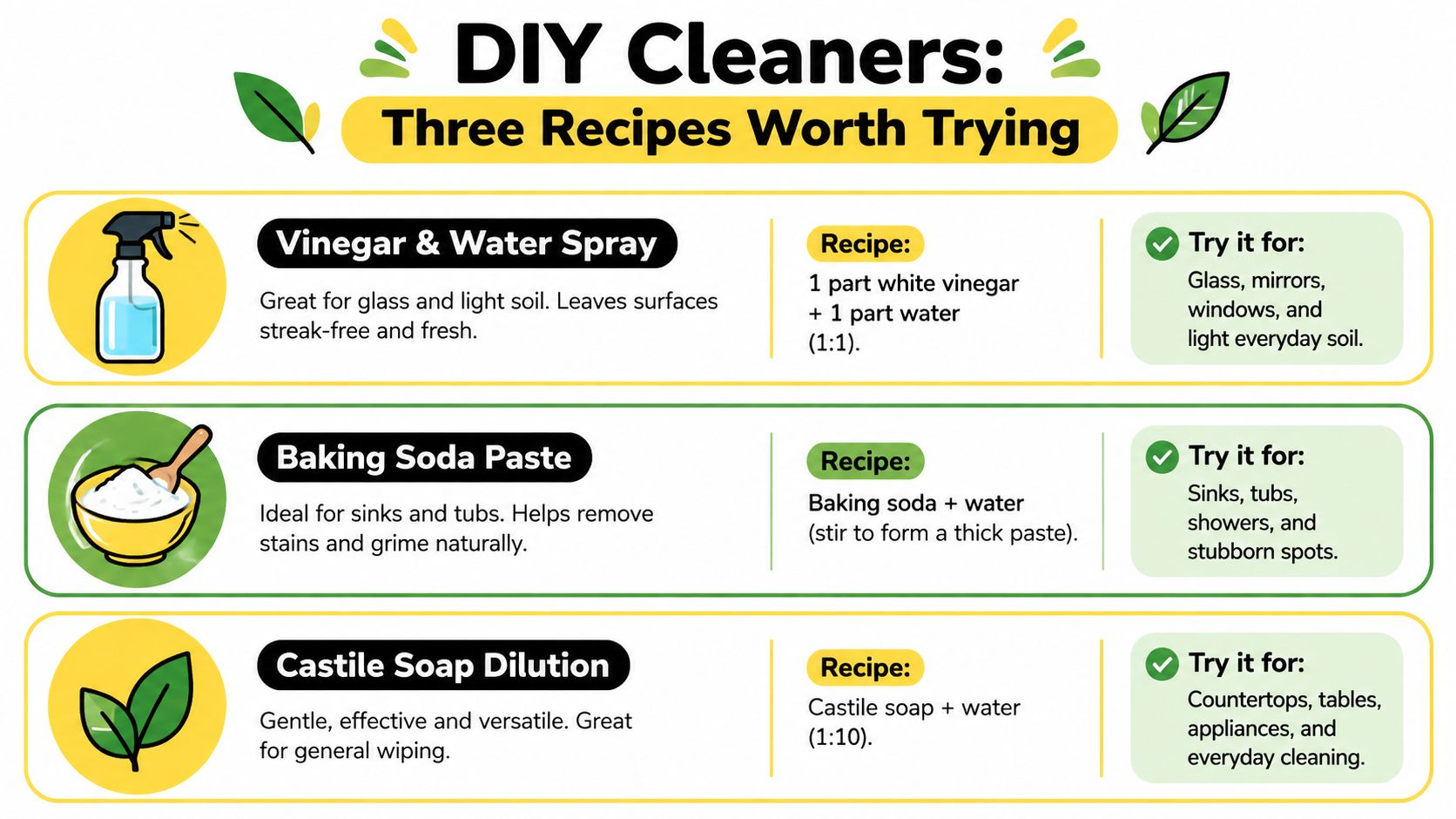
A homemade spray can handle a dusty shelf or a light ring around a sink, yet fail on baked-on grease or mineral scale. Each recipe works like a small tool in a toolbox. Choose it for the soil and surface, rather than treating DIY cleaner as a universal replacement for a tested commercial formula.
Three simple options
Vinegar and water spray: Mix vinegar and water in a 1:1 ratio for glass and light soil. The acidic solution can loosen mineral residue and support basic wiping. Keep it away from marble, travertine, and other acid-sensitive natural stone. Never combine vinegar with bleach or other incompatible cleaning chemicals.
Baking soda paste: Add water to baking soda until it becomes a thick paste. Spread it on a sink or tub, scrub gently with a non-scratch cloth, and rinse well. Baking soda works through mild abrasion, much like a very fine polishing powder, so test glossy finishes before treating a broad area.
Castile soap dilution: Dilute castile soap with water for general wiping. A 1:10 dilution is a commonly used starting point, but follow the soap manufacturer's directions and adjust only when the surface allows it. Hard water can leave a soap film, so finish with a clean-water wipe when needed.
Mold-related cleaning raises a common confusion: fizzing shows a reaction, not necessarily effective mold removal. This discussion of vinegar baking soda for mold explains why those ingredients should not be judged by bubbles alone. Skip essential oils added only for fragrance. They change the mixture's exposure profile, and some may be unsuitable around pets.
DIY mixtures give you control over ingredients, but they may lack the preservative system, stability testing, and carefully balanced performance of a commercial concentrate. For more lower-waste ideas, explore natural cleaning products for the home.
Store-bought eco-friendly options may use plant-based surfactants, refillable bottles, concentrated formulas, and transparent certification claims. Look for concrete programs such as EPA Safer Choice when a certification helps you compare products. Packaging color alone says little about how a cleaner performs or suits your surfaces.
Watch this short demonstration for a visual look at homemade cleaning approaches:
Choosing, Storing, and Using Your Cleaner with Confidence
Start with the surfaces you clean. If your home has sealed counters, tile, stainless steel, and routine food or dust residue, a mild all purpose household cleaner may cover most daily work. If you also have natural stone, finished wood, pets that walk across treated floors, or a family member with asthma, choose for compatibility and low irritation rather than maximum strength.
A practical buying checklist
- Name the main soil: Choose a general spray for light residue, a degreaser for heavy oily buildup, and a descaler for mineral deposits.
- List sensitive materials: Check for marble, travertine, waxed wood, aluminum, screens, plated jewelry, and porous surfaces.
- Consider household exposure: Look for fragrance-free or low-fragrance options when scent triggers discomfort.
- Separate cleaning from disinfection: Buy a disinfectant only when the task requires a labeled disinfecting claim and follow its contact-time directions.
- Plan the cloth: Microfiber usually lifts soil efficiently, but use a fresh section for food areas and rinse the cloth after use.
- Protect your skin: Gloves can help people with sensitive hands, especially when using concentrates or stronger alkaline products.
Store every product in its original labeled container, with the cap secured, in a cool, dark location away from children and pets. Don't transfer cleaners into an unmarked bottle, and keep acidic products separate from alkaline products and from bleach. Never combine household chemicals unless the label explicitly says the combination is safe.
Dilution deserves discipline. A concentrated product that's too strong may leave residue or harm a finish, while an over-diluted mixture may fail and encourage extra scrubbing. Follow the label, spray onto the cloth when practical, and rinse surfaces where children, pets, food, or bare skin will contact them.
A sensible home setup can stay compact: one everyday spray for kitchen and bathroom messes, one gentler approach for sensitive materials and electronics zones, and one stronger product reserved for garage or automotive work. Jewelry owners can add an ultrasonic-safe solution only after confirming that their pieces can tolerate ultrasonic cleaning.
Evo Dyne Products offers home-care solutions alongside ultrasonic jewelry cleaning formulas and other cleaning essentials, giving you a way to choose a targeted product when a general spray isn't appropriate. Visit Evo Dyne Products to explore options for routine household care, jewelry maintenance, and other practical cleaning needs.