


You've got a stainless part clamped, the insert is screaming, and the finish has gone from clean to torn before the cycle is half finished. The sump looks full, but the cutting zone is still running hot, chips are dragging across the work, and the next pass may hit a hardened surface created by the last one.
That's the common failure pattern with cutting fluid for stainless steel. The right product matters, but chemistry alone won't rescue a poorly aimed nozzle, a weak mix, or intermittent flow. Stainless machining needs a coordinated choice of lubrication, cooling, chip evacuation, and fluid maintenance.
Why Stainless Steel Is Harder on Tools and Fluids
Austenitic grades such as 304 and 316 are common on manual lathes and CNC machining centers, yet they punish cutting habits that carbon steel may tolerate. Low thermal conductivity traps heat near the tool, the surface work-hardens when the edge rubs, and the material's toughness produces long chips. Those failure modes drive the fluid requirements. Cooling must reach the interface, lubrication must limit adhesion, and flow must help clear chips. Material-based guidance also treats stainless as a higher-demand application than ordinary carbon steel.
A typical failure begins with a light pass, a dwell, or a brief hesitation. Instead of shearing cleanly, the tool rubs across the surface. That contact creates a hardened layer for the next engagement, while heat concentrates at the edge. The chip stretches rather than breaking, and the tool starts losing its edge through adhesive wear, thermal damage, or chipping.
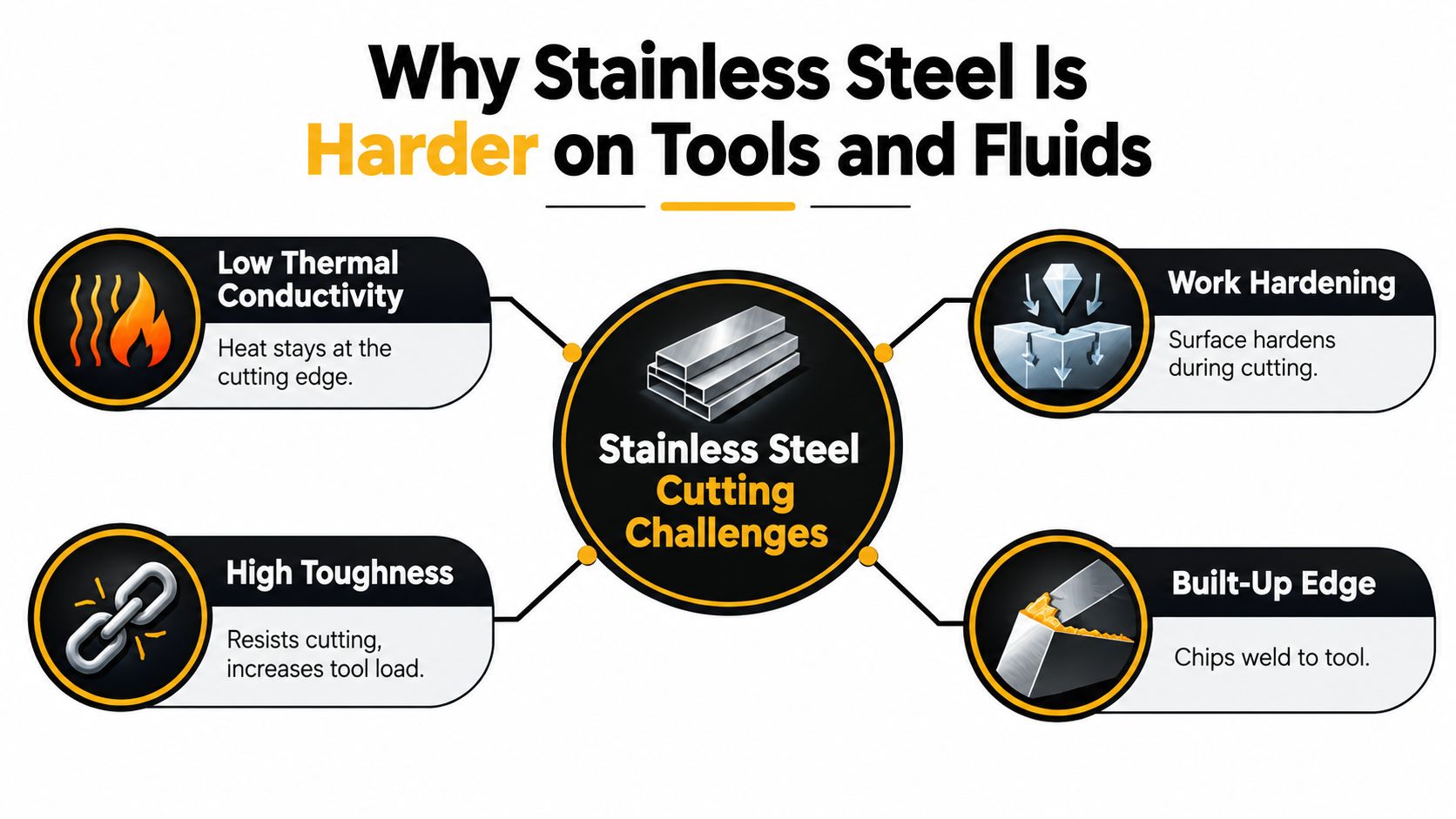
The heat has nowhere useful to go
Carbon steel often transfers more heat into the workpiece and chip. Stainless keeps more of it around the tool-work interface, increasing the thermal load on an insert, drill point, or tap. Fluid therefore has two jobs: remove heat and reduce the friction that generates it.
A coolant that removes heat but provides little lubrication can still leave a rough finish and shorten tool life. The reverse trade-off appears in tapping. A straight oil may protect the tap during a severe thread, but its cooling capacity may be inadequate for a fast milling cut. Choose chemistry according to the dominant failure mode, then make sure delivery reaches the actual cutting zone.
Practical rule: Stainless needs cooling and lubrication at the same time. Judge a fluid by both results, not cooling performance alone.
Work hardening punishes hesitation
Keep the edge cutting fresh material with firm, consistent engagement. Dwell, rubbing, spring passes, and an overly light feed can harden the surface. Once that layer forms, raising spindle speed usually adds heat without removing the underlying problem.
Long chips create a second failure path. They can recut against the wall, wrap around the tool, scratch the part, and carry friction back into the cut. Fluid flow helps move them away, but it cannot compensate for an unsuitable chipbreaker, an incorrect feed, or an unstable toolpath.
The working model is direct: stainless creates heat, resists clean shearing, hardens when rubbed, and produces chips that need active evacuation. Fluid selection and delivery should address each failure mode without relying on one property to solve all of them.
Choosing the Right Cutting Fluid Chemistry for Stainless Steel
A 304 turning job that starts clean can finish with a welded edge if the fluid film collapses. Tapping 316 creates a different problem, because pressure and adhesion can overwhelm a water-rich coolant. Stainless fluid selection should therefore start with the failure mode, then match chemistry to the operation.
Water-based products remove heat from the work zone efficiently. Straight oils and high-lubricity formulations form a stronger film where tool-chip contact, pressure, and built-up edge are the main risks. Soluble oils, semi-synthetics, and synthetics sit between those extremes, with different balances of cooling, boundary protection, cleanliness, and sump control.
| Fluid Type | Best For | Lubricity and EP Strength | Tradeoffs |
|---|---|---|---|
| Soluble oil | General turning, milling, and drilling | Good lubricity with useful cooling | Can leave more residue and needs careful sump control |
| Semi-synthetic | Mixed CNC work and shops needing balance | Moderate to strong boundary protection | May not match a straight oil for severe tapping |
| Synthetic | Heat-heavy operations and cleanliness-sensitive work | Strong cooling, usually less oil-film strength | Can struggle when adhesion and pressure dominate |
| Straight oil | Tapping, threading, broaching, and demanding localized cuts | Strong lubrication and EP protection | Limited bulk cooling and more cleanup |
| Vegetable-based fluid | Operations where lubricity and wear reduction matter | Can provide strong lubricity and boundary performance | Must be tested against the machine, material, and finish requirements |
EP additives need a reason
Sulfurized or chlorinated extreme-pressure packages can reduce adhesive contact at the tool-chip interface. Use them when stainless is welding to the edge, a tap is loading up, or a slow, high-pressure cut needs more lubrication than a standard emulsion provides. They are not a substitute for correct speed, feed, chip control, or directed delivery.
Additive chemistry can also affect the finished surface. A 2023 stainless-steel study reported that chlorinated paraffin changed the proportion of metal oxides on the processed surface from 20.4% to 22.0%, 32.9%, 26.6%, and 31.1% as dosage rose from 1 mL to 6 mL in a 500 mL fluid volume, while the authors reported improved corrosion resistance through higher charge-transfer resistance and lower corrosion-current density (the study summary and source discussion). The practical conclusion is limited: test a new EP package under controlled conditions instead of tipping it into the sump without checking edge condition, finish, and corrosion behavior.
For background on biodegradability and lubrication considerations, see the MA Hydraulics 2026 guide. A hydraulic-fluid reference can provide context, but the cutting-fluid manufacturer's technical data remains the basis for concentration, compatibility, and safety decisions.
Use this guide to choosing metal-cutting fluid types and best practices to compare product families before a stainless trial. On the machine, monitor edge wear, chip behavior, finish, odor, residue, and corrosion under the actual load. The fluid that looks suitable on paper must still keep the edge cutting instead of rubbing and welding.
How to Match Concentration and Delivery to the Job
Stainless jobs punish weak concentration and poor fluid placement quickly. Work hardening raises cutting load, while trapped heat softens the edge and encourages rubbing or built-up material. Start with the product maker's stainless-steel guidance, commonly around 8–12% concentration, then adjust within the approved range for the operation. The UTEC stainless machining recommendations provide a useful reference, but the product's technical data controls the final mix.
A light milling pass in 304 does not need the same approach as deep drilling in 316. Tapping and threading often need more lubrication at the tool than a higher concentration of water-mix coolant can provide. A localized straight oil or a heavy EP product may control torque and chip welding better.
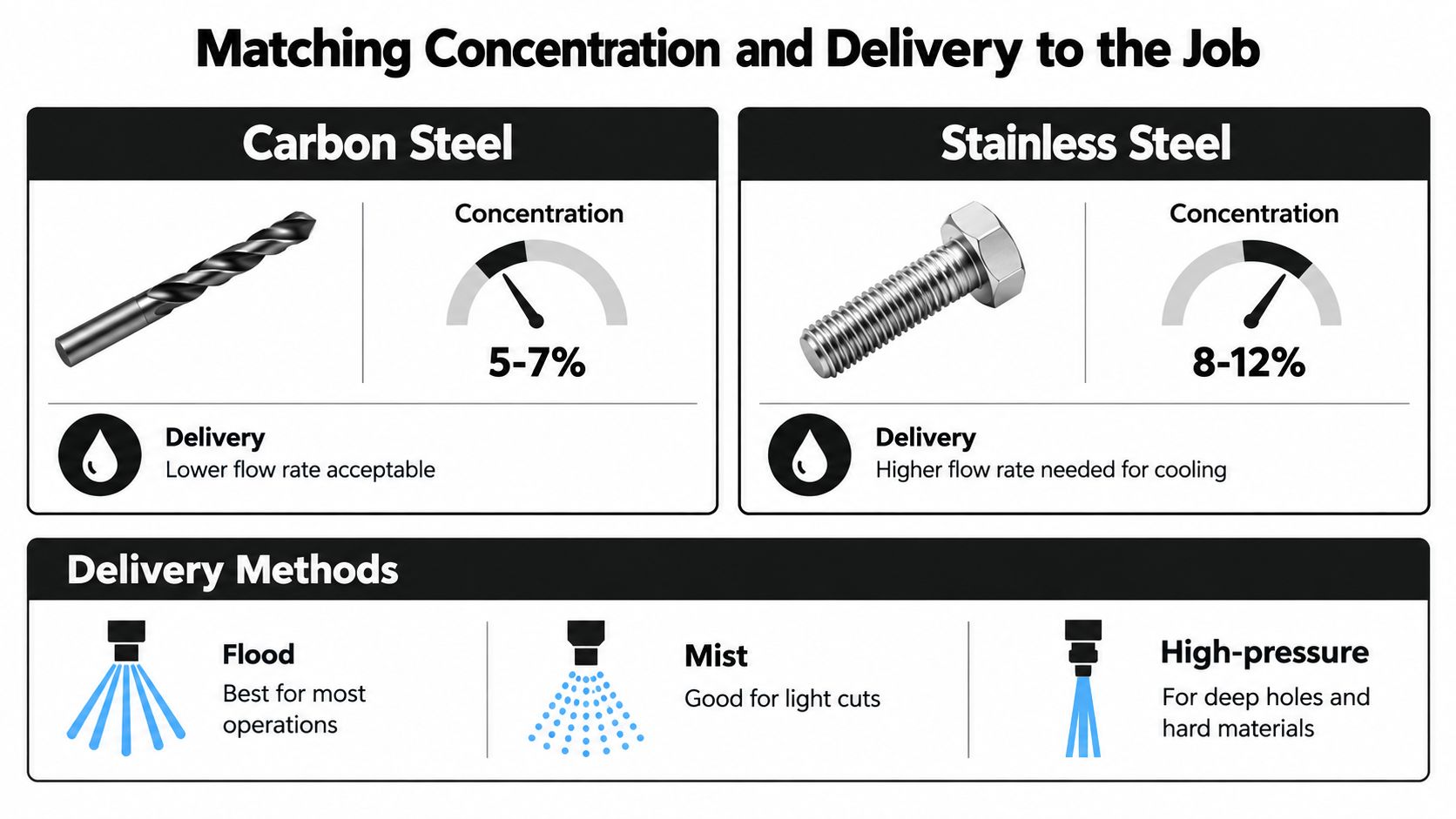
Concentration and delivery decisions
| Job condition | Concentration approach | Delivery choice | What to watch |
|---|---|---|---|
| Light milling or turning | Start within the approved stainless range, without weakening the mix unnecessarily | Flood with directed nozzles | Edge temperature, finish, and chip control |
| Heavy continuous cutting | Use the stronger side of the approved range | High-volume flood | Heat discoloration and flank wear |
| Deep-hole drilling | Follow the fluid maker's stainless recommendation | Through-tool or high-pressure delivery where available | Packed flutes and chip recutting |
| Tapping or threading | Prioritize lubrication at the cutting edge | Apply fluid directly at the tool | Torque, chip welding, and thread finish |
| Light, open cuts | Test MQL before adopting it | MQL or controlled mist where suitable | Heat buildup and airborne exposure |
Flood remains the dependable choice for most stainless milling, turning, and general drilling. It removes heat and helps carry long chips away from the cut. Direct the stream at the tool-work interface, where the edge enters the material, rather than wetting only the fixture or enclosure.
High-pressure or through-tool delivery earns its place in deep holes and restricted internal features. Ordinary flood coolant may not reach the drill point, leaving heat and chips trapped where they can accelerate wear. MQL can suit light cuts when lubrication matters more than bulk cooling, but stainless leaves little room for poor chip evacuation or rising temperature.
The same principle applies to lubrication systems for metals and steel. Check concentration, nozzle direction, flow, and chip removal together. A good fluid delivered badly is still a bad process.
Applying Cutting Fluid for Best Tool Life and Surface Finish
A stainless job can have the correct chemistry in the sump and still burn an insert. The stream may strike the wrong side of the cutter, lose pressure through a restricted line, or reach the engagement zone after heat has already built in the edge.
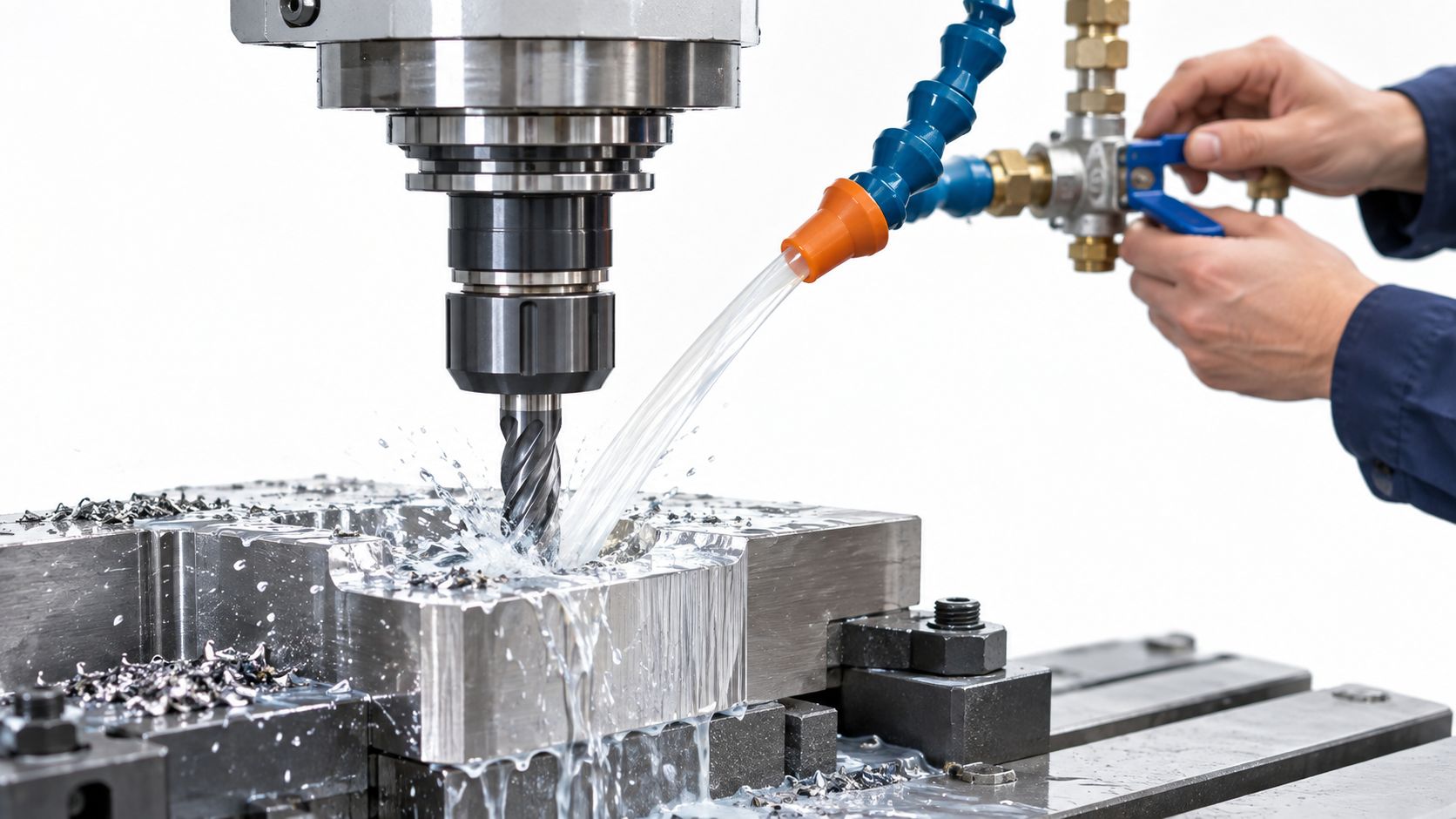
Set the process before the first part
- Aim at the engagement point. Set the nozzle so fluid reaches the tool-chip interface as the edge enters the stainless. Wetting the workpiece alone does little for the cutting *and may leave heat trapped at the contact zone.
- Keep the flow continuous. Leave flood delivery on through the cut instead of cycling it. Repeated heating and cooling can promote cracking and chipping, especially during interrupted milling.
- Measure the mix. Check concentration with a refractometer against the fluid maker's chart. Correct the mixture using the proper procedure. Color and appearance are not reliable concentration measurements.
- Remove chips from the sump. Stainless chips that circulate back to the cut can recut the wall and damage the finish. Screens, skimmers, and suitable filtration reduce that circulation.
- Control tramp oil. Hydraulic and way oil can interfere with coolant performance and support biological contamination. Skim the oil, locate the leak, and repair its source.
For 304 tapping, use enough boundary lubrication to keep the tap from welding to the thread. Apply the fluid directly at entry and maintain a steady feed. A thin flood stream may cool the area while still allowing torque and adhesion to rise, so cooling alone is not a substitute for lubrication at the cutting area.
During 316 plate milling, keep coverage stable across the cutter. A tool that exits and re-enters the material needs fluid on every engagement, not a nozzle aimed at only one side. For tougher duplex grades, chip evacuation should determine the delivery method. Surface flood may not reach the drill point, making through-tool delivery or another chip-clearing method more suitable for the hole.
Check the sump as part of the setup
Fluid condition affects repeatability. Watch for odor, foam, floating oil, sediment, and a noticeable color change. These signs can have different causes, so test concentration, inspect filtration, check lines and pumps, and confirm that the mixture matches the product specification.
A clean finish still depends on the tool and cutting parameters. Fluid reduces friction and carries chips away, but it cannot compensate for a worn insert, a feed that causes rubbing, or a chipbreaker poorly matched to the cut.
Use the following video as a visual reference for coolant application and cutting-fluid behavior. Compare it with the actual access, nozzle position, and flow around your machine.
Shop check: Inspect return flow near the enclosure opening only after the machine has stopped and is safe. Check visually, never by reaching toward the cutter. Consistent delivery and clear chip movement indicate that the system is doing its job.
Troubleshooting Common Stainless Steel Cutting Fluid Problems
A stainless job can leave a rough wall, a blue edge, or a welded chip while the insert still looks like the obvious culprit. Before changing geometry or grade, check whether fluid is reaching the cut, carrying heat away, and arriving at a usable concentration. Those checks often prevent another tool from being sacrificed.
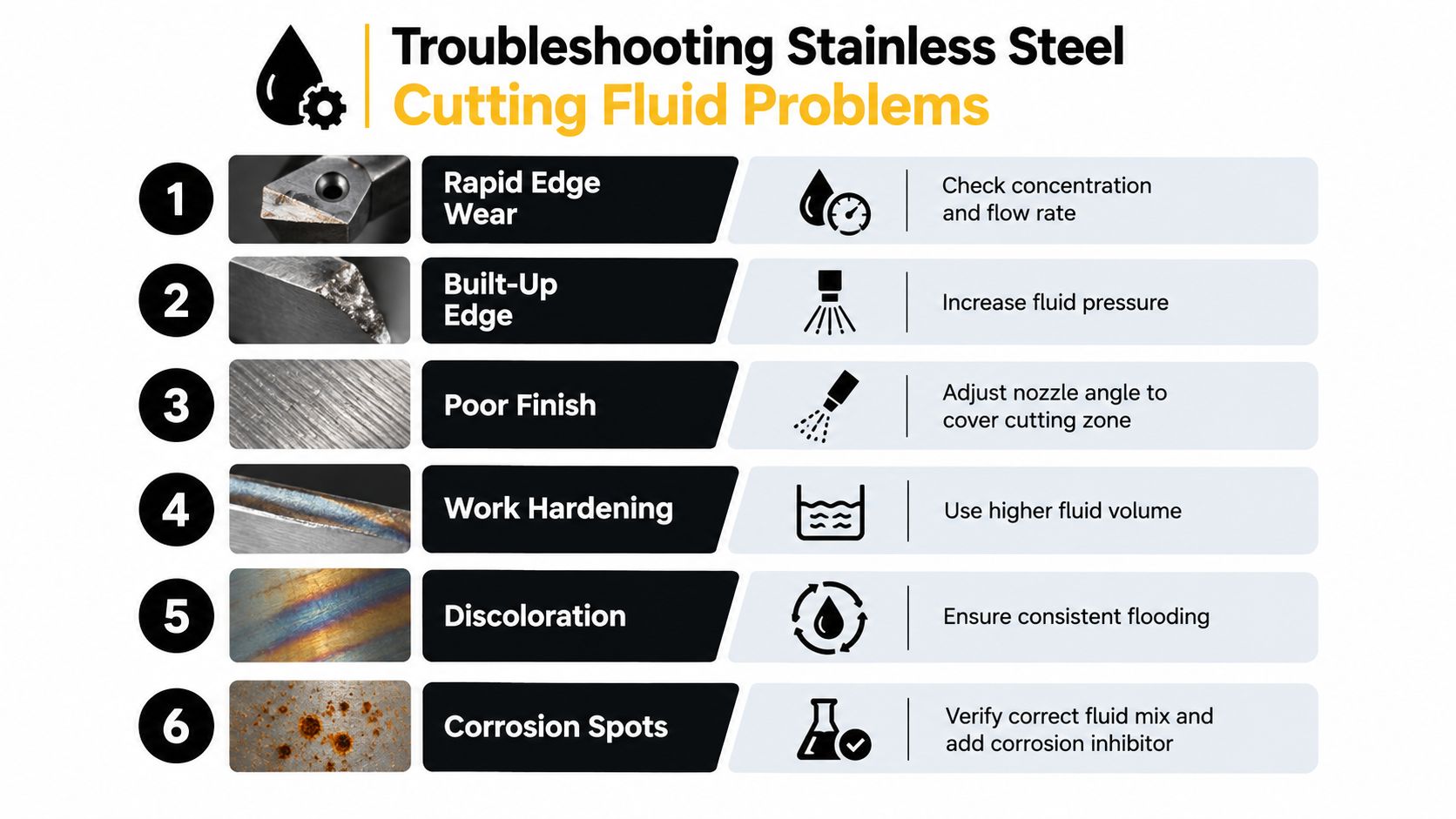
Start with the symptom
- Rapid edge wear: Check the refractometer reading, pump output, filter, and nozzle blockage. Use the concentration range noted earlier as the starting reference, then verify the product data sheet. A weak mix or interrupted flow can leave stainless hot enough to accelerate wear.
- Built-up edge: Increase lubrication at the cutting zone. For tapping or threading, test a suitable EP oil or localized high-lubricity product instead of asking a general-purpose coolant to handle the whole load.
- Poor finish: Follow the chip first. Long chips recutting against the wall point to nozzle angle, flow direction, or evacuation problems. If the tool is rubbing or the edge is already damaged, fluid cannot restore the surface.
- Work-hardened surface: Eliminate dwell, rubbing, and repeated light passes. Keep the tool engaged with a decisive cut and deliver enough fluid to prevent heat from staying at the edge. Fluid supports the correction, but engagement and feed determine whether the next pass meets a hardened layer.
- Discoloration: Look for a dry side of the cutter, a blocked nozzle, or heat trapped at the exit. Uneven cooling can create inconsistent thermal stress, particularly where a milling cutter repeatedly enters and leaves the work.
- Corrosion spots: Check the working mix, tramp oil, contamination, and corrosion-inhibitor package. Surface chemistry affects the result. Earlier stainless surface-integrity findings showed that changing chlorinated-paraffin dosage altered oxidation and corrosion behavior, so treat chemistry as part of the diagnosis rather than a minor maintenance detail (the stainless surface-integrity findings).
Don't optimize finish at the expense of wear
Fluid choice involves a real tool-life trade-off. In milling precipitation-hardened stainless steel with coated carbide inserts, a study found longer tool life with dry cutting than with abundant emulsion under its tested conditions. Dry cutting was associated mainly with attrition, while emulsion produced thermal cracking and chipping. More coolant is therefore not automatically safer for every grade, insert, and cutting setup (the precipitation-hardened stainless milling study).
Duplex 2205 can produce a different result. In a comparative study, chilled air improved surface finish compared with conventional flood coolant, while flood cooling delivered better tool life. Measure both outcomes during a trial. A smoother part is not a process win if the tool fails early, and longer tool life does not help if the finish misses its requirement (the 2205 duplex coolant comparison).
Key Takeaways for Longer Tool Life on Stainless Steel
Reliable stainless-fluid choices start with the failure mode at the machine. Continuous milling that overheats the tool needs cooling capacity and steady flow. A tap that welds to the work needs boundary lubrication and EP protection. A deep hole that packs with chips needs better delivery and evacuation before a different brand.
Use the earlier concentration guidance as a starting point, then verify the product data sheet and the machine's delivery limits. A richer mix can help austenitic stainless, but concentration alone will not prevent work hardening, trapped heat, or poor chip removal.
Keep this setup checklist beside the machine
- Identify the grade: 304, 316, precipitation-hardened stainless, and duplex 2205 may require different fluid and delivery choices.
- Name the limiting failure: Heat, work hardening, chip recutting, built-up edge, corrosion, and thermal chipping each call for a different correction.
- Match chemistry to the cut: Use water-based fluid for broad cooling, stronger EP lubrication for severe threading and tapping, and test vegetable-based products when tool-life results justify the trial.
- Deliver fluid continuously: Aim at the engagement zone, maintain flow, and use through-tool or high-pressure delivery when surface flood can't reach the cutting zone.
- Track both metrics: Record tool wear and surface finish together. Earlier comparisons show why either measure alone can give the wrong process decision.
- Maintain the sump: Check concentration, remove chips and tramp oil, inspect nozzles, and replace degraded fluid through a controlled maintenance routine.
Keep the trial controlled. Run the same grade, tool, speeds, feeds, and delivery method while changing one fluid variable at a time. Log flank wear, finish, chip shape, heat, and fluid condition. The goal is to identify which chemistry and delivery setup controls the actual failure, rather than choosing a fluid from a general stainless label.
For demanding stainless drilling, tapping, and milling, Evo Dyne Cutting Fluid is one option described for multipurpose metal cutting and stainless-steel work. Review its application guidance, compare it with the current process, and visit Evo Dyne Products to evaluate its cutting-fluid and industrial-maintenance offerings.