

You've run your ultrasonic cleaner, watched the bath fizz, and expected a dull ring, cloudy glasses, or greasy metal parts to come out looking new. Instead, the grime has only shifted, and a faint film remains. That result usually isn't a failure of the machine. It's a sign that the bath lacks the right ultrasonic cleaner chemical.
Ultrasonic energy supplies the movement, but chemistry determines what happens to the contamination afterward. Surfactants help the solution reach hidden surfaces, chelating agents control mineral residue, and the right pH helps dissolve a specific type of soil without attacking the item underneath. The safest approach also depends on whether the solution goes directly into the tank, sits in an indirect container, or contains a flammable or corrosive ingredient.
Why Plain Water Leaves Your Treasures Dull
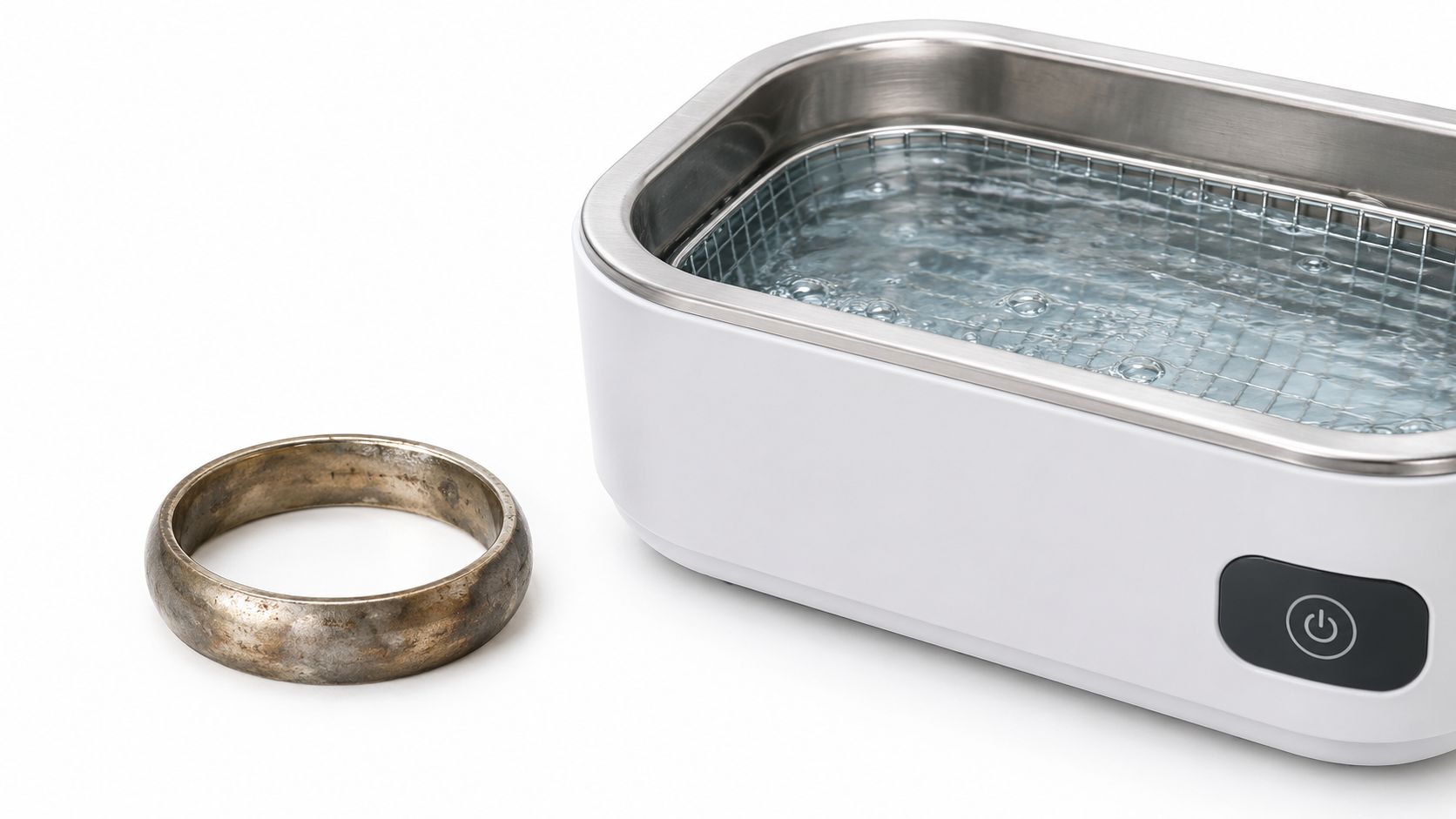
A homeowner named Maria recently placed a pair of everyday rings in her ultrasonic cleaner after gardening and cooking. The machine produced a steady hum, and tiny bubbles moved around the settings. After the cycle, loose dirt had disappeared, but the stones still looked cloudy and the metal carried a soft, greasy haze.
Maria had supplied ultrasonic energy, but she hadn't supplied a chemistry that could deal with the full mixture of skin oils, perspiration residue, household grime, and mineral deposits. Water can carry loosened particles away, yet it doesn't automatically dissolve oily films or stop hard-water minerals from settling back onto a surface.
Cavitation needs chemical support
An ultrasonic tank creates microscopic bubbles in the liquid. Those bubbles form and collapse repeatedly, sending energy into recesses, pores, threads, and narrow gaps that a cloth can't reach. That mechanical action is powerful, but it doesn't guarantee that every contaminant will dissolve.
A useful analogy is washing a greasy pan with a strong spray of plain water. The spray can move crumbs and disturb the surface, but it struggles with an oily layer that clings to the metal. A suitable detergent changes the behavior of the water, allowing the mechanical action to work against contamination that would otherwise remain attached.
Practical rule: Bubbles remove what the liquid can suspend or dissolve. They don't turn unsuitable water into a complete cleaning system.
The history of the technology reflects this distinction. Ultrasonic cleaning emerged as a distinct industrial method in the mid-20th century, with the earliest patent record specifically using the term “ultrasonic cleaning” issued in December 1954. By the 1970s, the technology had become established for industrial and domestic use, while environmental rules pushed the industry away from hazardous solvent systems and toward safer aqueous and semi-aqueous formulations (historical background on ultrasonic cleaning).
What Ultrasonic Cleaner Chemicals Actually Do
A purpose-formulated solution doesn't replace cavitation. It makes cavitation more useful. The ingredients alter how the liquid wets a surface, interacts with minerals, and carries loosened soil away from the item.
Surfactants make hidden surfaces easier to wet
Surfactants and wetting agents lower surface tension in the bath. Lower surface tension reduces the cavitation threshold, so microscopic bubbles can form and collapse more readily. The solution also spreads into small openings instead of pulling away from them.
That matters around a ring setting, a machined thread, or a porous-looking surface where water alone may not make consistent contact. Technical guidance on ultrasonic chemistry describes surfactants as a way to improve bubble activity and penetration into cracks, pores, and recessed geometries (how ultrasonic cleaning chemistry supports cavitation).
Chelating agents keep minerals from returning
Hard water contains dissolved minerals, including calcium, magnesium, and iron. During cleaning and rinsing, those ions can contribute to spots, scale, or re-deposited residue. Chelating agents, such as EDTA, bind these metal ions, helping keep them in solution rather than allowing them to stain the item again.
Think of a chelator as a temporary carrier. It holds unwanted mineral ions while the contaminated bath is drained and the cleaned item is rinsed. It doesn't provide the main scrubbing force, but it helps preserve the clarity achieved by the ultrasonic cycle.
Supporting ingredients control the bath
A complete formula may also use pH buffers and corrosion inhibitors. Buffers help keep acidity or alkalinity more stable during the cycle, while inhibitors can reduce unwanted reactions between the solution and compatible metals. The exact blend should match both the soil and the material.
The global market reflects the shift toward these purpose-formulated solutions. One market estimate places ultrasonic cleaning solutions at $2.61 billion in 2025, with a projection of $4.84 billion by 2034 and a 6.8% compound annual growth rate. The same estimate gives aqueous solutions 42.3% of the market, while another estimate values the broader ultrasonic cleaning market at $1.66 billion in 2026 and projects $2.11 billion by 2031 (market estimates for ultrasonic cleaning chemistry).
For laboratories and workshops, chemistry is only one part of a reliable process. Guidance on best practices lab instrument hygiene can help you connect solution selection with handling, rinsing, and contamination control.
Choosing Between Alkaline, Acidic, and Enzymatic Formulas
The right formula depends on what you're trying to remove. A cleaner that excels at oily machining residue may be a poor choice for mineral scale, and a gentle neutral detergent may leave organic soil behind.
| Formula type | Most suitable direction | Important limitation |
|---|---|---|
| Alkaline | Oils, grease, and heavy workshop soil | May be unsuitable for sensitive materials |
| Acidic | Mineral deposits and some oxidation-related residue | Requires strict material and tank compatibility |
| Enzymatic | Organic contamination | Needs a formula and process suited to the soil |
| Neutral | Routine, lower-aggression cleaning | May lack the activity needed for stubborn organic soil |
| Emulsifying | Oily contamination suspended in the bath | Performance declines as oil accumulates |
Match the chemistry to the contaminant
For a greasy tool or a part carrying machining oil, an alkaline detergent is usually the logical category to investigate. Alkalinity helps break down and suspend oily residues, although the product label still needs to confirm compatibility with the particular metal or coating.
Mineral deposits call for a different approach. An acidic formulation can address deposits that an alkaline bath may leave untouched, but acids introduce greater risk to the tank, the item, and the operator. Direct-tank acid use isn't a casual substitution for detergent.
Organic soil deserves special attention. A study summarized by Elma reports that ultrasonic washing combined with an enzyme detergent outperformed ultrasonic washing with a neutral detergent for soil removal (ultrasonic cleaning chemistry guidance and formulation categories). That doesn't mean enzymes belong in every household bath. It means “neutral” and “gentle” aren't synonyms for “most effective.”
Treat emulsifying solutions as consumable baths
An emulsifying cleaner holds oil in suspension, but the bath becomes less effective as oily contamination accumulates. If the solution looks heavily loaded or cleaning performance falls, changing it is more useful than extending the cycle.
Before choosing, write down two things: what is dirty and what the item is made of. That short check prevents the common mistake of selecting a product because its label sounds mild, powerful, or familiar.
Material Compatibility for Jewelry, Metals, and Plastics
Cleaning power and material safety must be considered together. The same cavitation that reaches a narrow setting can expose weak joints, porous stones, coatings, or aged plastic to stress that a hand wash would never create.
Start with the manufacturer's care instructions for the item. Jewelry with loose stones, delicate settings, glued components, plated surfaces, or hidden damage should be treated as a special case, even when the metal itself appears compatible.
Jewelry requires more than a metal check
Gold and platinum are commonly associated with ultrasonic cleaning, but the complete piece matters more than the metal name. A ring may contain a stone, adhesive, coating, or setting that changes its suitability. Diamonds, sapphires, and rubies are often considered more tolerant than porous or internally delicate stones, but a jeweler should assess an expensive or damaged item before immersion.
Pearls, opals, turquoise, and emeralds should not be placed in an ultrasonic bath, according to the safety boundaries supplied for this cleaning application. The concern isn't only the detergent. Acoustic energy can harm vulnerable stones, so switching from an alkaline formula to a neutral one doesn't remove that risk.
Metals and finishes need separate decisions
Steel and hardened metal parts may need stronger chemistry for grease or production residue, while polished, plated, anodized, or coated surfaces may require a less aggressive formula. Silver can benefit from chemistry aimed at tarnish, but repeated or excessive exposure can be inappropriate for a delicate finish.
Use a basket rather than placing parts directly on the tank floor. Keep pieces from striking one another, and inspect soldered joints, stones, and surface treatments before the first full cycle.
Plastics can react slowly
Plastic components deserve caution because repeated exposure to harsh solvents or strongly alkaline chemistry can cloud, swell, soften, or degrade some polymers. If the plastic type is unknown, test an inconspicuous area with a compatible, water-based formula and use a short observation cycle rather than assuming that “nonmetal” means safe.
Material check: Select the bath for the soil, then verify the chemistry against every material in the assembly, not just its largest component.
Safe Dilution Ratios and Water Quality Guidelines
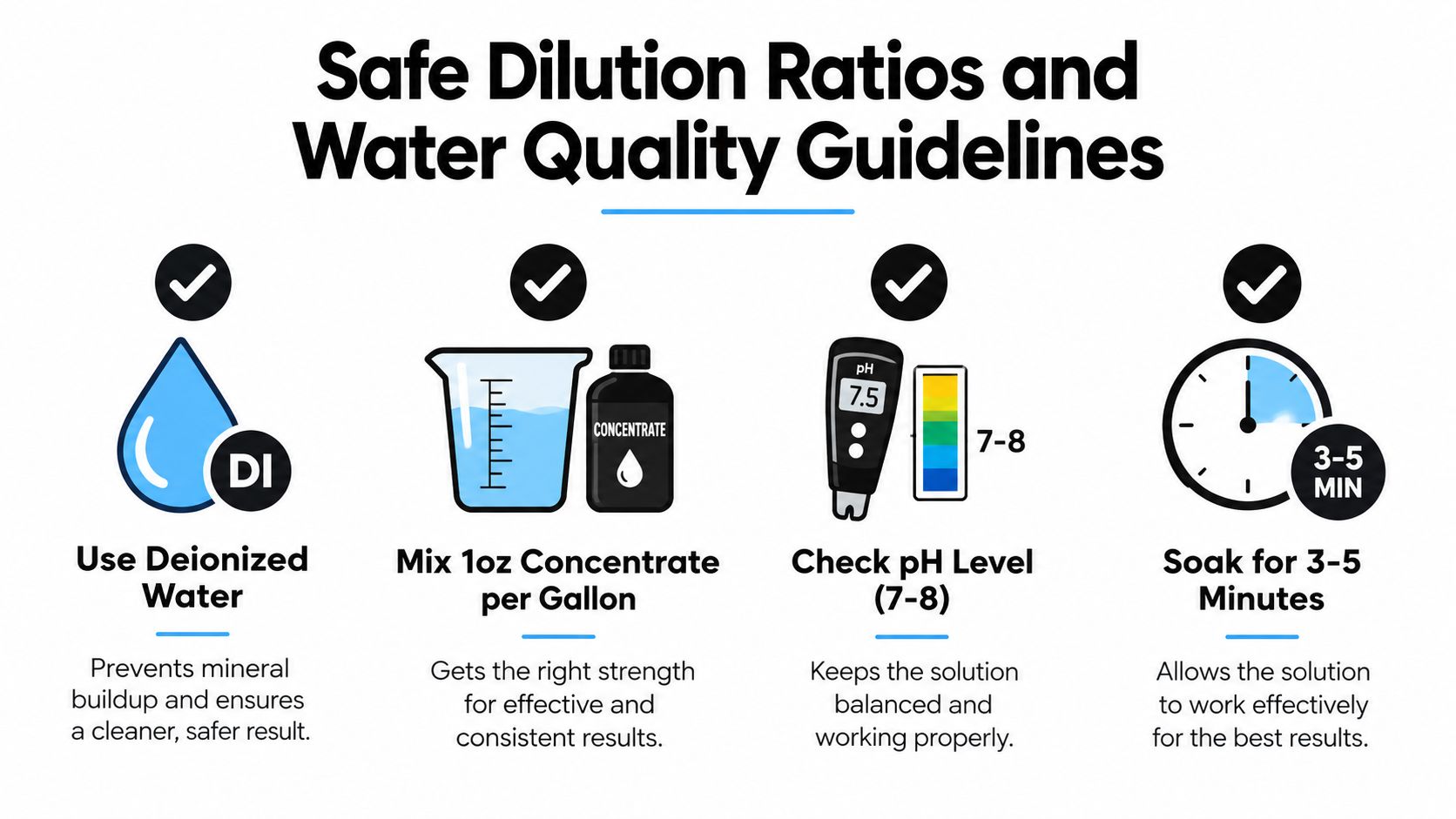
A good formula can still perform poorly if it's mixed with unsuitable water or poured into the tank at the wrong strength. Start with deionized, demineralized, or distilled water whenever the product directions permit it. Tap-water impurities, including calcium carbonate, can reduce cleaning efficiency and leave deposits on cleaned surfaces (technical guidance on water quality, temperature, foaming, and solvent risk).
Build the bath in the right order
- Choose the water. Use the water quality specified by the product maker. Purified water helps reduce mineral spotting and makes the chemistry more predictable.
- Measure the concentrate. Follow the label's dilution instructions with a measuring tool. More concentrate isn't automatically better. Excess detergent can create foam, and excessive foaming can suppress cavitation.
- Check the solution. Look for unusual cloudiness, separation, or an unexpected reaction before adding valuable items.
- Load carefully. Put parts in a basket and keep them from resting on the tank bottom or colliding with one another.
- Rinse after cleaning. A clean rinse removes suspended soil and detergent residue instead of allowing it to dry on the surface.
The exact dilution ratio belongs to the specific product, so don't copy a generic recipe from a different concentrate. A formula for jewelry may not be appropriate for a workshop degreaser, even if both products are sold as ultrasonic solutions.
Control heat and hazardous ingredients
Detergent-based ultrasonic cleaning commonly performs well around 50 to 60°C, a range cited in technical guidance for balancing soil removal and cavitation efficiency. Monitor the bath rather than assuming that hotter is safer or faster.
Never place a low-boiling volatile solvent directly into an ordinary ultrasonic tank. Ultrasonic heating can accelerate vapor formation and create a fire risk. Non-flammable, water-based solutions are preferred for standard equipment, and explosion-proof equipment doesn't eliminate the need for ventilation or hazardous-vapor controls.
Acid requires another boundary. Nitric, sulfuric, formic, and hydrofluoric acid chemistries may require an indirect cleaning arrangement in an acid-resistant container, with the tank itself holding a suitable coupling liquid. Don't pour such acids directly into a consumer tank unless the equipment documentation and a qualified safety procedure explicitly permit that use.
For a jewelry-specific discussion of whether untreated water belongs in the bath, see this guide to using tap water in an ultrasonic jewelry cleaner. It reinforces a simple habit, use the specified water and avoid guessing at the mixture.
Why Fragrance-Free Proprietary Formulas Matter
A pleasant scent doesn't prove that a cleaning solution is suitable for an ultrasonic tank. Fragrance blends can add compounds that have no cleaning role, may leave residue, and can behave unpredictably when the bath warms and produces vapor.
A fragrance-free proprietary formula is designed around function rather than sensory appeal. Its ingredients can be selected to support wetting, soil suspension, mineral control, rinse clarity, pH stability, and material protection. That doesn't make every proprietary product automatically safe. You still need to read the label, confirm the intended use, and check the equipment instructions.
Avoid turning household products into experiments
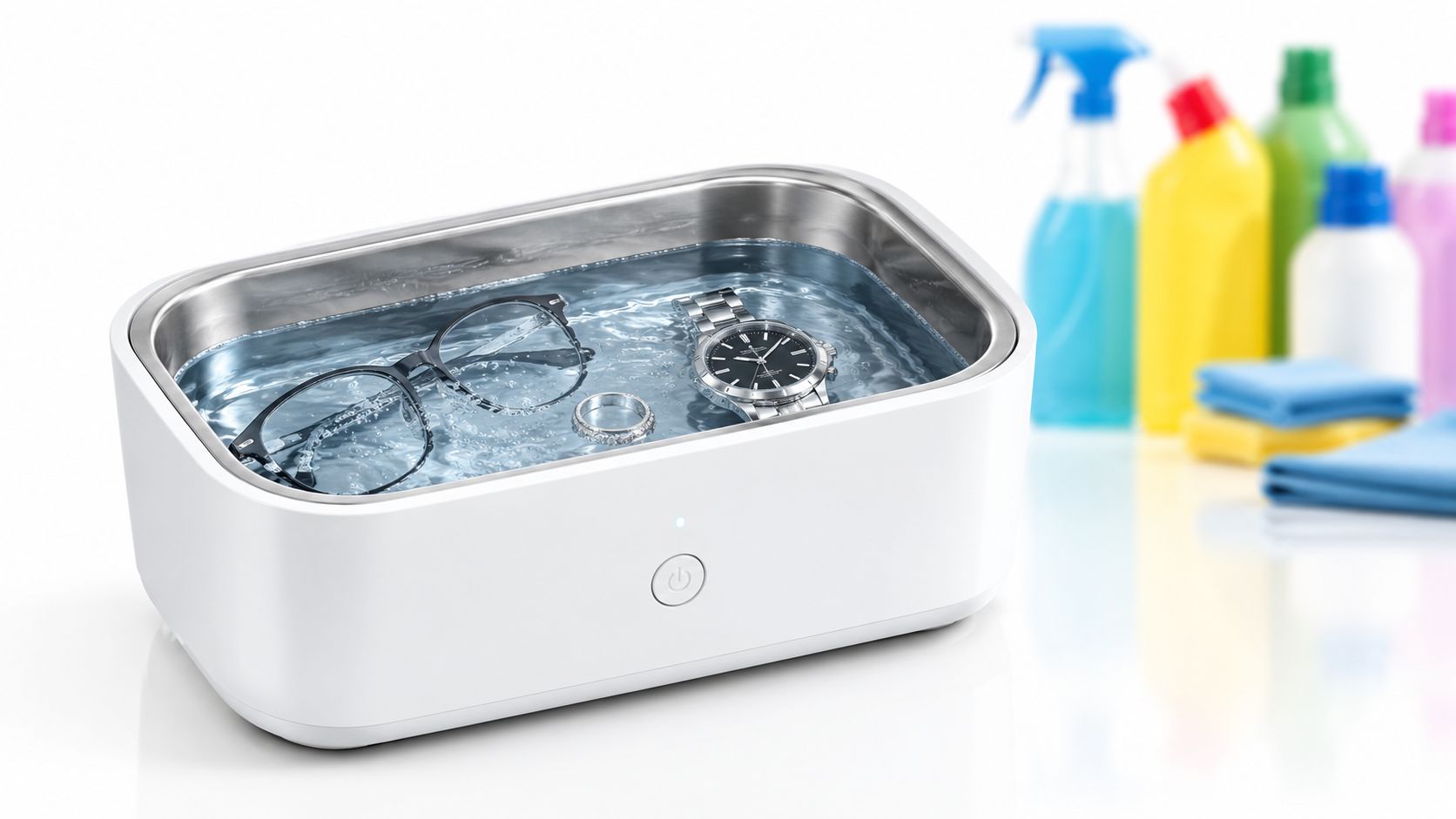
Dish soap is familiar, inexpensive, and useful for ordinary hand washing. It isn't a universal ultrasonic detergent, however. A formula that creates a large amount of foam can interfere with cavitation, while a household product may lack the chelating, buffering, or rinsing characteristics needed for repeated tank use.
The same caution applies to scented cleaners, essential oils, alcohol-based additives, and improvised solvent mixtures. They can create residue, alter the bath's surface behavior, or introduce vapor and compatibility risks. The absence of fragrance doesn't guarantee performance, but fragrance adds a variable that usually has no place in a precision cleaning bath.
Look for evidence in the product information
A useful label should identify the intended application, dilution method, material limitations, storage requirements, and disposal guidance. It should also make clear whether the product is water-based and intended for ultrasonic equipment.
Buffered chemistry can help maintain a more consistent pH during a cycle, which supports repeatable cleaning and reduces sudden changes that may affect sensitive metals. Chelating ingredients can also make a difference when water quality or mineral spotting is a concern.
A scent is an experience. Cleaning performance comes from the formulation.
Use ventilation, avoid breathing bath vapor, and keep the tank covered when the equipment instructions allow it. If a product label doesn't explain its use in an ultrasonic machine, don't assume that a familiar household cleaner is a suitable substitute.
Making the Right Ultrasonic Cleaning Choice
Choosing an ultrasonic cleaner chemical becomes simpler when you make the decision in a fixed order.
First, identify the contaminant. Grease and machining residue point toward an appropriate alkaline category, mineral deposits may require an acidic approach with special controls, and organic soil may respond better to an enzyme-based detergent than to a neutral formula. Emulsifying products need closer attention to bath replacement because accumulated oil reduces their effectiveness.
Next, identify every material in the item. A metal part with plastic seals needs a different review from a bare steel component. A gold ring with a porous gemstone needs a different decision from a plain metal band. If the item is valuable, damaged, porous, glued, plated, or unfamiliar, professional advice is safer than a test cycle.
Then prepare the bath properly:
- Use suitable water: Choose deionized, demineralized, or distilled water when directed.
- Measure the concentrate: Follow the product instructions instead of increasing strength by guesswork.
- Control the environment: Keep volatile flammable solvents out of ordinary tanks and provide ventilation.
- Use indirect acid cleaning only when appropriate: An acid-resistant container can separate a specialized chemistry from the main tank.
- Rinse and inspect: Check for film, spotting, loosened components, or changes in finish before repeating the process.
For broader maintenance jobs, a separate guide to best boat cleaning products can help you distinguish surface-care products from specialized ultrasonic chemistry. The key distinction is purpose. A product made for wiping or spraying a large exterior surface isn't automatically engineered for cavitation.
The best bath is not the strongest one. It's the formulation that matches the soil, protects the materials, works with the equipment, and leaves a clean surface after rinsing.
Evo Dyne Products offers ultrasonic jewelry cleaning solutions formulated for use with sonic and ultrasonic machines, including a concentrated formula with a chelating agent that is mixed with water. Visit Evo Dyne Products to review its ultrasonic cleaning option and choose a solution that fits your jewelry-care routine.