


You pull a favorite necklace from your jewelry box before heading out, expecting the familiar flash of color. Instead, the chain looks dull, one rhinestone has a cloudy edge, and the earrings leave a faint mark on your skin. The instinct is understandable: reach for polish, soak the piece, or run it through an ultrasonic cleaner.
That quick fix can turn a tired-looking accessory into a damaged one. Clean costume jewelry needs care that respects thin coatings, glued stones, porous materials, and the possibility that visible shine says nothing about chemical safety. The safest routine removes surface residue while preserving the construction underneath.
Why Your Favorite Pieces Lose Their Sparkle
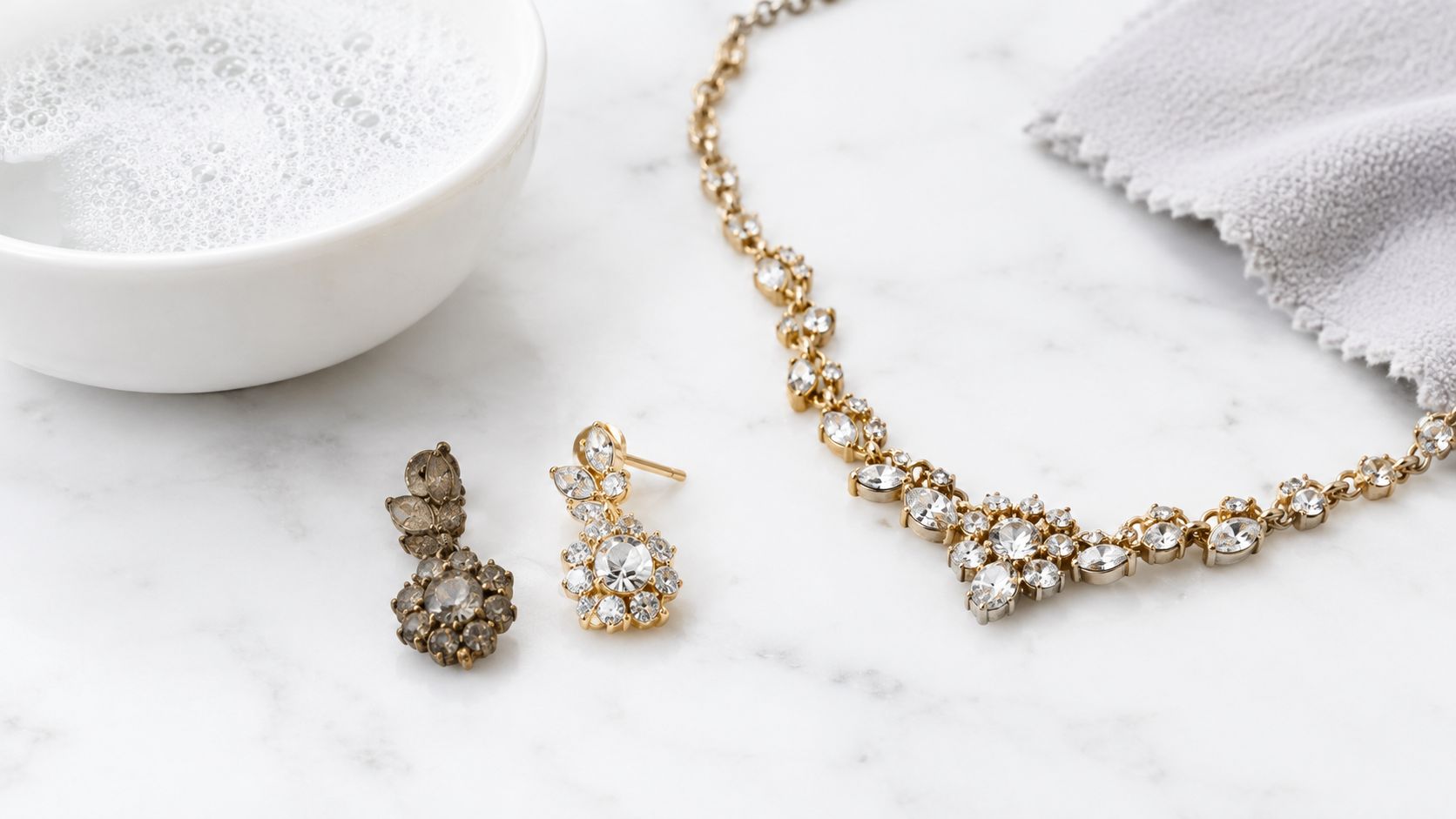
Costume jewelry collects more than dust. Lotions, soap, skin oils, sweat, and everyday airborne particles settle on chains, backs, clasps, and stone settings. That film softens the reflection from glass rhinestones and makes plated metal appear gray or lifeless, even when the piece itself is still structurally sound.
The trouble often becomes obvious on a favorite item because frequently worn jewelry receives the most exposure. A necklace may rub against moisturizer at the collarbone, while an earring back remains in contact with skin for hours. A bracelet can pick up residue from hand cream and soap long before the metal shows visible discoloration.
Shine can hide a construction problem
A cleaning session is also an inspection opportunity. Before wiping, look for a clasp that no longer closes cleanly, a stone that shifts when touched, a seam beginning to lift, or plating that has worn thin along an edge. These details matter because moisture and friction can turn a small weakness into a missing stone, a discolored patch, or a broken adhesive bond.
Practical rule: If a piece looks dull, inspect it before you try to make it bright.
The right maintenance habit is light and regular rather than aggressive and occasional. A dry wipe after wearing removes residue before it sits against the finish. A targeted, barely damp wipe may handle more persistent grime, but only when the construction permits it. Prolonged immersion, abrasive scrubbing, and strong chemical dips can remove decorative coatings instead of removing only the soil.
Clean appearance is not the same as safe contact
A polished surface doesn't prove that a piece is suitable for sensitive skin. Costume jewelry may contain plated or base-metal components, and the coating can wear where the item touches the body. If earrings, a necklace, or a bracelet repeatedly causes itching, redness, or discomfort, stop wearing it rather than trying to clean the reaction away.
Cleaning protects the piece's appearance and helps you notice damage early. It can't change the alloy beneath a coating or make an irritating item chemically safer.
Identifying Materials Before You Clean
The safest cleaner depends on the least water-resistant component in the piece. A necklace may combine plated alloy, glass rhinestones, adhesive, enamel, and an organic material in one assembled design. Treating that necklace like solid precious metal gives every vulnerable component the same exposure, even though they don't tolerate it equally.
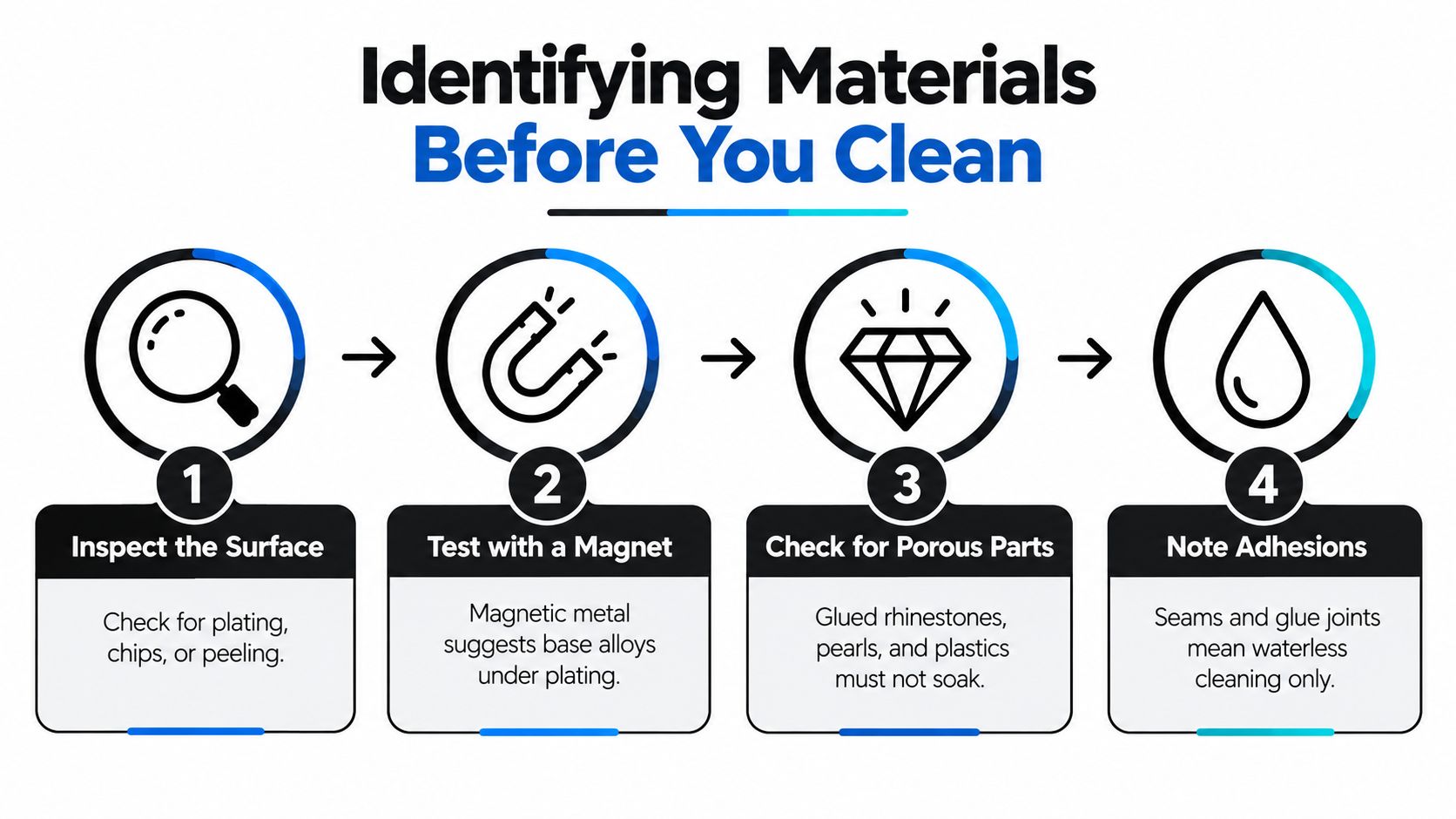
Start with a close visual inspection under a bright light. A magnifying glass helps reveal edge lifting, scratches, pinholes, exposed base metal, hairline cracks, loose stones, and adhesive around a setting. Check the clasp and seams as well. If a surface already shows haze or peeling, cleaning may worsen the defect.
Use the construction to choose the method
A magnet can offer a basic clue about the metal, but it can't identify an alloy or confirm that a coating is safe. More useful questions concern the design:
- Foil-backed rhinestones: Keep moisture away. Liquid that reaches the reflective backing can cause permanent clouding.
- Glued stones: Favor dry dusting and carefully controlled wiping around the setting. Water can weaken adhesive over time.
- Pearls, coral, amber, Bakelite, and acrylic: Treat these as porous or chemically sensitive components. Avoid immersion and harsh cleaners.
- Lacquer and enamel: Use minimal moisture and no abrasive action, since rubbing can dull or remove the finish.
- Hollow or sealed parts: Don't force liquid into openings, seams, or cavities where it can remain trapped.
- Damaged plating: Skip ultrasonic treatment. Cavitation can enlarge defects and detach a poorly bonded coating.
One technical guide identifies plating below 1 micrometer as unsuitable for ultrasonic treatment, while intact plated surfaces still require a condition check before exposure. That makes a machine a construction-dependent tool, not a default setting for every piece. This material guide on ultrasonic cleaner restrictions provides further context on why thin plating and assembled jewelry need caution.
When material identification remains uncertain, choose the least aggressive option. Dry microfiber, a soft brush, or a cotton swab can remove loose soil without committing the piece to water. A hidden-area spot test should come before any cleaner reaches a visible surface.
A Gentle Cleaning Workflow for Plated Jewelry
Plated costume jewelry responds best to a non-immersive workflow. The objective is to lift residue while keeping liquid away from stone edges, seams, glue joints, and areas where the coating has already weakened.
Begin with a dry inspection. Look at the clasp, chain joints, back of the setting, and contact surfaces. Photograph a sentimental or intricate piece before cleaning so you can compare its condition afterward. If you see lifting, a scratch through the plating, a loose stone, or exposed base metal, limit the process to dry dusting or seek a professional opinion.
Follow a controlled sequence
- Test first. Put a tiny amount of the intended cleaner on an inconspicuous area. Wait long enough to check for color change, haze, or surface softening before continuing.
- Use very little product. Place a small amount on a soft, lint-free cloth or cotton swab, not directly on the jewelry. A swab gives you better control around a clasp or narrow metal edge.
- Wipe lightly in one direction. Don't scrub back and forth. Work on the metal only, and avoid dragging the cloth across glued or foil-backed stones.
- Remove residue carefully. Use a barely damp swab with distilled water where the construction permits it. Keep the contact area small.
- Dry immediately. Pat with a clean, dry section of the cloth, then check crevices and stone edges for trapped moisture.
Inspect the surface under magnification before and after cleaning. Stop if the finish develops color change, haze, lifting, or a newly exposed base metal. Delamination at an edge, copper-rich discoloration, moisture beneath a stone, and adhesive failure are not signs that the jewelry needs more scrubbing. They're signs that the method has exceeded the piece's tolerance.
A clean surface is a successful result only when the original coating and construction remain intact.
Aggressive polishing and prolonged soaking create the wrong trade-off for plated jewelry. They may produce a short-lived shine while removing the decorative layer that gives the item its color. For pieces made with more durable materials, compare this approach with gold filled cleaning methods, because gold-filled construction shouldn't automatically be treated like thin fashion plating.
Choosing Between Homemade and Commercial Cleaners
A mild homemade solution can be useful, but it isn't a universal permission slip. Warm water with a small amount of mild dish soap may suit a sturdy, uncomplicated item when the manufacturer allows wet cleaning. That same mixture is a poor choice for glued rhinestones, foil-backed stones, pearls, porous materials, lacquer, and assembled costume jewelry.
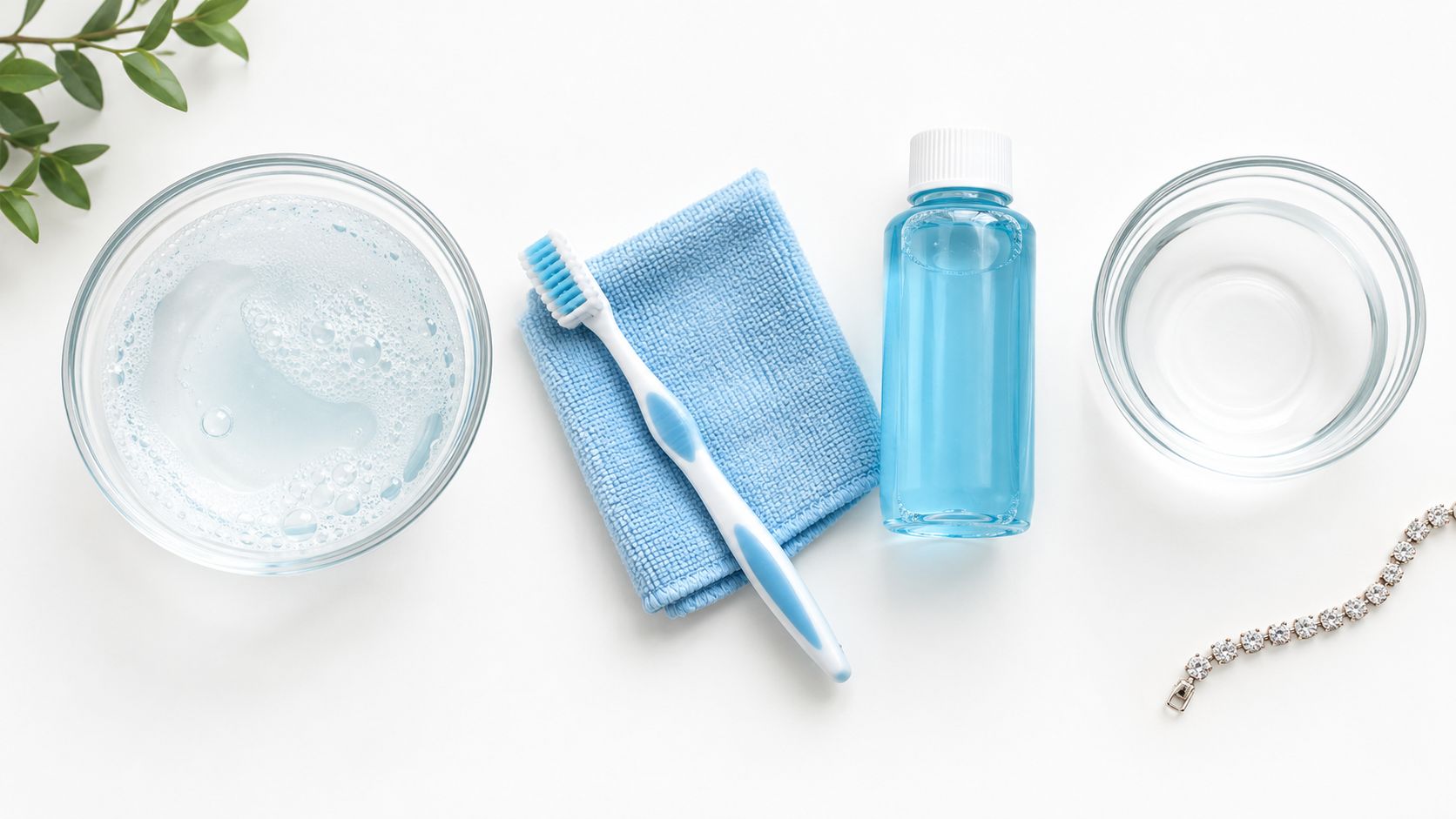
For a suitable sturdy piece, mix the solution weakly, apply it to a cloth rather than submerging the jewelry, wipe the approved surfaces, and remove residue promptly. A soft toothbrush can loosen particles from durable, open areas, but it shouldn't be used to scrub thin plating or adhesive borders. The more components a piece contains, the more valuable control becomes.
Homemade methods
The main advantage of a homemade cleaner is simplicity. You know the ingredients, can use a small amount, and can stop immediately if the surface reacts. Its limitation is that it won't repair worn plating, remove embedded alloy metals, or safely compensate for unknown construction.
Avoid turning common pantry products into a stronger treatment. Baking soda, toothpaste, vinegar, lemon juice, bleach, ammonia, and abrasive powders can scratch, etch, discolor, or weaken components. A method that works on solid silver doesn't automatically belong on a plated necklace.
Commercial solutions and ultrasonic machines
Commercial jewelry solutions may be formulated to loosen grime in crevices, but the label doesn't override the jewelry's material limits. An ultrasonic solution designed for a machine still depends on a piece being suitable for ultrasonic exposure. Glued stones, thin or damaged plating, foil-backed components, and fragile assemblies can fail under cavitation even when the liquid itself is mild.
For product-specific guidance on cleaner ingredients and applications, consult this natural cleaner resource from Evo Dyne. Read the instructions, test conservatively, and reserve machine cleaning for items whose construction and condition are known.
The practical choice is straightforward. Use a dry or barely damp cloth when uncertainty is high. Choose a commercial solution only when the material, finish, and application method are compatible. Use ultrasonic cleaning for appropriate durable pieces, not as a way to make a delicate item “extra clean.”
The Hidden Safety Risks in Inexpensive Jewelry
A piece can look spotless and still contain metals that matter for skin contact or ingestion risk. Cleaning removes surface residue. It doesn't remove metals alloyed into the item or embedded beneath a coating. That distinction is especially important for earrings, jewelry worn by children, and pieces with coating loss.
An Ecology Center investigation found that 58 of 99 inexpensive jewelry items contained high levels of at least one hazardous chemical. The same investigation reported that 27 items exceeded the U.S. children's-product lead limit of 300 ppm, while 10 exceeded 100 ppm cadmium. These findings don't mean every low-cost accessory is hazardous, but they do show why appearance alone isn't a sufficient screening method. The investigation summary and its reported findings are useful when evaluating inexpensive jewelry for children and families.
Nickel presents a separate concern because prolonged contact can trigger allergic contact dermatitis in susceptible people. The European Union adopted Directive 94/27/EC on June 30, 1994, following concerns about nickel exposure from jewelry and other consumer products. The rules took full effect in June 2001 and prohibited the sale of items intended for direct, prolonged skin contact when they released more than 0.5 micrograms of nickel per square centimeter per week. A time-series study covering 180,390 patients found that nickel allergy prevalence declined significantly, by at least 10% among young women in Denmark, Germany, Italy, and the United Kingdom after regulation. The dermatology study covering these regulatory milestones explains why coating durability and skin-contact materials belong in a care discussion.
Safety Benchmarks for Costume Jewelry
| Substance | Limit or finding | Source |
|---|---|---|
| Nickel | EU rules addressed prolonged skin-contact items releasing more than 0.5 micrograms per square centimeter per week. Posts inserted into pierced body parts later received a stricter limit of less than 0.2 micrograms per square centimeter per week. | European nickel regulation and allergy findings |
| Lead | 27 of 99 inexpensive jewelry items exceeded the U.S. children's-product limit of 300 ppm. | Ecology Center investigation summary |
| Cadmium | 10 of 99 inexpensive jewelry items exceeded 100 ppm cadmium in the reported investigation. | Ecology Center investigation summary |
The safest purchasing habit is to look for transparent material disclosure and documented testing. “Nickel-free,” “hypoallergenic,” and “non-toxic” aren't interchangeable terms unless the seller supports them with a specific standard or test documentation. If a piece causes a rash, stop wearing it. Washing it more often won't change the underlying composition, and sealing a problem area isn't a dependable long-term safety strategy.
Drying, Polishing, and Storage Best Practices
Moisture control does as much for costume jewelry as cleaning does. Water left around a stone, clasp, or seam can remain hidden after the visible surface feels dry. That trapped moisture can contribute to discoloration and weaken assembled components.
Dry the piece before you put it away
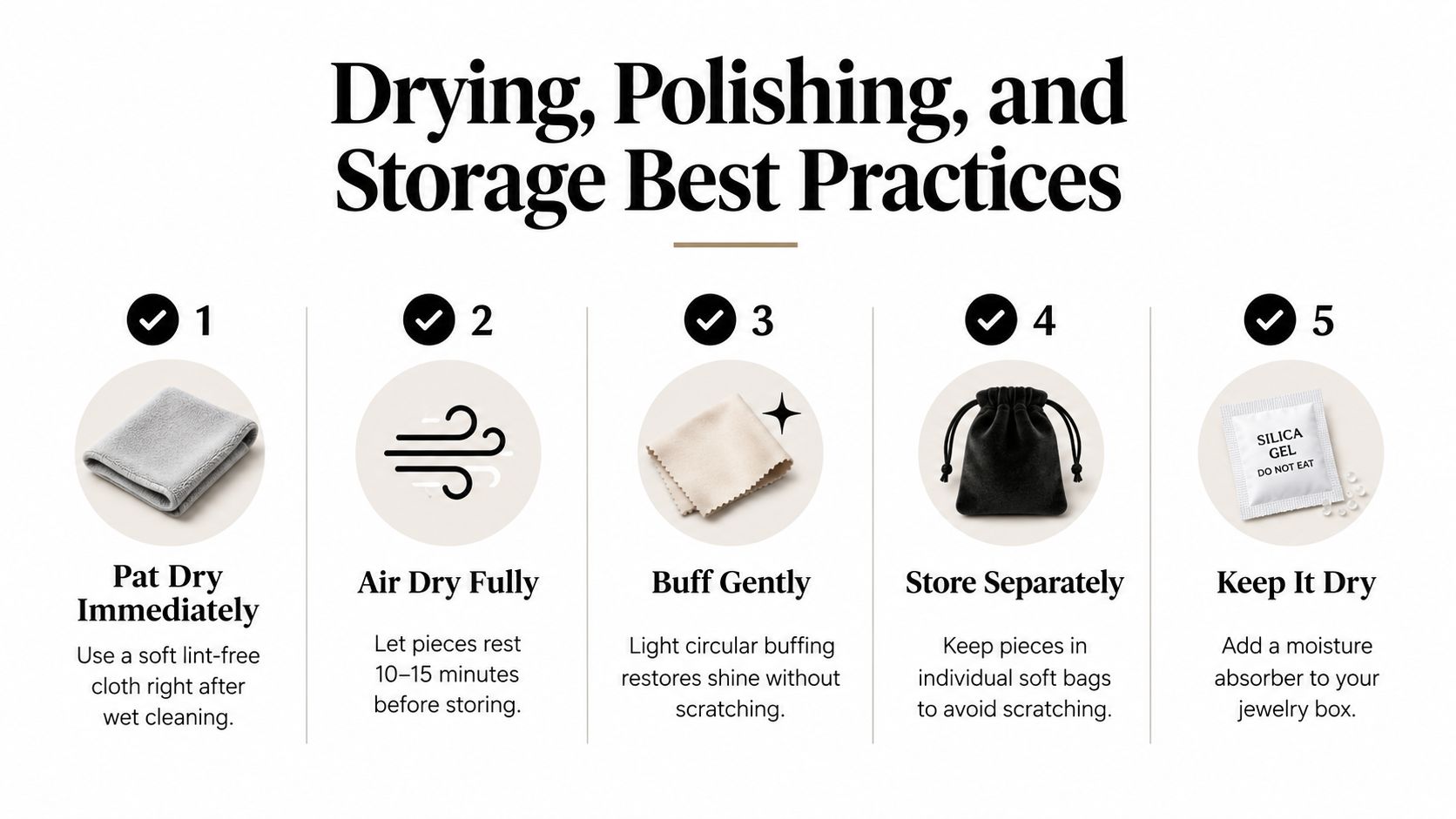
Pat the jewelry with a lint-free cloth immediately after any approved wet cleaning. Use the corner of the cloth or a dry cotton swab to reach clasp interiors and narrow crevices. For glass rhinestones, remove loose particles with a soft brush first, then wipe carefully without forcing liquid beneath the setting.
A clean microfiber cloth can restore a light surface shine without adding abrasion. Don't use a silver polishing cloth or aggressive tarnish treatment on thin plating unless the product and construction specifically permit it. If discoloration remains after gentle cleaning, the problem may be worn plating or exposed base metal rather than removable dirt.
Storage habit that pays off: Keep each piece dry, separated, and easy to inspect.
Store necklaces, earrings, and bracelets in individual soft pouches or separate compartments. Contact between pieces can scratch finishes and create tangles that stress delicate chains. Choose a cool, dry location rather than a humid bathroom, and use a moisture absorber in the jewelry drawer if appropriate.
Avoid enclosing damp jewelry in plastic or putting it away before crevices are fully dry. Storage should prevent new residue and moisture exposure, not trap them against the surface. Put jewelry on after lotions and sprays have settled, and remove it before bathing, swimming, exercising, or washing dishes.
Building a Realistic Jewelry Care Routine
A workable routine doesn't require constant deep cleaning. It starts with a brief dry wipe after wear, especially on skin-contact surfaces such as earring backs, necklace chains, and bracelet interiors. That small step removes residue before it accumulates and gives you a regular chance to notice a loose stone or changing finish.
Keep a compact care kit together so the gentle method is the convenient method:
- For daily wiping: Use a clean lint-free or microfiber cloth.
- For controlled detail work: Keep cotton swabs and a soft brush available.
- For limited wet cleaning: Use distilled water and a mild soap only when the construction allows it.
- For inspection: Add a bright lamp and a magnifying glass.
- For storage: Use separate soft pouches and a moisture absorber.
Frequently worn pieces can receive a careful inspection and light cleaning when residue becomes visible. Deep cleaning should be occasional and construction-dependent, not an automatic chore. Photograph sentimental or complex jewelry before treatment, test a hidden area, and choose dry cleaning when the item contains glued stones, porous materials, foil backing, damaged plating, or an uncertain finish.
Historical and intricate pieces deserve stabilization-focused care. The purpose is to preserve what remains, not force an old coating, adhesive, or alloy to behave like a modern fine-jewelry setting. If itching or a rash appears, remove the piece and reassess its material rather than increasing the cleaning intensity.
Evo Dyne Products offers jewelry cleaning solutions for removing dirt, buildup, and tarnish, with options intended for ultrasonic machines and soft-bristle application. Visit Evo Dyne Products to review the available jewelry care products and choose a method that matches your piece's construction.