

Your favorite ring can look fine in the jewelry box and strangely flat the moment it reaches your hand. The stone hasn't necessarily lost its brilliance. A film of lotion, soap, skin oil, dust, or hard-water residue may be blocking the light.
That's why choosing a natural cleaner for jewelry isn't about finding one miracle mixture. It's about matching the cleaning method to the metal, stone, setting, finish, and type of buildup. Mild soap and water can be an excellent first choice for durable pieces, while the same “natural” ingredients can damage pearls, opals, porous stones, plating, or glued settings.
Why Your Jewelry Looks Dull and What Natural Cleaning Really Means
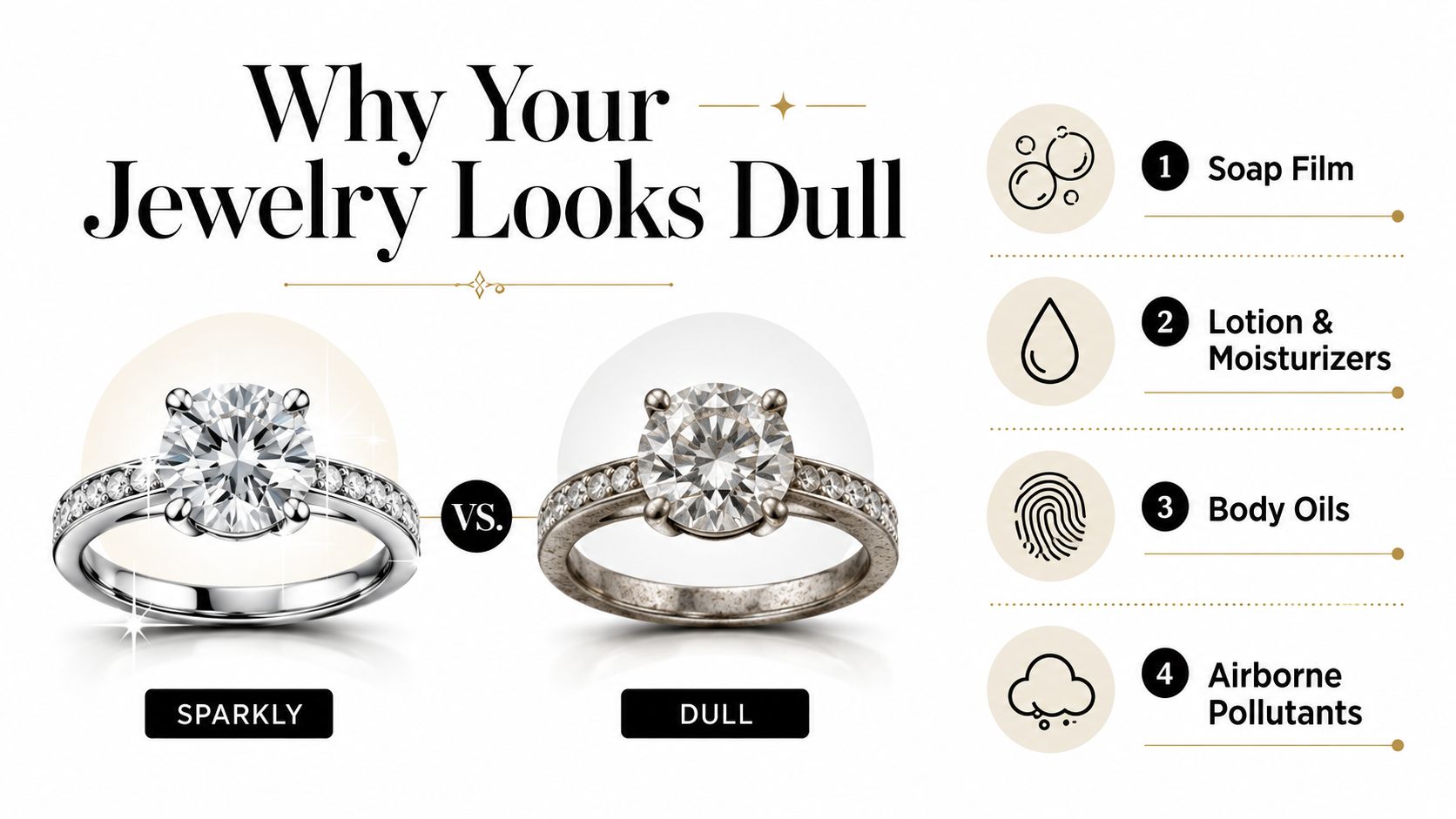
Daily wear leaves a surprisingly persistent coating on jewelry. Hand soap can dry into a film around prongs, moisturizer settles beneath rings, body oils cling to stones, and fine dust sticks to those oily surfaces. A diamond may still be reflecting light, but the residue scatters that light before it reaches your eyes.
A 2023 survey of more than 2,300 U.S. jewelry wearers found that 52% clean jewelry only when it looks dull or dirty, while 22% clean it monthly, 10% weekly, and 2% daily. One in six respondents said they never give jewelry a thorough cleaning. The same survey found that soap and water was the most common method, used by 25% of respondents, followed by polishing cloths at 17% and commercial jewelry cleaners at 11%. These findings support what many people discover at the sink: cleaning is often reactive, occasional, and based on inexpensive household methods. Research and Markets summarizes the jewelry-cleaning behavior survey.
Natural does not mean universally gentle
In practical jewelry care, “natural cleaner” can describe several very different approaches:
- Mild soap and water, which lifts oils and everyday residue.
- Plant-derived surfactants, which help suspend grease so it can rinse away.
- Citric acid, useful for limited tarnish treatment on suitable solid silver.
- Baking soda and salt, which can support a tarnish-transfer reaction on appropriate silver.
- Water-only ultrasonic systems, which rely on mechanical cleaning rather than a strong chemical formula.
The contrast is usually drawn against ammonia-heavy, alcohol-based, strongly fragranced, or otherwise aggressive commercial formulas. But the important distinction isn't just natural versus synthetic. The key question is whether the method is compatible with the jewelry.
A simple gold ring with a diamond can tolerate a different routine from a pearl pendant, an opal ring, or an antique piece with glued components. Start by identifying what you're cleaning and what kind of soil you're removing. Oil and soap film need a degreasing wash. Silver tarnish needs a different chemical approach. A porous stone needs restraint, not a stronger recipe.
The Material Compatibility Problem Behind Natural Cleaners
A natural ingredient can still damage jewelry. Citric acid, vinegar, baking soda, salt, and a stiff brush are common household tools, yet each creates a different risk for different materials. The deciding factor is whether the method is compatible with the jewelry.
Acids can attack sensitive materials
Citric acid and vinegar may help with limited tarnish on suitable solid silver. They are poor choices for pearls, opals, malachite, turquoise, coral, and other porous or delicate materials, however. Acid can affect a surface, change a finish, or enter vulnerable areas around a setting.
Alkalis and pastes can leave damage behind
Baking soda is milder than many commercial abrasives, but a paste still creates friction. Rubbing it across a polished surface, plated finish, or soft stone can produce fine scratches or remove surface material. Salt crystals add mechanical abrasion, especially when scrubbing replaces careful contact time.
Pressure matters as much as chemistry
A toothbrush can reach behind prongs, but force turns the bristles into an abrasive tool. Glued-in stones, antique settings, fracture-filled gems, and delicate surfaces may loosen or become marked after forceful brushing or prolonged soaking.
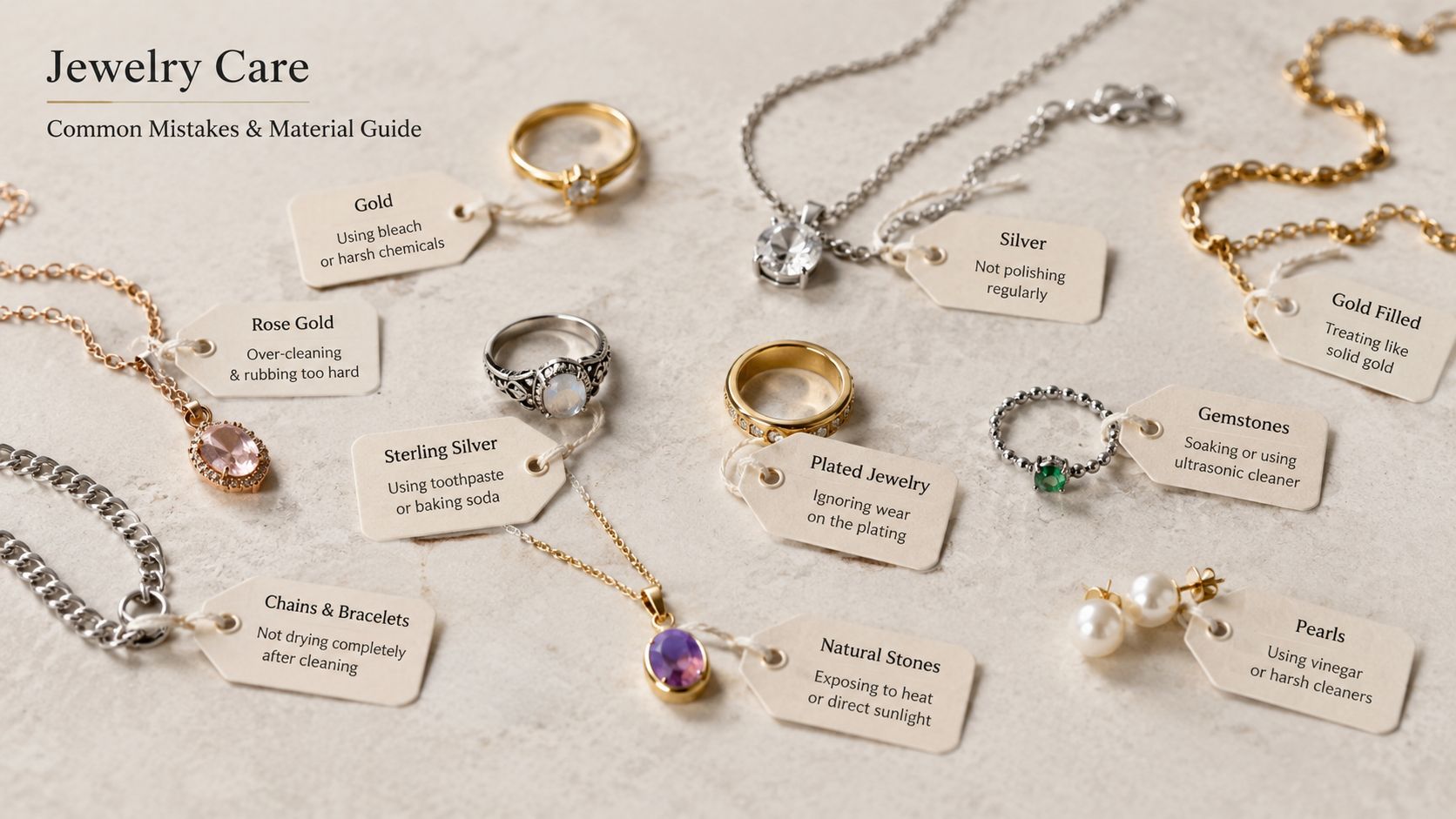
Practical rule: If you cannot identify the stone, finish, or setting method, use a barely damp soft cloth and ask a jeweler before applying a recipe.
Durable stones such as diamonds, sapphires, and rubies generally tolerate mild cleaning solutions when their settings are sound. That provides a safer starting point than cleaning porous stones, but it does not make every treatment suitable.
Hallmark stamps can identify the metal. Marks such as 925, 14K, 18K, or PT offer useful clues, but they do not show whether a stone is glued, treated, fracture-filled, or mounted in a setting requiring extra care. With an unusual mixed-metal piece, such as this two toned ring from Astro West, identify every metal and stone before choosing an acidic, abrasive, or ultrasonic method.
Test an inconspicuous metal area first, never the visible face of a gemstone. Stop if the surface changes, the cloth picks up unusual color, a stone moves, or the finish becomes cloudy.
The Mild Soap and Water Method That Handles Most Pieces
For durable jewelry with ordinary daily buildup, mild soap and water is the baseline I'd choose before experimenting with stronger chemistry. It loosens skin oils and cosmetic residue without forcing you to polish away the surface.
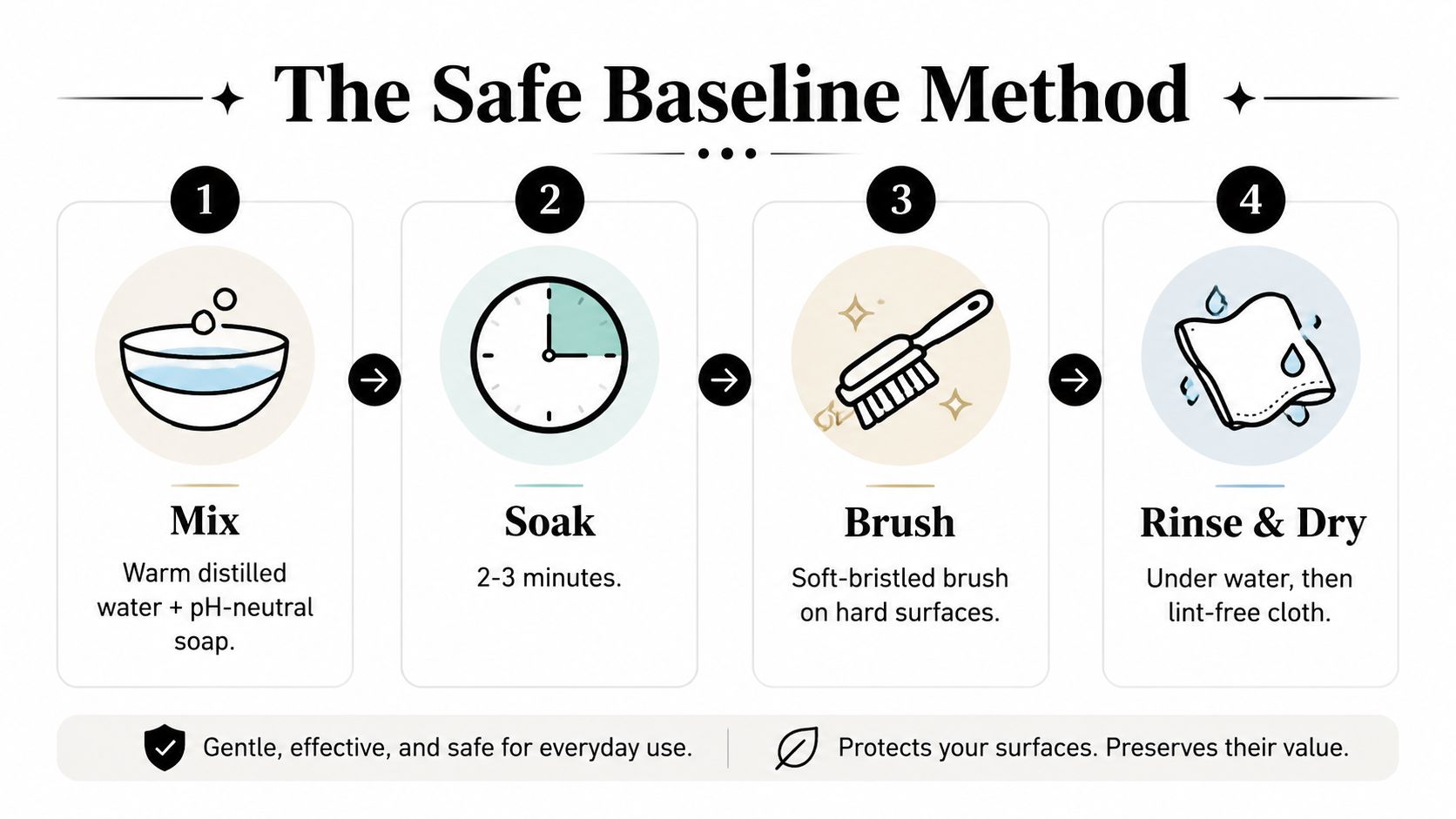
Use distilled water warmed to about 100–110°F, a few drops of pH-neutral dish soap, a soft-bristled brush, and a lint-free cloth. The warmth helps loosen residue, while the soap surrounds oils so clean water can carry them away.
A careful sink-side routine
- Prepare the bath. Mix the warm distilled water with a few drops of pH-neutral soap in a small bowl. Don't use boiling water, bleach, chlorine, or a strongly fragranced cleaner.
- Soak briefly. A short soak of 15–20 minutes can loosen film around the setting. For a piece with an uncertain construction, shorten the exposure and favor a damp cloth instead.
- Brush the structure, not just the stone. Use small circles behind prongs, beneath the stone, and around the edges of the setting. Let the brush do the work. Pressing harder won't make the solution safer or more effective.
- Rinse completely. Soap residue can leave its own cloudy layer and attract more dirt. Rinse with clean distilled water, or rinse over a bowl rather than an open drain.
- Dry immediately. Pat and buff with a lint-free cloth. Pay attention to crevices where trapped moisture can leave spots.
This method suits gold, platinum, most diamonds, sapphires, rubies, and plain solid sterling silver without soft stones, provided the settings are secure. It's also a sensible first test for many sturdy mixed-metal pieces, although plating and vulnerable stones still require caution.
The method won't solve every problem. Heavy tarnish, dense lotion buildup in filigree, and oil trapped under flush settings may remain after washing. For information about essential oils and cleaning applications outside jewelry, Aroma Warehouse's guide for spas and wellness centers provides broader household context, but essential oils shouldn't be added casually to a jewelry bath. They can leave a film, and fragrance doesn't improve material compatibility.
Targeted Natural Recipes for Sterling Silver Tarnish
Silver tarnish is different from the greasy film that makes a diamond ring look dull. A natural recipe can make sense here, but only when the piece is solid sterling silver and free from vulnerable stones, glue, lacquer, or delicate plating.
For light tarnish, dissolve 1 teaspoon of citric acid powder in 1/2 cup of distilled water. Use a short 1–2 minute soak, watch the piece rather than walking away, then rinse thoroughly and dry. This is a targeted treatment, not a general-purpose jewelry bath.
For moderate tarnish, line a non-metal bowl with foil. Add 1 tablespoon of baking soda, 1 tablespoon of sea salt, and 1 cup of near-boiling distilled water, then place the suitable silver in the solution for 3–5 minutes. Tarnish can transfer to the foil, leaving dark residue behind. Town & Country describes this foil, baking soda, and salt approach.
Compare the methods before choosing one
| Material | Mild Soap & Water | Citric Acid Dip | Baking Soda & Foil | Ultrasonic, Safe Pieces Only |
|---|---|---|---|---|
| Solid sterling silver | Suitable for everyday film | Suitable for light tarnish | Suitable for moderate tarnish | Suitable when the piece has no vulnerable stones or loose parts |
| Gold and platinum | Suitable for routine cleaning | Not a default choice | Not a default choice | Suitable when stones and settings are ultrasonic-safe |
| Diamonds, sapphires, and rubies | Usually suitable with a secure setting | Avoid unless a professional confirms compatibility | Avoid unless a professional confirms compatibility | Often suitable when untreated and securely set |
| Pearls, opals, malachite, and porous stones | Use a damp cloth or highly cautious spot cleaning | Avoid | Avoid | Avoid |
| Glued components, lacquered finishes, and vermeil plating | Avoid soaking unless the maker approves | Avoid | Avoid | Avoid |
Vinegar soaks don't improve this decision. They introduce another acid without giving you a universal solution, and they're particularly unsuitable for porous stones, glued components, plated finishes, and mixed-material jewelry.
Never use either silver recipe on pearls, opals, malachite, glued components, lacquered finishes, or vermeil plating. Copper alloys may respond to tarnish treatment, but the finish can vary, so test a hidden area and stop if the color changes unevenly.
Ultrasonic Cleaning With Natural Solutions Done Safely
An ultrasonic cleaner uses cavitation, the formation and collapse of microscopic bubbles, to dislodge grime from crevices a brush may not reach. That mechanical action can complement a low-residue, fragrance-free solution, but it doesn't make an unsafe gemstone safe.
For pieces approved for ultrasonic cleaning, fill the tank with warm water at about 100–110°F. Add 3–5 drops of a pH-balanced, ammonia-free cleaner, place the jewelry in the basket without crowding it, and run a short 3-minute cycle. Remove the items, rinse them with clean water, and buff them dry. The Sparkle Bright product guidance outlines this ultrasonic workflow and its material cautions.
Know what belongs in the tank
Diamonds, sapphires, rubies, solid gold, platinum, and plain silver bands may be suitable when they're securely constructed and free from problematic treatments. A secure setting still matters. Ultrasonic vibration can expose a loose prong or weak mount that hand washing might not disturb.
Keep pearls, opals, emeralds, turquoise, coral, antique stones, fracture-filled stones, treated stones, and glued pieces out of the tank. Avoid any item whose construction you can't verify. Emeralds deserve particular caution because treatments and internal features can make them vulnerable even when the stone looks hard and durable.
Cloudy residue after a cycle usually points to incomplete rinsing, too much cleaner, dirty tank water, or loosened grime redepositing on the surface. Drain the tank, rinse the jewelry separately, and buff it with a clean lint-free cloth. If cloudiness remains, inspect the finish and stone rather than repeatedly extending the cycle.
The attraction of a natural or low-chemical ultrasonic routine is convenience with less fragrance and residue. The limitation is just as important: ultrasonic cleaning is a compatibility decision first and a cleaning decision second.
Storage and Maintenance Habits That Reduce Heavy Cleaning
The easiest jewelry to clean is the jewelry that hasn't collected a thick layer of residue. Storage and wearing habits determine how much work reaches the sink.
Keep silver away from humid bathroom air when possible. Store individual pieces in anti-tarnish pouches or cloth bags instead of dropping everything into one shared box. A closed jewelry drawer with silica gel packets can help limit exposure to moisture and sulfur compounds, while separate compartments reduce scratching, tangling, and metal-to-metal contact.
Put jewelry on last. Apply lotion, perfume, makeup, and hairspray first, allow them to settle, and then fasten your pieces. Remove rings before swimming in chlorinated pools, washing with strong household products, or doing work that exposes them to grit.
After each wear, wipe the metal and stones with a soft cloth. This takes only a moment, but it removes skin oils before they combine with dust and dry into a harder film. For a deeper storage routine, use these expert tips for storing silver jewelry to prevent tarnishing.
A quick inspection rhythm
Run your finger lightly over prongs and clasps before putting on a valuable piece. Look for a stone that rocks, a prong that catches on fabric, a clasp that no longer closes firmly, or a gap beneath a setting that wasn't there before.
- Prongs: Check that none feel sharp, bent, or loose.
- Clasps: Confirm that the closure catches and stays shut.
- Settings: Look for movement, gaps, or a stone sitting at an unusual angle.
- Surface: Note sudden discoloration, flaking plating, or a cloudy finish.
A small repair can prevent a much more expensive loss. Don't clean a piece aggressively when the actual problem is a loose stone. Set it aside and have the setting inspected.
When a Natural DIY Mix Is Not Enough
Natural recipes have a clear place in jewelry care, but DIY isn't automatically the better answer. A mild wash may struggle with lotion packed into intricate filigree, oxidation settled into engraving, or oil trapped beneath a flush setting. Mixed-metal jewelry creates another complication, because the tarnished metal may tolerate acid while the neighboring finish or stone does not.
A purpose-built, fragrance-free ultrasonic solution can be useful for safe materials with stubborn buildup. Chelating agents bind with certain metal ions and help lift mineral or metallic residues so the tank's cavitation can carry them away. That doesn't mean a chelating formula should replace gentle hand washing, and it doesn't override a gemstone's care requirements.
The practical sequence is straightforward:
- Start with mild soap and water.
- Use a silver-specific natural treatment only for compatible solid silver.
- Move to a fragrance-free chelating ultrasonic solution for persistent buildup on pieces confirmed to be ultrasonic-safe.
- Send valuable, antique, loose, treated, or uncertain jewelry to a professional.
The broader jewelry-care category has room for this layered approach. One market forecast projects growth from about USD 900.37 million in 2026 to USD 1.277 billion by 2035, with a 3.96% compound annual growth rate, while another estimate places the category at roughly USD 1.4–2.2 billion in 2024 and projects 4.5%–6.5% annual growth through 2030. Separate research identifies cleaning solutions as the largest jewelry-care product segment, representing 38.4% of jewelry-care revenue in 2025, or about USD 1.08 billion. These estimates come from different market models, so they shouldn't be treated as interchangeable, but they do show sustained demand for practical jewelry-cleaning products. Industry Research presents the market estimates and segment data.
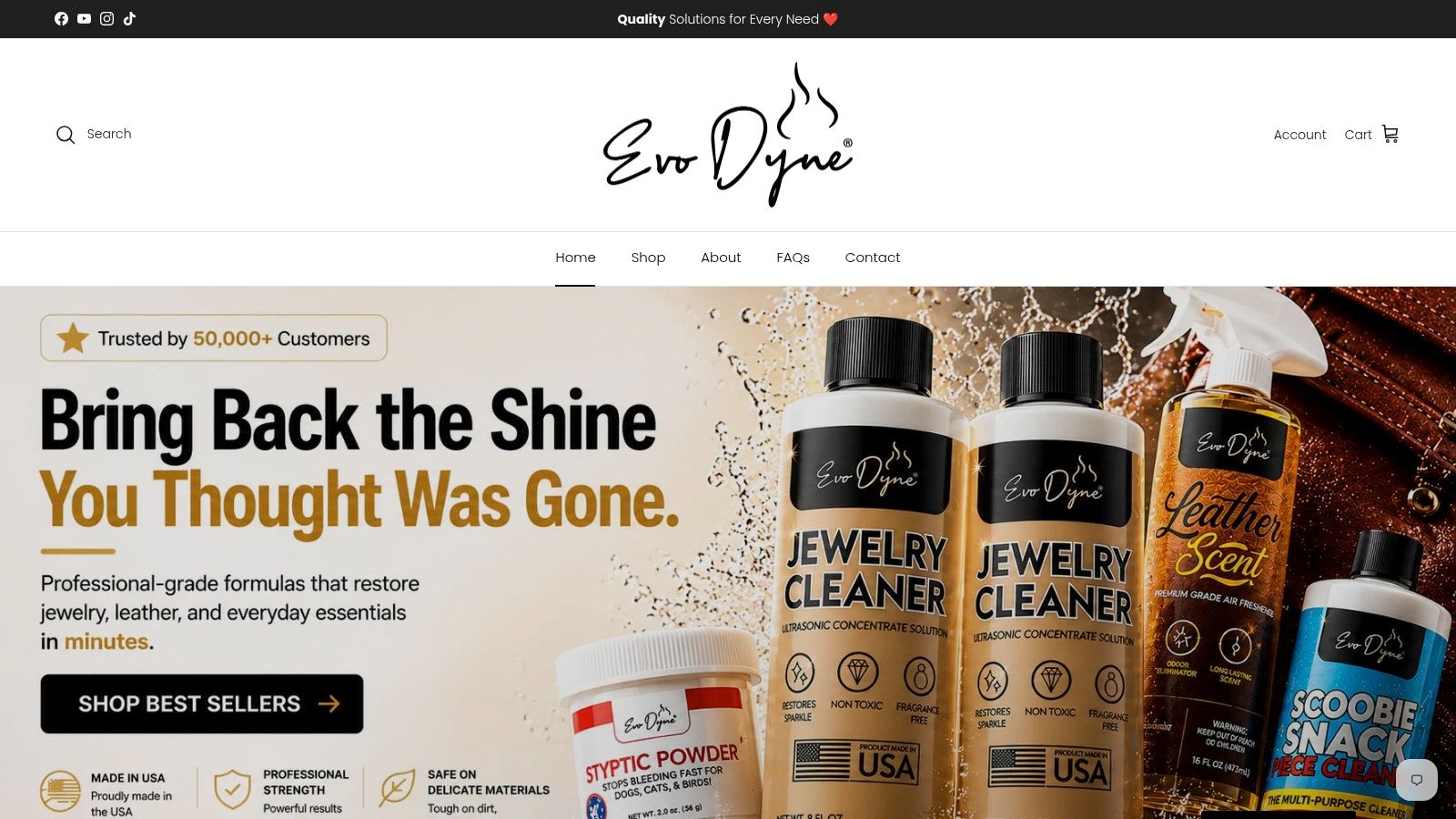
Evo Dyne Products offers fragrance-free ultrasonic jewelry-cleaner solutions formulated with a proprietary chelating agent for compatible diamond, gold, silver, and gemstone pieces. Visit Evo Dyne Products to choose a solution for your ultrasonic routine and keep your natural hand-cleaning method available for everyday maintenance.