


You wipe the refrigerator door, step back, and see a fresh set of streaks running through the fingerprints you meant to remove. The surface may look worse than it did before cleaning, even though the grime is gone. In most cases, the problem isn't the stainless steel. It's the wrong product, too much moisture, or residue left behind by the wipe.
Stainless steel wipes can be excellent for routine maintenance, but they aren't all designed to do the same job. Some clean, some polish, and some leave a protective film. Understanding that difference helps you avoid hazy finishes, unnecessary scrubbing, and chemical damage to the metal's passive surface.
Understanding What Stainless Steel Wipes Actually Do
A stainless steel wipe is a pre-saturated towelette designed to deliver a controlled amount of cleaning formula without a spray bottle, mixing step, or separate cloth. That convenience matters, but the wipe's real value depends on what its formula is engineered to accomplish.
Consider a refrigerator door with fingerprints and a faint water haze. A cleaning wipe should loosen and lift skin oils, grease, and mineral residue. A polishing wipe goes further by improving the reflective appearance and reducing visible smears. A protective wipe leaves a thin barrier intended to make future fingerprints easier to remove. Those functions overlap, but they aren't interchangeable.
Practical distinction: Cleaning removes what is already on the surface. Polishing improves the finish. Protecting changes how quickly new fingerprints and residue settle.
The confusion starts when a product label uses broad language such as “shine” or “fresh finish.” A wipe can make steel look brighter because it has spread oil across the surface, not because it has removed contamination. That temporary gloss may turn into dust attraction, greasy marks, or a cloudy film.
Match the wipe to the surface
For a lightly marked appliance, a low-residue cleaner may be all you need. If the door has an established film from previous products, you may need a mild initial wash followed by a purpose-made stainless steel cleaner. If you want fewer visible fingerprints between cleanings, choose a formula that explicitly describes a protective barrier and follow it with a dry buff.
The metal's brushed grain also matters. Wiping across it can push loosened material into the fine surface lines, creating the streaks you were trying to avoid. The same product can produce a clean finish or a smeared one depending on the direction and pressure of application.
For broader routines covering appliances, cloth care, and recurring household maintenance, cleaner maintenance advice can help you build a consistent system rather than relying on improvised fixes.
Before buying, check whether the product is intended for appliances, commercial equipment, coated finishes, or food-contact areas. A wipe marketed for appearance maintenance may not disinfect, and a product that leaves a barrier may not be appropriate where food touches the steel directly.
The Science of Pre-Saturated Cleaning Formulas
Pre-saturated wipes solve a practical chemistry problem: they deliver a ready-to-use formula in a consistent dose. That removes the uncertainty of adding too much water, using an overly concentrated homemade mixture, or applying a spray unevenly across a vertical appliance door.
Market data reflects the appeal of this format. One industry report estimates that wipes represented 24.6% of stainless steel cleaner market value, while the overall market was valued at $1.8 billion in 2025 and is projected to reach $2.8 billion by 2034, at a 4.5% CAGR. The same stainless steel cleaner market report identifies pre-saturated wipes as a growing format, with a projected 5.8% CAGR, because they eliminate mixing and storage while providing consistent dosing for homes, healthcare, and food service.
The demand also follows the spread of stainless steel equipment. The report connects category demand with 42 million stainless steel appliance units shipped globally in 2025, a year-over-year increase of 5.8%. More high-finish appliances create more situations where users need quick, controlled surface care rather than a bucket, spray bottle, and separate measuring step.
Why formulation matters
Stainless steel readily attracts organic films and microscopic particles. Finger oils, food grease, dust, and residue can remain in surface texture even when the metal looks clean from a distance. A wipe formula combines liquid chemistry with mechanical action. The chemistry loosens or dissolves soil, while the textile lifts it away.
DIY mixtures can work for limited tasks, but they often lack controlled surfactant balance and may leave acidic, oily, or mineral residue. A prepared wipe is not automatically safe or effective, though. The label, compatibility guidance, and final drying step still determine whether the formula helps or creates another film.
A good wipe should leave enough moisture to suspend contamination, but not so much that liquid pools around handles, seams, or control panels. If the surface stays visibly wet, the user has probably applied too much product or needs a separate dry cloth.
Proper Wiping Technique and Residue Control
The wipe itself can't compensate for poor mechanics. Stainless steel finishes show every direction change, excess drop of liquid, and oily pass, especially under bright kitchen lighting.
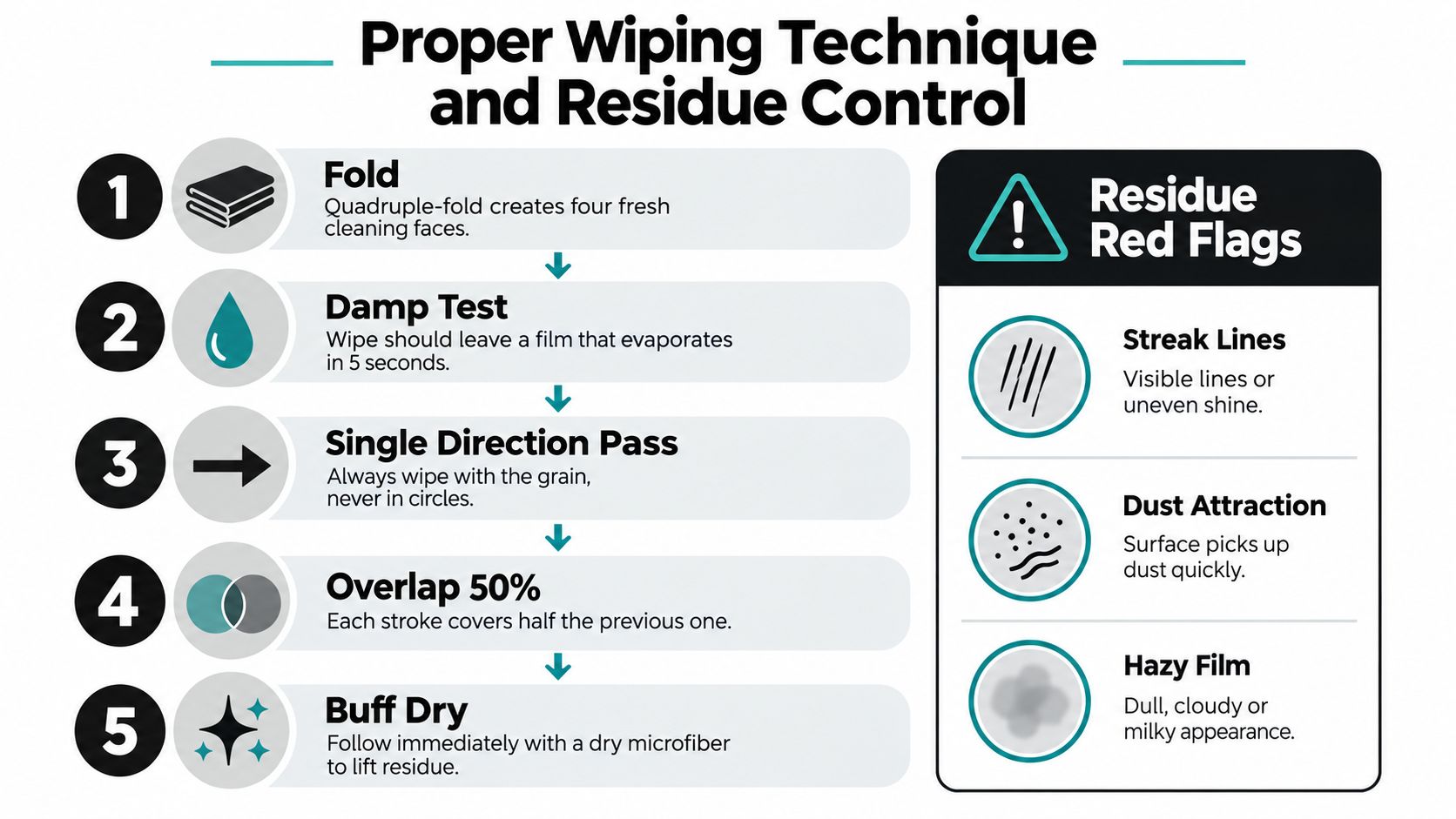
Start by inspecting the grain. Move the appliance into good light and look for the fine parallel lines in the brushed finish. They may run horizontally or vertically, and you should follow that direction throughout the cleaning pass.
Use the wipe as a lifting tool
- Remove loose soil first. Brush away crumbs and abrasive particles before wiping. Dragging grit across the finish can create fine scratches.
- Fold the wipe when possible. A folded wipe gives you fresh faces as one side becomes loaded with grease. Don't keep pushing a contaminated section across the door.
- Work in manageable sections. Wipe from one edge toward the other with smooth, overlapping strokes. Moderate pressure is enough. Pressing harder can spread residue into the brushed texture.
- Follow the grain. Keep each pass parallel to the visible lines. Avoid circular scrubbing, which crosses the grain repeatedly and makes leftover film more noticeable.
- Dry-buff immediately. Use a clean, dry microfiber cloth to remove moisture and remaining formula. Buff with the grain on the final pass, especially around handles and edges where liquid collects.
Leaving a wet stainless surface to air-dry is an invitation to streaks, water spots, and uneven residue.
Residue control is more than a cosmetic concern. Technical guidance on stainless surfaces notes that the metal can adsorb organic material and micron-sized particles, meaning a poor wipe technique may redistribute contamination rather than remove it. For a specific black-residue problem, that guidance identifies mechanical wiping with an alkaline cleaner as the most effective approach, while chemical cleaning, passivation, and hydrojetting were described as rarely effective for that residue. The technical discussion of stainless residue removal also illustrates why the combination of chemistry and physical wiping matters.
Know when the wipe is spent
Replace the wipe when it becomes visibly dirty, dries out, or begins dragging instead of gliding. A dry wipe may push particles around, while an overloaded wipe can redeposit grease. Use a separate dry microfiber for buffing, not the same saturated textile used to loosen the soil.
If streaks remain, don't immediately scrub harder. First ask whether the wipe is leaving a film, whether the cloth is contaminated, or whether the surface has an existing coating that reacts poorly to the formula. A small test area is safer than treating the entire appliance.
Comparing Wipes to Sprays and DIY Cleaners
No single format wins every cleaning job. Wipes are convenient for fingerprints and quick touch-ups, while sprays and concentrates can make more sense for large equipment or heavy soil. Oils may create a temporary shine, but they can also leave a surface that attracts dust and requires another cleaning pass.
| Cleaning Method | Convenience | Residue Risk | Surface Safety |
|---|---|---|---|
| Pre-saturated stainless steel wipe | Ready to use and portable | Low to moderate, depending on formula and drying | Good when labeled for the finish |
| Stainless steel spray | Flexible coverage for larger areas | Moderate if over-applied or not buffed | Good when compatible and used sparingly |
| Mild soap and water | Useful for heavier greasy soil | Moderate if soap isn't rinsed away | Generally suitable when rinsed and dried |
| Oil-based polish | Creates shine and may add a barrier | High if applied heavily | Finish-dependent, test first |
| Vinegar-based DIY mixture | Easy to prepare | Can leave odor or uneven residue | Repeated acid exposure may dull some finishes |
| Water alone | Simple but limited | Mineral spotting as it dries | Usually gentle, but drying is essential |
A spray gives you more control over coverage, but it also makes over-application easy. Never flood seams, touchscreens, electrical controls, or door gaskets. Apply a small amount to a cloth when the product instructions permit it, then work in sections.
Wipes make more sense when you need a fast maintenance pass on a refrigerator handle, dishwasher front, elevator panel, or other high-touch surface. They also reduce the temptation to mix a strong homemade solution. Their drawback is waste and limited coverage on large surfaces.
Cloth choice still matters
A clean microfiber cloth remains useful for rinsing, drying, and buffing. In commercial settings, selecting durable commercial kitchen dish cloths can help separate greasy work from final polishing, but any cloth used on visible stainless steel must be clean, non-abrasive, and free of detergent buildup.
For product-specific considerations around cleaner and polish combinations, see this guide to stainless steel cleaner and polish. The important comparison isn't just price or speed. Consider the soil level, finish type, amount of surface area, and whether the product leaves protection that suits the environment.
Choosing Safe Wipes for High-Finish Surfaces
A label that says “stainless steel safe” deserves closer inspection. Stainless steel isn't a single finish with identical chemistry. Appliance panels, food-service equipment, polished components, coated surfaces, and industrial grades can respond differently to the same formula.
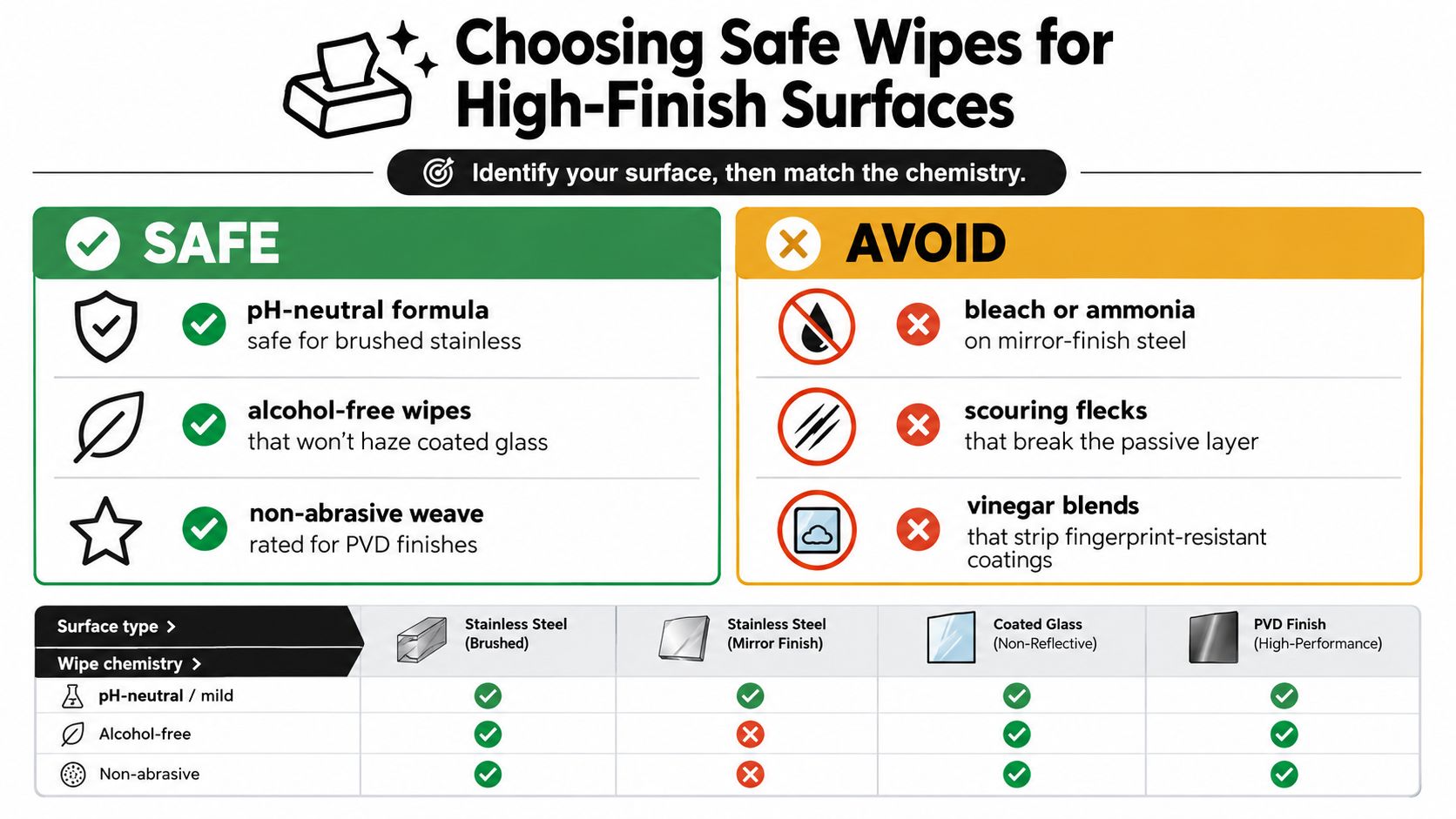
The passive chromium oxide layer is what gives stainless steel much of its corrosion resistance. Chloride-containing cleaners can attack that protection and contribute to pitting, particularly when residue remains wet against the surface. That makes chloride-free chemistry a practical buying requirement for routine care, not a marketing detail.
Read the label beyond the headline
Look for compatibility with the exact material and finish, low-residue language, and instructions covering drying or buffing. A technical bulletin for a disinfecting wipe lists compatibility with stainless grades including 316 and A2, while also advising users to rewet and immediately dry the surface if streaking or residue appears. The PURELL surface disinfecting wipe technical bulletin supports a simple rule: compatibility claims don't remove the need for correct application and drying.
Avoid abrasive particles, steel wool, scouring pads, and unverified mixtures containing bleach or strong acids. Ammonia and bleach also create problems for many appliance finishes and should not be treated as universal stainless-steel solutions. If the surface has a fingerprint-resistant coating, follow the appliance manufacturer's care instructions before using any polish or protectant.
Test before committing
Apply the wipe to a hidden edge or inconspicuous area. Let the area dry, then inspect it under angled light for haze, color change, tackiness, and streaking. If a residue appears, rewet the area with a compatible cleaner or water as directed by the product label, then dry it immediately with a clean cloth.
For healthcare or commercial users, disinfection adds another layer of complexity. If you need to find a disinfectant that won't rust steel, check both the disinfectant claim and the material-compatibility instructions. A wipe may be safe for stainless steel while still being unsuitable for direct food-contact surfaces or coated panels.
Hygiene Expectations and Food Safety Realities
A stainless steel wipe that removes fingerprints isn't automatically a disinfectant. Cleaning improves appearance and removes soil, but sanitizing or disinfecting requires a product specifically labeled and used for that purpose. Many polish-oriented wipes are intended for appearance maintenance and may not be approved for direct food-contact surfaces.
The distinction matters most around cutting boards, prep tables, refrigerator interiors, and food-service equipment. If the label excludes food-contact use, don't treat the wipe as the final step on a surface where food will touch. Follow the product instructions, and use a suitable food-contact cleaning or sanitizing process when required.
What the research shows
A peer-reviewed study on home environmental surfaces reported stainless steel cleaning effectiveness of 98.69% for bleach and 90.04% for another effective product, with both meeting a minimum standard of at least 85% removal. The same evidence summary reported a 59.41% reduction for a DIY cleaner. These figures come from the stainless steel wipes market evidence summary, and they shouldn't be interpreted as proof that every wipe disinfects.
A separate food-industry study reported median bacterial-count reductions between 36.34% and 41.33%, depending on stainless finish. Cleaning with alkaline detergent produced reductions between 41.57% and 58.33%, compared with 12.95% to 30.55% using water alone, according to the same evidence summary. The practical lesson is straightforward: chemistry and technique affect soil removal, but cosmetic cleaning and verified disinfection remain separate tasks.
For a kitchen routine, remove visible grease first, use a product approved for the intended surface, respect any required contact time, and prevent chemical residue from contacting food. Dry the steel after cleaning. A polished appearance is useful, but it isn't a substitute for following the label and your food-safety procedure.
Evo Dyne Products offers maintenance solutions for household and professional users, including metal-care products and guidance for stainless-steel cleaning applications. Visit Evo Dyne Products to review its available solutions and choose the product format that fits your surface-care routine.