


Your dog is already wet, the shampoo bottle says concentrate, and you're trying to hold a slippery collar while deciding how much water to add. A splash feels easier than measuring, especially when your dog is ready to leave the tub.
Learning how to dilute dog shampoo starts with a less exciting but more useful step: reading that particular bottle. Dilution can help shampoo spread through the coat and rinse away, but there's no universal ratio. Ready-to-use shampoo stays as packaged, medicated formulas need their own directions, and any diluted mixture belongs to today's bath, not next month's.
Table of Contents
- Dilution Ratios That Match the Bottle
- How to Mix and Rinse One Bath
- Contact Time for Medicated and Thick Coats
- Mix Fresh and Skip Stored Dilution
- Itching Residue and Other Bath Problems
- Check the Label Before the Next Bath
Dilution Ratios That Match the Bottle
Two bottles can sit side by side on the grooming shelf and still call for completely different amounts of water. The table below sorts the common label situations so you can find the row that matches the bottle in your hand.
Dog shampoo dilution by product type
| Product type | Ratio | What to measure | Contact time | Use this row when |
|---|---|---|---|---|
| Medicated shampoo | Only what that product's label or your veterinarian specifies | The shampoo amount and water volume named in those directions | Only the contact time those directions give | Any medicated or prescription-strength formula |
| Predilution for spread and less sting | About 1:5 to 1:10, shampoo to water | 1 part shampoo plus 5 to 10 parts water | Follow that bottle | Product-specific guidance calls for this weaker mix |
| Weight-dosed medicinal example | Fixed dose into 300 ml warm water | 30 ml at 1.5–5.0 kg; 50 ml at 5.1–15.0 kg; 70 ml at 15.1–30.0 kg | 2 minutes for that formula only | Your bottle carries these exact weight-based instructions |
| Non-medicated, label silent | Equal parts, or 1–2 tablespoons in 2 cups water | Matching volumes, or the stated spoon-and-cup preparation | Follow application directions; don't borrow a medicated timer | Ordinary grooming shampoo permits dilution but gives no ratio |
| Ready-to-use | Do not dilute | Use as packaged | As labeled | The bottle says ready to use |
Notice what the table doesn't give you: a default ratio for medicated shampoo. There isn't one. A medicated formula gets diluted only as its own label or your veterinarian directs, and a medicated label that stays silent on dilution is a reason to call the manufacturer or your veterinarian before adding a drop of water.
These are product categories, not interchangeable recipes. The authorized veterinary shampoo instructions illustrate why the formulation matters: the weight-dosed example uses 30, 50, or 70 ml of shampoo in 300 ml of warm water, rather than a single strength for every dog.
For ordinary non-medicated grooming products, Whole Dog Journal's bathing guidance gives examples ranging from equal parts water and shampoo to 1–2 tablespoons of shampoo in 2 cups of water. Those examples aren't permission to dilute a ready-to-use bottle or alter a prescribed treatment.
Read which ingredient comes first
A ratio without ingredient names is easy to misread. Some bottles put water first, while others put shampoo first. Write the ingredient names beside the ratio before reaching for a measuring jug.
A part is a matching unit of volume, the same way a recipe's "one cup" works with whatever cup you grab first. Pick one small measure, then use that same measure for every ingredient. Don't measure shampoo with a large cap and water with a smaller one.
The total mixture includes both ingredients. Adding shampoo to a measured volume of water isn't the same as adding enough water to reach a final fill line. If the label says "add to water," measure the water separately rather than treating the final mixture as the water allowance.
Practical rule: Choose the instructions that match your bottle, not the row that sounds gentlest.
Let the formulation set the decision
Start with whether the product is ready-to-use, concentrated, or medicated. Then use the dog's weight only if that label supplies weight bands. Adjust for a skin condition only when the label or your veterinarian explicitly tells you to.
More water isn't automatically gentler. With a treatment shampoo, extra dilution changes the amount of active ingredient reaching the skin, which can undercut the reason the product was recommended. Extra concentrate doesn't make a routine bath more thorough either; it makes even distribution and complete rinsing harder.
If the bottle is unclear, pause before wetting the dog. Ask the manufacturer to clarify the ratio, and ask your veterinarian whenever medication is involved.
How to Mix and Rinse One Bath
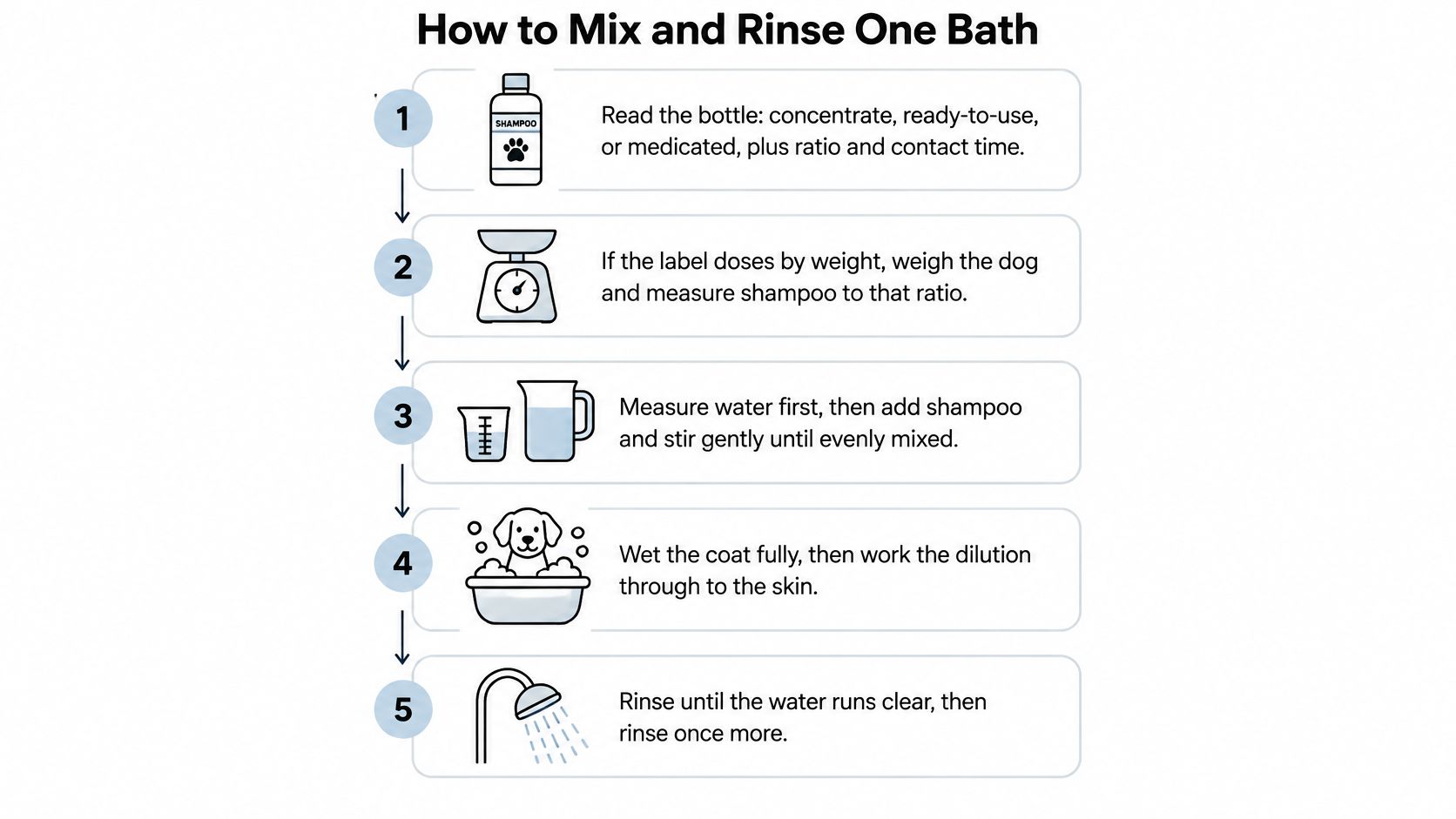
Set a graduated jug, a clean mixing bottle, towels, and a timer beside the tub before bringing your dog in. Keep the original shampoo bottle within reading distance so you don't have to remember its directions while managing a wet dog.
The veterinary medicinal shampoo specification describes the essential sequence: wet thoroughly, apply the prepared mixture in small amounts, massage through the coat while avoiding facial openings, maintain the product's contact time, and rinse completely. Its two-minute contact time belongs only to that formulation, not to every medicated shampoo.
Follow a measured routine
- Read before pouring. Identify whether the bottle contains concentrate, ready-to-use shampoo, or a medicated formula. Write down the dilution direction and contact time so you won't have to handle a slippery bottle mid-bath.
- Check any weight-based dose. If the instructions use body-weight bands, use your dog's current weight and that product's specified amount. Don't borrow a dose from another brand just because both bottles say medicinal shampoo.
- Prepare a clean container. Use a washed, fully dry jug or dilution bottle and lukewarm water. A narrow-spout bottle can help you place small amounts through dense fur without dumping the mixture over the dog.
- Measure both ingredients separately. Follow any mixing order printed on the label. Otherwise, measuring water into the container before adding the measured shampoo can make gentle mixing easier without producing an overflowing head of foam.
- Stir or gently invert until uniform. Look for thick shampoo collecting at the bottom or clinging to the container wall. Don't assume a foamy top means the concentrate underneath has blended.
- Wet the coat all the way through. Part dense fur with your fingers and check that water has reached underneath. A wet outer layer can hide dry hair close to the skin.
- Apply small amounts and massage with fingertips. Work from the neck toward the tail, distributing the mixture through the coat rather than leaving it on top. Keep shampoo away from the eyes, nostrils, mouth, and ear canals; don't scrub with your nails.
- Time, then rinse thoroughly. Use the bottle's contact-time instructions and keep your dog supervised. Rinse methodically, including beneath the chest, between the legs, and under the tail, where product can remain unnoticed.
Keep this visual beside your bathing supplies if it helps you follow the sequence.
Check the coat rather than chasing bubbles
A large pile of lather isn't the goal. You want the correctly prepared product distributed where the instructions say it should go, followed by a complete rinse. Don't add another squeeze of concentrate just because the foam looks modest.
Applying concentrate directly when the label calls for dilution can leave thick patches that are difficult to move through dense fur. If you notice uneven distribution, don't improvise a stronger second application. Finish safely and correct the preparation for the next bath.
For help arranging the tub, handling your dog, and preparing towels, use our guide to bathing a dog at home. Good preparation lets you focus on the label and your dog rather than searching for supplies with wet hands.
Contact Time for Medicated and Thick Coats
Contact time is part of the treatment instructions, not an optional waiting period. The MSD Veterinary Manual describes common medicated shampoo dilution of 1 part shampoo to 3 or 4 parts water and, for some products, approximately 10 minutes of contact before rinsing, while giving priority to product-specific or veterinary directions.
A dense coat makes skin access especially important. The aim is to place the prepared shampoo where it's intended to work, not to cover the outer hair with bubbles.
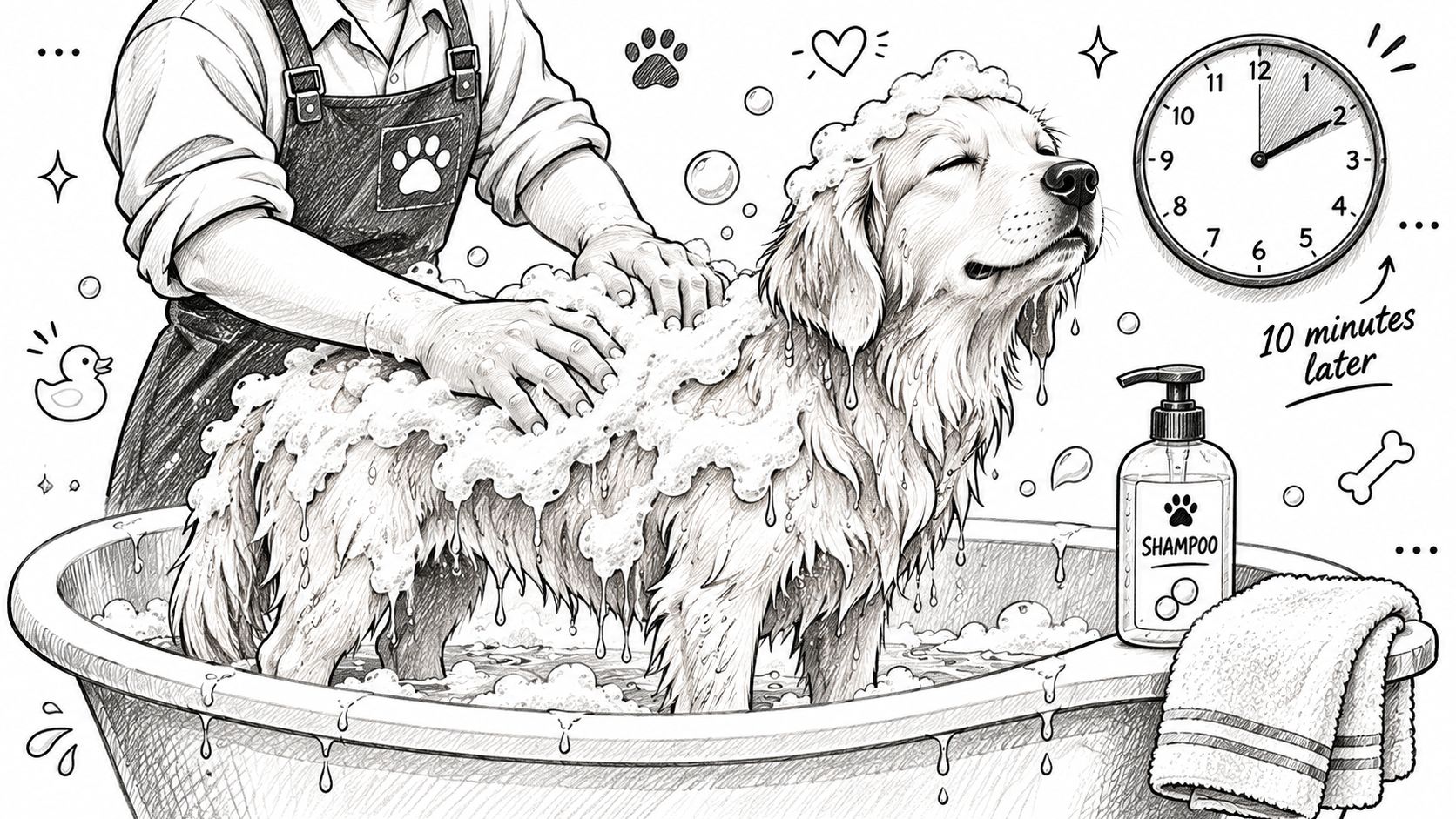
The formula determines the clock
A short-haired dog doesn't automatically need less contact time. Short hair may make application easier, but it doesn't change the treatment directions. You still need to avoid the eyes, nose, and mouth, and rinse as instructed.
A medium-length coat doesn't justify choosing a middle-of-the-road timer, either. If the label provides a contact-time range, follow the specific direction your veterinarian has given within that range. Don't select a time based on how much foam remains.
For a double-coated dog, the extra work is reaching the skin and removing the product afterward. Thorough wetting and careful distribution help prevent the outer coat from receiving most of the mixture while the skin underneath receives little.
Don't compensate for an uncertain dilution by leaving the shampoo on longer.
Changing both strength and time makes it harder to know what treatment the dog received. If you accidentally prepare the wrong dilution, ask for product-specific advice rather than inventing a longer or shorter soak.
Give thick coats a deliberate rinse
Separate the hair with your fingers while rinsing, especially around the ruff, chest, hindquarters, and other dense areas. Direct clean water through the coat instead of letting it run only over the surface.
Continue until the water is clear and no product remains, then make another careful pass through thick areas. Leftover shampoo can irritate skin, so a dog that looks clean may still need more rinsing beneath the outer hair.
This bathing demonstration can help you visualize handling and rinsing, but your bottle still determines the dilution and timer.
Keep your dog comfortably supported throughout the wait. If your dog becomes distressed or develops irritation, don't force completion of a timer at the expense of safety. Rinse and contact your veterinarian for guidance about completing or changing the treatment.
If written veterinary directions differ from the packaging, clarify the discrepancy with the prescribing clinic. Don't average the instructions or switch between them from bath to bath.
Mix Fresh and Skip Stored Dilution
A half-used bottle of diluted shampoo may look like a useful head start, but it's not a dependable supply for the next bath. Adding water changes the storage situation, so treat preparation and cleanup as hygiene tasks.
A study of dog-grooming products found diluted products were significantly more frequently contaminated than undiluted products, with an odds ratio of 15.5. That finding supports a practical precaution: prepare what you need immediately before use rather than keeping a diluted bottle in the shower.
Keep the concentrate and working mixture separate
Leave undiluted shampoo in its original labeled container with the cap closed. Use a separate, clearly identifiable container for the bath mixture so nobody mistakes diluted leftovers for the original product.
Don't pour unused dilution back into the concentrate. Don't top up an old mixture with fresh shampoo or water, either. Those shortcuts make it difficult to know what's in the bottle and carry material from the old mixture into the new preparation.
A clean container means more than an empty container. Remove old product from the bottom, threads, cap, and dispensing tip. Rinse thoroughly and let every component dry before putting it away.
Storage reminder: A mixture that still smells like shampoo isn't proof that it's safe to keep.
Cloudiness or an unusual smell is reason to discard a mixture, but the absence of those changes doesn't establish safety. Don't use appearance as a substitute for fresh preparation.
Keep this checklist with your dilution bottle.
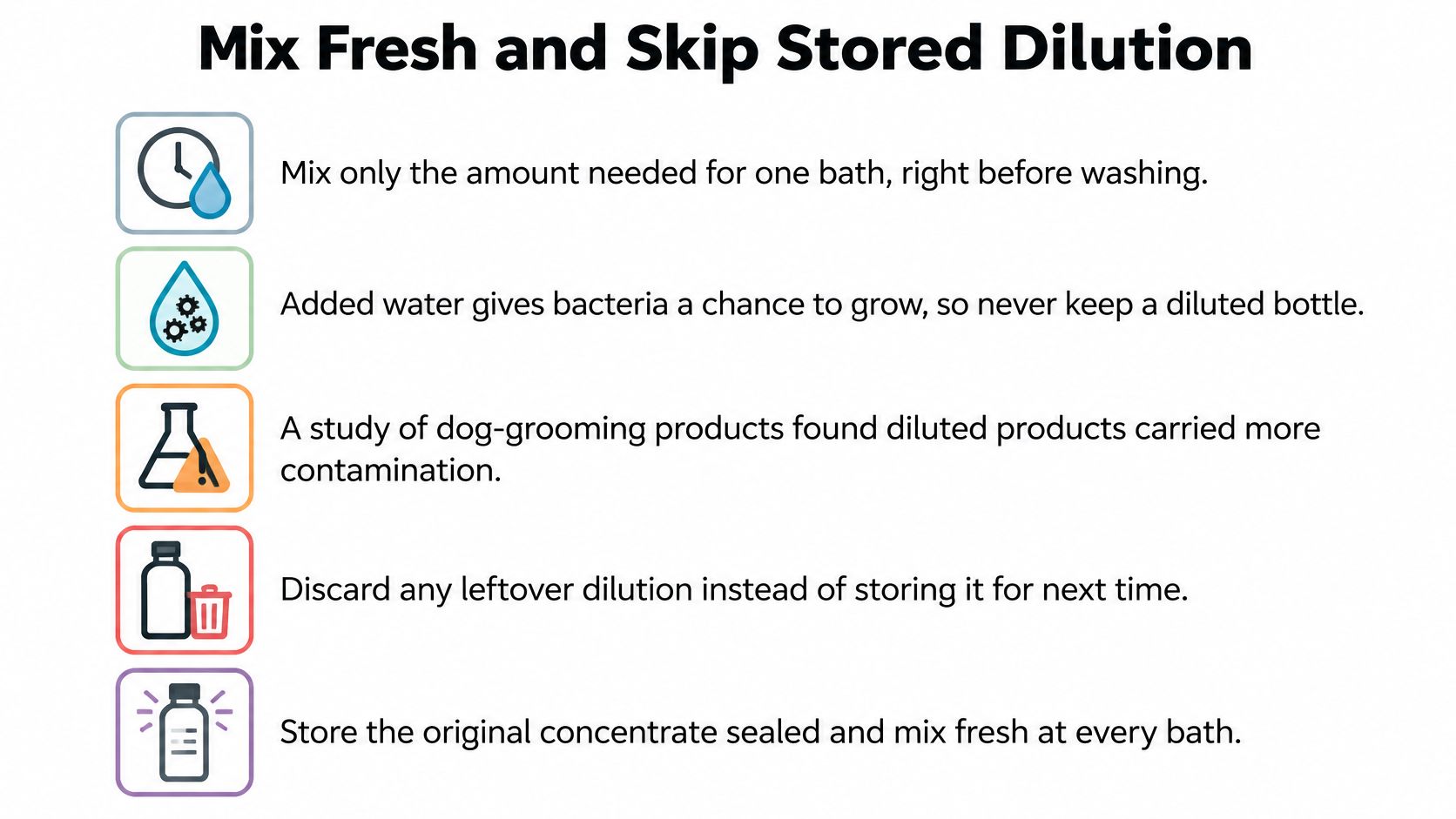
Before and after the bath
- Mix immediately before washing. Use lukewarm water and a clean, dry container, rather than preparing a warm bottle and leaving it on a windowsill.
- Prepare only the needed amount. Measure a manageable batch using the permitted ratio. If more is necessary, make a fresh batch with clean equipment.
- Discard leftovers after use. Follow any product-specific disposal instructions, especially for medicinal products. Don't leave the mixture overnight for another bath.
- Clean the whole bottle. Wash the container and its removable parts so old shampoo isn't trapped beneath a cap or in a nozzle.
- Dry before storing. Let the bottle, cap, and dispensing parts dry completely before reassembling them.
- Keep the original sealed. Store the concentrate separately from the cleaned mixing equipment and according to its label.
If someone else bathes the dog, explain which bottle is the original and which is only a mixing container. An unlabeled squeeze bottle invites guessing about strength, ingredients, and storage history.
Finish cleanup while the bath is still fresh in your mind. An empty, clean, dry container is a better starting point than a saved mixture whose age nobody remembers.
Itching Residue and Other Bath Problems
Leftover shampoo is a practical first thing to check when a dog seems uncomfortable after bathing, especially beneath dense fur. It isn't the only possible cause, though. New redness, swelling, or persistent scratching shouldn't be dismissed as ordinary residue.
Veterinary dermatology guidance describes predilution in approximately 5 to 10 parts water to improve spreadability and reduce localized irritation, while emphasizing fresh preparation and complete rinsing. That doesn't make this weaker preparation appropriate for every medicated bottle.
Bath problems and the next fix
| What you see | Likely cause | Next action |
|---|---|---|
| Itch or dry skin after an otherwise normal bath | Possible surfactant left in the coat; other skin problems remain possible | Rinse again thoroughly, including beneath a double coat |
| Patchy lather or sticky feel | Concentrate on dry fur or an uneven mix may have distributed poorly | For the next bath, pre-wet fully and measure both ingredients |
| Medicated results seem weaker | Dilution beyond the label may have changed treatment delivery | Check the printed ratio with the prescribing veterinarian |
| Redness, swelling, or scratching that persists | Irritation or a reaction | Stop home treatment and call a veterinarian |
| Shampoo in the eye | Accidental exposure during application or rinsing | Flush promptly with clean water and contact your veterinarian |
| Mix smells off or sat overnight | Diluted product has been held instead of freshly prepared | Discard it and clean and dry the mixing container |
Separate a rinse problem from a skin problem
If you suspect retained shampoo, rinse rather than adding another cleanser. Work clean water beneath the hair and pay attention to places where the coat presses against the body. Don't scrub irritated skin to make it feel cleaner.
Persistent itching needs a different response. A dog can have an underlying skin condition, a reaction to the product, or another problem that dilution won't solve. Repeated baths can also make it harder to identify which change caused the discomfort.
Our guide to dog skin irritation relief can help you organize the symptoms and practical care questions to discuss with your veterinarian. It shouldn't replace an examination when the skin is red, swollen, painful, or persistently itchy.
Don't troubleshoot medication by guesswork
If you added extra water because the shampoo seemed strong, tell the prescribing clinic exactly what you measured. Don't repeat the bath at a stronger concentration to make up for it, and don't lengthen the next contact time without instructions.
A greasy or sticky coat doesn't identify a single cause on its own. Check how the mixture was prepared and applied, but don't assume the dog needs a harsher cleanser. The useful correction may be better wetting and distribution rather than more product.
Eye exposure deserves prompt attention. Flush with clean water without directing a forceful jet into the eye, and contact your veterinarian for advice, particularly with a medicated product. Squinting, redness, rubbing, or ongoing discomfort warrants urgent assessment.
Don't substitute human shampoo, dish soap, or a neighbor's prescription bottle to see whether the next bath goes better. Their formulations and instructions don't transfer to the product your dog was supposed to receive.
Check the Label Before the Next Bath
Before turning on the faucet, make the instructions easy for everyone in the household to follow. A strip of tape on the bottle can prevent the familiar bath-day question of whether somebody already diluted it.
Keep the original label visible. The tape is a quick reference, not a replacement for warnings, application directions, or veterinary instructions.
Make a clear bottle note
Write these details in plain language:
- Product form. Mark concentrate, ready-to-use, or medicated, using the description on the packaging.
- Mixing instruction. Write the ingredient order explicitly, such as shampoo followed by water, or copy the weight-based dose when the product uses one.
- Contact instruction. Record the printed contact time or the prescribing veterinarian's direction.
If an instruction is missing or ambiguous, don't fill the gap with a ratio remembered from another bottle. Ask the manufacturer about ordinary grooming shampoo and the prescribing clinic about treatment shampoo.
Keep the measuring tool with the bathing supplies so the person doing the next bath doesn't have to improvise with an unmarked cap. Store the clean mixing container empty, with no leftover dilution inside.
Watch the dog as well as the timer
A timer helps you follow directions, but your dog's condition still matters more than completing a routine. Notice whether your dog starts rubbing the face, scratching intensely, or reacting painfully to touch.
Contact your veterinarian the same day for redness, swelling, scratching that doesn't settle, or shampoo exposure to an eye. Severe swelling, breathing difficulty, or significant eye pain requires urgent veterinary care. Don't try another dilution as the next experiment.
Keep separate grooming tasks separate, too. Styptic powder is for minor grooming nicks, not bath-related skin irritation. If you use our styptic powder, apply a small amount with a clean, slightly moistened applicator and gentle pressure until bleeding stops.
A successful bath doesn't require the strongest mixture or the biggest lather. It requires the right product instructions, measured preparation, appropriate skin contact, and careful observation. Leave the bottle note legible, the mixing container clean and dry, and any unresolved skin concern with your veterinarian rather than another home experiment.
At Evo Dyne Products, we offer pet-care products and practical guidance to help you use the right product the right way. Visit Evo Dyne Products to explore our pet-care range and grooming guides, and keep your shampoo's own label as the starting point for every bath.
