

The dog found something dead in the yard an hour ago, and the back seat of the car now smells like it. You have a bottle of something, a towel, and a dog backing toward the door. Most home baths get decided in that moment, and the ones that go wrong rarely fail because of the shampoo. They fail on a wet tub floor with no grip, cleanser left deep in a double coat, water sitting in an ear canal, or a coat still damp to the skin four hours later.
Bathing a dog at home is a short list of skills that shifts with the dog in front of you. A husky and a poodle don't share an interval, a puppy and a twelve-year-old Labrador don't share a technique, and a dog with allergies is a different job from a dog that rolled in something. What follows is how to bathe a dog at home in the order that works: frequency first, then setup, handling, the wash, the fixes for the usual failures, and the point where a vet takes over.
Table of Contents
- How Often Your Dog Really Needs a Bath
- Gather Supplies and Set Up the Bathroom
- Calming a Nervous Dog and Preventing Slips
- Step-by-Step Dog Bath at Home
- Bath Problems and Quick Fixes
- When Bathing Becomes a Vet Question
How Often Your Dog Really Needs a Bath
No fixed calendar survives contact with a real dog. Coat type, lifestyle, age and skin health set the interval, which is why the VCA guidance on grooming and coat care treats bathing frequency as a judgement call rather than a rule. The default worth carrying in your head is every 6 to 8 weeks for a healthy dog with a continuously growing coat, no skin disease, and a life spent mostly on sidewalks.
Everything else is an adjustment to that baseline. A dog that swims, finds something decomposing, or soils itself needs a bath after the event, not on a schedule. Heavy double-coated breeds do better with fewer baths and far more brushing, especially through the spring and fall coat blow. A dog with an oily coat can go as often as once a week, provided the shampoo is gentle and made for dogs. Dogs with allergies or other skin disease sit outside the chart entirely, because their schedule comes from a veterinarian.
| Dog or situation | Typical bath interval | What to do between baths |
|---|---|---|
| Healthy, non-shedding coat | Every 6 to 8 weeks | Brush regularly to spread natural oils |
| Muddy, swimming or rolled in something | After the event | Rinse, then dry thoroughly |
| Oily coat | Up to once a week | Use a gentle dog-formulated shampoo |
| Heavy double coat | Fewer baths than average | Brush more, especially in spring and fall shedding |
| Allergies or skin disease | Set by a veterinarian | Follow the vet plan and do not improvise |
Reading Your Dog Instead of the Calendar
Two observations tell you more than any chart. If the coat looks greasy or the dog smells between baths, shorten the interval by a week or two and watch what changes. If the skin turns flaky or the dog starts scratching after a bath, the gap is too short, the shampoo is too harsh, or the rinse stopped early. Brushing more between baths is usually a better answer than washing more, because frequent bathing strips the oils that keep a coat water-resistant.
A working default: bathe for a reason (dirt, odor, a vet's plan), not for a date on the calendar.
Water breeds complicate the picture in a useful way. A rare Midwest waterfowl retriever guide is worth reading if you own one of these dogs, because a coat built to shed water and dry slowly needs a clean rinse after every swim and a full shampoo only when the rinse stops being enough.
Gather Supplies and Set Up the Bathroom
A bath stalls the moment you leave the dog to hunt for a towel. Put everything within arm's reach of the tub before the dog comes in, because one hand stays on the dog for the whole wash.
Shampoo formulated for dogs. Human shampoo, baby shampoo included, is too harsh for canine skin, which differs from ours in thickness and pH. If you're weighing formulas, this gentle dog shampoo guide covers what a mild, dog-specific cleanser should contain.
Footing. A rubber nonslip mat, or a towel laid flat in the tub if you don't own one. A skidding dog panics, and a panicking dog is how a bath turns into a strain or a bite.
Water delivery. A plastic cup or a handheld sprayer on its softest setting. A cup gives you more control around the head and ears than a fixed shower head ever will.
Towels. Two or three, more for a thick coat. Blotting takes volume, not force.
Heat. A dryer on low heat and low airflow, only if your dog tolerates the noise. Skip it entirely for a noise-sensitive dog.
Grooming kit. A brush for the dry coat, and styptic powder within reach for a nick opened while working out a mat. Ours is a fast-acting support for minor grooming nicks on dogs, cats and birds, and it's formulated to be safe for dogs, cats, birds and small animals when used as directed.
Close the door on drafts, keep the room warm enough that you'd be comfortable in a shirt, and run the water until it's lukewarm on your wrist. Then brush the dry coat. Water tightens tangles into felt, and a mat you could have combed out becomes a mat you have to cut.
Calming a Nervous Dog and Preventing Slips
A dog that trembles at the tub edge is telling you the setup is wrong, not that the bath is impossible. Build tolerance days before the wash: three to five short sessions where the dog stands in an empty tub for treats, then one paw in an inch of lukewarm water, then a cup of water over the back. Keep each session under five minutes and finish while the dog is still calm, not after the panic starts.
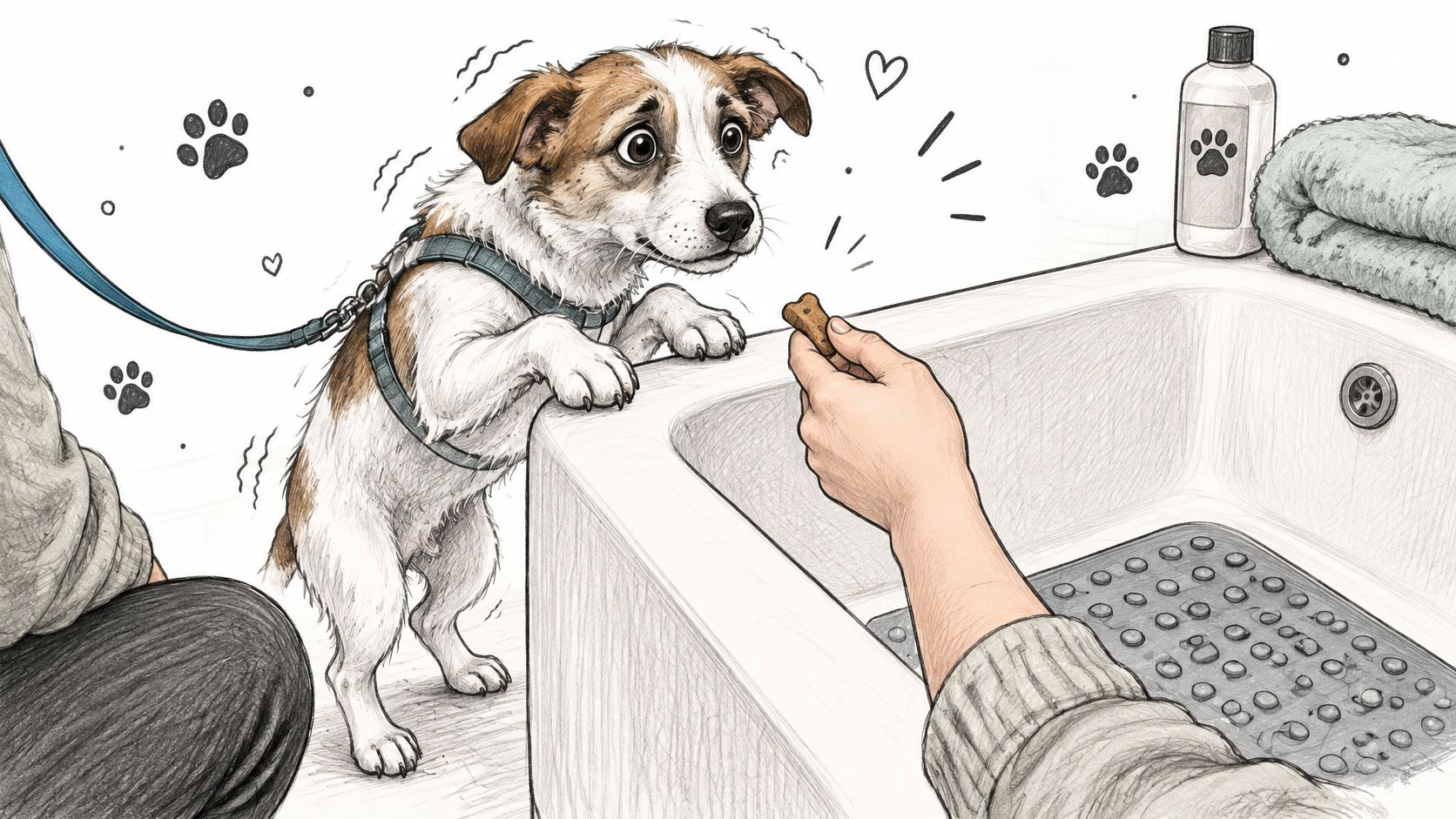
A nonslip mat and lukewarm water are the two most repeated recommendations for good reason: dogs get hurt slipping and distressed by temperature extremes, and the PetMD guide to bathing a dog puts both at the centre of a safe setup. The same guide notes a 2025 pilot study that linked classical music to calmer behaviour in dogs, particularly males. Treat music as one low-stimulation tactic among several, not a fix.
Handling rule: end every session while the dog is still calm, even if the coat is only half done.
Secure the leash to a fixed point with a loop that can't tighten around the neck, and never leave a dog unattended in water, not for a second and not for a towel you forgot.
Puppies still learning balance need firm footing and a second pair of hands to steady them. Senior dogs with stiff joints need their rear end supported on the way in and out, plus a rest on a towel between rinses, and helping senior dogs stay comfortable covers the wider handling picture for older animals. Large breeds are hard to lift safely, so use a ramp or let the dog step in under its own steam while you support the chest and hindquarters, never by the front legs alone. For dogs that panic specifically at restraint, this guide to tools and calm techniques for grooming nervous pets goes deeper on restraint-free handling.
A walk-in shower or a warm day outdoors with a hose on low pressure can beat a tub entirely. Keep the room quiet, talk in a low steady voice, and reward the calm moments as they happen rather than only at the end.
Step-by-Step Dog Bath at Home
The order of operations matters more than the products. Warm the room and secure the footing first, because everything after depends on a dog that isn't shivering or sliding. AVMA journal guidance on bathing dogs puts the comfortable ambient range for dogs and cats at roughly 50 to 80°F (10 to 26.6°C) with 30 to 70% relative humidity, which in practice means a closed bathroom door, a warm room and no drafts across a wet coat.
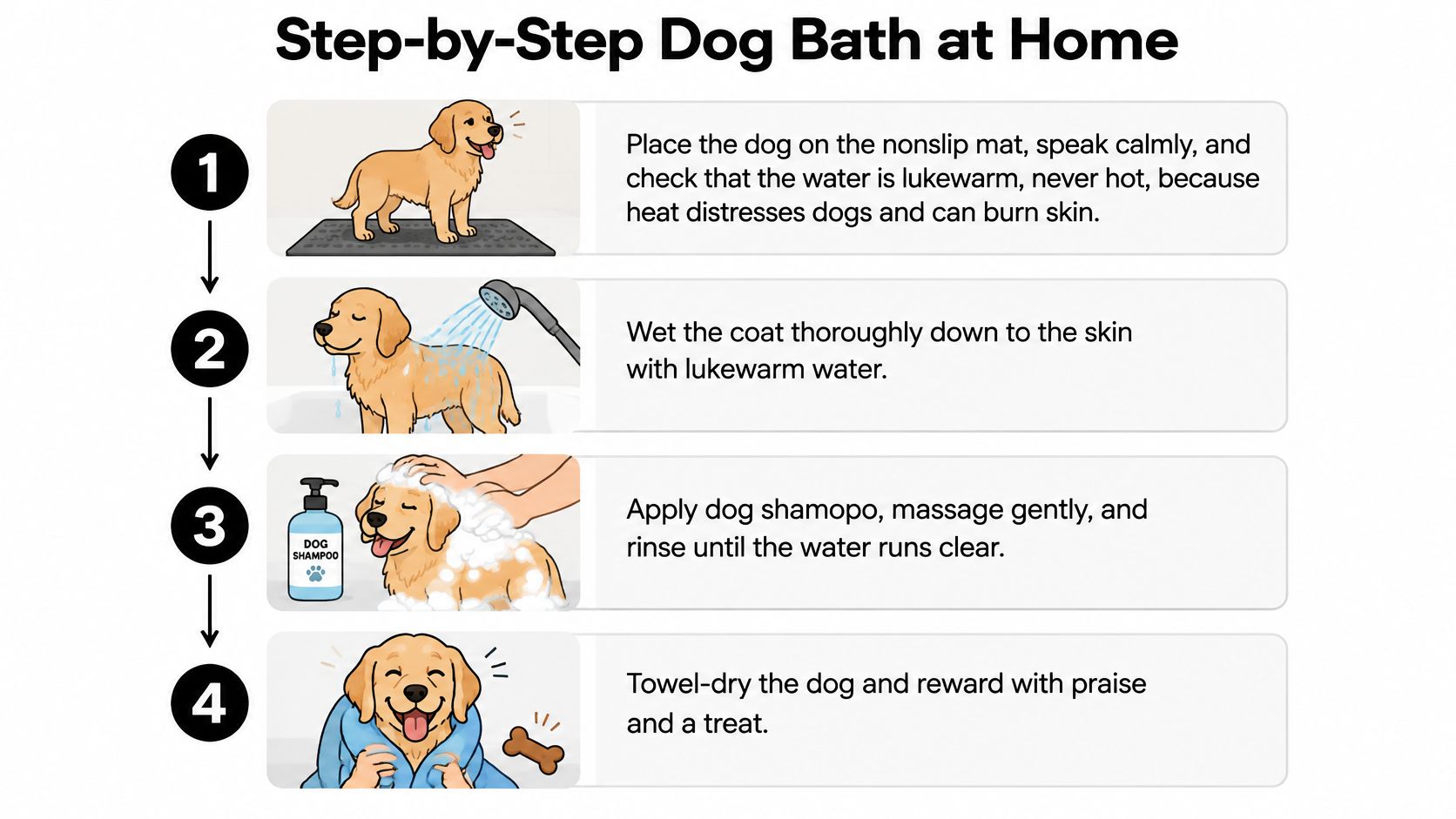
Here's the sequence at a glance, then the detail that matters for each step.
Set Up and Soak the Coat
1. Place the dog on the nonslip mat and test the water on your wrist. Lukewarm, never hot. Heat distresses a dog, and hot water on thin skin is a genuine burn risk, so a wrist test beats judging from the tap by hand.
2. Wet the coat down to the skin. Use a cup or a sprayer on low pressure, starting at the back and working forward. A dry undercoat repels shampoo, so a coat that's only damp on the surface gives you a wash that never reaches the skin and a rinse that never carries the cleanser away. Double coats take noticeably longer here, and that extra minute pays for itself at the rinse.
3. Guard the ears while the head gets wet. Cup one hand over each ear canal, tip the head slightly down and let water run off rather than in. Moisture trapped in the canal sets up ear trouble, particularly in floppy-eared dogs and dogs with a history of infection, which is why the AVMA guidance says to keep direct spray away from the ears and eyes.
Shampoo and Rinse
4. Apply shampoo made for dogs and work it down to the skin. Trunk first, then legs, belly and paws, keeping it out of the eyes and nose. Use an ordinary canine shampoo unless a vet has prescribed something, and when they have, follow the label exactly, including contact time. Some antimicrobial regimens call for five minutes on the coat before rinsing, and a thirty-second version of a five-minute treatment doesn't do the job.
5. Rinse until the runoff is completely clear. The neck, belly, armpits and the space between the toes are where rinsing stops early. Residual cleanser is the most common practical failure in a home bath, and it's the usual cause of a dog scratching a day later.
The rinse test: keep going until the water running off the belly is as clear as the water going in, then rinse the belly once more.
That's the wash. Everything after this is drying, which is where a bath is either finished properly or undone.
Watching it done once is faster than reading it twice. This walkthrough shows the handling and the rinse sequence on a real dog.
Drying and the Final Check
6. Blot with towels instead of rubbing. Hard rubbing tangles long coats and irritates skin. Fold floppy ears back and towel-dry the outer ear and every bit of moisture you can safely reach, and don't put cotton swabs or anything else into the canal.
7. Use a dryer only on low heat and low airflow, and only if the dog tolerates it. Keep it moving constantly, never hold it against the ear, and never park hot air on one patch of skin. For a dog that panics at the noise, towels do the whole job.
8. Keep the dog indoors until the coat is dry to the skin. Damp undercoat in skin folds, under the collar and between the toes is what grows yeast and causes hot spots, and cool weather makes it worse.
9. Run a two-minute check before the dog leaves the bathroom. The coat should feel clean and soft, not tacky, and the skin should show no new redness. The AVMA guidance is direct about the stop signs: widespread redness, pustules, painful lesions, intense odor or persistent itching mean a veterinary visit rather than another wash, because repeating an unsupervised treatment can worsen inflammation and delay a diagnosis.
Coat type changes the drying clock more than anything else. A short coat is dry in minutes; a thick undercoat can hold water for hours, and that's the difference between a bath that ends when the towel comes out and one that ends at bedtime. Don't clip a double coat to speed things up. The undercoat insulates against heat as well as cold, and shaving it changes how the coat grows back.
Bath Problems and Quick Fixes
The most common complaint arrives a day later: a dog scratching at the neck and flank, or pink skin where the coat parted. Most of the time the cause is shampoo left in the coat or water hot enough to irritate, not an allergy that appeared overnight. Rinsing longer fixes more post-bath itching than switching products does.
| Problem | Likely cause | Fix to try first |
|---|---|---|
| Itching or redness within a day | Leftover shampoo or water too hot | Rinse longer until runoff runs clear, use lukewarm water |
| Dry, flaky coat | Bathing too often or harsh human shampoo | Space baths out and switch to a dog-formulated shampoo |
| Odor that returns quickly | Damp coat or skin folds not dried | Blot dry folds, between toes and under the ears |
| Dull, sticky coat | Residue on neck and belly | Give an extra rinse and check these areas before drying |
| Bumps or sores on the back days later | Possible product or rinse contamination (rare) | Check daily for 24 to 72 hours and see a vet if inflamed |
Residue is worth a second look because it hides. The neck under the collar, the belly, the armpits and the gaps between toes are where a rinse quits early, and the coat there feels tacky rather than soft once it dries. Run a hand against the grain in those four places before you call the bath done.
Then watch. Check the back, the skin folds, the paws and the ears once a day for 24 to 72 hours after a bath, and note anything that spreads: new redness, raised bumps, a smell that wasn't there before, or a dog that suddenly doesn't want its back touched. A problem that outlasts that window needs a vet, not another bath.
When Bathing Becomes a Vet Question
There's a line between grooming and treatment, and home baths cross it more often than owners realize. Healthy dogs need occasional cleaning. A dog with skin disease needs a plan from a veterinarian before any bath becomes routine, and the schedule that plan produces can look nothing like a grooming calendar. Veterinary dermatology may prescribe two or three medicated baths per week until seven days after clinical resolution, then weekly maintenance, as summarized in the AVMA's report on the allergic skin disease guidelines. That cadence is a treatment protocol, not a grooming default.
The technical sequence for a medicated bath is brush first, wet completely, apply or dilute the product exactly as directed, massage systematically over trunk, limbs, paws and affected areas, hold the labeled contact time, rinse exceptionally well and dry completely. Home attempts fail in predictable places: the coat never got wet to the skin, the contact time was cut short, a dose was skipped, drying ingredients were overused, or relief from itching got mistaken for treatment of the underlying disease.
Never use a medicated shampoo for fleas, infection, allergy or a wound without veterinary direction.
Repeated unsupervised treatment carries real cost. Veterinary literature notes that bathing reduces itching, odor, exudation and crusting and removes allergens, but also warns that unsupervised polypharmacy can produce chronic inflammation and antimicrobial-resistant infections. Where frequent bathing isn't practical, regular brushing is recognized in AVMA infection-control guidance as a useful substitute between washes.
Keep the dates, product names and schedule in one place so a vet can see what's already been tried. Asking your vet for pet medical records explains how to pull that history together before the appointment. For ordinary dirt and odor, a routine canine shampoo plus more brushing between baths is the right tool, and a veterinarian can tell you when that stops being enough.
Evo Dyne Products stocks the small things that make a home bath safer and the cleanup quicker, from pet care items like fast-acting styptic powder for grooming nicks to the household cleaners that deal with a soaked bathroom floor. Many items are made in the USA in certified facilities, under a simple promise where quality meets care. Build your grooming kit before the next bath day at Evo Dyne Products.