

Most car air fresheners stay useful for roughly one to three months, with sprays and vent clips at the low end and wooden diffusers reaching two to three months or longer. The format table below gives the exact figures, from about 22 days for a non-aerosol spray on a fabric pad to 90 days or more for a wooden diffuser.
How long do car air fresheners last? Ask it twice and you get two useful answers. The first is the one above, the calendar life of the product. The second is the date the driver notices, which almost always arrives earlier, when the scent stops carrying from the driver's seat to the passenger door with the fan running.
Format sets the ceiling on that first number. Heat, airflow and parking habits decide how close a real cabin gets to it. Keeping those two clocks separate is the difference between a scent that feels disappointing and one you planned for correctly.
Table of Contents
- How Long Each Car Air Freshener Type Lasts
- Why Scent Fades and How Conditions Shorten It
- How to Stretch Scent Life With Daily Habits
- Signs Your Freshener Is Spent and Needs Replacing
- Does a Longer-Lasting Scent Mean More Exposure?
- Choose a Freshener Format for Your Driving Habits
How Long Each Car Air Freshener Type Lasts
A spray and a wooden diffuser can sit on the same shelf and obey different clocks. The spray gives roughly three to four weeks of scent strong enough to notice from the driver's seat; the diffuser can keep releasing for two to three months or longer. Those ranges describe the period when the fragrance still carries across the cabin. The detectable tail usually runs longer, and that tail is where exposure questions begin.
| Format | Typical useful life | Main limit |
|---|---|---|
| Non-aerosol spray with fabric pad | About 3 to 4 weeks | Needs repeat application |
| Plastic solid | About 4 to 6 weeks | Dose is fixed at manufacture, with no way to refresh mid-block |
| Vent clip with gel core | About 5 to 7 weeks | Scent turns sharp in high heat |
| Refillable gel | About 6 to 8 weeks | Stiffens and releases less in cold |
| Vent-mounted cartridge | About 4 weeks | Strength drops with heat and airflow |
| Wooden diffuser | 2 to 3+ months | Subtler scent, slower release |
What separates the formats
Sprays sit at the short end because they deposit fragrance on a fabric pad and then give it up quickly. The three-to-four-week range assumes reapplication along the way, so a spray works more like a tool you use than a fixture you install. Plastic solids and vent clips land in the middle at roughly four to seven weeks. Their dose is set when you open the package, and neither format lets you refresh the scent mid-block. That fixed dose is why a vent clip can feel strong for a week and then fade steadily rather than fail all at once.
Vent-mounted cartridges sit near one month, close to the plastic solid and vent clip band, but their weakness is airflow rather than dose. A cartridge placed in a strong vent stream gives up fragrance faster, while a weak stream leaves the scent stranded near the vent. Refillable gels stretch to six to eight weeks because you refill the reservoir instead of discarding the whole unit. Wooden diffusers run two to three months or more, but they diffuse more subtly throughout. The trade is duration for presence. A diffuser that lasts twice as long may never fill the cabin the way a fresh spray does on day one.
Practical rule: Write the install date on the unit or in your phone the day it goes into the car. The number you write down is the only honest benchmark you will have, because package figures assume conditions you probably do not drive in.
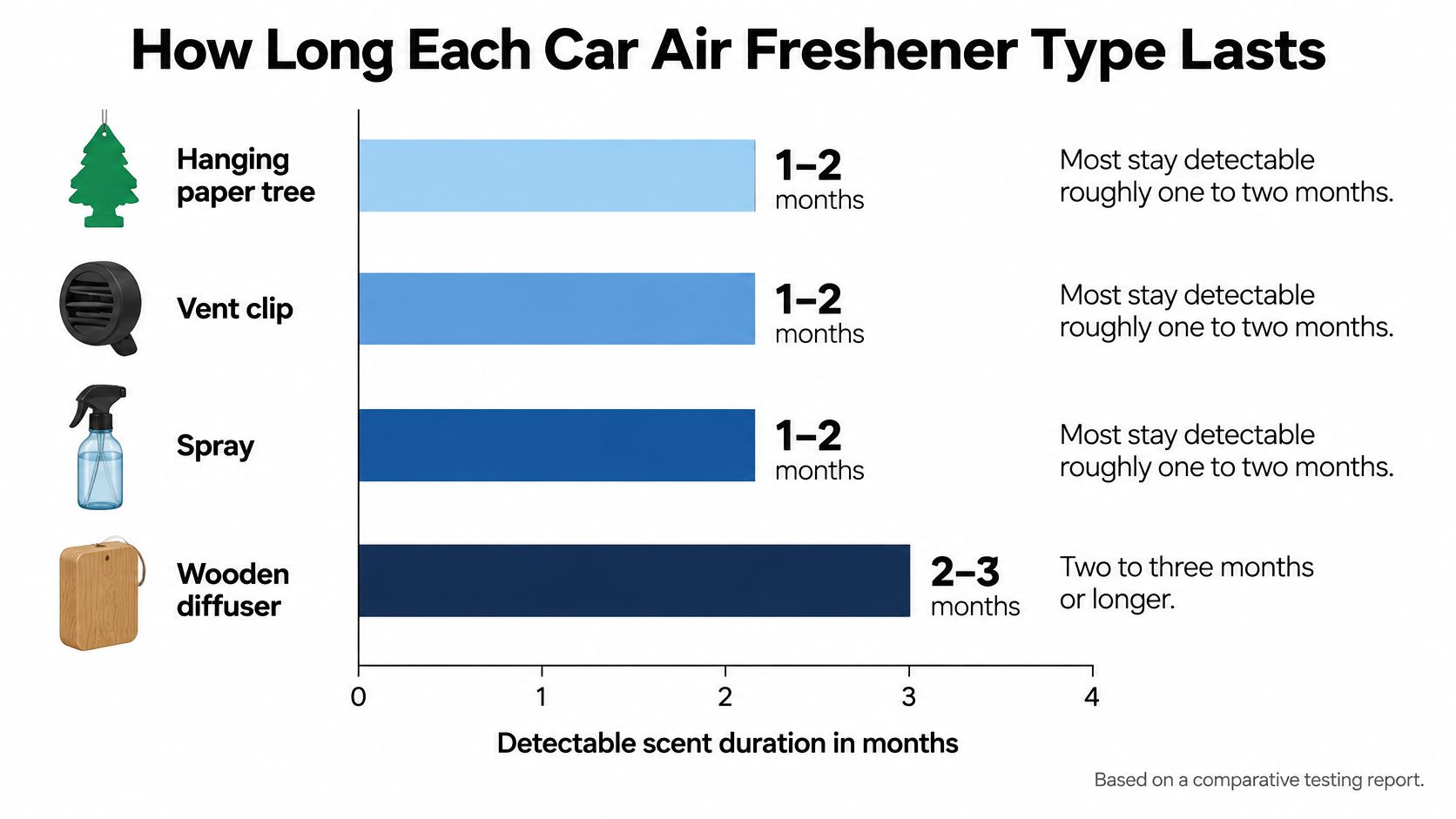
Treat the table as a ranking tool. A minivan in Phoenix and a hatchback in Seattle will land at different points inside the same row. Heat and airflow can move a format up or down the list, and a slow-release format that stays present for months also keeps fragrance molecules in the cabin for months. Check the row against your parking situation, not against the package promise.
Why Scent Fades and How Conditions Shorten It
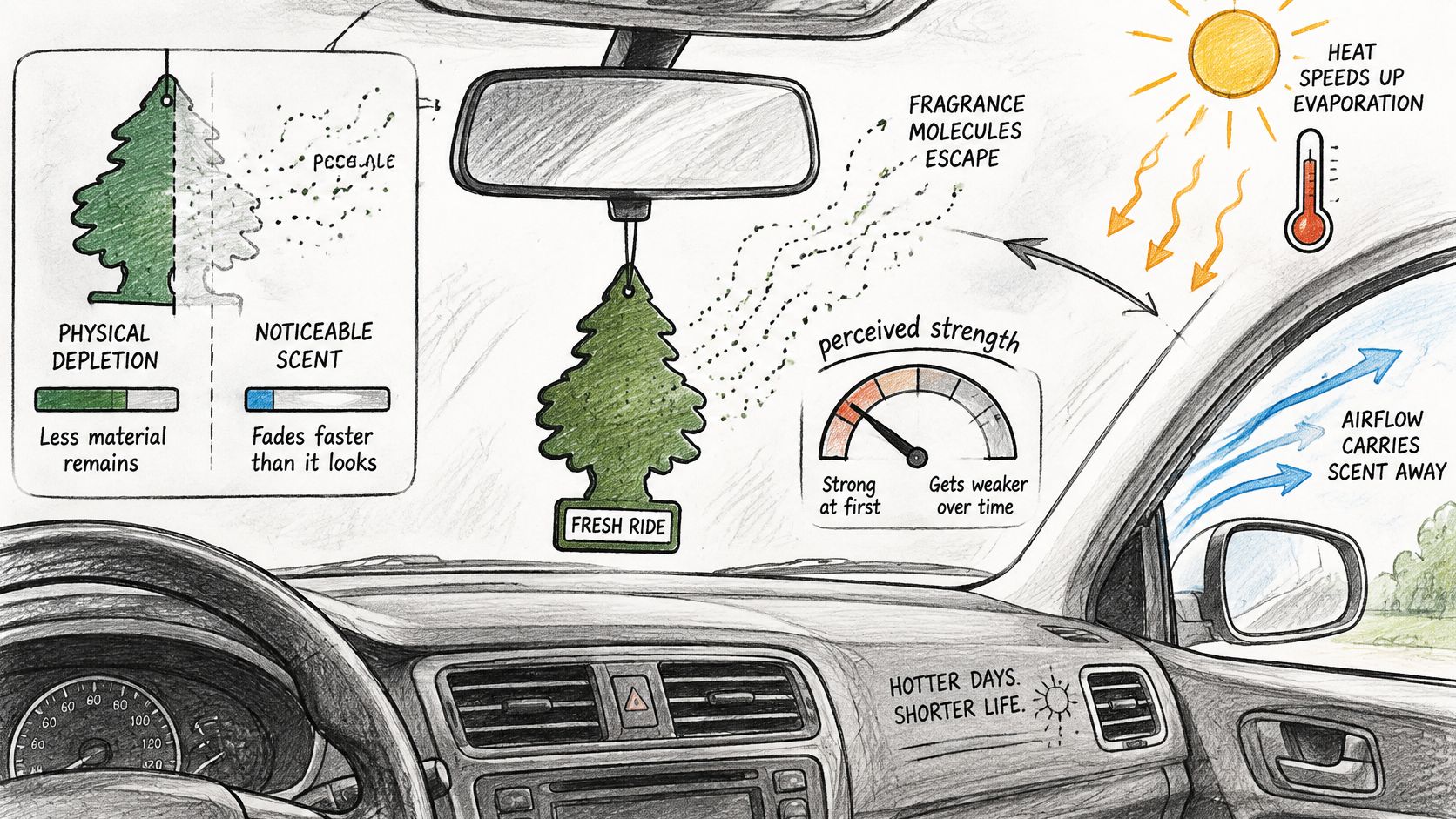
"Lasts" hides two different measurements. There is physical depletion, the point where the carrier holds no meaningful fragrance. And there is acceptable perceived strength, the point where you can still register the scent without leaning in. Most drivers replace on the second metric and assume they've hit the first, which is why products seem to die long before their contents do.
Independent consumer testing reported by Better Homes & Gardens put cartridge-style products at approximately 4 weeks under average use, with the evaluation window stretching from about two weeks to nearly a month to watch how scent persistence behaved. That makes a 30-day expectation defensible for enclosed cartridges, while remaining an average-use estimate. A driver chasing a consistently strong fragrance may burn through more than one cartridge a month. A driver content with a quieter scent can often stretch the interval.
The mechanism, in two sentences
Fragrance molecules move from a liquid, gel or treated substrate into cabin air, and heat raises vapor pressure, which speeds that transfer. Vehicle cabin research published in Indoor Air found that odorants don't all behave the same way: some vaporize rapidly as cabin temperature climbs, while others keep diffusing slowly out of interior materials, and direct sun heating a dashboard increases the release of higher-boiling compounds.
That second finding matters more than it first appears. The car's own interior is competing with your freshener, and it gets louder as the cabin heats up.
| Condition | Effect on scent | Formats most affected |
|---|---|---|
| Sun-heated dashboard or cabin | Faster evaporation and sharper higher-boiling notes | All formats |
| Shaded, moderately ventilated cabin | Noticeable intensity lasts substantially longer | All formats |
| Vent clip above 120°F | Scent becomes sharper and less pleasant | Vent clips with gel cores |
| Gel below 40°F | Gel stiffens and fragrance release drops | Refillable gels |
| Hot cabin with windows open | Strong-scent phase shortens | Sprays and cartridges |
| Continuous high HVAC airflow | Fragrance exhausts faster from the source | Sprays, cartridges and vent products |
Two fresheners can hold identical amounts of fragrance and still last different lengths of time in two cars parked on the same street. Shade and airflow write more of the outcome than the label does.
A vent clip that smelled clean and bright in April can turn harsh by July, and that change isn't a manufacturing defect. It's the gel core sitting in a cabin that has soaked up sun all afternoon. If you're comparing formats for tight, enclosed spaces where subtlety matters, this guide to choosing subtle fragrances for elevators and small rooms applies much the same logic to a car cabin.
Here's a self-test that settles the argument in three seconds. If you have to lean toward the vent or the hanging card to catch the scent, the strong phase has ended, even if fragrance remains in the carrier. Replace on that signal, not on the date printed on the package.
How to Stretch Scent Life With Daily Habits
Duration is a maintenance result. These habits do not add fragrance to the product. They slow how fast the cabin pulls it out. Two clocks are running at once: how long the scent stays strong enough to notice on a normal breath, and how long a faint trace is still detectable if you search for it. Extending the second clock is not only a benefit. Fragrance that stays in a closed cabin is also fragrance you keep breathing.
- Clean the source before you add scent. Vacuum crumbs, lift old food, and treat stains in carpets and seats. A freshener can cover odor, but it cannot remove the material producing it, so a dirty cabin will wear a new product down in days. Clear dry debris before any wet cleaning, or you grind the source deeper into the fabric. The Eco Clean Solutions move-out checklist lists that dry-then-wet order for a home, and the same sequence keeps a cabin smell from rebuilding.
- Shake the spray before every use. Fragrance settles and separates in the bottle, so the first spray of the week rarely matches the last. A few seconds of shaking gives an even mist instead of a heavy blast followed by a thin one. Uneven doses make longevity look random when the bottle was unmixed.
- Apply a light mist where fabric lives. Carpets, floor mats, under the seats, and fabric upholstery hold fragrance and release it gradually. Keep the mist off plastic, painted trim, and other hard surfaces, which can stain. A light pass beats a soaking one. Extra liquid on fabric sits there and does not buy a longer strong phase.
- Move the source when you park. A gel jar or hanging card left on a sunlit dashboard spends its reservoir while the car is empty, before anyone is there to notice the scent. Shift it under a seat or toward the rear of the cabin on bright days. You are protecting the hours you will smell it, not the hours the package claims.
- Run the fan on the lowest setting that works. Higher airflow exhausts the fragrance source faster. A strong stream makes the scent obvious at the outlet and empties the reservoir sooner, so the phase that is easy to notice ends while a weak trace may still be there. Low fan speed trades peak intensity for a longer stretch of usable scent, and it keeps cabin concentration from spiking.
- Keep windows closed while the scent is active, then flush the cabin. Open windows during a drive pull fragrance out as fast as it is released. Leave them up while you want the scent, then use outside air for a few minutes when you first get in, or after a long closed drive. That flush cuts the stale load without asking the freshener to run at full strength the whole trip.
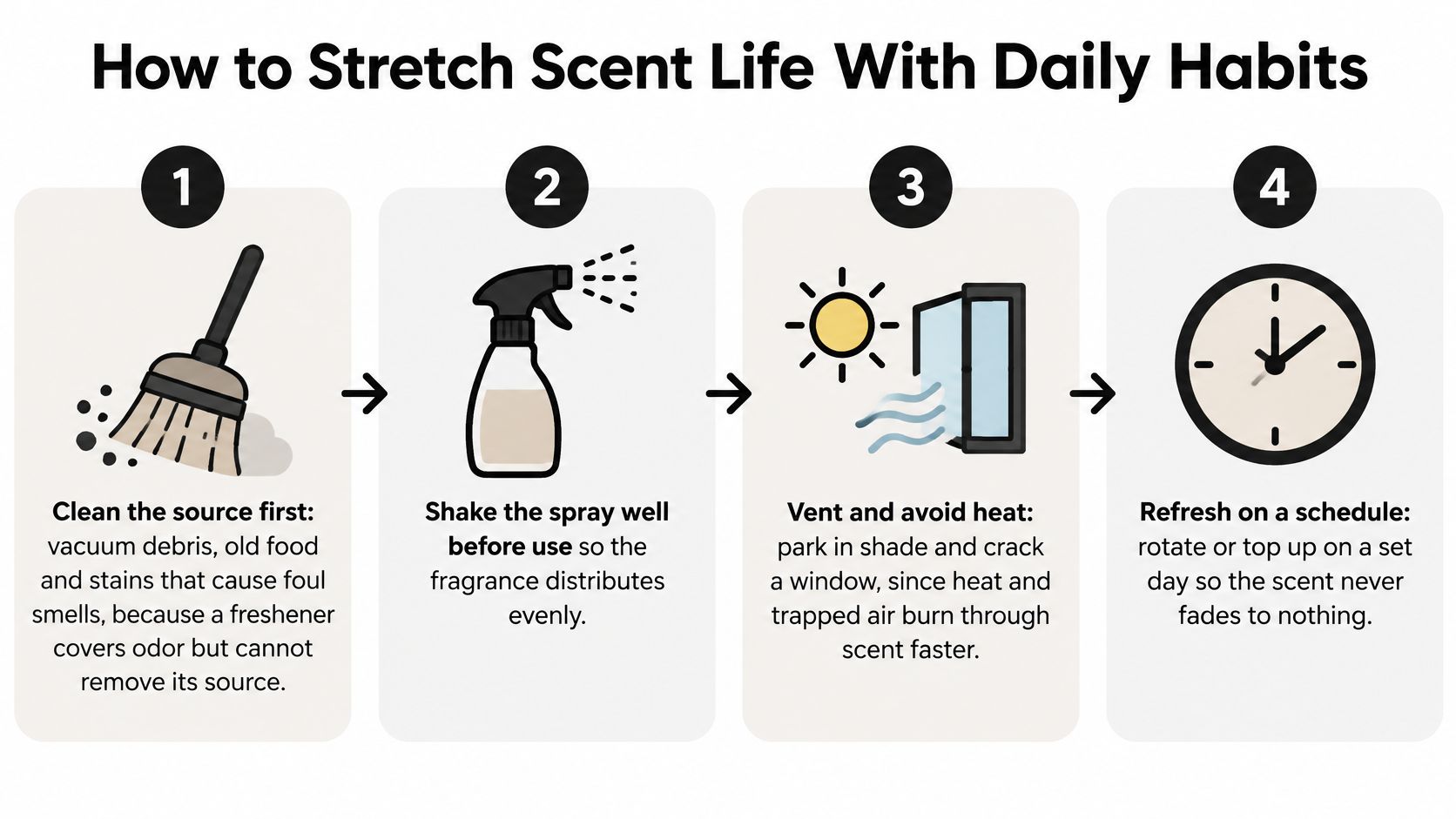
Note the date you start the product, then mark whether you still notice it without leaning toward the source. If only a trace remains, the habits extended detectability, not the strong phase. Buy the next format against that split, not against a feeling that it "faded fast."
Signs Your Freshener Is Spent and Needs Replacing
Run this checklist at the car door before you spend money. Each item is something you can confirm in under a minute.
- You smell nothing after a warm drive with the windows closed. Heat should be pushing fragrance into the cabin. If a closed, warm car gives you nothing, the reservoir is finished.
- You're topping up more than twice a week. Frequent refreshing means the carrier is no longer holding a charge, not that you're fussy.
- A cartridge has passed about four weeks of average use. Enclosed cartridges land near that mark, so treat the date as a prompt to evaluate, not a guarantee either way.
- A vent clip smells sharp or chemical after a hot day. Heat damage changes the note, and no amount of airflow will bring the original back. Swap it.
- A refillable gel has gone stiff and weak after a cold snap. Warm it to room temperature and give it a day. If the scent stays thin, replace it rather than fighting the gel.
- A wooden diffuser is past two to three months and its subtle scent has gone. These release slowly, so the fade is easy to miss until someone else notices.
- Odor returns within a day of a fresh application. That isn't a failing product. The source wasn't cleaned, and a new freshener will behave exactly the same way.
When the scent is gone on two checks in a row, replace the product and clean the source before you add anything new. Doing both at once is what breaks the cycle of fresheners that seem to die early.
Does a Longer-Lasting Scent Mean More Exposure?
Durability gets marketed as a pure benefit. Cabin air quality tells a more complicated story, because a product that keeps releasing fragrance for weeks is also releasing everything else it contains for weeks.
A study of 12 car air fresheners identified 546 emitted volatile organic compounds, including 30 classified as potentially hazardous, as reported in the CDC's archived copy of the study. Every tested product emitted at least one such compound. Fewer than 2% of the detected compounds appeared on labels or safety data sheets, which means the ingredient list on the package tells you almost nothing about what's coming out of it.
Separate vehicle testing found that spraying rapidly increased particle concentrations, with maximum total VOC concentrations of 364.3 micrograms per cubic meter in the front seat and 241.3 micrograms per cubic meter in the rear at 20 °C. Outside-air ventilation reduced total VOC concentration to 56.0% to 57.2% of levels measured under other ventilation modes. Recirculation cut particles but kept generated VOCs circulating inside the cabin.
That's the trade most drivers never consider: recirculation feels efficient on a hot day, and it's the setting that concentrates whatever the freshener is emitting.
Some occupants should act on this more carefully than others. Children, pregnant occupants, asthma sufferers and frequent rideshare passengers spend more time in a smaller, more enclosed volume of air than a solo commuter does, and they can't choose to step away from it. For those riders, a low-scent application with outside air flowing beats a strong fragrance every time.
What this changes: A subtle scent that lasts four weeks and a strong one that lasts six aren't equivalent products. You're choosing a dose as well as a duration.
If you want to lower the dose, start with an eco-friendly car air freshener and treat cabin ventilation as part of the routine rather than an afterthought. And don't take "natural" or "green" on the label as evidence of lower emissions. Fewer than 2% disclosure means the front of the package is a marketing surface, not a specification sheet.
Choose a Freshener Format for Your Driving Habits
Driving pattern decides which row of the lifespan table you should be shopping in. Format choice, climate and parking situation all narrow the field before scent preference enters the conversation.
Daily commuter with no shade at work. Pick a format you can refresh on a schedule, because no product survives a sun-baked lot indefinitely. A non-aerosol spray on fabric pads gives you a 22 to 31 day window and lets you top up rather than replace the whole unit. Aim the mist at carpets, floor mats and under the seats, and keep it off hard trim. A comparison of air freshener sprays versus hanging fresheners is worth reading before you commit, since the two formats fail in completely different ways.
Cold climate driver. Skip refillable gels as your primary format. Below 40°F the gel stiffens and release drops off, which reads as a dead product when the reservoir is still full. If you already own one, bring it inside overnight and let it reach room temperature before judging it.
Hot climate driver. Avoid vent clips with gel cores that sharpen above 120°F, and prioritize shaded parking over any product claim on the box. A hanging card tucked toward the rear of the cabin will outlast the same card clipped to a sun-hit vent.
Rideshare driver or frequent carpooler. Weight the exposure question first. Outside air, a lighter scent and a source kept away from passengers' breathing zone will serve you better than a long-lasting cartridge running at full strength all day.
Occasional driver who wants something passive. A wooden diffuser fits, with 60 to 90 or more days of subtle release and no maintenance between installs. Accept the quieter presence as part of the deal.
For our own part in this, the 16 oz New Car Smell Spray is a repeat-application format rather than a set-and-forget one: a couple of sprays cover a full-sized vehicle, recommended spots are carpets, floor mats, under seats, fabric upholstery and a light mist at the vents, and per application the scent runs from several hours to days depending on the cabin.
Match your climate and driving pattern to a row in the lifespan table, clean the source before the new product goes in, and set the replacement date on your calendar the day you install it.
Evo Dyne Products makes the New Car Smell Spray, a 16 oz made-in-USA air freshener built to eliminate existing odors rather than mask them, with a new car scent that blends leather, light florals and clean fresh notes. It fits the repeat-application approach this article describes: a couple of sprays cover a full-sized vehicle, and the $14.99 bottle works in trucks, vans, RVs and big rigs as readily as a sedan. Visit Evo Dyne Products to see the spray alongside the rest of the shop, and start your scent calendar with a bottle in the door pocket.