
Your towels came out of the wash smelling fine. Then you used one after a shower, and the sour smell came right back. Your gym shirt looks clean but still carries that baked-in workout odor. The couch seems fresh right after a spray, yet by evening the smell of pets, food, or damp fabric has returned.
That's the moment they start shopping for a fabric odor eliminator.
The confusing part is that many products make fabrics smell better without removing the odor source. A pleasant scent can hide sweat, mildew, smoke, or pet odor for a while. It can't always solve what's stuck inside the fibers. Real odor control depends on two things: what caused the smell, and what kind of fabric is holding onto it.
For homeowners, pet owners, and car owners, that difference matters. Upholstery, towels, car mats, throw blankets, and sportswear don't all trap odor the same way. A spray that works on a cotton sofa may disappoint on polyester activewear. A quick refresh on a chair may not touch the biofilm and residue that make towels smell musty again and again.
Why Fabrics Hold Onto Odors Long After Washing
A fabric isn't a flat plate that you wipe clean once and forget. It's more like a tiny maze made of fibers, loops, and pockets. Odor molecules settle into that maze. Skin oils, detergent residue, food particles, pet dander, and moisture can stay behind too. Once that mix gets into the fabric structure, simple washing or a strong scent often isn't enough.
That's why so many everyday items become repeat offenders. Sofas collect body oils and cooking smells. Car seats absorb sweat, spilled drinks, and damp air. Bath towels stay wet long enough for odor problems to build. Polyester workout gear seems to grab onto body odor and hold it through wash after wash.
Why clean doesn't always smell clean
One reason people get frustrated is that visual cleanliness and odor removal aren't the same thing. A shirt can look spotless and still smell off. A throw pillow can be lint-free and still carry stale odor.
Independent review literature notes that malodor can persist after laundering, especially in hydrophobic polyester, because odor compounds remain in the fiber and can re-emerge after wear and washing. That same review explains that current odor reduction often relies on added fragrances or essential oils, which are masking agents rather than true odor-conversion methods, as discussed in this textile odor review.
Practical rule: If a fabric smells good only while it's wet with spray, you may be getting fragrance masking instead of true odor removal.
The real-world trouble spots
Some fabrics repeatedly trap odors because of how people use them.
- Damp towels: They stay moist, collect body residue, and often develop persistent musty odor.
- Polyester sportswear: It tends to hold onto body odor more stubbornly than many natural fibers.
- Upholstery: It isn't washed often, so oils and airborne odors build slowly.
- Car interiors: Seats, mats, and trunk liners pick up moisture, food smells, and daily use.
A useful way to think about odor is this. The smell you notice in the room is often just the final signal. The underlying issue sits on or inside the textile surface. If you want lasting freshness, you have to deal with that source rather than just perfume the area around it.
How Fabric Odor Eliminators Actually Work
Picture odor as a cloud floating above the fabric. In reality, a lot of odor trouble starts at the fiber surface. Odor molecules land, stick, and sometimes get released later when the fabric warms up, gets damp, or rubs against your skin.
That sticking process matters. A 2023 study on odor adsorption in textiles found that acetic acid and ammonia adsorption onto wool, cotton, and nylon followed a pseudo-second-order kinetic model, and the same study reported that wool had the highest adsorption ability for both odors because its surface chemistry creates stronger interactions than cotton or nylon, according to the Royal Society of Chemistry article.
Think sponge, hook, and trap
A simple way to picture fabric odor is to use three household analogies.
- A sponge: Some fibers soak up odor-related compounds more readily than others.
- A hook board: Fibers have places where odor molecules can latch on.
- A trap box: Some odor-control ingredients capture molecules so your nose detects less of them.
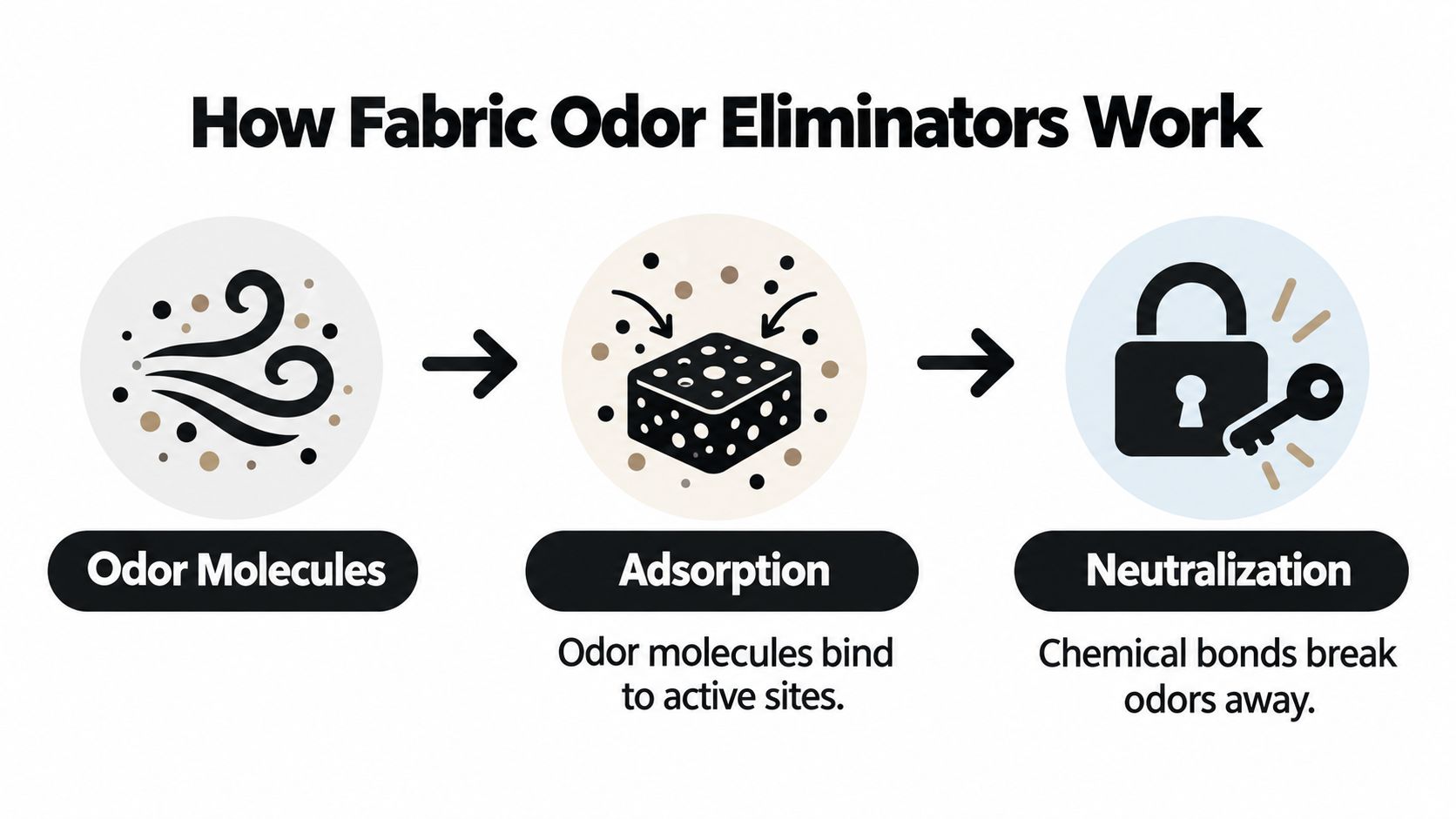
A true fabric odor eliminator tries to interrupt that process. Depending on the formula, it may trap odor molecules, loosen residues that hold odor, reduce the compounds your nose detects, or help remove the material that keeps generating the smell.
Why one product works on one fabric and fails on another
Fiber type changes everything. Wool, cotton, nylon, and polyester don't behave like copies of each other. They differ in surface chemistry, moisture behavior, and how tightly they hold odor compounds.
That's why a lightly scented refresher may seem helpful on curtains but weak on gym wear. It's also why a towel can smell okay out of the dryer and then turn sour again after it absorbs moisture. Heat and humidity can encourage trapped odor to show up again.
Adsorption is only part of the story. If the source of odor keeps forming on the fabric, the smell can return even after a product seems to work.
A major approach in this category is cyclodextrin-based odor control. Cyclodextrin works like a tiny cup. It can hold small odor molecules in a hydrophobic cavity rather than chemically destroying them. Review literature notes that cyclodextrin finishes increased odor retention on cotton and polyester while reducing perceived malodor, and cyclodextrin-containing detergents showed better body-odor removability than detergent without cyclodextrin in the review on odor control in textiles.
What homeowners should take from the chemistry
You don't need to memorize the science to make better choices. You just need to ask better questions.
- Is this product trapping odor, breaking down residue, or mainly adding scent?
- What fabric am I treating?
- Will heat, sweat, or moisture bring the odor back?
- Is the smell coming from the fabric itself, or from dirt and buildup sitting on it?
If you're dealing with upholstered furniture, practical cleaning habits still matter alongside product choice. This guide on treating smelly couches naturally is a helpful companion because it focuses on removing the source before relying on a spray.
Types of Fabric Odor Eliminators and When to Use Each
The label on the bottle may say “eliminates odors,” but the formula inside can work in very different ways. That's where a lot of bad purchases happen. People buy for the promise, not the mechanism.
The easiest way to sort options is by asking what the product is trying to do. Is it digesting residue, trapping molecules, changing them chemically, binding metal-related odor contributors, or competing with odor-causing microbes?
Fabric odor eliminator types compared
| Type | Mechanism | Best For | Limitation |
|---|---|---|---|
| Enzymatic | Breaks down organic residues such as body oils, food traces, or pet mess components | Persistent sweat odor, pet bedding, car mats, high-residue textiles | Needs contact time and may work unevenly if the fabric is heavily coated with old residue |
| Masking | Adds fragrance to overpower unpleasant smells | Quick touch-ups before guests arrive, low-level room freshness on washable fabrics | Can leave the underlying odor source in place |
| Oxidizing | Changes odor compounds through oxidation | Strong set-in odor when the label permits stronger chemistry | May be too harsh for delicate fabrics or special finishes |
| Chelating | Binds certain mineral-related residues that can contribute to dullness or trapped grime around fibers | Fabrics affected by hard-water buildup or residue issues in laundering | Doesn't address every odor source by itself |
| Probiotic or microbe-targeting | Uses biology-based approaches aimed at competing with odor-causing buildup over time | Ongoing odor maintenance in recurring problem areas | Usually slower and more maintenance-oriented than a quick spray |
Where each type tends to shine
Enzymatic options make the most sense when odor comes from something still living on the fabric surface or left behind in it. Think sweat zones on shirt underarms, pet accidents on a throw blanket, or car carpet that has picked up snack spills and moisture. These formulas are often more useful when the smell has a residue problem behind it.
Masking products have a place, but it's a narrow one. They're fine when the odor is mild and temporary, or when the fabric has already been cleaned and you just want a fresher feel. They're less convincing on polyester activewear and damp towels because those items often have a deeper source problem.
Oxidizing systems are more aggressive tools. They can help when odors are stubborn, but fabric safety matters more here. Upholstery dyes, delicate weaves, and special coatings may not tolerate them well.
The often-missed middle ground
Chelating and probiotic-style products don't get as much attention, but they matter in specific situations.
Chelating chemistry is useful when fabrics aren't just smelly. They also feel stiff, dingy, or residue-heavy after repeated washing. In those cases, the odor problem may be tied to what's clinging around the fiber, not just the odor molecule itself.
Probiotic or bio-targeted products fit homes where odor returns again and again from the same source area. They're not always the fastest fix, but they can be part of a maintenance plan.
A strong scent is not proof of stronger odor removal. It may only be proof of stronger fragrance.
For residue-driven messes, especially on soft surfaces, it helps to understand where enzymes can outperform deodorizing alone. This overview of choosing an enzyme cleaner for carpet stains is useful because carpet and upholstery often share the same odor-residue problem. If you want a product-selection lens focused on sprays specifically, this guide to odor eliminator spray options is also a practical reference.
Safety and Fabric Compatibility You Should Check First
A product can be good at odor control and still be wrong for your fabric. That's especially true with upholstery, wool blends, dark dyes, delicate trims, and car interiors with mixed materials.
Start with the fabric, not the smell. A towel, microfiber couch, wool coat, and seat insert in your car may all need different handling even if they all smell musty.
Check the label before the bottle touches the fabric
Look for care tags, manufacturer cleaning codes, and any finish on the fabric surface. Water-safe fabrics usually give you more flexibility. Water-sensitive or dry-clean-only materials need a slower approach.
A simple safety filter
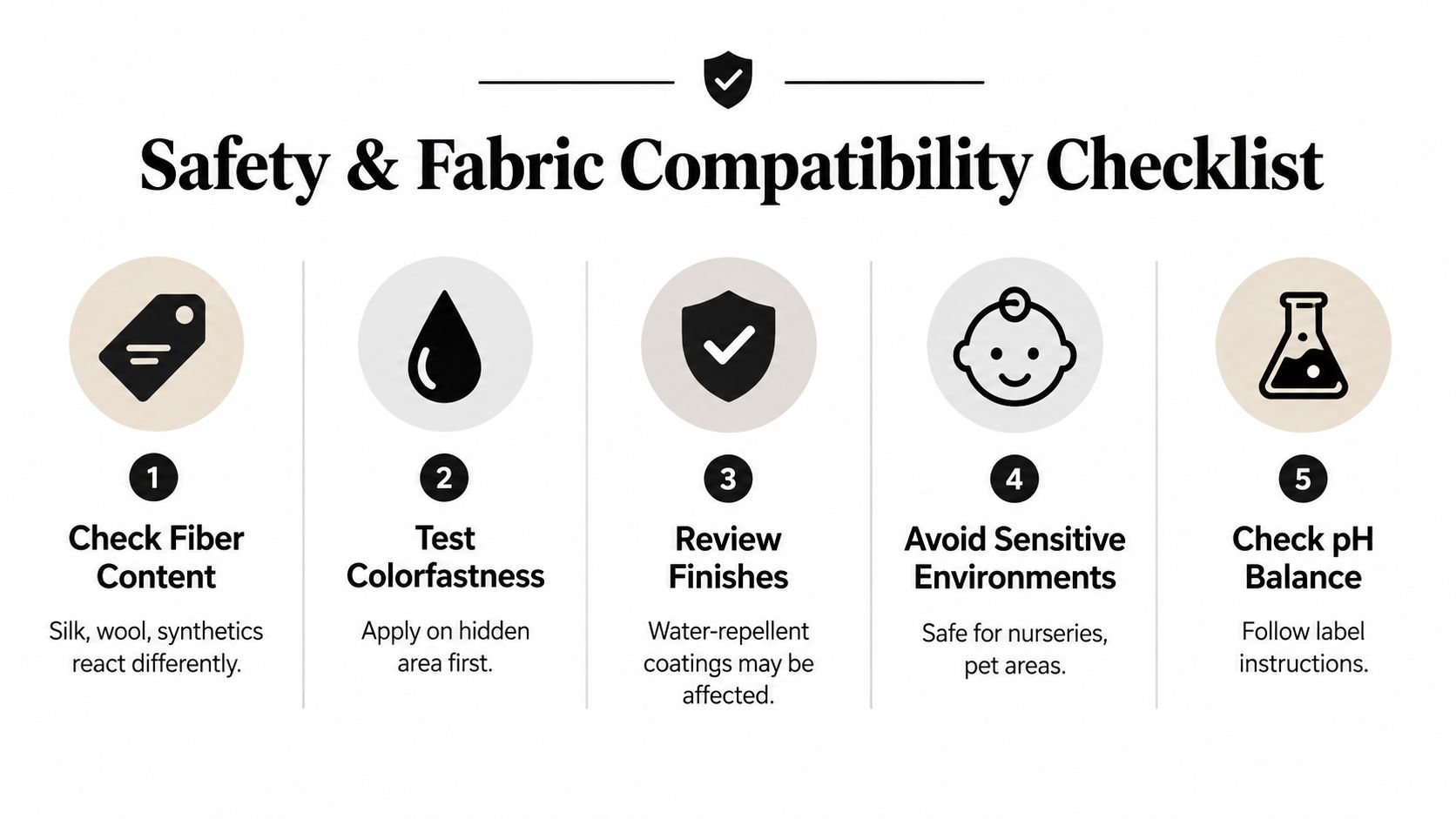
Use this quick check before treating anything valuable.
- Read the care code: Upholstery and garment labels tell you whether water-based treatment is likely to be safe.
- Patch test first: Spray or dab a hidden area and let it dry fully before treating the visible section.
- Watch for finishes: Water-repellent or stain-resistant coatings can react differently than untreated fabric.
- Ventilate the area: Open air helps drying and reduces the chance of over-application.
- Avoid soaking: More product doesn't always mean better results. Oversaturation can spread residue deeper into padding.
Where people accidentally make odors worse
One common mistake is using too much product on a cushion, car seat, or mattress cover. The surface smells fresh at first, but the extra moisture sinks in, dries slowly, and can leave behind more opportunity for odors to linger or return.
Another mistake is applying heat too soon. If an adsorbed odor hasn't been fully dealt with, heat can encourage it to reappear. That's why a towel may smell worse after use than when it came out of storage.
Test for both color change and texture change. A fabric can keep its color and still end up stiff, tacky, or ring-marked.
Homes with pets and children need a little extra caution too. Keep treated items out of use until fully dry, and avoid using any formula casually on chewable pet bedding or nursery fabrics unless the label clearly fits that setting.
How to Apply Fabric Odor Eliminator for Lasting Results
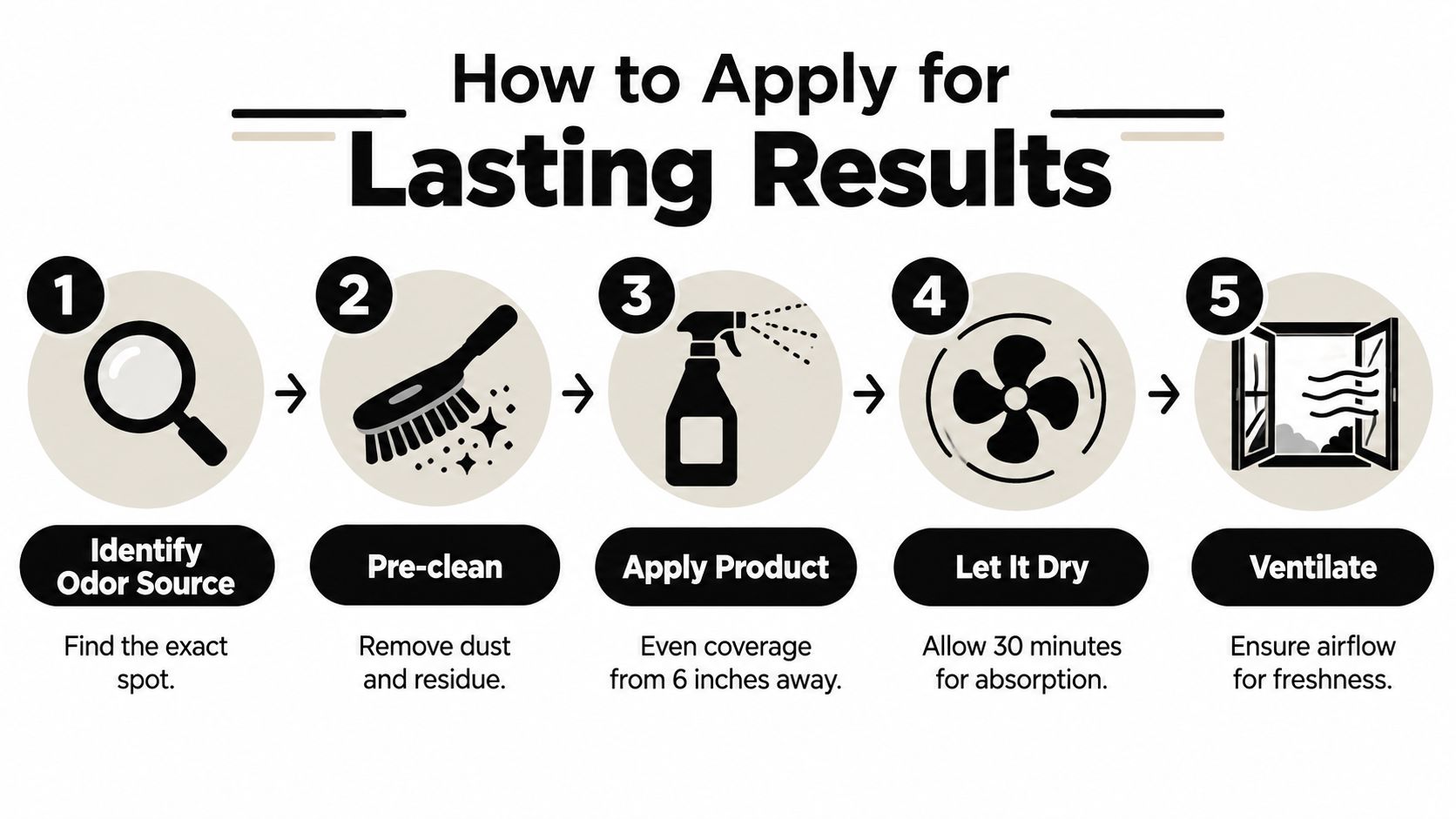
Application is where many decent products underperform. The formula matters, but the method matters almost as much. If you spray the wrong area, skip pre-cleaning, or rush drying, you may only freshen the top layer while the odor source stays behind.
Recent review literature notes that laundering can still leave odor behind on fabrics, and a state-of-the-science review reports that coliform bacteria can survive washing and extended drying in bath towels, which helps explain why some towel odors keep returning, as discussed in the review on microbes and textiles.
Start where the odor actually lives
Don't treat the whole fabric first. Find the hotspot.
- Sportswear: Underarms, chest panels, waistbands
- Towels: Folds, hems, and the area that stays damp longest
- Couches: Headrest zones, armrests, seat cushions
- Cars: Floor mats, cloth seat bases, trunk liners
A workflow that works better
First, remove loose material. Brush off pet hair, crumbs, lint, or dusty buildup. Odor products work better when they can reach the fabric surface instead of coating debris.
Then pre-treat high-residue zones. This step matters most on shirt underarms, towel edges, pet blankets, and seat fabric near spills. If the odor source is thickest there, the treatment should be too.
Apply evenly, not heavily. Mist enough to contact the fibers. Don't drench the fabric unless the product specifically tells you to.
Give it dwell time. Many people spray and judge the product too fast. Odor-control ingredients often need time to interact with what's on the textile.
Dry with airflow. Air movement helps moisture leave instead of lingering inside the material.
How to tell if it actually worked
A useful test is to come back later when the fabric is dry, warm, or slightly humid from use. That's when hidden odor often returns.
If the odor reappears, ask these questions:
- Did I clean away the residue first?
- Did I treat the actual hotspot?
- Is this a fabric that needs repeated treatment because buildup is deep?
- Am I using a masking product on a source problem?
For vehicle fabrics, one option in this category is Evo Dyne Products New Car Smell Spray, which the brand describes as an enzymatic odor-reducing spray for vehicle interiors including carpets and mats. That makes it relevant when the smell sits in fabric-like interior surfaces rather than in hard plastic trim.
If you're refreshing a sofa or swapping removable covers after treatment, it also helps to know what size cover fits correctly so moisture doesn't get trapped in bunching fabric. This guide to compare cushion cover sizes can help if you're re-dressing seat cushions after cleaning.
DIY Remedies Versus Commercial Solutions
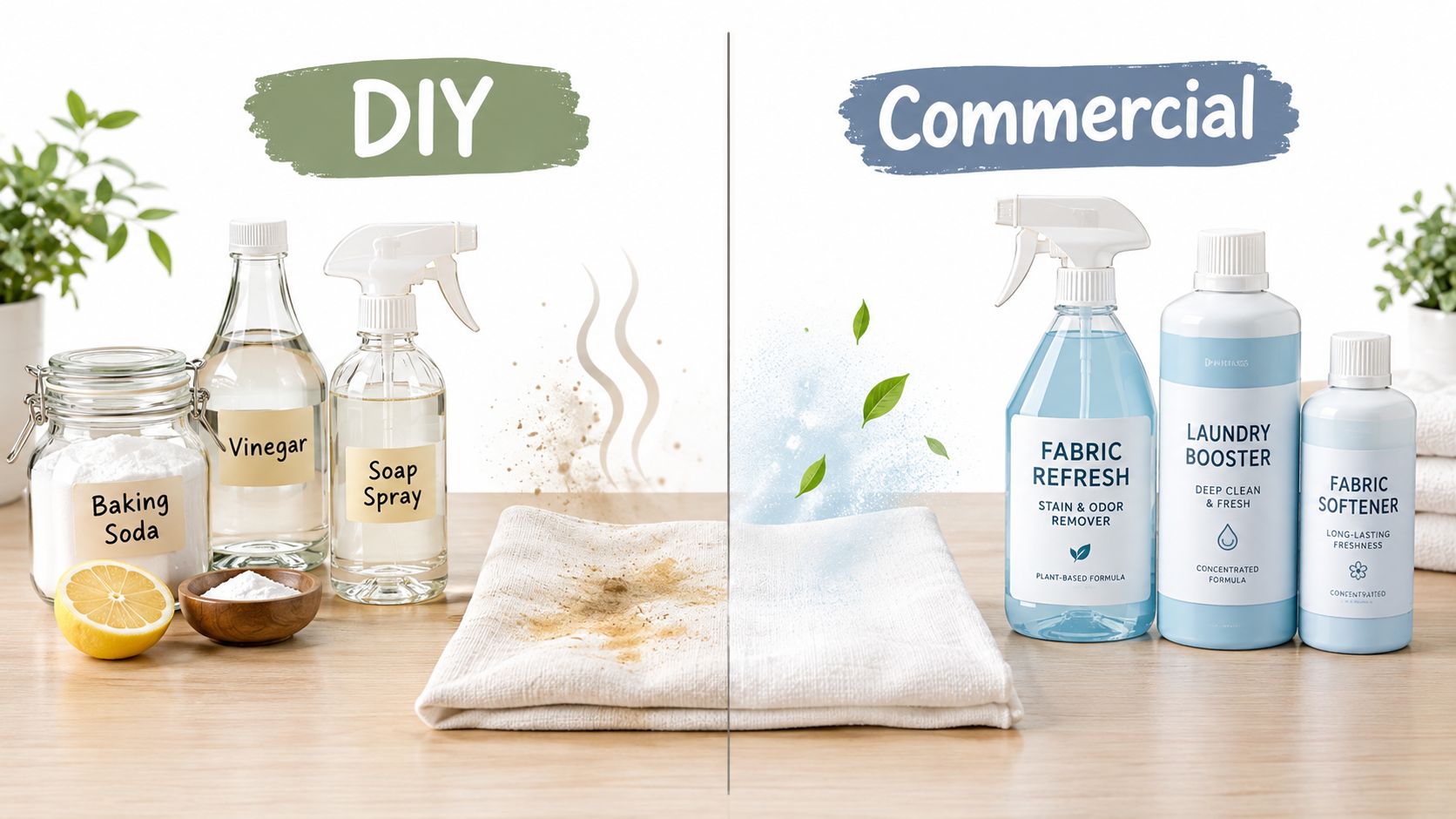
DIY odor control can absolutely help. It's just not good at everything. The trick is knowing when you're dealing with a light odor issue and when you're dealing with a fabric chemistry problem.
When home remedies are enough
Baking soda can help with light surface odor. Vinegar-based rinses or diluted fabric-safe soap mixes may help on washable items when the smell is mild and the fabric isn't delicate. These approaches make the most sense for routine freshness maintenance, laundry baskets, simple fabric accessories, or washable pet bedding with low-level odor.
They're also appealing because they're familiar. Many households already have them on hand, and they don't require a special shopping trip.
When commercial formulas earn their place
Commercial products become more useful when the problem is persistent, repeated, or fiber-specific. Polyester gym wear, old towel odor, upholstery with long-term body oil buildup, and car seat fabric with embedded smells usually need more targeted chemistry than a pantry remedy can provide.
A well-designed commercial fabric odor eliminator may use enzymes, odor-trapping ingredients such as cyclodextrin, or other technology aimed at the textile surface rather than the room air. That's the main advantage. It's less about making the area smell pretty and more about matching chemistry to the source.
This video gives a practical look at product-style odor treatment in action:
A quick decision guide
- Choose DIY first if the odor is light, the item is washable, and you're mainly doing upkeep.
- Choose commercial chemistry if the odor keeps returning after wash or drying.
- Be cautious with DIY on wool, specialty upholstery, or anything with an unknown finish.
- Don't judge by scent strength because stronger fragrance doesn't mean deeper odor removal.
A pet blanket that smells faintly stale may respond well to basic home care. A synthetic training shirt that still smells after washing usually won't.
Smart Shopping Checklist and Troubleshooting Common Issues
A smart purchase starts with the odor, not the packaging. Before buying a fabric odor eliminator, pause and sort the problem into three buckets: what smells, what caused it, and what fabric holds it.
The broader odor-control field isn't tiny or experimental. One projected market benchmark in adjacent textile odor-control technology valued the global textile odor control finishes market at USD 1,038.6 million in 2025 and projected it to reach USD 2,397.2 million by 2036, implying a 7.9% CAGR over 2026 to 2036, according to this fabric odor control market summary. That matters because it shows odor control sits inside an established technical category, not just a shelf of perfumed refreshers.
What to look for when shopping
- Mechanism clarity: Look for labels that suggest how the product works, not just that it “freshens.”
- Fabric fit: Check whether it's appropriate for upholstery, clothing, towels, or auto interiors.
- Fragrance choice: If you're sensitive to scent, look for low-fragrance or fragrance-free options.
- Wash compatibility: For clothing and towels, it helps when the product fits into a broader laundry routine.
- Residue awareness: If your fabrics already feel coated or stiff, consider whether buildup is part of the problem.
If the odor comes back
A returning smell usually points to one of a few issues.
- The source wasn't removed: Residue, biofilm, or grime may still be in the fabric.
- The product was mainly masking: The fabric smelled pleasant for a while, but the malodor source remained.
- The wrong fabric strategy was used: Polyester sportswear and damp towels often need more targeted treatment.
- Heat or moisture re-released trapped odor: The fabric seemed fine until use exposed what was still there.
Buy for the cause, not the scent. That single habit will save more money than trying bottle after bottle.
A good fabric odor eliminator doesn't just make the room smell nicer for an hour. It helps reduce the odor where it lives, at the textile surface, in a way that suits the fabric you own and the mess you're dealing with.
Evo Dyne Products offers practical care solutions across home and auto use, including odor-focused products relevant to fabric-like surfaces such as vehicle carpets and mats. If you want to explore options that fit everyday maintenance and targeted odor problems, visit Evo Dyne Products.