
Your car doesn't lose that fresh cabin feel all at once. It fades in layers. First it's takeout, gym bags, wet floor mats, and that coffee that tipped in the cup holder three weeks ago. Then you spray something labeled “new car” and get a blast of perfume that smells more like a dealership waiting room than a clean interior.
That's why picking the best new car smell spray takes more than sniffing caps and reading marketing copy. Some products add a pleasant scent for a while. Some are built to neutralize odors first. A few reset the cabin well enough that the fragrance feels believable instead of fake.
Before getting into the details, here's the quick comparison most buyers need.
| Format | Best use case | What it does well | Where it falls short |
|---|---|---|---|
| Spray | Daily drivers, targeted refreshes, odor-prone interiors | You control where it goes, how much you use, and whether you treat carpets, mats, or fabric | If the formula only masks odor, the smell won't last |
| Vent clip | Set-and-forget light fragrance | Consistent passive scent through the vents | Limited control, weak against embedded odors |
| Hanging freshener | Cheap, simple scent boost | Easy to use and easy to replace | Often starts strong, then drops off fast |
| Gel canister | Mild steady fragrance in small cabins | Works without clips or spraying | Less precise, usually not great for real odor problems |
| Fogger | Full-cabin reset after smoke, mildew, or heavy odor buildup | Reaches HVAC pathways and interior surfaces more thoroughly than basic fresheners | One-time treatment, less precise, not ideal for small touch-ups |
Restoring That Unmistakable New Car Scent
A lot of drivers buy a new car smell spray when the interior still looks clean but no longer feels clean. That difference matters. The seats may be spotless and the dash may shine, yet the cabin tells a different story the moment the door opens.
What many drivers want isn't a loud fragrance. They want that crisp, dry, clean smell a car has when the interior hasn't been lived in yet. That's a hard thing to recreate with a generic air freshener because daily use changes the cabin in specific ways. Fabrics hold onto food and moisture. Floor mats trap dirt. Air vents circulate yesterday's smells every time the fan kicks on.

The biggest mistake is treating all “new car” products as if they do the same job. They don't. Some only add scent. Others can help remove what's making the car smell old in the first place.
What usually goes wrong
A quick spray into the air might make the cabin smell better for the drive home. By the next morning, the stale note comes back and mixes with the fragrance. That's when the interior starts smelling layered instead of fresh.
Practical rule: If a product smells good for ten minutes but the car still smells bad underneath, you bought a masking product, not a fixing product.
The goal is simple. Start with odor control, then add a scent that reads as clean and believable. That combination gets much closer to the feeling people are chasing.
Understanding the Science of New Car Smell
“New car smell” isn't one note. It's a mix of materials releasing their own aroma over time. Plastics, vinyl, adhesives, sealants, foam, and trim pieces all contribute to that distinct scent profile when a vehicle is fresh off the lot.
That's why a lot of sprays miss the mark. They try to imitate the idea of a new interior with a blunt perfume. The result can smell sweet, chemical, or heavy because it doesn't resemble the subtle mix people remember.
Why masking falls apart fast
When a car develops odor, the problem usually lives in the soft materials. Carpets, cloth seats, trunk liners, and floor mats absorb moisture and organic residue. If you spray only into the air, you're treating the least important part of the problem.
Industry testing found that creating a neutral smell before adding fragrance requires interior cleaners with odor-eliminating properties, and products with odor-eliminating enzymes stand apart from simple masking agents in that role, as noted in Automoblog's car air freshener review.
That neutral baseline is what many product roundups skip. They rank scents, but they don't spend enough time on the condition of the cabin underneath the scent.
What odor elimination actually means
An odor eliminator doesn't just compete with a bad smell. It aims to break down the material causing it. In practical terms, that means the product has a chance to make the interior smell clean even after the fragrance fades down.
A masking spray can still be useful. If your car is already clean and you only want a quick refresh, a fragrance-first product may be enough. But if the cabin has absorbed food odor, pet smell, mildew, or old smoke, fragrance alone usually creates a weird blend instead of a fresh reset.
Here is the easiest way to view it:
- Masking products add scent on top of existing odor.
- Odor-eliminating products try to reduce or remove the source first.
- Balanced new car sprays work best when they do both in the right order.
For a deeper look at why people respond so strongly to this scent profile, Evo Dyne's article on the science behind the new car smell and why we love it so much gives useful background.
Why authenticity matters
The best new car smell spray doesn't announce itself the second you open the door. It should register as a cleaner cabin, not a stronger fragrance. That's a subtle but important distinction.
A believable “new car” scent smells dry, clean, and restrained. If it smells sugary, oily, or overpowering, it's usually trying too hard.
That's also why prep matters so much. You can't recreate a clean-material aroma inside a dirty interior. You can only cover it.
Sprays vs Other Air Fresheners A Performance Showdown
Walk up to two cars labeled “new car scent” and the result can be completely different. One smells clean for a few minutes, then turns flat. The other improves the cabin because the product reached the fabric, mats, and other surfaces that hold odor. Format drives a big part of that difference.
That is why sprays deserve a closer look against vent clips, hanging fresheners, gels, and foggers. The question is not just which one smells strongest on day one. It is which format gives you the best mix of odor control, believable scent, and cost per use.
| Format | Scent longevity | Application control | Odor elimination power | Long-term value |
|---|---|---|---|---|
| Spray | Depends heavily on the formula and whether the interior was cleaned first | High. You can target the exact areas that need treatment | Moderate to strong if the formula is built to deodorize surfaces | Often the best value when used selectively instead of soaking the whole cabin |
| Vent clip | Usually more consistent than a quick mist spray | Low. Output is tied to airflow and placement | Low for embedded odor in fabric or carpet | Easy to budget because replacement timing is fairly predictable |
| Hanging freshener | Usually strongest at first, then drops off fast | Low | Low | Cheap to buy, but frequent replacement raises the real monthly cost |
| Gel canister | Fairly steady in small cabins | Medium | Low | Reasonable for maintenance, limited for odor correction |
| Fogger | Longer-lasting than standard fragrance products when the odor problem is severe | Very low during use | Strong for full-cabin treatment | Good value as an occasional reset, poor fit for routine touch-ups |

Where sprays earn their place
Sprays give the best control. That sounds simple, but in practice it matters more than raw longevity claims.
Odor usually lives low in the cabin. Floor mats, seat bases, trunk carpet, and cloth upholstery do most of the absorbing. A spray lets you treat those zones directly instead of pushing fragrance through the vents and hoping it reaches the source. That targeted approach also improves cost per use. A few light sprays on problem areas often do more than replacing a clip or hanger every few weeks.
I have found this is the point many buyers miss. They compare products by sticker price, not by how much usable treatment each format delivers. A spray that costs a little more up front can still be the better buy if it handles odor in the right places and does not need constant replacement.
Precision is the spray format's real advantage. You can adjust both location and intensity, which is hard to do with passive air fresheners.
The downside is consistency. Weak formulas fade fast, and heavy perfume-based sprays can make a cabin smell glossy or artificial. The format gives you control, but the formula still determines whether the result feels close to a new interior or like a cover-up.
Where vent clips and hanging fresheners still make sense
Vent clips stay popular for a reason. They are simple, tidy, and require almost no effort after installation. According to a market analysis by Fortune Business Insights on the car air fresheners market, vent and clip-style products make up a major share of the category, with retail leading sales and online channels continuing to grow.
That lines up with real-world use. Vent clips work best in cars that already smell fine and just need a light maintenance scent. They are less convincing in cars with trapped food odor, wet-carpet smell, pet odor, or stale smoke. In those situations, airflow spreads fragrance well, but it does very little for the material causing the smell.
Hanging fresheners are even more basic. They are inexpensive and immediate, but the scent curve is rarely smooth. Many start too strong, then fade unevenly. For a commuter car with no real odor issue, that may be acceptable. For anyone trying to restore a clean, realistic new-car feel, they are usually too blunt.
The middle ground between maintenance and reset
Gel canisters sit in the middle. They tend to release scent more steadily than paper hangers, and they are less dependent on HVAC airflow than vent clips. In a small, already-clean cabin, that can work well enough. Their limitation is reach. They do not actively treat fabrics, and they are slow to make a difference in a car with absorbed odor.
Foggers solve the opposite problem. They are made for broad cabin treatment, including areas a hand spray may miss. That makes them useful after smoke exposure, mildew, or a neglected interior cleanup. As detailed in a Chemical Guys guide to choosing car fragrance products, full-cabin odor products are positioned as occasional reset tools rather than everyday fresheners.
That distinction matters. Foggers are for correction. Sprays are better for maintenance and for spot treatment after the big odor issue is handled.
Which format fits which driver
- Choose a spray if you want control, targeted treatment, and better cost-per-use in the areas that hold odors.
- Choose a vent clip if the cabin is already clean and you want steady background scent with almost no effort.
- Choose a hanging freshener if low purchase price matters more than realism, consistency, or odor correction.
- Choose a gel if you want mild, low-maintenance scent in a small cabin.
- Choose a fogger if the whole interior needs a broad reset before a maintenance product will make sense.
For most drivers, the strongest setup is simple. Correct the cabin first if it has a real odor problem, then use a spray to maintain the result without wasting product where it is not needed.
How to Choose the Right New Car Smell Spray
You clean the interior, spray once, and the cabin smells promising for an hour. By the next commute, the old odor is back. That usually means the product was built to perfume the air, not treat the materials that hold smell.
The right spray starts with the problem you are trying to solve. In a newer car with no embedded odor, a fragrance-first product can be enough. In an older daily driver, family SUV, or work truck, the better choice is a formula that targets odor at the source and does not force constant reapplication.

Check what the formula is trying to do
Labels usually tell the story if you read past the scent name. Some products are plainly fragrance sprays. Others mention odor neutralizing ingredients, enzymatic cleaners, or deodorizing action meant for fabric, carpet, and other porous surfaces.
That difference shows up fast in real use. A fragrance spray gives you an immediate hit, but it often fades once the cabin airs out. A deodorizing formula has a better chance of improving how the car smells the next day because it is working on the surfaces where odor lingers.
If the label only describes notes like leather, suede, musk, or fresh vinyl, treat it as a scent product.
Pay attention to scent accuracy
A convincing new car scent is usually subtle. It should smell clean, slightly dry, and controlled. The misses are easy to spot. They turn sugary, overly leathery, or close to cheap cologne.
I judge this by how the cabin feels after ten minutes with the doors closed. Good sprays make the interior smell freshly detailed. Bad ones make it smell coated.
Cost per use matters more than bottle price
Many buyers waste money. A low bottle price looks good on the shelf, but it tells you very little about actual value if the formula burns off quickly or needs six sprays per ride.
Good Housekeeping points out the comparison problem clearly in its guide to the best car air fresheners, which notes that spray bottles often come with far less clear longevity information than vent clips, including cheaper $10 spray options. That gap matters because real value comes from how many treatments you get and how long each one holds up in your cabin.
A stronger concentrate can cost more upfront and still be cheaper over a month of use. A weak spray can look like a bargain and end up empty in two weeks.
Judge the bottle by treatments per month, not shelf price.
Safety and surface compatibility count
Car interiors are tight spaces, and overspraying causes problems fast. Heavy fragrance can trigger headaches, cling to clothing, or leave the cabin stuffy. For families, pet owners, and anyone sensitive to scent, cleaner formulas with lighter residue are usually the smarter buy.
Surface safety matters too. Many sprays are fine on carpet and cloth mats but should stay off screens, piano black trim, and some leather finishes. If the label is vague, use it only on fabrics and test a hidden spot first.
A quick buying checklist:
- For family cars: Choose a mild scent and a formula that focuses on odor control, not maximum intensity.
- For older vehicles or work trucks: Put deodorizing performance ahead of scent realism.
- For premium interiors: Pick a restrained spray that will not make the cabin smell artificially perfumed.
- For value shoppers: Estimate sprays per application and applications per week before deciding which bottle is cheaper to own.
Top Rated New Car and Leather Scent Sprays for 2026
You open the door after a long workweek, and the cabin smells tired. Not filthy, just flat. That's the moment product type matters more than marketing. A good new car smell spray should match the condition of the interior, the kind of odor you're dealing with, and how often you want to reapply it.
Some products are built to knock down embedded odor. Others are basically scent toppers for cars that are already clean. That difference decides whether you get a convincing fresh cabin or a sweet smell sitting on top of stale air.
For a broad cabin reset
If the whole interior smells off, a fogger-style treatment still has a place. Chemical Guys' Total Reset Odor Eliminator fits that role because it treats the cabin all at once instead of giving you a light maintenance mist.
That matters in cars with smoke residue, food odor, or that closed-up stale smell that settles into carpet and headliner. A fogger can reach areas a trigger spray usually misses.
The trade-off is precision. You get cabin-wide coverage, but not much control over where product lands or how strong the result feels afterward. It also tends to be a poorer value for routine upkeep, since each treatment is basically a full send.
For drivers who care more about scent than deodorizing
A lot of “new car” sprays are really fragrance products with a car-themed scent profile. There's nothing wrong with that if the interior already smells clean.
These are the bottles I'd use for quick touch-ups before a commute, date night, or rideshare shift in a well-kept car. They give instant payoff, but they don't do much against odor that's still active in the fabric or under the seats. If the cabin smells good for an hour and then drifts back, that's usually the limit of a fragrance-first formula.
For controlled routine maintenance
A hand spray is still the format I reach for most often. It lets you treat the spots that hold odor, use less product per application, and keep the scent level where you want it.
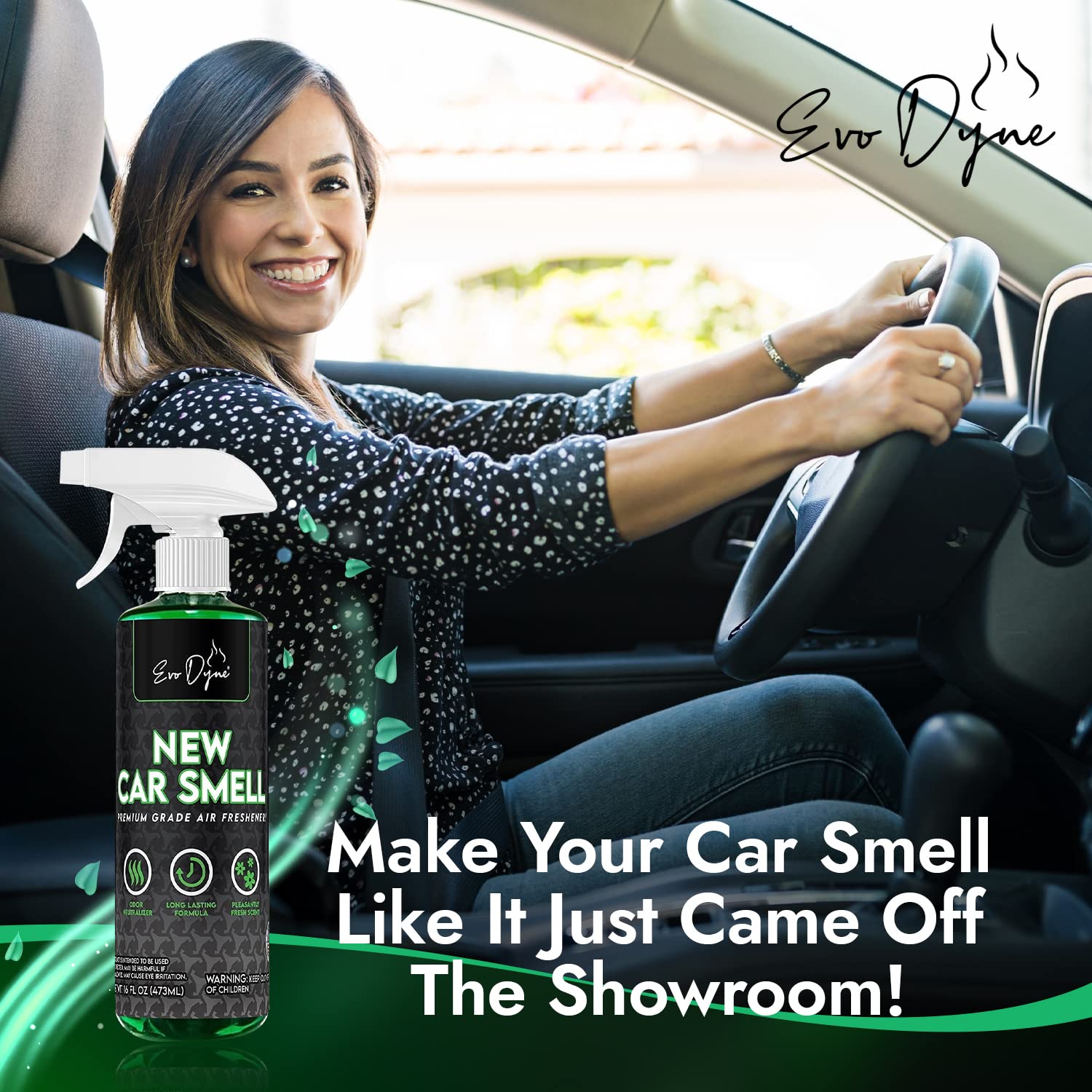
Evo Dyne Products' New Car Smell Spray falls into that practical middle ground. It is described as a USA-formulated enzymatic spray that targets odors while also working as a water-based air freshener for cars and other spaces. On paper, that is the right combination for drivers who want more than a perfume effect but do not want the commitment of a full-cabin fogger every time.
That combination also matters for cost-per-use. A controllable spray usually stretches further than one-shot treatments because you can apply a few light mists to carpet, mats, or cloth seat bases instead of treating the entire cabin every time the smell fades.

For leather-heavy interiors
Leather scent and new car scent are not the same thing. Real leather-focused sprays usually smell warmer, drier, and less synthetic. That tends to work better in upscale interiors where a strong plastic-forward fragrance can smell fake fast.
I'd choose a leather-specific scent for vehicles with leather seating, leather door inserts, and a generally clean cabin that already feels well cared for. In that setting, a leather spray adds finish. It does not need to cover problems.
Leather scent works best as a final layer on a clean interior, not as a fix for trapped odor.
My practical shortlist by situation
- Whole cabin smells stale or contaminated: Start with a fogger or full reset treatment.
- Interior is clean but loses freshness quickly: Use a targeted spray with odor-control claims.
- Leather-heavy cabin with a premium feel: Use a leather-specific scent instead of a generic new car fragrance.
- You only want fast scent impact: A fragrance-first spray is fine, as long as you do not expect true odor removal.
The best pick is the one that solves your actual problem. If the issue is lingering odor, buy for elimination and cost-per-use. If the issue is restoring a fresh, just-detailed impression, a lighter scent spray is often enough.
Application and Maintenance for a Lasting Fresh Scent
Most spray failures come from bad prep and overuse. People spray the air, close the doors, and expect the cabin to reinvent itself. It doesn't work that way.
If you want the best new car smell spray to last, treat the interior first and the air second.
Start with the odor zones
Vacuum the carpets, mats, seat creases, and trunk. Wipe down hard surfaces. If something spilled, clean that spot before you even think about scent. A spray can improve the smell of a clean interior. It can't make a dirty interior honest.
Then check the usual problem areas:
- Floor mats: They hold moisture and shoe odor.
- Under the seats: Crumbs and forgotten trash live there longer than people think.
- Cup holders and door pockets: Sticky residue creates stale smells fast.
- Trunk carpet: Grocery leaks and damp gear often go unnoticed.
Apply lightly and low
Most odor sits in absorbent surfaces, so that's where a spray should go. Lightly mist carpets, cloth mats, and fabric areas under or around the seats. Those surfaces hold the product and release scent gradually.
Avoid drenching the cabin. More product doesn't equal a better result. It usually just creates a heavy opening note and wastes bottle life.
Spray low and let the cabin breathe. If you can taste the fragrance in the air, you used too much.
Be careful with dashboards, screens, and leather. A standard air freshener spray isn't the right product for every material, especially if the finish is delicate or coated.
Use airflow the smart way
After application, let the car air out briefly. Then run the fan for a short period so the scent distributes through the cabin instead of sitting in one corner. If your vents smell stale, address that separately rather than hoping fragrance will fix it.
For maintenance, don't spray on a schedule just because the calendar says so. Spray when the cabin starts losing freshness. Clean interiors need less product. Dirty interiors need cleaning, not more fragrance.
A simple pattern works well:
- Clean the cabin.
- Treat soft surfaces lightly.
- Ventilate.
- Reapply only when the interior needs it.
That approach keeps the scent believable and the bottle lasting longer.
Your Car Air Freshener Questions Answered
Can I use a new car smell spray around kids and pets
Read the label and use common sense. In a small enclosed cabin, strong fragrance can be unpleasant even when a product is intended for interior use. Light application is safer and usually smells better anyway. If the product feels harsh after spraying, use less and ventilate the vehicle before driving.
Can I spray it directly on leather seats
Usually, that's not the first place to spray unless the product is meant for leather or you're using a leather-specific scent. For most new car smell sprays, carpets, mats, and fabric areas are better targets because they hold odor and release fragrance more evenly. Leather is better treated as its own material, not as a catch-all scent surface.
How long should a bottle last
That depends on how much you use per application and how clean the car is before you spray. Reviews often leave that question unanswered, which makes comparisons harder than they should be. In practice, a bottle lasts much longer when you use it for maintenance on a clean interior than when you're constantly trying to cover an untreated odor problem.
Why does my car still smell bad after I spray it
Because the source is still there. The usual culprits are dirty mats, damp carpet, spills under the seats, stale vents, trunk odor, or upholstery that's absorbed organic residue. If the smell comes back quickly, stop adding fragrance and go looking for the source.
Persistent odor is a cleaning problem first and a fragrance problem second.
Is a spray better than a vent clip
For control and targeted treatment, yes. For passive convenience, no. A vent clip is fine in a clean car that only needs a background scent. A spray is better when you want to treat the areas causing the smell.
If you want a more practical approach than hanging another freshener from the mirror, Evo Dyne Products offers car scent options like New Car Smell and Leather Scent sprays for drivers who prefer controllable application and a focus on odor management rather than scent alone.