


Most advice about the best cutting oil starts in the wrong place. It tells you to find the slickest product, apply it generously, and expect longer tool life. That works only when friction is the main problem. In a high-speed milling cycle, an interrupted cut, or a production line where heat builds continuously, the fluid that lubricates best on paper may not remove heat well enough in practice.
The useful question is simpler: does this operation need a stronger oil film, or does it need faster heat removal? Tool geometry, workpiece material, cutting speed, delivery pressure, and maintenance all change the answer. A heavy neat oil can be the right choice for tapping stainless steel, while a water-rich emulsion can make more sense for continuous CNC milling.
| Fluid Type | Composition | Cooling Capacity | Lubricity | Best For |
|---|---|---|---|---|
| Straight, or neat, oil | Undiluted mineral, synthetic, or bio-based oil with additives | Lower | High | Tapping, threading, broaching, deep drilling, low-speed heavy cuts |
| Soluble oil | Oil concentrate mixed with water | High | Moderate to high | General machining where both cooling and lubrication matter |
| Semi-synthetic | Small oil phase combined with synthetic chemistry and water | High | Moderate | CNC work requiring clean operation and balanced performance |
| True synthetic | Water-based chemistry without conventional mineral oil | Very high | Lower to moderate, formulation-dependent | High-speed machining and operations dominated by heat removal |
Rethinking the Search for the Perfect Fluid
The thickest, slickest cutting oil isn't automatically the best choice. Lubricity reduces sliding and adhesion at the tool-workpiece interface, but heat still has to leave the cutting zone. If the fluid can't carry heat away quickly enough, a low-friction film may protect against galling while the insert continues to overheat.
That trade-off becomes especially important in interrupted cutting. Independent experimental work from RWTH Aachen found that, when high-pressure fluid was supplied during interrupted cutting, cooling rather than lubrication was the main factor reducing tool wear (RWTH Aachen experimental study). The same work found a smaller effect from cutting-fluid application in materials with self-lubricating behavior.
Practical rule: Choose the fluid and delivery system around the failure you're actually seeing. A worn flank, welded chip, or galling problem points toward lubrication. Thermal discoloration, rapid edge breakdown, or dimensional drift points toward cooling.
What “best” means at the machine
Start with the cut, not the label on the container. A manual lathe doing a slow threading operation creates a concentrated load at the tool tip. The oil film must stay intact while the tool displaces material. A high-speed milling operation spreads heat across repeated passes, chips, the tool, and the workpiece. That cycle often benefits more from volume, flow, and heat capacity than from maximum viscosity.
Interrupted cuts deserve particular attention because the tool repeatedly enters and leaves the material. High-pressure delivery can improve access to the cutting zone, but the fluid's dominant benefit may still be thermal. Flooding a cut with a very lubricious oil doesn't solve a heat problem if the oil's thermal properties and circulation system can't move enough energy away.
Stop ranking products in isolation
Product rankings flatten different operations into one score. They also hide the role of concentration, nozzle position, filtration, chip evacuation, and sump condition. A fluid that performs well in a clean, controlled test can disappoint when tramp oil, fines, or poor delivery changes the cutting environment.
A better buying brief lists the material, operation, speed, tooling, delivery method, fire constraints, and waste requirements. Only then should you compare additive packages and brands.
Core Metalworking Fluid Categories Explained
Fluid categories describe how the product is built, but they don't predict performance by themselves. The base fluid controls viscosity, wetting, and heat movement. Additives then modify boundary lubrication, corrosion protection, foam behavior, and compatibility with the machine and workpiece.
Straight, or neat, oils
Neat oils contain little or no water and are used without dilution. Their strength is a persistent lubricating film, especially during operations where the tool carries concentrated pressure. Threading, tapping, reaming, broaching, and difficult drilling often benefit from this behavior.
A heavy oil can cling to the work zone and support extreme-pressure chemistry. Sulfurized or chlorinated additives may improve load carrying, but they can create compatibility, staining, odor, or disposal concerns depending on the metal, machine materials, and local requirements. Aluminum is particularly sensitive to staining from unsuitable active sulfur chemistry, so the supplier's material-compatibility guidance matters.
Neat oils also bring practical costs. They can leave a heavier film on the machine, generate mist under aggressive delivery, and require careful fire-risk control. They're useful when lubrication is the limiting factor, not because they're universally superior.
Soluble oils and semi-synthetics
Soluble oils form an emulsion after mixing with water. The oil phase supplies lubricity, while the water phase carries heat away. That combination suits general-purpose machining where the shop needs a compromise between tool protection and thermal control.
Semi-synthetics reduce the oil phase and use synthetic components to improve cooling, cleanliness, and stability. They're common candidates for CNC work with varied materials and changing operations. Their performance depends heavily on mix quality, water condition, concentration, and biological control.
The mixing order matters. Add concentrate to water, not water to concentrate, unless the product's technical sheet says otherwise. A poor mix can destabilize the emulsion, create foam, or leave areas of weak protection.
True synthetics
True synthetic fluids use water-based chemistry without a conventional mineral-oil phase. They generally emphasize cooling, cleanliness, visibility, and circulation. That makes them attractive for high-speed operations where heat removal dominates.
Their lower oil content doesn't mean they never lubricate. Additives can still provide boundary protection, corrosion control, and wetting. However, a true synthetic may not replace a neat oil in severe tapping or broaching where the contact pressure overwhelms its lubricating film.
Read the technical data sheet for viscosity, corrosion testing, foam behavior, material compatibility, and recommended concentration, rather than judging a product by its category alone.
Friction Reduction Versus Heat Transfer
Tribology data makes the trade-off visible. A bio-lubricant comparison reported a boundary-lubrication coefficient of friction of around 0.25 for one cutting fluid, while Acculube LB-2000 produced the best friction reduction across all tested lubrication regimes (comparative bio-lubricant tribology study). Those results point to the value of a strong lubricating film when the tool and workpiece are carrying load in close contact.
The same study found higher thermal conductivity and specific heat in water-rich fluids. That gives water-based or emulsified systems a clear thermal advantage over pure mineral oil, which showed comparatively lower heat-transfer properties. In practical terms, a low-friction oil can protect a loaded interface, while a water-rich fluid can pull heat out of a continuous cut more effectively.
Read the data sheet like a machinist
A friction number is useful only if the test resembles your operation. Boundary-lubrication results tell you how a fluid behaves when the tool and workpiece are close to direct contact. They don't tell you whether the fluid will keep a high-speed milling cycle within a safe thermal window.
Look for evidence in four areas:
- Boundary lubrication: Relevant to tapping, threading, broaching, and rubbing-prone cuts.
- Thermal behavior: Thermal conductivity and specific heat indicate how strongly the fluid can absorb and move heat.
- Delivery performance: Flow, pressure, nozzle placement, and filtration determine whether the fluid reaches the shear zone.
- Material compatibility: Additives must protect the cut without staining aluminum, attacking seals, or accelerating corrosion.
The shop-floor decision
If the tool is welding material to its edge, the finish is tearing, or the cut is galling, increase attention to lubricity and additive chemistry. If the tool is failing from heat during long continuous passes, improve fluid flow, concentration, filtration, and heat transfer before choosing a thicker oil.
Neither side wins every operation. The best cutting oil is the one that addresses the dominant wear mechanism without creating a new problem elsewhere.
Matching Fluid Chemistry to Material and Operation
Material behavior gives you the first useful filter. Operation gives you the second. A fluid that works well on free-machining steel may stain aluminum, fail to protect a stainless-steel tap, or overheat during continuous milling.
Aluminum needs adhesion control
Aluminum tends to stick to the tool's cutting surface when the lubricating film breaks down. That can produce built-up edge, poor surface finish, and dimensional variation. Choose a fluid with strong lubricity and confirm that its additive package is approved for the alloy and finish requirements.
For drilling and tapping, a targeted neat oil or a compatible high-lubricity product often makes sense. For high-speed aluminum milling, a water-miscible system may be preferable if the machine produces more heat than friction. In that case, don't rely on fluid chemistry alone. Use a sharp tool, maintain chip evacuation, and aim the nozzles where chips and heat leave the cut.
Stainless steel and titanium punish weak delivery
Stainless steel can work harden when the tool rubs instead of cutting cleanly. Interrupted cuts, deep passes, and poor chip evacuation increase the risk. Strong lubrication helps keep the edge engaged in the material rather than sliding across a hardened surface.
Titanium also demands disciplined heat management because it doesn't readily forgive poor cutting conditions. Use a fluid and delivery arrangement that matches the insert geometry, engagement, and speed. A neat oil may help concentrated operations such as tapping or drilling, while a water-based system can be more suitable when continuous cutting generates sustained heat.
A practical selection matrix
- Manual turning and low-speed heavy cuts: Start with a neat oil when the operation is torque-heavy and friction-limited. Keep mist, residue, and fire controls in place.
- Tapping, threading, and broaching: Prioritize film strength and extreme-pressure protection. Brush, drip, or through-tool delivery should reach the actual contact zone.
- High-speed CNC milling: Begin with a soluble oil, semi-synthetic, or synthetic when heat removal controls tool life. Verify concentration and flow rather than assuming more fluid solves the problem.
- Mixed-metal production: Favor a formulation with broad compatibility, then test it on aluminum, stainless, and ferrous parts before converting the whole system.
- Interrupted or high-load cutting: Evaluate high-pressure delivery and thermal performance together. The RWTH Aachen findings show why lubrication alone can be the wrong priority in this setting (experimental findings on cooling and tool wear).
Run a controlled trial on one machine. Record tool wear, finish, chip shape, odor, residue, and cleanup effort. A small, disciplined test tells you more than a generic claim that a fluid is suitable for “all metals.”
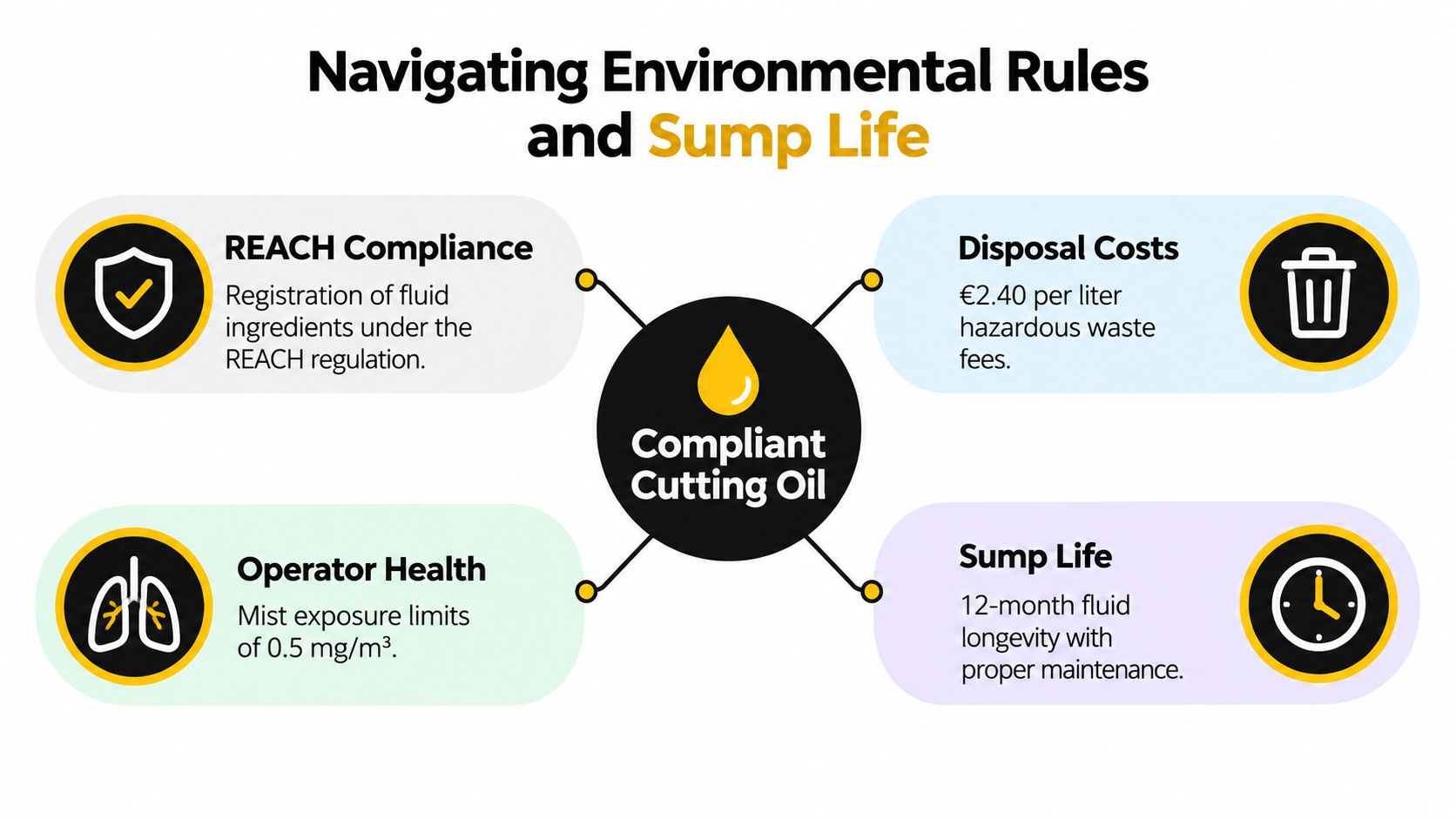
Navigating Environmental Rules and Sump Life
A cutting fluid's purchase price is only one part of its cost. Disposal, cleaning, operator exposure, machine contamination, and production interruptions can outweigh the price difference between two products. The more fluid a shop circulates, the more important those lifecycle details become.
Market direction reinforces that point. Neat cutting oils held a 42.1% share of the metalworking-fluids market in 2025, while synthetic-based fluids are projected to grow fastest through 2033, according to Grand View Research's metalworking fluids market analysis. The same source describes water-based concentrates as increasingly relevant in high-volume lines because they dissipate heat, reduce fire risk, and can lower environmental burden.
Compliance starts with chemistry
Environmental and chemical rules are moving attention toward bio-based formulas, persistent chemicals, and fluid-management practices. A market overview from The Insight Partners identifies PFAS and persistent chemicals, AI-assisted formulation, and service-based fluid-management contracts as emerging concerns and trends. That doesn't mean every shop should abandon petroleum-based oil immediately. The transition is gradual, and performance, compatibility, and local disposal rules still decide what works.
Ask suppliers for ingredient disclosure, regulatory documentation, and disposal guidance. A bio-based label isn't enough if the product has poor sump stability or creates frequent replacement waste.
Treat the sump as a process
Water-miscible fluid lasts only as well as the shop's maintenance routine. Remove tramp oil, keep chips out of the reservoir, control concentration, and prevent stagnant zones. These actions reduce odor and instability while helping the fluid perform consistently.
For adjacent maintenance decisions, a useful antifreeze performance and cost comparison illustrates the same broader lesson: evaluate a fluid by performance, service life, handling, and end-of-life burden, not just its container price.
Neat oil needs a different control plan. Monitor mist, leaks, residue, and ignition sources. Use extraction where required, keep oily waste in suitable containers, and follow the product's safety data sheet.
Shop-owner perspective: A fluid with a longer usable life is valuable only if the shop can keep it clean and within specification.
The Case for Premium Formulations Like Evo Dyne
Cheap, unbranded fluid becomes expensive when it causes a tool to chip, a finish to fail, or a machine to stop for cleanup. The hidden cost isn't limited to the oil itself. It includes lost setup time, rejected parts, extra inserts, contaminated sumps, and the labor required to diagnose inconsistent results.
That doesn't mean a premium label guarantees success. It means a reputable supplier should provide a consistent formulation, clear technical documentation, material guidance, and responsive support when the operation doesn't behave as expected. Those basics matter more than a bold claim on the front of a bottle.
What to verify before buying
For a heavy-duty cutting oil, ask for the technical data sheet and safety data sheet before putting it into production. Confirm the intended operations, viscosity range, additive chemistry, aluminum compatibility, storage requirements, and disposal considerations.
Evo Dyne Products offers Evo Dyne Cutting Fluid, a multipurpose metal cutting oil described for drilling, tapping, and milling. That makes it one candidate for shops comparing professional-grade fluids, but the final decision should still come from a controlled trial against the actual material, tooling, and delivery method.
A premium formulation earns its place when it produces repeatable cutting behavior and fits the shop's handling process. Evaluate it by tool wear, finish, chip control, cleanup, and fluid stability, not by branding alone.
Safe Handling and Daily Maintenance Protocols
Even the best cutting oil fails when operators neglect the sump or treat fluid contact as harmless. Set the handling standard before the product reaches the machine. Use the personal protective equipment listed in the safety data sheet, keep ventilation working, and prevent avoidable skin contact during mixing, transfer, and cleanup.
Daily checks that prevent trouble
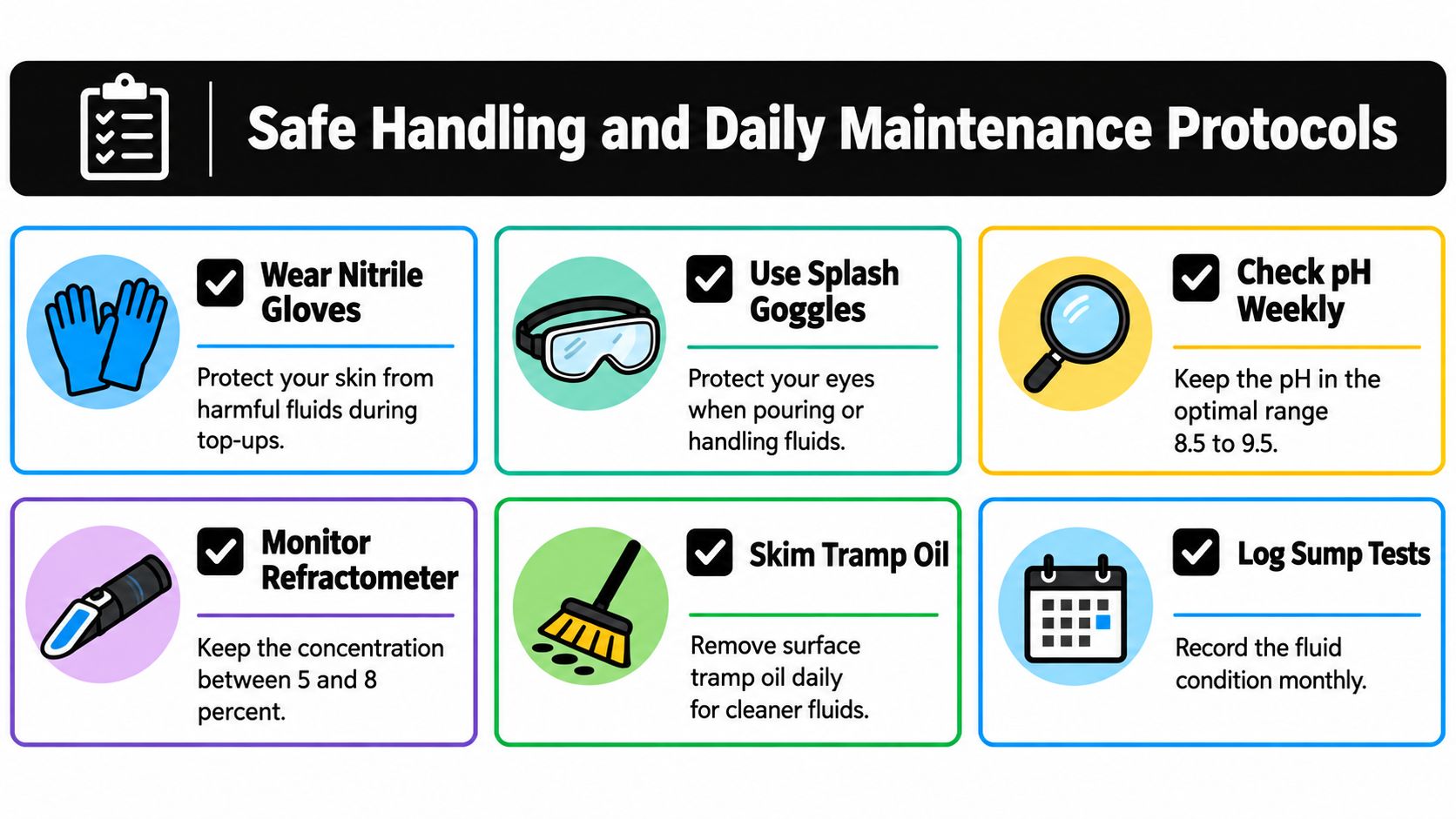
For a water-miscible system, check concentration with a refractometer and record the result. Inspect the surface for tramp oil, skim it before it circulates through the system, and look for foam, odor, discoloration, or unusual deposits.
Check pH on the schedule specified by the fluid supplier. A falling pH can indicate contamination or fluid degradation, while an excessive reading can increase skin irritation. Don't correct chemistry by guesswork. Adjust with the approved concentrate or maintenance product.
- Wear suitable gloves: Use chemical-resistant gloves during top-ups and cleanup, and replace contaminated gloves promptly.
- Protect your eyes: Wear splash goggles when pouring concentrate, draining sumps, or handling pressurized lines.
- Control mist: Use enclosure extraction or mist collection for operations that aerosolize neat or water-miscible fluids.
- Keep the machine clean: Remove chips and residue so contamination doesn't return to the reservoir.
- Log changes: Record concentration, pH, additions, odor, and visible contamination so gradual deterioration doesn't go unnoticed.
Weekly and periodic discipline
Inspect pumps, nozzles, filters, hoses, and skimmers. A good fluid can't cool the cut if a blocked nozzle sends it away from the tool. Check for leaks and seal compatibility, especially after changing from one chemistry to another.
For neat oils, focus on mist collection, spill control, storage, and ignition prevention. Keep containers closed when they aren't in use, follow the safety data sheet, and dispose of oily waste through an approved route.
Use the cutting-oil maintenance mistakes guide as a practical checklist when reviewing shop routines. The right fluid, clean delivery, and consistent records work together. Changing the product without fixing poor maintenance rarely solves the underlying problem.
Evo Dyne Products offers cutting and lubrication fluids for machinists, metalworkers, and auto shops, including a multipurpose cutting fluid for drilling, tapping, and milling. Visit Evo Dyne Products to review the available options, then test the fluid on your material and operation before committing to a wider shop conversion.