

A stronger scent is not evidence that the smell is gone. So when an industrial odor eliminator spray fills a bay with pine or citrus, what changed: the odor molecules, or only your perception of them?
That question splits the category in two. One group of products changes what your nose reports for an hour or two. The other changes the chemistry in the air and on the surface. Both arrive in spray bottles with confident claims, and the front label rarely tells you which one you're holding.
Sorting them out takes a few minutes. What an odor physically is, which approaches remove it, where a spray is the wrong tool entirely, and how to check a result without trusting fragrance as the measure.
Table of Contents
- How Odor Eliminator Sprays Work, Side by Side
- Why Source Control Comes Before Any Spray
- Where Industrial Odor Sprays Are Used and Why
- What to Check on the Label Before You Buy
- Choosing a Spray Safely for Sensitive Occupants
- How to Apply an Odor Spray Without Spreading It
- How to Tell Whether the Spray Is Working
How Odor Eliminator Sprays Work, Side by Side
An odor is a cloud of molecules. Some drift through the air, others settle onto counters, fabric, drain surrounds and floor seams. A stale kitchen smells because molecules keep arriving from a source and because a reservoir of them sits on the surfaces a metre away.
Spray a strong perfume over that kitchen and the smell vanishes for twenty minutes. Nothing was removed. Fragrance molecules outcompete the odor at your nose receptors, the scent fades, and the old smell returns because it never left. That is the distinction most buyers miss, and it decides whether a product is worth the money in a workplace.
Four approaches, one question
Every industrial odor eliminator spray on the market uses one of four routes, or a combination. Masking covers a smell with a stronger scent and leaves the odor molecules in place. Absorbing or complexing binds odor molecules to the product or the surface so they stop circulating. Chemical or enzymatic neutralization reacts with odor molecules and converts them into compounds that don't smell. Source removal and ventilation takes the emitting material away and clears the air.
Only the last three reduce the odorant burden, and the middle two do it only on their own terms: enough contact time, complete surface coverage, and the humidity, temperature and compound the chemistry was built for. A neutralizer misted on and wiped off ten seconds later has had almost no chance to react.
The two panels below show the difference at a glance.
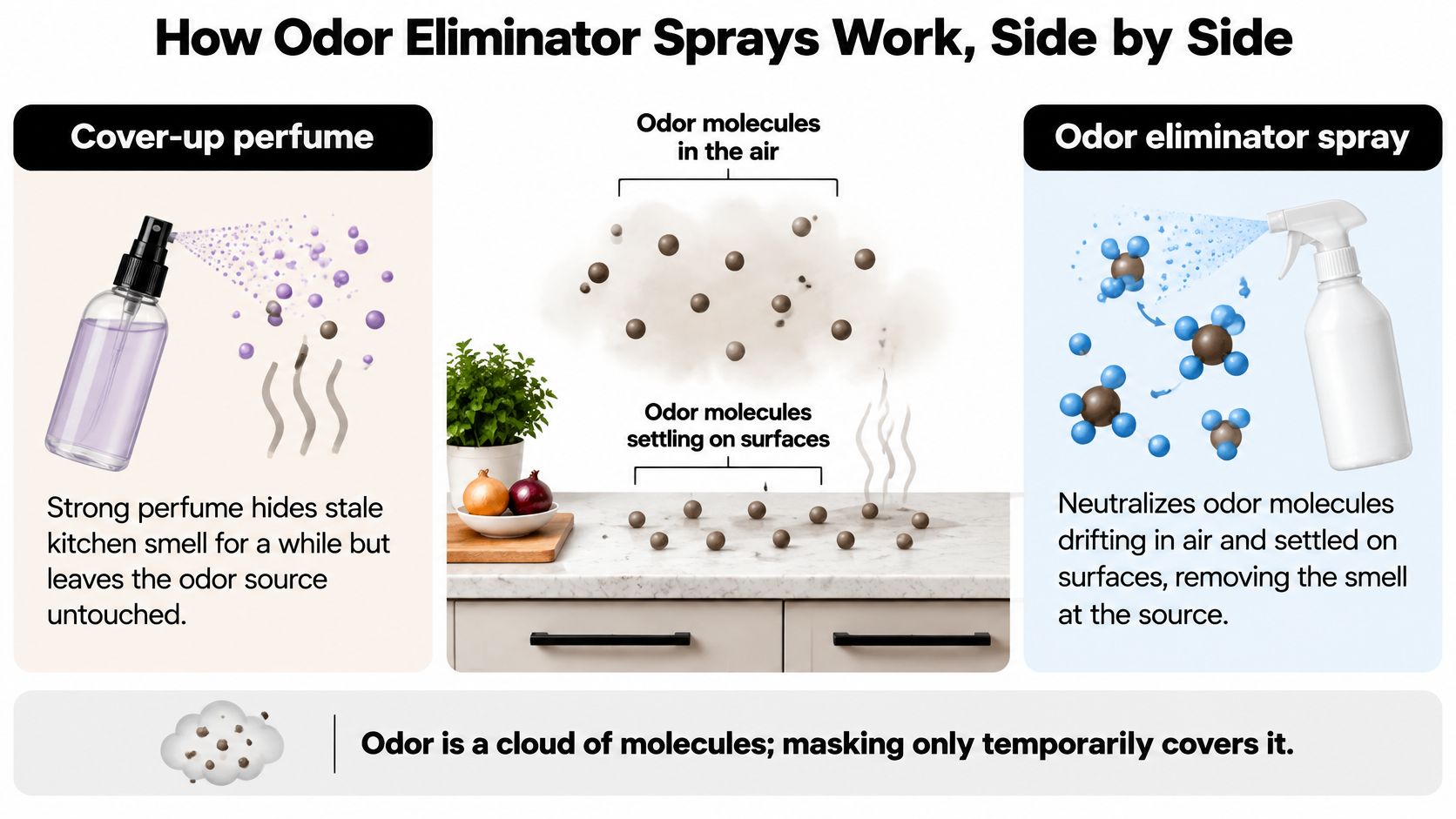
Read across the rows to see which approach changes the air and which only changes your impression of it.
| Approach | How it works | Reduces odor molecules? | Best use |
|---|---|---|---|
| Masking fragrance | Covers the smell with a stronger scent | No, the molecules stay in the air | Short cover when the source cannot be reached yet |
| Absorbing or complexing | Binds odor molecules so they stop circulating | Yes, binds them to the product or surface | Porous materials, fabric and soft surfaces |
| Chemical or enzymatic neutralization | Reacts with odor molecules and changes them | Yes, if contact time and coverage are adequate | Organic residue on hard or porous surfaces |
| Source removal and ventilation | Eliminates the emitter and clears the air | Yes, removes the source | Always the first step before any spray |
The test that matters: judge a spray by how far the odor drops, not by how strong the scent is at the moment you press the nozzle.
Removal is a bigger subject than any bottle. This walkthrough of odor removal methods that work covers the cleaning, ventilation and surface work that does most of the job before a spray is even opened.
Why Source Control Comes Before Any Spray
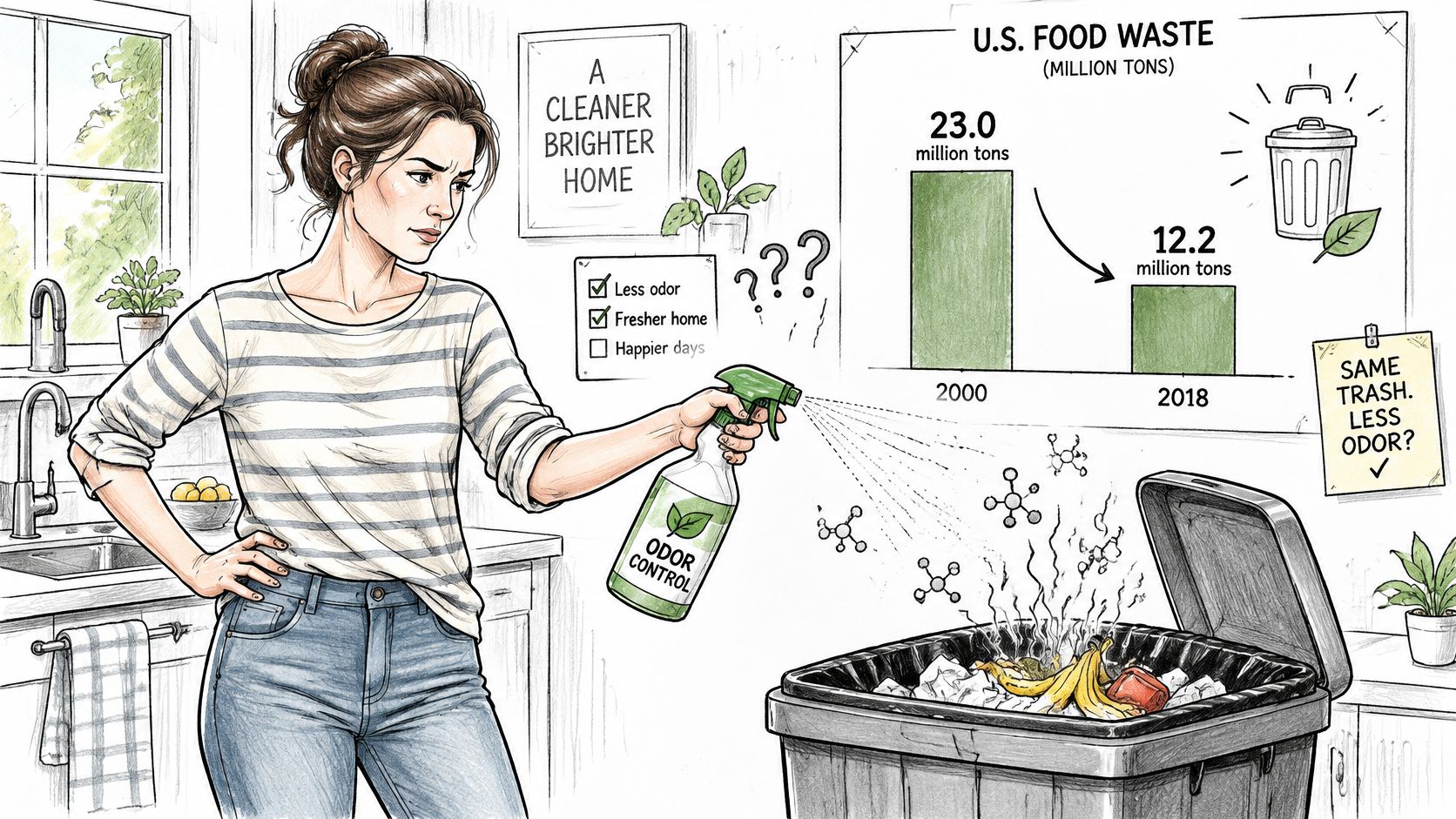
Why does an odor return soon after someone sprays a workshop? A leaking floor drain or active process can keep releasing odor compounds into the room. The spray may change what people smell temporarily, while the source continues to emit.
Industrial odor can involve many sources, including chemical production, petroleum refining, and metals production. The EPA's indicator on volatile organic compound emissions reports that estimated human-caused VOC emissions declined between 1990 and 2014. That trend does not mean industrial odors have disappeared, or that every odor indicates the same exposure.
ASHRAE describes ventilation as a way to control workplace odors and points to local exhaust as an approach for capturing contaminants near their source. That is like catching smoke at the stove rather than trying to clear it after it spreads through the room. Clean the surface, repair the leak or process release, and use suitable ventilation before treating any odor that remains.
A spray can address residual odor. It cannot stop an active source from releasing more.
Spraying into occupied air can spread a product through the space and add its own fragrance or solvent vapor. As a general precaution, use the smallest amount needed, apply to a cloth or sponge where appropriate, and direct spray away from people. For steps on how to eliminate lingering house odors, focus first on removing the cause and improving airflow. The same sequence applies at home: see this guide to eliminating odor in a house.
Where Industrial Odor Sprays Are Used and Why
Every setting where these sprays get used has a different primary odor source, and that source decides what the spray is for. Find your row, then read the control column first.
| Setting | Typical odor source | Control first | Spray role |
|---|---|---|---|
| Waste and recycling area | Decomposing organic matter and sludge | Remove waste and drain liquids | Spot treat surfaces and bins |
| Food processing or restaurant kitchen | Grease in drains and grease traps | Clean traps and repair drains | Surface-directed treatment after cleaning |
| Warehouse or shared facility | Spills, stored materials and damp areas | Fix the spill or moisture source | Controlled treatment of floors and soft surfaces |
| Workshop or garage | Solvents, oils and adhesives | Ventilate and use local exhaust at the work area | Residual treatment only, never a replacement for exhaust |
| Wastewater or sump area | Dissolved sulfur compounds in sludge | Pump, cover and vent the area | Spot treatment of surfaces around covers |
| Hotel or commercial building | Mildew, smoke and kitchen exhaust | Remove the source and repair leaks | Treatment of soft surfaces after cleaning |
Reading your own row
A waste yard and a workshop smell completely different and need different chemistry, yet both end up on the same purchase order. The waste area is an organic decomposition problem, so the spray has to handle biological residue on bins, concrete and drain surrounds. The workshop is a solvent problem, and no spray fixes solvent vapor hanging in the air of a bay with no exhaust. Notice that in every row the spray role is narrower than the control column.
If your setting isn't in the table
Name the emitter before you name a product. Follow the smell to a specific surface, drain, material or process, and ask whether it can be removed, repaired or contained. A spray earns its place when the answer is yes and a residual film or fabric still carries the odor afterwards. If nobody can point to the emitter, the money goes on ventilation and investigation first.
What to Check on the Label Before You Buy
A stronger scent is not evidence that odor molecules left the room. Fragrance works like a loud radio over a rattle: you notice the radio, and the rattle is still there. The label and the safety data sheet show whether a spray absorbs or breaks down odor, or only perfumes it. Those sheets usually sit unread on the same shelf as the bottle.
One EPA-registered deodorizer label reports a hydro-alcoholic, non-petroleum formulation with 5.50% triethylene glycol and under 30% VOC by weight, on the EPA registered deodorizer label. Those figures are one example of how such a label states composition. They are not a pass mark for every bottle. Read each product's own stated VOC percentage by weight and set the sheets side by side. After use, indoor air can hold more volatile material than outdoor air, and ventilation is what lets those levels fall.
What a labelled active looks like
A named ingredient with a percentage beside it marks a product built to act on odor, not only to cover it. Triethylene glycol is one absorbing chemistry: odor compounds move into the liquid instead of staying hidden under perfume. Enzymatic products take another route, using biological action on organic residue. If the only active listed is "fragrance" or "perfume," you are holding a masking product, whatever the front label promises.
| Label or safety data sheet item | What to look for | Why it matters |
|---|---|---|
| Total VOC content | Stated VOC percentage by weight, compared across products | A stated percentage lets you choose a lower-emission option for occupied air |
| Active mechanism | A named absorbing or neutralizing ingredient, not only fragrance | Shows the product is aimed at odor molecules |
| Fragrance role | Fragrance is not the main active ingredient | A fragrance-led formula mainly masks |
| Propellant and flammability | Stated propellant type and flammability classification | Sets storage, handling and ignition controls |
| Ventilation requirement | Minimum air exchange or local exhaust stated | Defines where the product may be used |
| Surface compatibility | Warnings for plastic, painted or hard surfaces | Prevents staining and surface damage |
| Re-entry and PPE | Wait time before occupancy and required gloves or respirator | Protects workers and sensitive occupants |
If a product can't state its VOC content, its active mechanism and its re-entry conditions, that silence is your answer. Buy something else.
For workers, the safety data sheet should define application rate, ventilation, incompatibilities and re-entry conditions. A plain check records spray mass per square metre and compares odor intensity before and after, so the result is a number rather than a memory of how strong the room smelled.
Choosing a Spray Safely for Sensitive Occupants
Work through the decision in order rather than starting with the product shelf.
- Confirm the source can be removed or contained. If it can't, no spray will hold and the budget belongs upstream.
- Confirm ventilation or local exhaust for the area and note the air exchange the label requires.
- Match the product to the job. A masking product is a short cover only. An absorbing or neutralizing product suits residue on fabric, porous and organic surfaces.
- For children, pets, workers with asthma and chemically sensitive people, choose low-VOC and fragrance-free. Keep those occupants out for the full re-entry time. Fragrance can be an access barrier for them, as the Massachusetts indoor air quality guidance sets out.
- Watch for by-products. The federal definition of air fresheners explicitly covers products designed to mask odors, and California's Air Resources Board warns that emissions from cleaning products can react with other airborne chemicals to form harmful by-products.
- Never treat a suspected hazardous chemical release with a spray. Call for exposure assessment and local exhaust.
Our own New Car Smell Spray follows that logic: it contains no masking fragrances and works enzymatically to eliminate odors and reduce new odors. If you want the broader case for unscented chemistry in shared spaces, our notes on fragrance-free cleaning go further.
How to Apply an Odor Spray Without Spreading It
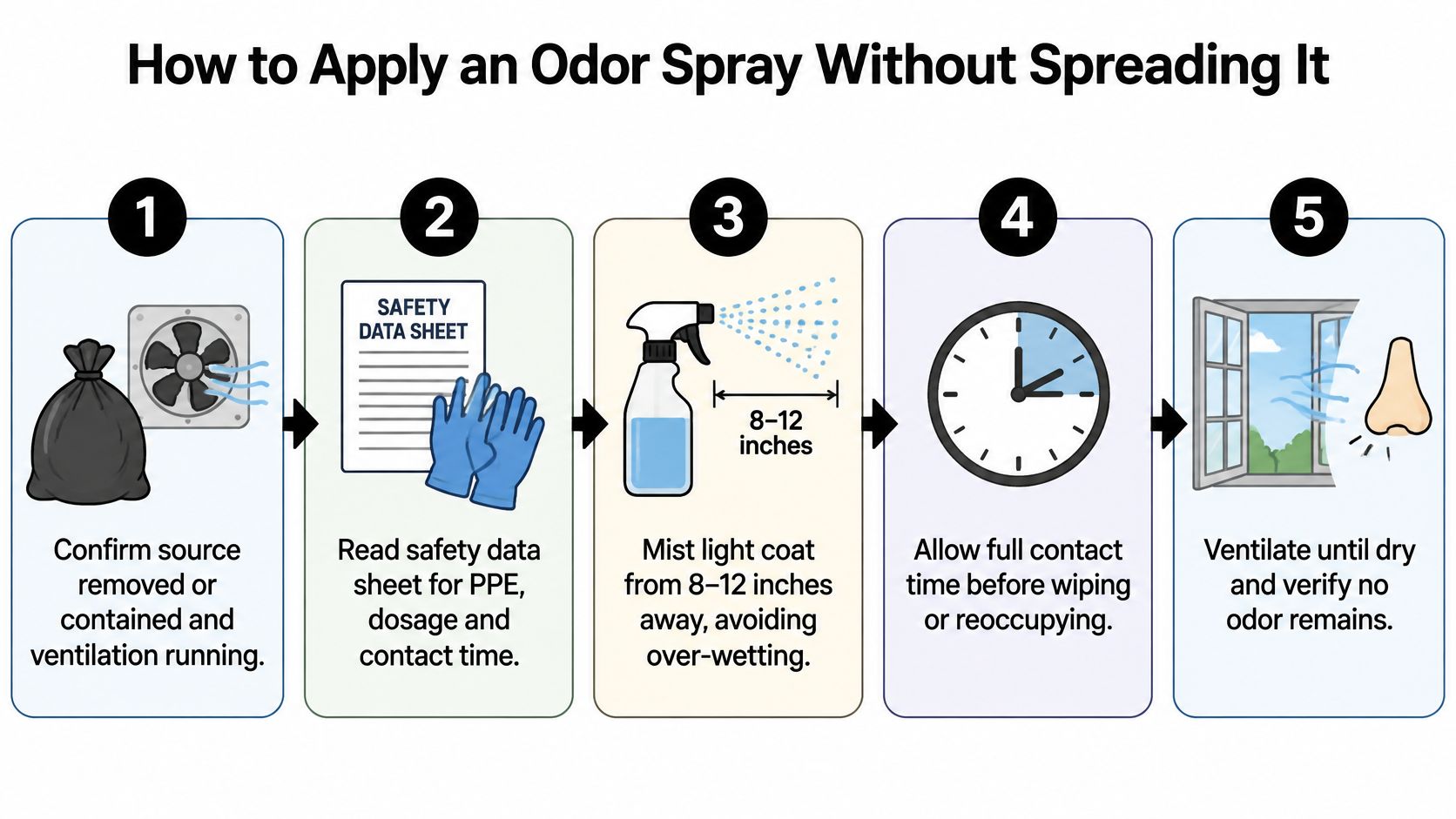
- Confirm the source is gone or contained, with ventilation running. If the drain still seeps, stop here. Otherwise turn on local exhaust or open the space up before the bottle is uncapped.
- Read the safety data sheet for that day's job. PPE, dosage and incompatible surfaces are all listed. The usual slip is assuming the front label covers it.
- Patch test a hidden area and let it dry fully. Spray a small section of the same material, wait, then inspect. Staining often looks mild when wet and worse once dry.
- Spray onto a cloth or sponge, not into the air. Aerosolizing into occupied space moves vapor around without lowering its mass, and it puts solvent and fragrance into lungs that didn't ask for it. EPA's advice is to minimize dispersed sprays and keep the nozzle pointed away from people.
- Treat residual reservoirs, not incompatible surfaces. Carpet backing, fabric, drain surrounds and floor seams hold odor. Plastic, painted panels and polished hard surfaces may stain or react.
- Record the amount applied per square metre. Write the dose on the maintenance sheet. Without a number, "a light mist" means something different to every shift and every contractor.
- Keep occupants out for the full re-entry time and keep air moving. Re-entry limits exist because vapor is still coming off the surface while it dries.
- Return after the stated period and assess the odor again. Compare against your pre-treatment rating, not against how the room smells to someone who just walked in from outside.
The most common mistake in the whole procedure is step four. Spraying the air feels productive and treats almost nothing.
How to Tell Whether the Spray Is Working
Verification is where most programs fall apart, because the person checking is also the person who wanted the product to work. Four checks cut through that.
- Rate intensity on a fixed scale before and after. Use the same person, or a panel of two or three, and the same scale every time so results are comparable across weeks.
- Measure odorant concentration where equipment exists. In Louisville's Rubbertown industrial area, an EPA-supported study found VOC concentrations higher at sites near industrial sources than at community and more distant sites, and researchers developed the Odor VOC Emissions Tracker to detect and measure odorous VOCs and help identify fugitive emissions, as described in the EPA account of next-generation emission measurements. Sensors answer the question your nose can't.
- Check persistence after several hours and again the next day. A masking product shows the original smell returning as the fragrance fades. A neutralizer shouldn't.
- Test for re-emission. Warm, humid weather and renewed activity at the source will bring a residual odor back if the chemistry didn't finish the job.
Run one treated area against one untreated control and take the same readings at the same times. If the odor drops and returns quickly, the source is still emitting and the fix belongs upstream, not in a second application. For household-scale detail on tracking down where a smell keeps coming from, the Renue Systems Four Points odor advice is a practical companion.
Evo Dyne Products makes a New Car Smell Spray for vehicle interiors that follows the principle running through this whole article: it works enzymatically to eliminate existing odors and help keep new ones from forming, with no masking fragrances and no harsh chemicals in the formula. A couple of sprays covers a full-sized vehicle, applied to carpets, floor mats, under seats, upholstery and a light mist through the vents, after you've vacuumed out the debris causing the smell in the first place. Visit Evo Dyne Products to see the full range of auto, home and industrial solutions.
