
You've cleaned the family room, emptied the trash, and lit a candle, yet the dog smell, last night's fish, or that damp basement note is still there when you walk back in. That pattern usually means the source is still active, not that you need a stronger fragrance. Learning how to eliminate odor in house settings starts with finding what's feeding the smell, removing it, and then clearing the air that's left behind.
Table of Contents
- Why Some House Smells Will Not Go Away
- The Five-Step Source-Control Protocol
- Tackling the Four Most Common Odor Categories
- Using Humidity and Ventilation as Measurable Tools
- Choosing Products That Help Instead of Mask
- Common Mistakes That Keep Smells Around
- Building an Odor-Free Maintenance Routine
Why Some House Smells Will Not Go Away
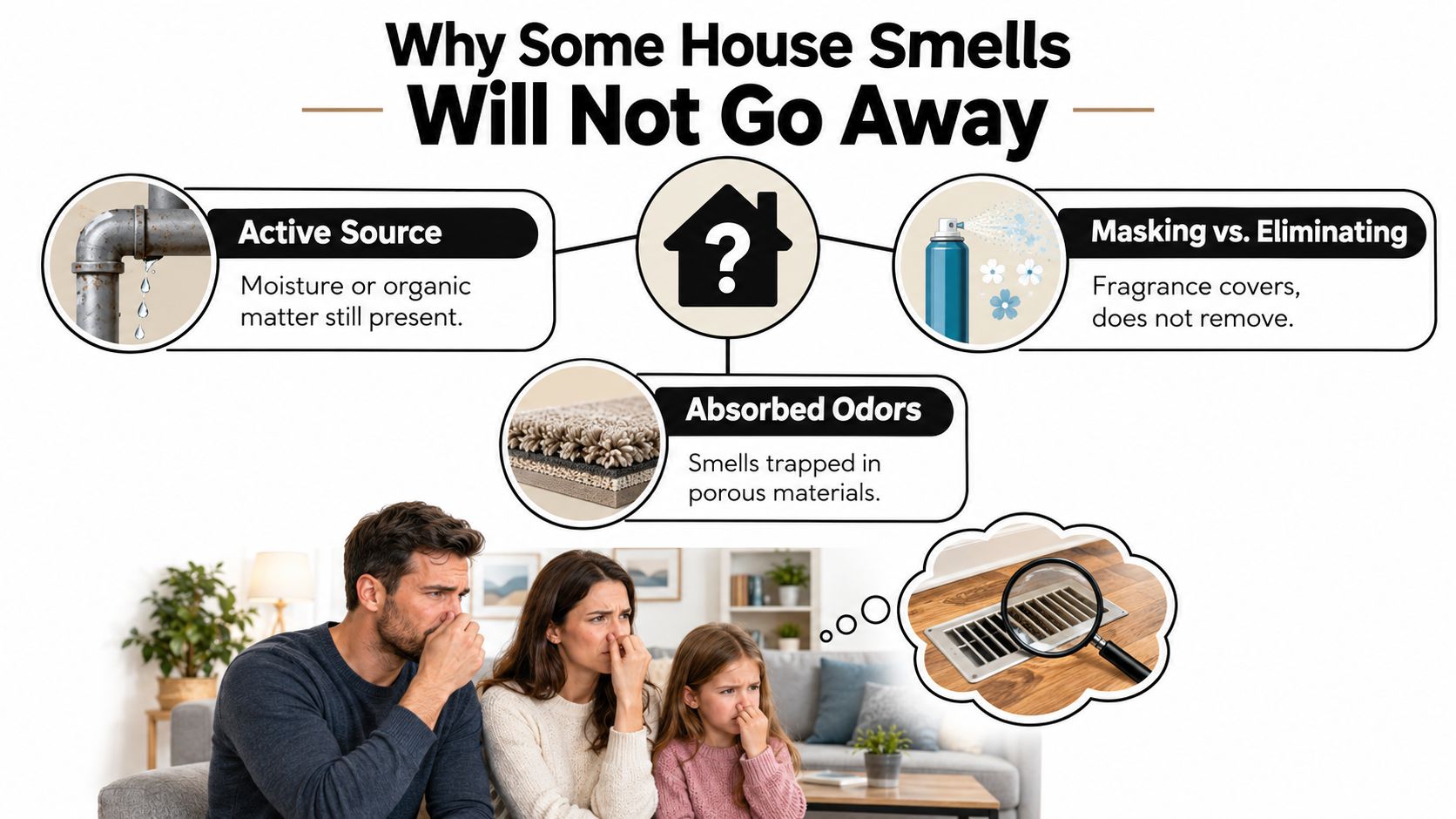
A lingering smell behaves differently from a brief one. Cooking steam fades once the pan is washed and the kitchen airs out. A smell that returns after cleaning is being replenished, either by something wet, something organic breaking down, or something trapped in a porous material that releases odor slowly.
The visual below maps the three reasons I check first when a homeowner says nothing works.
Masking Adds Instead of Subtracting
Air fresheners, scented candles, and plug-ins don't remove odor molecules. They layer fragrance over them, so the room smells like fish and vanilla, then like fish again once the fragrance fades. That layering matters because fragranced products can add their own volatile organic compounds to indoor air.
The World Health Organization indoor air guidance identifies sources that can also create persistent odors, including cooking fuels, tobacco smoke, building materials, pesticides, cleaning chemicals, perfumes, and other volatile organic compounds, and it recommends source control first, then dilution through outdoor-air ventilation.
Where Persistent Smells Hide
- Active moisture: A slow leak under a sink, a damp carpet edge, or condensation in an HVAC drain pan keeps producing musty odor until it's dried and repaired.
- Porous reservoirs: Carpet pad, upholstery foam, curtains, and unfinished wood absorb smoke, urine, and grease, then release them with heat and humidity.
- Hidden organic matter: Grease film on cabinets, food residue in a drain, or pet accidents soaked below the surface continue breaking down out of sight.
Smoke shows this clearly because residue coats walls, fabric, and ducts at the same time. Homeowners dealing with that heavier end of the problem often look beyond surface cleaning, which is why resources on smoke damage restoration Florida focus on removing residue from the materials themselves rather than perfuming a room.
If a smell returns within a day of cleaning, stop buying sprays and start looking for what's still wet, soiled, or saturated.
That mindset, remove the source, then ventilate the residue, is the organizing principle for everything that follows.
The Five-Step Source-Control Protocol
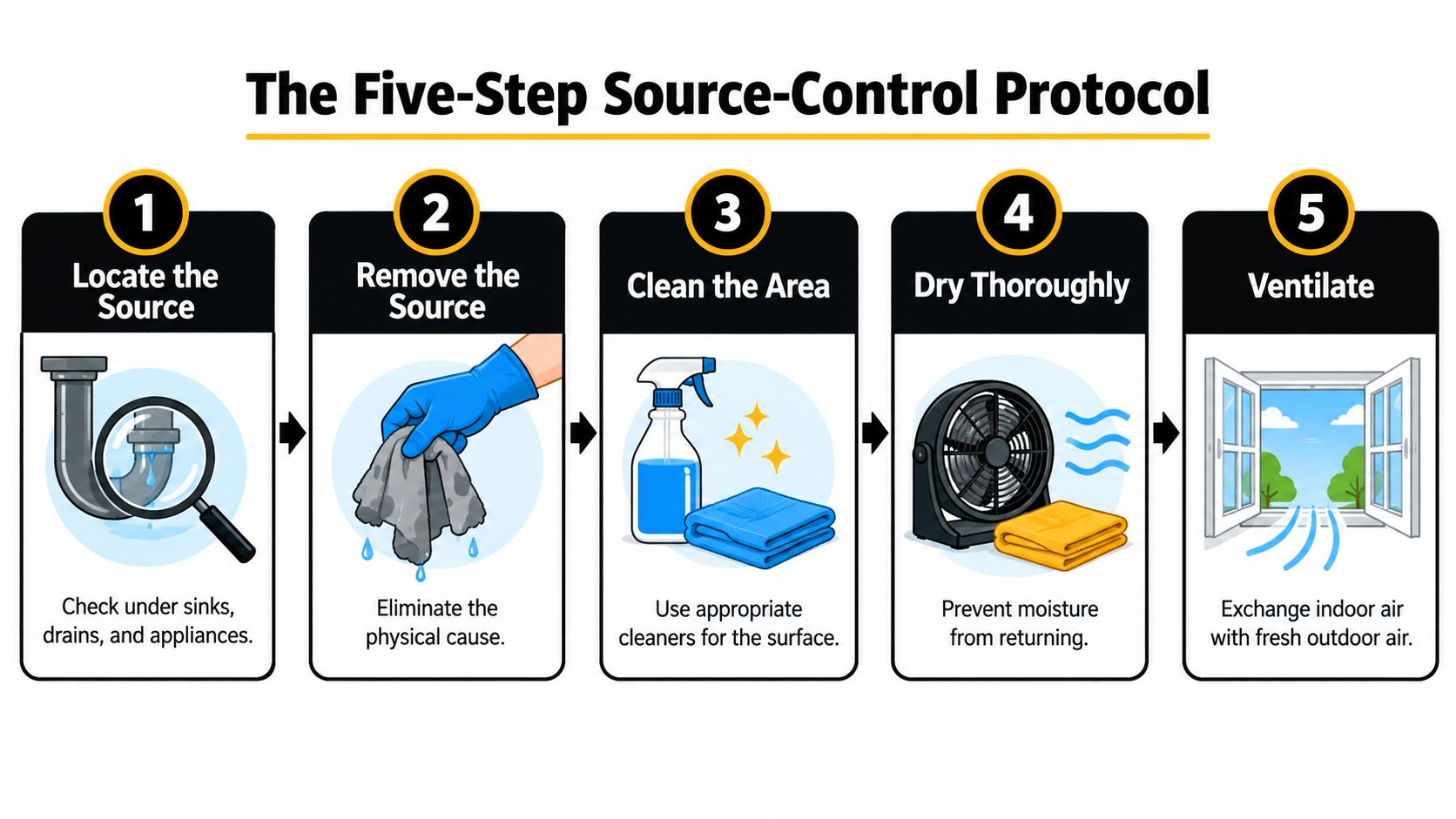
Most odor jobs fail because people run the steps out of order. They buy a purifier before checking under the sink, or they shampoo a carpet that's sitting on a wet pad. The sequence below works on almost any smell because it stops the source from feeding the air before you try to clear the air.
The flow chart summarizes the sequence before the detail that follows.
Steps One to Three
- Locate the source: Check under sinks, around toilet bases, inside drains, behind appliances, along carpet edges, in trash storage, and at the HVAC filter and condensate pan. Use your nose close to surfaces, not just in the middle of the room.
- Remove or isolate it: Take out spoiled food, bag contaminated rags, lift a soaked rug pad, or shut a door to contain a room while you work. Isolation stops odor spreading to clean areas.
- Clean and dry: Wash grease and biological residue from hard surfaces, launder washable fabrics, and dry wet materials fast. The EPA guide to indoor air quality in buildings identifies source removal or isolation as the primary strategy, followed by ventilation and dilution, with air cleaning as a supplementary step, and it recommends drying wet materials within 24 hours to prevent mold growth.
Steps Four and Five
- Exhaust air outdoors: Run a range hood or bathroom fan that's vented outside, and open windows for cross-ventilation when weather allows. Keep the fan running during the activity and after it, until moisture and smell clear.
- Filter only as a supplement: Use a HEPA purifier or activated charcoal after the source is gone. Filtration polishes air, it doesn't fix a leak or digest urine in a pad.
This short walkthrough shows the same locate, remove, and ventilate logic in a real room.
Re-inspect after drying, because damp material can smell fine while it's cold and ventilated, then announce itself once the room closes up. Regional practitioners who publish their own checklists, such as Eagle Restoration's Marion County tips, tend to land on that same verification habit.
Verification habit: Leave the room closed for a while after cleaning, then walk back in. Your first breath tells you more than sniffing while fans run.
Tackling the Four Most Common Odor Categories
Different smells live in different places, so the protocol changes shape by category. Pet odor is a chemistry problem in fibers. Smoke is a coating problem on everything. Cooking odor is mostly grease, and mold odor is a moisture problem with a smell attached.
Pet Odors in Carpet and Upholstery
Urine doesn't stay on the surface. It wicks into carpet backing, pad, and sometimes subfloor, where dried salts reactivate with humidity. Regular soap can spread the spot and leave residue that attracts soil.
Use an enzymatic cleaner such as Nature's Miracle or Rocco & Roxie, applied generously enough to reach as deep as the urine did, then keep the area damp for the dwell time on the label. Blot, don't scrub, and repeat rather than rushing to a steam cleaner, since heat can set some stains and drive odor deeper.
The bottle in this photo is the type of product that belongs in this step, used on the fibers rather than sprayed into the air.
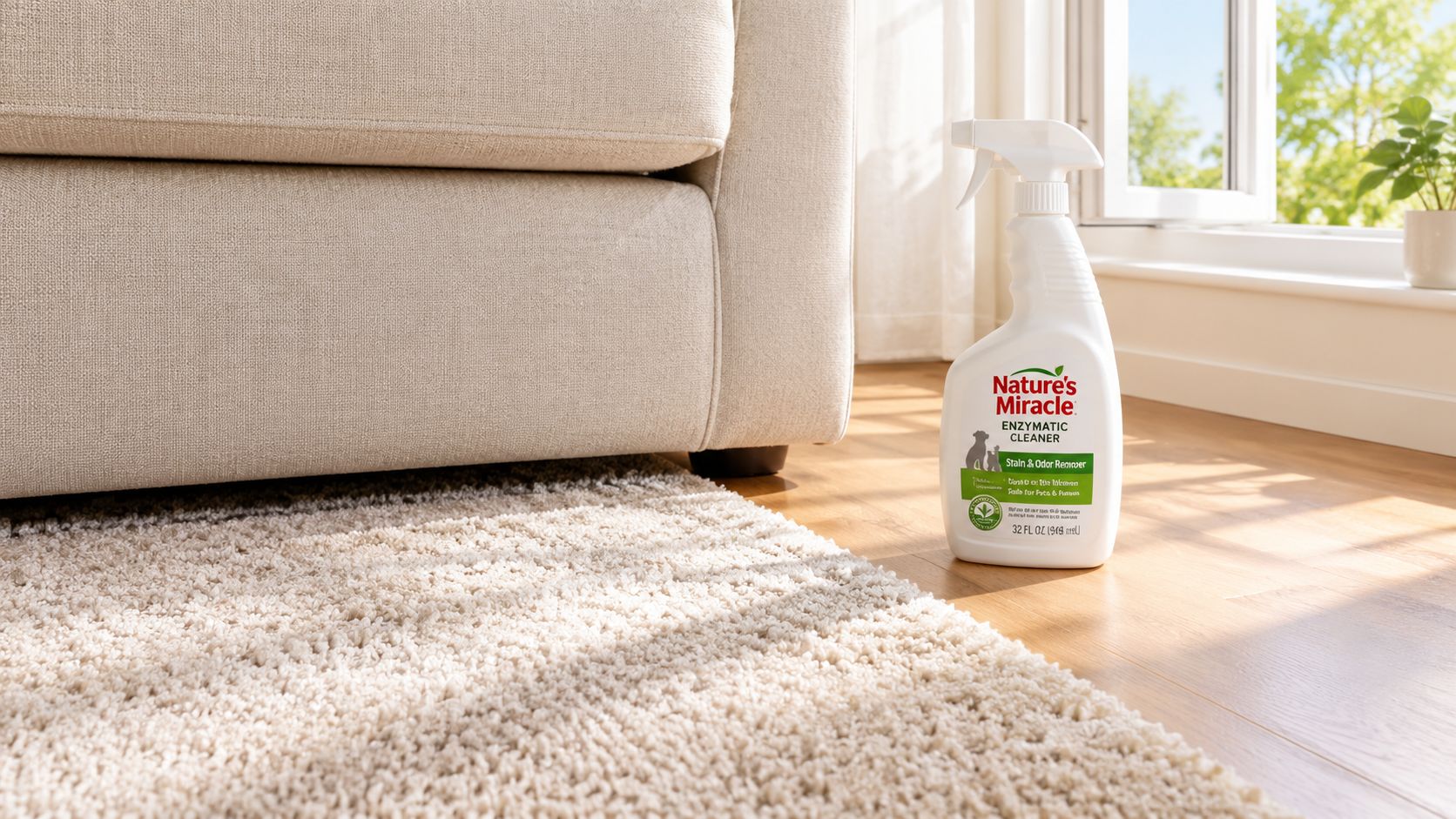
If the pad is saturated, replacing the pad section and treating the subfloor usually matters more than another surface pass. For a deeper comparison of formats and use cases, see this guide to choosing a pet odor eliminator for home use.
Smoke and Cooking Odors
Smoke particles settle on paint, fabric, and inside cabinets. Wash hard surfaces with a degreasing cleaner such as Krud Kutter or a trisodium phosphate substitute, launder or dry clean textiles, and expect severely saturated porous items to need sealing with a shellac based primer like Zinsser B-I-N or replacement. A HEPA purifier helps after that cleaning, not instead of it.
Cooking odor follows a smaller version of the same pattern. Grease aerosols land on cabinet tops, range hood filters, and nearby walls, so degrease those surfaces and wash or replace the hood filter. A hood that vents outdoors removes the aerosol at the stove, while a recirculating hood mostly traps some grease and returns the smell to the kitchen.
Mold and Wet Carpet Odors
Musty odor means you should look for water first and cleaner second. Fix the leak, dry the material, and only then clean visible growth, because cleaning mold on a surface that stays wet buys you a short reprieve.
Wet carpet deserves special suspicion because the pad holds moisture long after the pile feels dry. The practical walkthrough from RestoTek TX on wet carpet smell is useful here because it treats the pad and drying time as part of the odor problem, not an afterthought. If padding can't be dried fully and promptly, removal is often the honest fix.
Using Humidity and Ventilation as Measurable Tools
Homeowners often describe a musty room as stuffy or heavy, then guess at solutions. A hygrometer turns that guess into a number you can act on. Once you can measure humidity, you can tell whether a dehumidifier, a repair, or better exhaust changed anything.
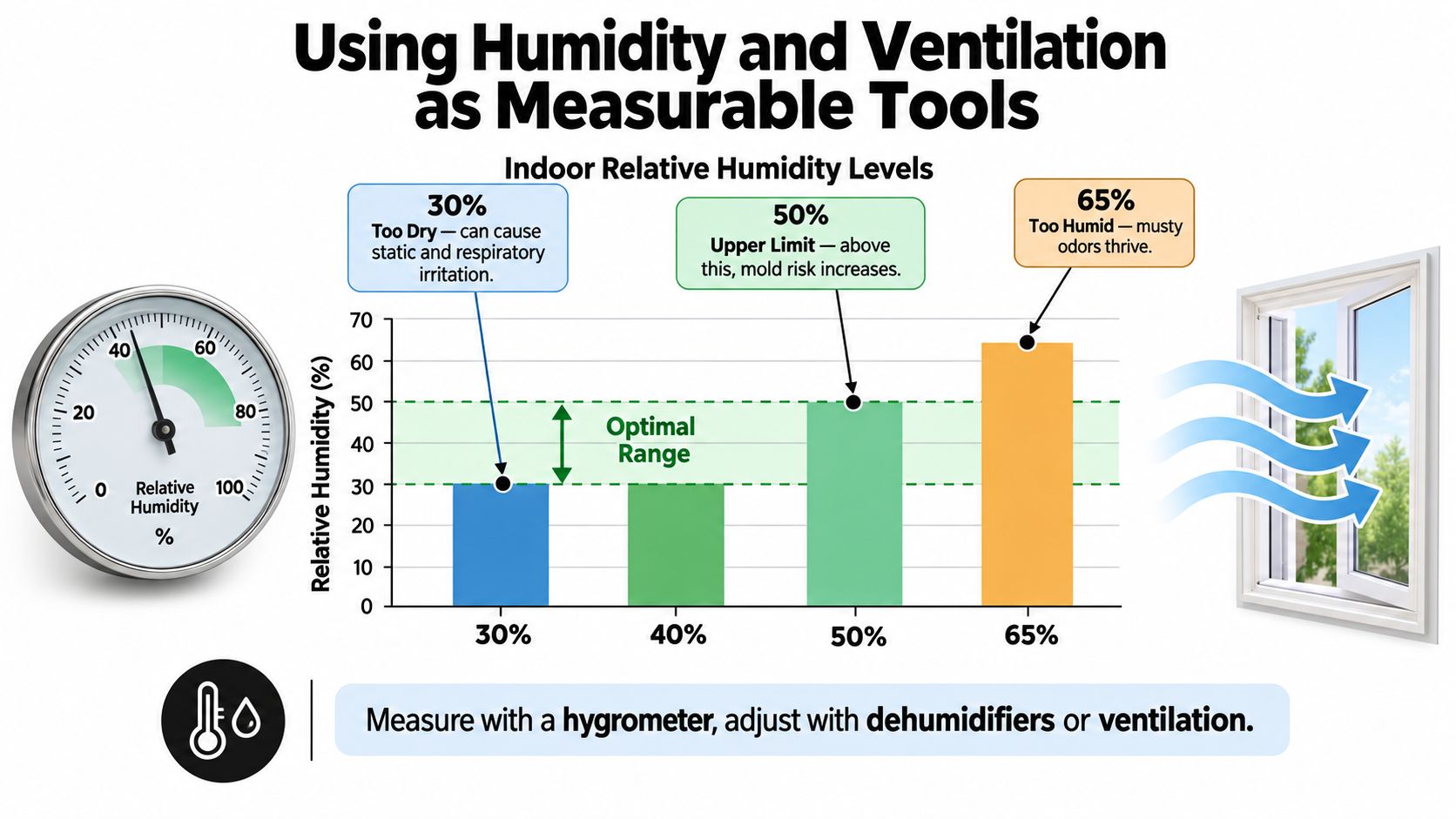
The chart below shows the target zone to aim for in living spaces.
The Number to Manage
Oregon State University Extension guidance on mold control recommends keeping indoor humidity below 50% for mold control, and EPA guidance specifies a 30–50% indoor relative humidity range as the broader target. Treat the top of that range as a ceiling, not a goal.
Measure in more than one room and at different times of day. A basement, a bathroom after showers, and a bedroom with the door closed overnight can read very differently from the hallway where the thermostat sits. Small digital hygrometers from brands like ThermoPro or Govee are accurate enough for spotting problem rooms and tracking trends.
A Practical Moisture Routine
- Find the water source: Inspect plumbing, roof flashings, foundation cracks, appliance hoses, and cold surfaces where condensation forms.
- Exhaust at the source: Vent bathrooms, kitchens, and laundry areas directly outdoors. A fan that dumps into an attic moves the moisture problem instead of solving it.
- Move air along surfaces: Pull furniture slightly off exterior walls and keep closet doors ajar in damp rooms so air doesn't stagnate against cold drywall.
- Choose dehumidification when windows hurt: In warm, humid weather, opening windows can raise indoor moisture. A refrigerant dehumidifier with a drain hose, such as units from Frigidaire or hOmeLabs, gives you controlled drying instead.
- Clean after correcting moisture: Wash visible mold once the area stays dry, then recheck humidity and odor over several days.
Practical rule: Don't judge a musty room by one dry afternoon. Judge it by readings across several days, including after showers, laundry, and rain.
Ventilation and humidity control don't replace cleaning a contaminated surface. They stop the conditions that let odor-producing growth return after you've cleaned.
Choosing Products That Help Instead of Mask
The cleaning aisle mixes three different jobs under one label. Some products break down odor-causing matter, some absorb airborne compounds, and some only cover a smell with fragrance. Reading the active ingredient and the intended surface tells you which job you're buying.
What Each Category Does
Enzymatic cleaners use enzymes and beneficial bacteria cultures to digest organic residues such as urine, vomit, and food spills in fibers. They need dwell time and moisture to work, and they fail when they're wiped off immediately or used after a harsh disinfectant that inactivates them.
Activated charcoal and zeolite bags absorb a range of airborne compounds in enclosed spaces such as closets, litter areas, and trash cabinets. They work slowly, cover a limited area, and need periodic replacement or reactivation according to the maker's directions.
Baking soda neutralizes some acidic odor compounds on soft surfaces and in refrigerators. It's cheap and safe on many fabrics, but it's slow, shallow, and no match for urine soaked into a pad or grease baked onto a cabinet.
Fragrance sprays, scented candles, and essential oil diffusers mainly change what you notice. They're fine as a finishing touch in a clean room, but they don't substitute for treating the material that's producing the smell. That distinction is central to choosing a fabric odor eliminator that's applied to the fibers themselves, and Evo Dyne Products is one option in that direct-to-fabric category alongside enzymatic sprays from pet care brands.
Matching Products to What They Do
| Product Type | Best For | Limitation |
|---|---|---|
| Enzymatic cleaner | Urine, vomit, and food residue in carpet and upholstery | Needs dwell time and deep saturation to reach the source |
| Activated charcoal or zeolite | Low level airborne odors in closets and enclosed spaces | Slow, limited coverage, needs replacement or reactivation |
| Baking soda | Light odors in refrigerators and on washable soft surfaces | Shallow action, weak on soaked or greasy sources |
| Degreaser | Cooking and smoke film on hard surfaces | Doesn't treat odor absorbed deep in porous materials |
| Fragrance spray or diffuser | Short term scent in an already clean room | Masks rather than removes, source keeps producing odor |
Match the product to the material first, then to the smell. If a label promises instant freshness but never names a surface or an active ingredient, you're probably buying perfume.
Common Mistakes That Keep Smells Around
The same few errors show up in house after house. A homeowner runs a fan in a damp bathroom with the window shut, buys a scented purifier for a room with a slow drain leak, or replaces a carpet while leaving the old pad in place. The effort is real, the order is wrong.
Recirculating Instead of Removing
A desk fan makes a room feel fresher because moving air feels cooler and dilutes odor near your nose. It doesn't exchange the air. The EPA overview of indoor air quality explains that indoor air-exchange rates depend on infiltration through building gaps, natural ventilation through opened windows and doors, and mechanical ventilation from fans or air-handling systems, which is why recirculating a smell with a fan doesn't remove it.
The setup in this photo is fine for comfort while you cook, but it won't clear grease or moisture from the house.
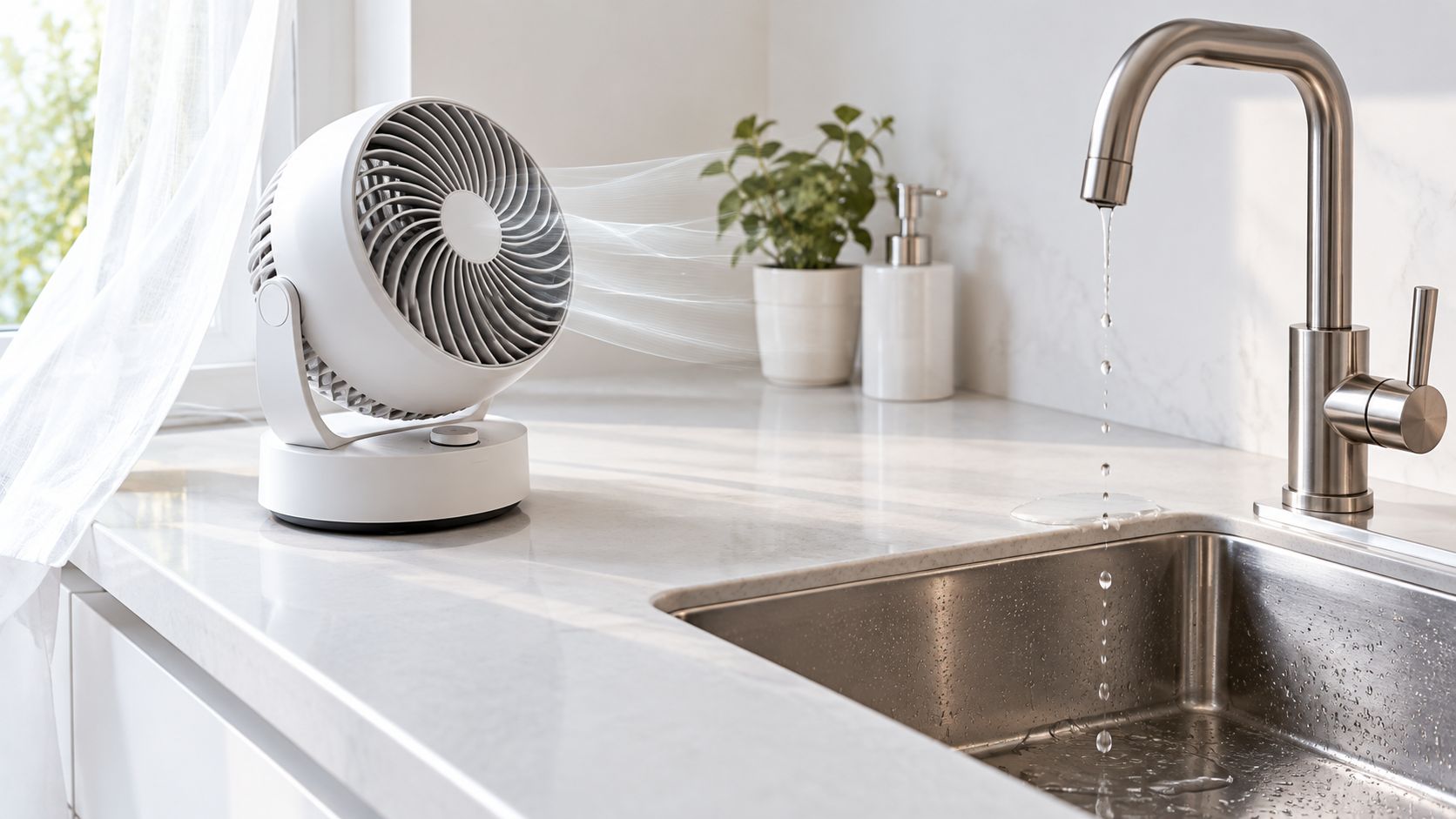
Use fans that exhaust outdoors for removal, and use portable fans to speed drying of a cleaned surface. Those are different jobs.
Traps That Undo Good Cleaning
- Venting into hidden spaces: A bathroom or dryer vent ending in an attic or crawl space feeds moisture to wood and insulation, and the musty smell migrates back into living areas.
- Replacing carpet over contamination: New pile over an untreated pad or subfloor lets old urine or mildew odor wick upward, especially on humid days.
- Ignoring the HVAC system: A loaded filter, stagnant condensate in the drain pan, or microbial growth inside ducts can distribute a sour smell to every room each time the blower runs.
- Skipping drains and traps: An unused guest bathroom or floor drain can let sewer odor in when the water seal in the trap dries out. Running water through rarely used fixtures keeps that seal in place.
- Trusting air conditioning alone: Cooling without adequate dehumidification can leave a closed up house damp enough for musty odors, particularly in basements and interior bathrooms.
A short inspection catches most of these before they become projects. Each month, look under sinks, run water in unused drains, check that exhaust fans pull air, and glance at the HVAC filter. Each season, inspect the drain pan, attic vent terminations, and any carpet edges near exterior doors or appliances.
Building an Odor-Free Maintenance Routine
A clean smelling home is mostly small habits repeated on schedule. Check hygrometers in problem rooms, run exhaust fans during and after showers and cooking, and launder pet bedding, throws, and removable cushion covers regularly.
Vacuum upholstery and carpet edges where hair and soil collect, refresh baking soda and charcoal on a set cadence, and inspect the HVAC filter and drain pan each season. Step up to a plumber, mold professional, or restoration contractor when you find recurring moisture, sewage odor, or growth you can't reach. Source control, measured ventilation, and the right product on the right material compound week after week.
If you're ready to treat the fabrics and surfaces that hold odor instead of perfuming the air above them, explore the home cleaning and odor care range at Evo Dyne Products. You'll find targeted solutions for household fabrics and everyday cleaning, backed by practical guidance on source removal, ventilation, and moisture control. Start with the room that bothers you most, apply the protocol above, and let the products do the finishing work they're designed for.