

Your dog just came in from the yard with a raw patch on one leg, or you found a small cut while brushing. The bottle of dog wound care spray is already in your hand. Put it down for a minute and sort the wound first. A spray is a supportive cleaning step for a superficial, uncomplicated injury. It doesn't close tissue, drain a pocket, or stand in for a vet visit when the injury is deep, dirty, or infected.
The brand matters less than that sort. A gentle rinse clears grit. A hard blast can drive it under the skin. Use the checks below before you mist anything.
Table of Contents
- Which Dog Wounds a Spray Can Handle and When to Call a Vet
- How to Clean and Spray a Dog Wound Step by Step
- Choosing a Spray and Knowing Its Limits
- A Daily Routine Until the Wound Closes
- Telling Healthy Healing From Infection
- Puppies, Seniors and Safe Spray Storage
Which Dog Wounds a Spray Can Handle and When to Call a Vet
If any row below says vet, book the visit before you spray. A dog wound care spray belongs only on a wound you have already judged as minor, clean, and shallow. Spraying first, then deciding, hides bleeding and can push dirt deeper.
| Wound type | Home spray suitable? | Action |
|---|---|---|
| Superficial abrasion or scrape with clean edges | Yes, after rinsing | Clip, rinse with saline, light spray, check daily |
| Small clean cut, bleeding stopped, edges together | Yes, after triage | Rinse, light spray, watch for 48 hours |
| Bite or puncture, even if small | No | Vet the same day |
| Deep or gaping wound, or exposed tissue | No | Vet assessment |
| Wound near eyes, mouth or a joint | No | Vet assessment |
| Heavily dirty wound or embedded debris | No | Vet, do not dig out debris at home |
| Bleeding that continues after several minutes of direct pressure | No | Emergency vet |
| Abscess, pus, swelling or foul smell | No | Vet examination |
Four checks before any mist
Run these in order. One failed check ends home care.
Depth. A scrape or a small cut whose edges sit together can usually be cleaned at home. A bite or puncture needs a vet the same day, even when the hole looks tiny, because the track under the skin is hidden and teeth push bacteria inward.
Contamination. Light surface dirt rinses off. Embedded gravel, matted hair, or a wound you can't see the bottom of needs professional cleaning. Don't dig with tweezers.
Bleeding. Firm direct pressure on clean gauze should stop a minor nick. Bleeding that continues after several minutes of that pressure is an emergency, not a spraying problem.
Location. Wounds near the eyes, mouth, or a joint are easy to contaminate and hard to dress. They belong in the clinic, as do gaping wounds and any exposed tissue.
Practical rule: A spray supports cleaning. It never replaces assessment.
For a minor clean wound, rinse with saline, apply a light mist as the label directs, and look at it once a day. Note the location and approximate size, set a reminder for the next check, and call if redness spreads, discharge thickens, or your dog goes quiet. Get Pet Vet's guide to signs your pet needs immediate care is a useful second pass when you are unsure the change is still minor. Our walkthrough of pet first aid for minor cuts covers the same clipping and pressure sequence for a small, already-triaged cut.
A nail that spots after a trim is a different job from an open wound. Our styptic powder is a fast-acting support for minor grooming nicks on dogs, cats, and birds, and it is formulated to be safe for dogs, cats, birds, and small animals when used as directed. Don't use it to pack a laceration.
How to Clean and Spray a Dog Wound Step by Step
Work only on a wound that passed triage. Set out gloves, clean gauze, blunt-tip scissors, saline, and a towel before you touch the dog. A wet floor and a spinning dog are how cuts get contaminated.
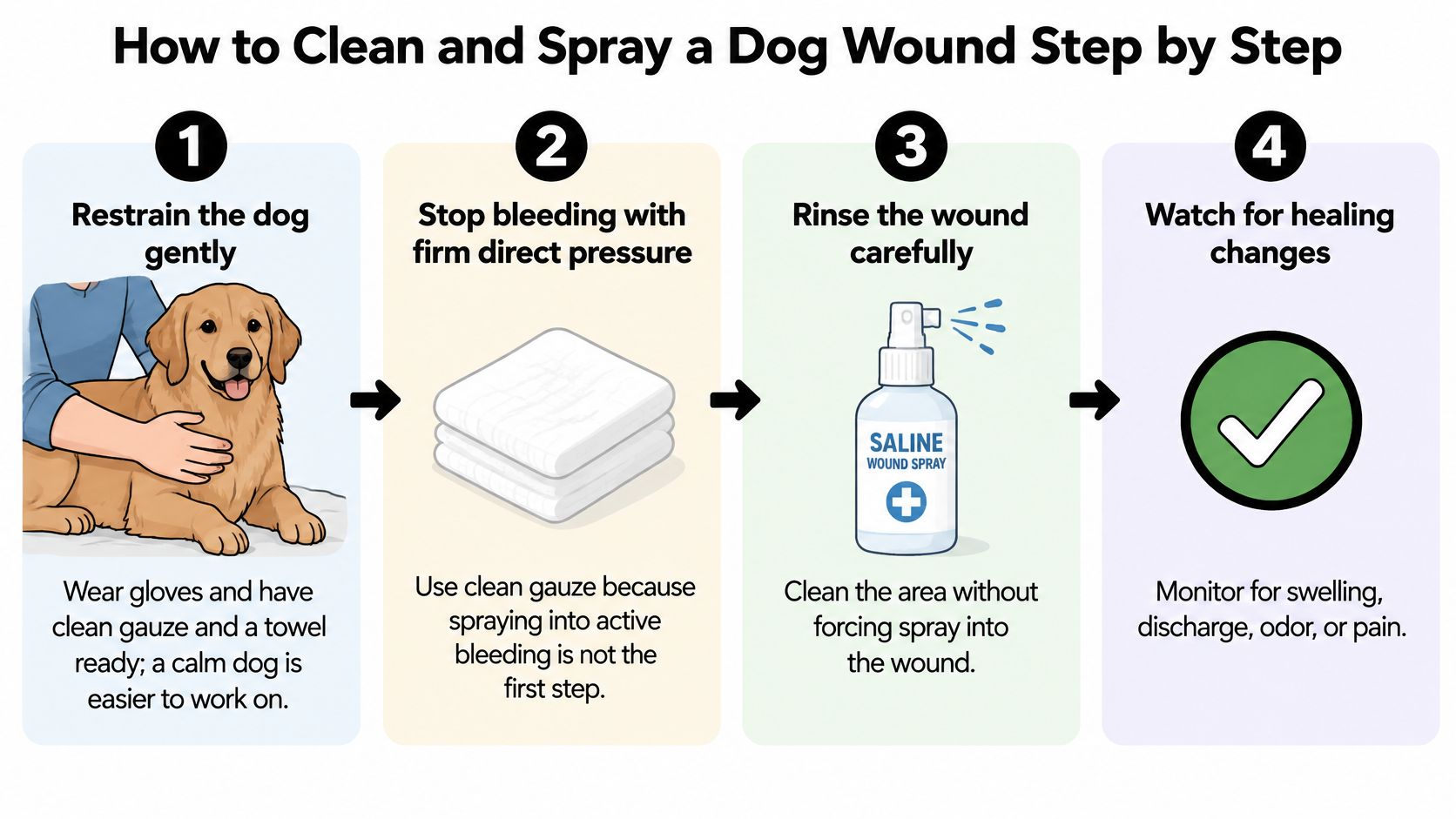
- Restrain the dog gently. A calm dog lets you see the edges. Slip on gloves, and have gauze and a towel ready. The common slip is starting while the dog is still spinning, so hair and dirt fall into the cut.
- Stop bleeding with firm direct pressure. Press clean gauze for several minutes. Spraying into active bleeding hides the wound and washes the clot away. Peeking every few seconds keeps a small nick bleeding.
- Clip the hair widely. Cut with the scissor tips pointed away from the wound so clippings don't drop in. Shaving flush to the skin often pushes stubble into the bed. A wide clip also lets you see swelling tomorrow.
- Lift off loose grit by flushing, not probing. A gentle stream moves sand. Tweezers belong only on debris sitting on the surface, never inside the tissue. If something is stuck, stop and call the clinic.
- Flush with 0.9% saline or another sterile isotonic fluid. Use a steady, low stream. The Merck Veterinary Manual identifies 0.9% saline as least toxic to healing tissue. Use enough flow to move grit off the surface, not so much pressure that you drive debris deeper.
- Mist from a short distance. Keep the nozzle off the skin and away from eyes and mucous membranes. Let the area air dry, or dress it only if your vet already told you to. Soaking the fur around the wound just invites licking.
- Repeat only as directed. One gentle rinse a day is a typical pace for a minor wound until the edges close, unless your vet sets another schedule. If the wound looks dirtier or more swollen the next day, call the clinic rather than adding a second product.
At the next check you want clean edges, no fresh bleeding, and no new thick discharge. If those three aren't there, stop the home routine.
Choosing a Spray and Knowing Its Limits
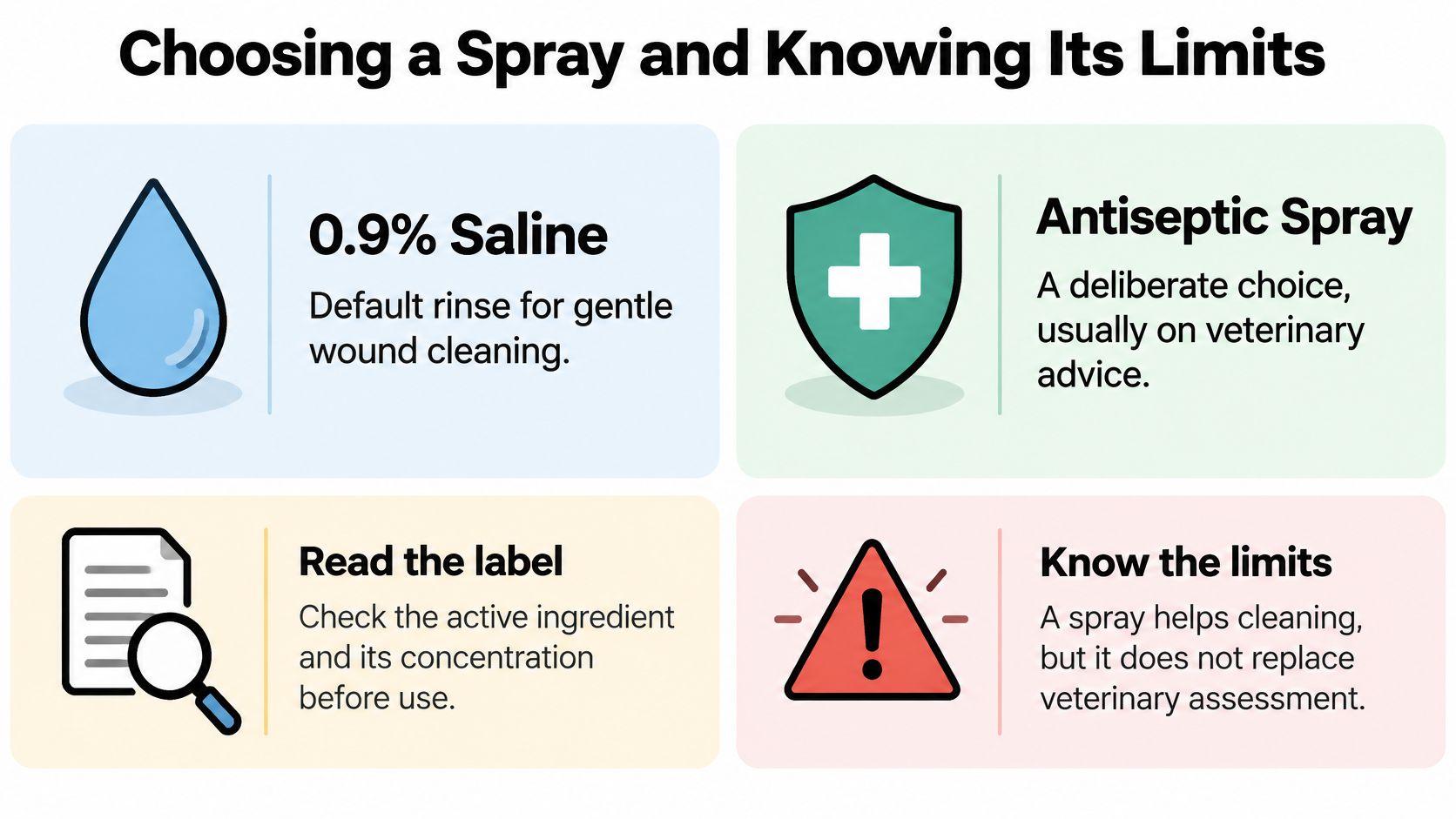
0.9% saline is the default rinse. An antiseptic is a deliberate second choice, usually because a vet asked for it. Read the active ingredient and the concentration. The same name at a stronger strength is a different product on open tissue.
| Option | Typical role | Home use | Caveat |
|---|---|---|---|
| 0.9% sodium chloride saline | Flushing and rinsing | Yes, first choice | Not antiseptic, but least toxic to healing tissue |
| 0.05% chlorhexidine diacetate | Antiseptic rinse | Only if vet recommends | Residual activity; stronger concentrations can damage tissue |
| 0.1% polyhexanide | Antiseptic | Only if vet recommends | Studied in clean surgical wounds |
| 0.1% povidone-iodine | Antiseptic | Only if vet recommends | Less antibacterial activity than 0.05% chlorhexidine in the 1987 study |
| Hydrogen peroxide or Dakin's solution | Not recommended | No | Can injure cells and delay repair |
| Undiluted surgical scrub | Not recommended | No | Detergent-containing scrubs damage healing tissue |
What dilute chlorhexidine did in living dogs
A 1987 controlled study irrigated full-thickness 2 × 2 cm wounds once daily for 14 days in five Beagle dogs. At 0.05%, chlorhexidine diacetate produced significantly greater bactericidal activity than povidone-iodine or saline, and both tested chlorhexidine concentrations kept an antibacterial effect for 6 hours after irrigation. Treated wounds also had greater healed area on days 7 and 14, and greater contraction on days 7, 14, and 21. Neither antiseptic stopped healing.
That is a useful label benchmark, not a reason to buy the strongest bottle. Concentration and contact time are what make an antiseptic harsh on the cells that have to close the gap. Using an antibacterial every day "just in case" also adds pressure toward resistance, with little extra benefit on a clean scrape.
Why a tidy surgery result doesn't travel
A 2025 peer-reviewed study compared 0.1% polyhexanide, 0.05% chlorhexidine digluconate, 0.1% povidone-iodine, and 0.9% sodium chloride in 40 dogs after elective orchiectomy or ovariectomy. Dogs were split into four groups of 10, with five males and five females in each. Macroscopic healing did not differ in a statistically significant way among those clean surgical wounds. Two of the 40 dogs (5%) developed signs of postsurgical infection, both females treated with polyhexanide or chlorhexidine. A moist topical dressing supported adequate tissue healing.
Those clean incisions are not bites, punctures, abscesses, or grit-filled scrapes. A spray alone doesn't speed closure.
If the skin around a scrape stays itchy after the wound itself looks quiet, Bandana Rx's notes on antiseptics for irritated pet skin are worth reading before you trade up to a harsher bottle.
Before you buy or refill, run this short list.
- Confirm the concentration printed on the label, not just the ingredient name.
- Skip alcohol and tea tree oil on open skin.
- Never substitute surgical scrub, hydrogen peroxide, or a bleach-based solution.
- Choose saline if you are unsure, and ask your vet before repeating an antiseptic.
A Daily Routine Until the Wound Closes
Keep the same small sequence. Changing products midweek makes it harder to tell a reaction from a setback.
Day one. Rinse once with saline, apply a light mist only if the label fits this wound, and leave it open unless your vet already prescribed a cover. A moist dressing is for a plan you were given, not a guess with kitchen wrap.
Days two and three. Repeat that once-daily rinse. Check any dressing for a wet spot or a sour smell, and change it if it is damp. Stop licking with an e-collar or a recovery suit. A tongue undoes a careful flush in seconds.
Days four to seven. Ease off only when the edges are drawing together and the surface stays clean. Don't spray over dark, leathery, or dead-looking tissue. That tissue needs a vet to remove it, not another mist.
Once the wound is closing and there is no discharge, stop spraying and let the skin finish on its own. Don't keep a spray routine going past closure unless your vet says to.
If the wound stalls or looks worse on any day, book a check instead of adding a second product.
A simple note on your phone, size and color in one line, beats trying to remember yesterday's look at the clinic door.
Telling Healthy Healing From Infection
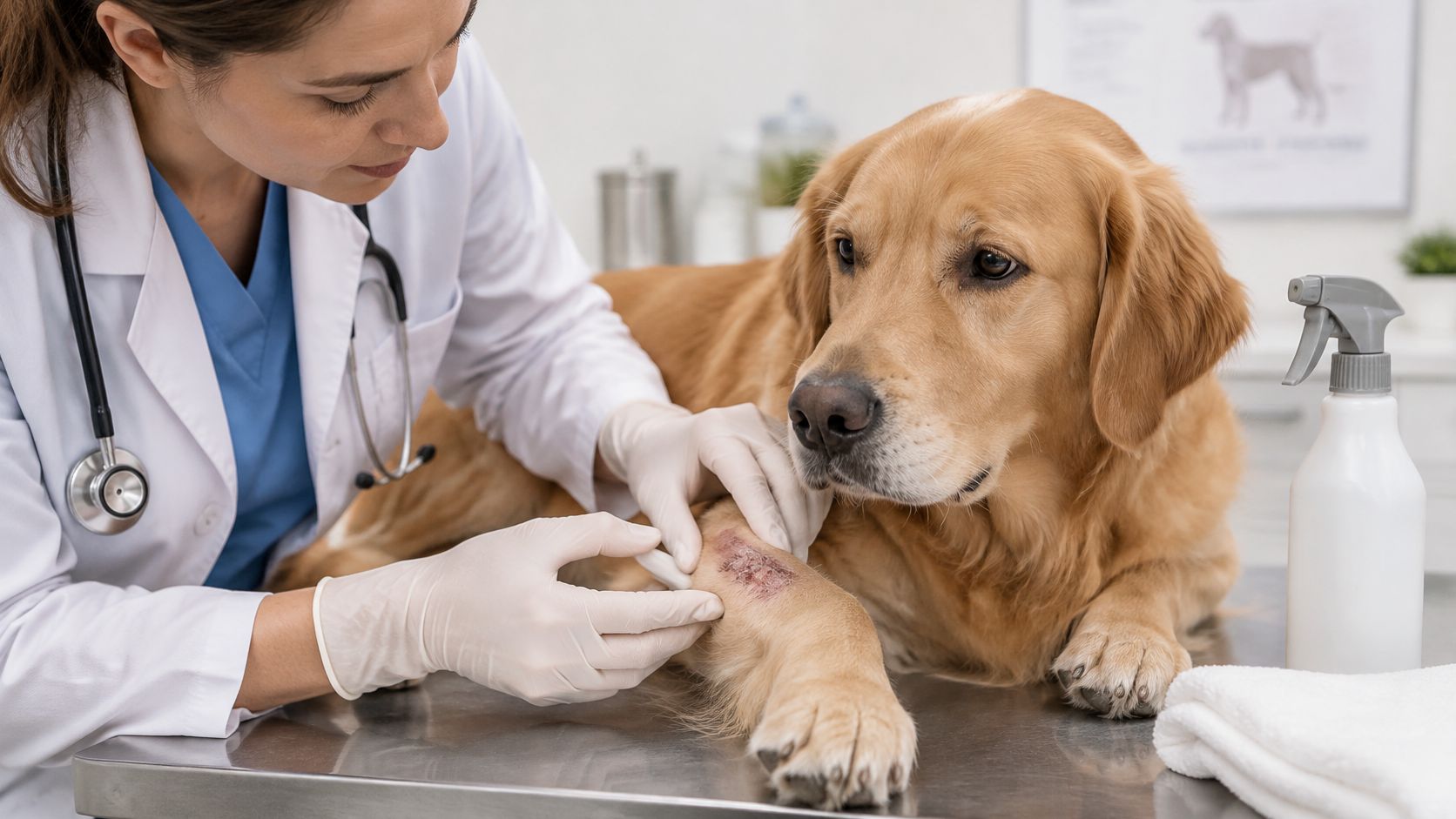
On day three the surface can look rinsed and still be slipping. A spray only supports cleaning. Debridement, culture, drainage, antibiotics, and any decision to close the wound stay with the clinic.
In a canine open-fracture dataset, 72.7% of dogs had aerobic and/or anaerobic bacterial growth, yet only 18% of later infections were caused by organisms found on the first culture, according to the Royal Canin veterinary academy. A single swab, or a wound that looks tidy after a mist, can miss what matters.
What to compare each day
| Sign | Healthy healing | Call the vet if |
|---|---|---|
| Discharge | Thin, clear or pale fluid that dries | Thick pus, green or yellow discharge, or foul smell |
| Colour around the wound | Pink edges that fade over days | Spreading redness, red streaks, or dark or grey tissue |
| Swelling | Eases within a few days | Growing, hot or hard swelling |
| Behaviour | Eats, moves and rests normally | Fever, lethargy, or pain when touched |
| Progress | Edges closing and the wound smaller at each check | No visible improvement after several days |
I would book the same day for fever, lethargy, spreading redness, pus, a foul smell, or no visible improvement after several days. Pure Paw Labs' guide to recognizing signs of inflammation in dogs helps separate a fading pink rim from redness that is moving outward.
Three home habits slow repair even when the spray itself is a reasonable choice. Another mist over dead tissue leaves bacteria a place to sit. Moisture trapped under a tight dressing turns a clean bed soggy. Licking drags mouth bacteria back onto the surface. Those habits, not a new bottle, are what how to prevent wound infection comes down to at home.
Photograph the wound at the same time each day, in the same light, with a coin or your finger for scale. If the series is moving the wrong way, call. A short look at how a clinic handles the first check can make your photos more useful.
Puppies, Seniors and Safe Spray Storage
Puppies. Their skin is thinner, and they chew at anything that stings or itches. Fit an e-collar or a recovery suit before you leave the room. Skip any spray that lists alcohol. Call sooner than you would for an adult dog, because a small puncture closes over and traps bacteria while you are still deciding.
Seniors. Healing is often slower, and diabetes or a quieter immune system changes the timeline. If a minor wound is not smaller and cleaner after a few days, get it seen rather than adding more spray. Pain that makes a senior skip meals is a reason to call, not a reason to wait for the weekend.
Any dog, first doses. Watch the first applications for itching, hives, facial swelling, or sudden lethargy. Stop the product, rinse with saline, and contact your vet if those show up. Keep every spray off the eyes and mucous membranes.
Storage, as a short checklist.
- Close the cap and keep the bottle where pets and children can't reach it.
- Store it away from heat and direct sun, and read the expiry date before each use.
- Discard it if the color shifts or the liquid turns cloudy.
- Wipe the nozzle so the next mist doesn't carry dirt back onto the wound.
A labeled bottle you can find is more useful than three half-used ones in a junk drawer.
Evo Dyne Products carries a dermal wound cleanser for cleaning minor wounds on dogs and cats once bleeding is controlled, plus other pet-care supplies for a simple home kit. Use it only after you have already sorted the wound as superficial, and stop if the daily check goes the wrong way. Visit Evo Dyne Products to see the pet-care range and the rest of the shop.