


Does a shampoo that smells clean suit your pet's skin, and does a label saying medicated tell you what it treats? Those questions matter more than a popular brand name or an impressive bottle.
The best pet grooming products match the animal's coat, make routine care comfortable, and state clearly what they're meant to do. A brush should reach loose hair without scraping skin. A cleanser should remove dirt without pretending to solve an undiagnosed skin problem. Start with those jobs, and buying becomes simpler.
Table of Contents
- Best Pet Grooming Products at a Glance
- Matching Brushes and Combs to Your Pet's Coat
- Reading Labels and Knowing When Grooming Becomes Treatment
- How to Build a Home Grooming Routine Step by Step
- Handling Nicks, Mats and Nervous Pets
- Build Your First Grooming Kit on a Budget
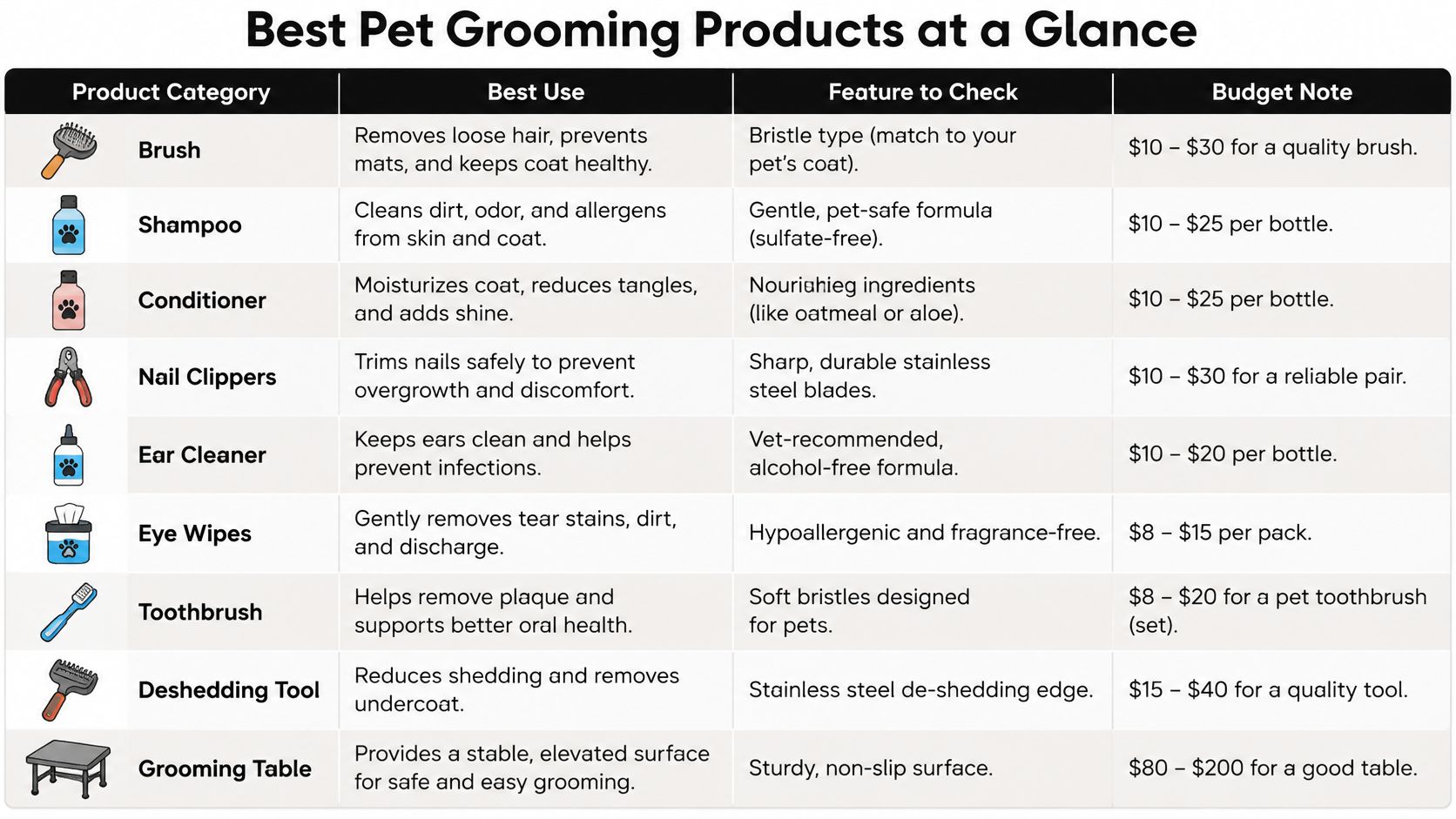
Best Pet Grooming Products at a Glance
U.S. pet-grooming-products revenue reached USD 5,910.1 million in 2025, according to Grand View Research's U.S. market outlook. For your own purchases, favor durable tools and formulas whose dilution instructions make their ongoing cost clear.
| Product category | Best for | Feature to check | Budget note |
|---|---|---|---|
| Slicker brush | Long, thick or lightly tangled coats | Pin spacing and a flexible pad | Spend on comfortable pins and sturdy construction |
| Bristle brush | Short coats and finishing shine | Natural or soft synthetic bristles | A basic, well-made brush is sufficient |
| Undercoat rake | Double coats and shedding season | Rounded tines that reach the undercoat | Prioritize tine shape over extra attachments |
| Metal comb | Detangling and checking the undercoat | Rounded tips with coarse and fine teeth | A simple metal comb is a useful budget buy |
| Pet shampoo | Routine cleaning | Concentration, species suitability, pH and fragrance level | Compare cost at the labeled dilution |
| Conditioner | Tangle-prone or dry coats | A light formula that rinses clean | Consider concentrate if you'll use it regularly |
| Clippers | Face, paws and sanitary trims by a confident handler | Quiet motor, blade cooling and replaceable blades | Replaceable parts can reduce replacement costs |
| Nail clippers or grinder | Regular nail maintenance | Stable grip and an appropriate guard | Manual clippers avoid charging and consumable bands |
| Pet dryer | Dense coats and bath drying | Variable airflow, low heat and manageable noise | Choose temperature control over maximum power |
What separates a useful tool from an expensive mistake
A slicker brush needs enough pin length to reach into the coat, but it shouldn't feel scratchy against your hand. A flexible pad helps the pins give under gentle pressure. It's useful for small tangles, not for forcing through a solid mat.
A bristle brush does a different job. Soft bristles smooth short hair and collect surface debris, but they won't clear a packed undercoat. For that, rounded rake tines must reach beneath the outer coat without digging into skin.
The metal comb is your checking tool. Coarse teeth help identify tangles; finer teeth check whether the brushed section is genuinely clear. A polished finish matters because rough seams can snag hair.
Buy for the job, not the size of the market
The global pet-grooming-products market was valued at USD 15.6 billion in 2025, according to Grand View Research. That scale doesn't tell you which bottle or appliance belongs in your cupboard.
For liquids, readable directions matter more than a luxury scent. Conditioner should improve comb-through without leaving the coat coated or sticky. With clippers and dryers, look for controls you can operate easily while keeping your other hand on your pet.
A nail-clipper guard is only an aid. It can't reliably identify the quick, the sensitive tissue inside the nail, particularly in dark nails.
Match the category to the coat before comparing brands. A modest comb that reaches the right layer is a better purchase than an elaborate brush that only polishes the surface.
Matching Brushes and Combs to Your Pet's Coat
| Coat type | Tool | Brushing frequency | Common mistake |
|---|---|---|---|
| Short smooth coat | Rubber curry brush or bristle brush | Weekly as a starting routine | Scrubbing too hard on skin |
| Double coat | Undercoat rake, then slicker brush | Several times weekly, increasing during shedding | Brushing only the topcoat |
| Long silky coat | Slicker brush and metal comb | Daily or every other day, adjusted to tangling | Missing tangles close to skin |
| Curly or wavy coat | Slicker brush and metal comb | Frequent checks, brushing before tangles tighten | Missing behind the ears and under the legs |
| Short wiry coat | Bristle brush; specialist stripping tool with instruction | Weekly checks and brushing | Leaving dead hair behind or attempting untrained stripping |
| Long-haired cat | Wide-tooth metal comb | Daily checks, with gentle combing as tolerated | Ignoring the belly and armpits |
Treat these schedules as starting routines, not targets to meet regardless of comfort. Coat length, harness friction, outdoor activity and tolerance all affect how much work your pet needs.
Use the parting test
Separate a small section of hair with your fingers and look down to the skin. You're checking whether the hair separates freely, whether loose undercoat is trapped underneath, and whether the skin looks normal for your pet.
Healthy skin isn't always pink. Pigmentation varies, so look for changes such as redness, flakes, sores or moisture rather than judging color alone.
Slide the comb through the section gently. If it stops, locate the tangle instead of pulling harder. Clumped hair near the skin may mean your brush isn't reaching far enough, your sections are too large, or the coat needs professional attention.
Practical rule: A smooth-looking topcoat doesn't prove the hair underneath is clear.
For a Husky, Golden Retriever or Shiba Inu, work through loose undercoat in small sections with a suitable rake. Don't make shaving the default answer to shedding or warm weather; significant matting or medical needs require an individual grooming or veterinary decision.
Poodles and doodles need careful attention where hair rubs together, especially behind the ears, beneath the legs and around harness straps. Use the slicker in small sections, then verify with the comb. If you're planning the wider costs of Poodle ownership, The Vet Price Comparison Site lets you compare vet costs for poodles, alongside the separate budget you'll need for coat maintenance.
Adapt the technique to the animal
A Beagle or Boxer generally needs light curry-brush strokes rather than a rake designed for dense undercoat. Stop if the skin reddens or the dog starts avoiding the brush.
For a long-haired cat, support the hair near its base while gently working through loose ends. Don't insist on finishing the belly if the cat becomes defensive.
Flat-faced pets need a soft, damp cloth around facial folds, followed by gentle drying. Keep comb teeth away from eyes and folded skin.
More pressure doesn't compensate for the wrong tool. If you encounter a firm mat, stop brushing across it and assess whether it can be separated safely.
Reading Labels and Knowing When Grooming Becomes Treatment
A grooming label should answer a practical question: Is this product cleaning a healthy coat, or claiming to treat disease? Read the directions and claims before deciding whether the front-label promise sounds appealing.
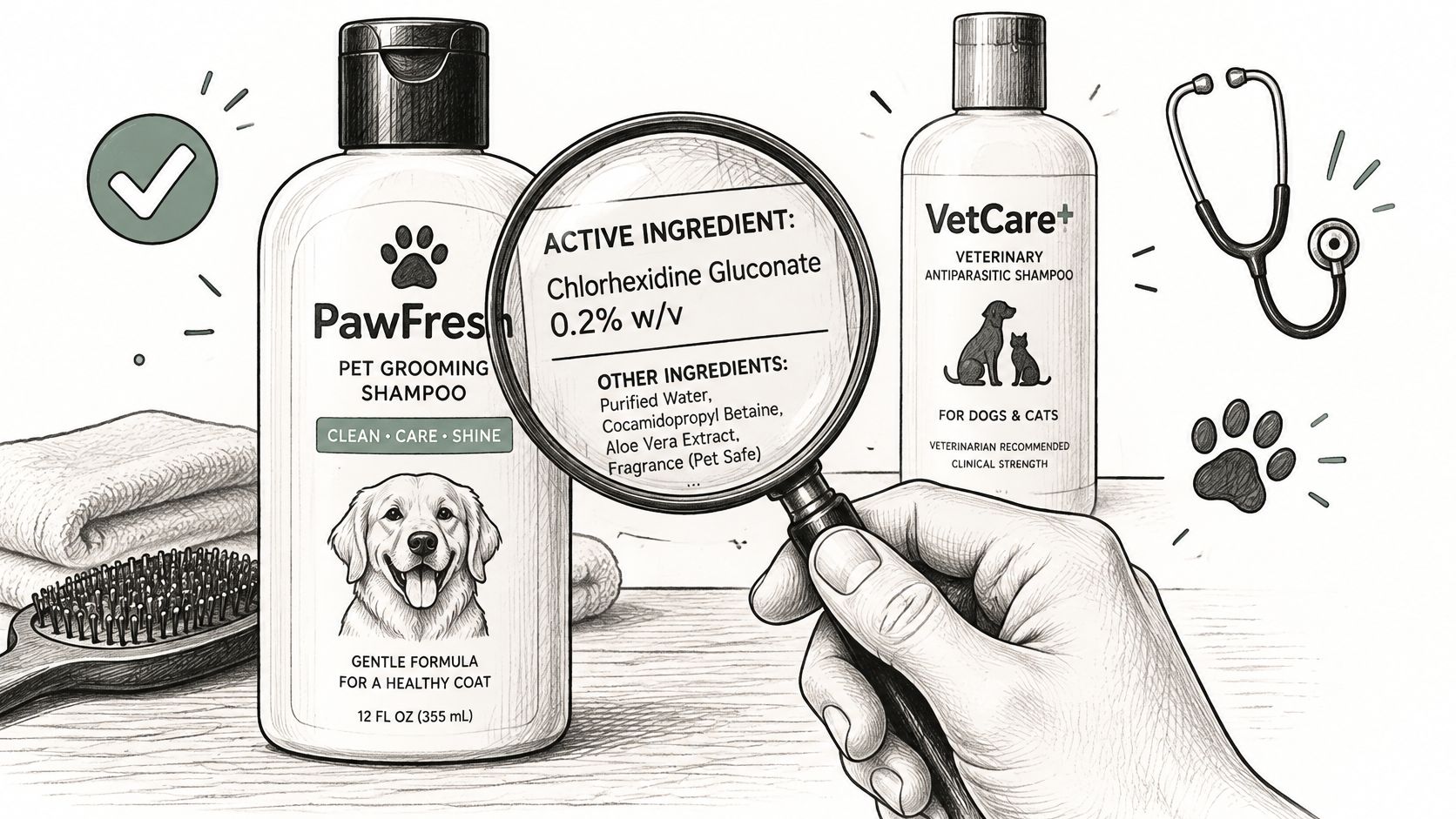
Read the label in a useful order
- Identify the species and purpose. Choose a product explicitly labeled for your animal. Don't assume a dog shampoo is suitable for a cat, or that a cosmetic cleanser can replace a prescribed shampoo.
- Check active ingredients and concentration. An antiseptic isn't automatically desirable for ordinary dirt. Higher strength can increase exposure without giving healthy skin a useful benefit.
- Assess the whole formula. Look for a species-appropriate, pH-appropriate cleanser with minimal fragrance, especially for a sensitive pet. A strong scent isn't evidence of better cleaning.
- Read dilution directions before buying. A concentrate only offers value if you measure it correctly. Don't guess the mixture or assume that using more product will improve results.
- Find the contact time and rinsing instructions. Therapeutic washes may need a specified period on fully wetted skin and coat. Rinsing immediately can undermine the intended treatment, while leaving a rinse-off product behind can irritate skin.
- Separate reassuring language from evidence. Natural, hypoallergenic and professional aren't interchangeable safety guarantees. Read the ingredient list, warnings and intended use rather than relying on those terms alone.
For a pet with a history of reactions, ask your veterinarian whether a new product is appropriate and whether a small-area trial makes sense. A successful spot application doesn't guarantee that a full bath won't cause irritation. Our pet shampoo buying guide offers additional help comparing formulas for different coat-care needs.
Why stronger doesn't necessarily mean better
In a controlled canine study, daily chlorhexidine gluconate application for two weeks showed that 4% had the potential to disrupt the skin barrier, while 0.5% retained antimicrobial activity without observed barrier disruption, as described in the published canine skin-barrier study. These findings don't provide a recipe for homemade dilution or make an antiseptic necessary for everyday grooming.
Formulation also matters. An AVMA veterinary review notes that formulations containing 2–3% chlorhexidine sometimes produced greater bacterial inhibition than products containing up to 4%. Surfactants, conditioners and other formulation details can affect performance, so comparing active percentages alone is misleading.
A veterinarian should select antimicrobial treatment for the diagnosed problem. Apply it to fully wetted coat and skin, observe its labeled contact period, and rinse as directed. Keep shampoo out of eyes, ear canals, mucous membranes and broken skin unless the product is specifically labeled and prescribed for that use.
Decode the claim before treating the symptom
In the United States, FDA consumer guidance on pet-health products distinguishes products intended only to cleanse or beautify animals from products making therapeutic claims. Grooming aids generally aren't regulated by the FDA, while therapeutic claims may bring a product under animal-drug regulation.
| Label language | What it suggests | Your next decision |
|---|---|---|
| Cleans, softens, conditions | Routine cosmetic care | Match it to species, coat and tolerance |
| Treats infection or kills yeast | Therapeutic purpose | Seek diagnosis and appropriate treatment |
| Relieves allergy-related itching | A claim about a health condition | Ask what's causing the itch before treating it |
Persistent odor, redness, greasy scale, itching, pustules or recurring skin and ear problems need veterinary assessment. Stop a product if grooming is followed by increased scratching, scaling or redness, because irritation and the original disease can look alike.
A cleaner coat isn't the same as a treated skin condition.
How to Build a Home Grooming Routine Step by Step
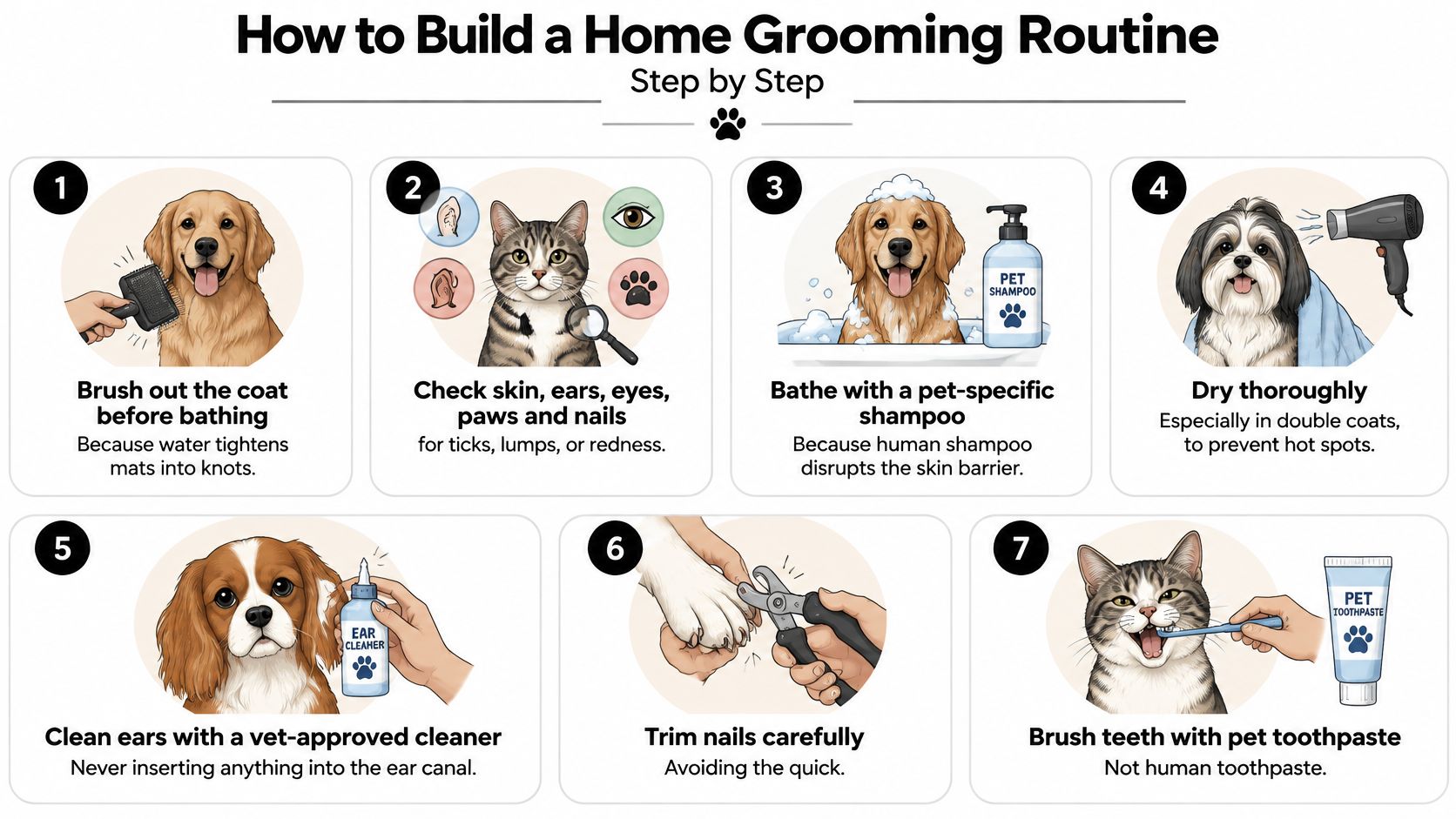
Set up a nonslip surface, towels and your prepared products before bringing your pet over. Keep tools within reach so you don't have to leave a wet animal unattended.
Work from inspection to drying
- Brush before bathing. Remove loose hair and manageable tangles while you can still identify them easily. Don't soak a tightly matted coat and expect shampoo to loosen it.
- Inspect before covering everything with suds. Look over the skin, ears, eyes, paws and nails for ticks, lumps, tenderness, discharge or unusual odor. Painful or inflamed areas may change whether you should continue.
- Wet the coat thoroughly with lukewarm water. Dense hair can look wet on top while remaining dry underneath. Direct water away from the face and ear openings.
- Apply the prepared shampoo. Massage with your fingertips rather than scratching with your nails. For a veterinary treatment, use a timer to follow its prescribed contact period accurately.
- Rinse methodically. Work through the chest, belly, armpits and beneath the tail, where product is easy to miss. Part dense hair so water reaches beneath the surface.
- Condition only where needed. For long or tangle-prone hair, distribute the appropriate conditioner through the lengths without packing product against the skin. Rinse according to its directions rather than deliberately leaving residue.
- Press with towels, then dry gently. Avoid vigorous rubbing that twists long hair together. Use comfortable airflow and low heat, keep the nozzle moving, and check the skin temperature with your hand.
- Finish once the coat is dry. Brush with the appropriate tool, then check small sections with your fingers and comb. Pay attention to areas that remain damp beneath the surface.
- Trim nails when your pet can cooperate. Take small amounts and check the cut surface frequently. If you can't identify a safe stopping point, ask a groomer or veterinary professional to demonstrate.
- Wipe the face and assess the ears. Use a separate soft cloth or an appropriately labeled wipe for each area. Don't push cotton swabs into the ear canal or put wipes near eyes unless they're intended for that location.
Let condition determine the schedule
Bathe a dog when the coat is soiled or according to veterinary advice, rather than repeatedly washing to cover an unexplained smell. Cats generally manage much of their own cleaning and may need bathing only when soiled or when a veterinarian recommends it.
Nail maintenance belongs on a separate schedule based on growth, wear and foot comfort. You don't need to combine every grooming task into the same session.
A good finish is functional: hair separates freely, the skin has no new irritation, and your pet can move comfortably. A pet who remains relaxed enough to return willingly has also had a successful session, even if you postpone a finishing task.
Handling Nicks, Mats and Nervous Pets
A nail-trimming nick needs a calm response, not another attempt to finish the paw. Put the clippers down, keep your pet still, and inspect where the bleeding is coming from.
Respond to a minor nail nick
Our Styptic Powder provides fast-acting support for minor grooming nicks on dogs, cats and birds. It's formulated to be safe for dogs, cats, birds and small animals when used as directed, and it's made in the USA with natural ingredients.
For a minor nail nick, apply a small amount according to the product directions and hold gentle pressure. Keep the powder away from eyes and don't use it as a substitute for care of a deep cut or torn nail.
- Bleeding that won't settle: Contact a veterinarian if bleeding persists despite pressure and appropriate first aid.
- A split or partly detached nail: Stop handling the damaged section and seek veterinary advice.
- Preparation before trimming: Keep clean gauze and your first-aid supplies beside you, not in another room.
Our guide to creating a pet grooming first-aid kit at home helps you organize supplies before an accident happens.
Separate small tangles, don't force solid mats
For a loose tangle away from the skin, use a species-appropriate detangler and spread the hair with your fingers. Support the hair near its base, then work gently from the outer ends inward with a wide-tooth comb.
Don't drag a brush repeatedly across the lump. That pulls on skin without reliably separating the trapped hair.
Never slide scissors beneath a mat. Skin can be drawn into the hair, making it difficult to see where the mat ends and the skin begins. Bladed dematting tools also need instruction; they aren't a safe shortcut for an inexperienced handler.
A mat pressed against skin, a broad felted patch or a painful area belongs with a professional groomer or veterinarian. Removing it safely may require clipping rather than combing.
Give a nervous pet a way to pause
Introduce a tool without using it immediately. Let your pet investigate, reward calm behavior, and progress to a brief touch before attempting a grooming stroke.
Finishing the task isn't worth teaching your pet to fear the next session.
Lip-licking, trembling, freezing, repeated escape attempts or growling can mean your pet needs distance or a break. Don't punish the warning or increase restraint to push through it. If fear stays high, arrange professional help and discuss pain or severe anxiety with your veterinarian.
Build Your First Grooming Kit on a Budget
Buy for the pet standing in front of you, not for every possible grooming task. A short-coated dog doesn't need the same kit as a long-haired cat, and a pet receiving professional trims may not need home clippers at all.
Price sensitivity is a real consideration: about 22% of pet owners reported spending less on pets in 2025, according to the American Pet Products Association. The useful response is to reduce unnecessary purchases, not compromise on comfortable handling or suitable formulas.
Copy this starter list
- Coat tool: A brush or comb that reaches the layer you need to maintain.
- Routine cleanser: A gentle, species-appropriate shampoo with readable dilution and rinse directions.
- Conditional extra: Conditioner for long or tangle-prone hair, rather than automatically adding it to every kit.
- Nail-care tool: Comfortable clippers or a grinder your pet tolerates.
- First-aid support: Styptic powder and clean gauze kept beside the nail tools.
- Drying equipment: Absorbent towels, with a controllable low-heat pet dryer if a dense coat needs it.
Spend where you'll notice the difference
Put more of your budget into the tool that touches the coat most often. Comfortable pins, smooth comb teeth and a secure handle matter more than matching colors or a large accessory bundle.
Compare shampoo cost by the amount of correctly diluted wash you can prepare, not bottle size alone. A concentrate isn't a bargain if you won't measure it, use it before its stated expiry, or store it properly.
For occasional trimming, replaceable clipper blades are more useful than decorative attachments. Don't buy a medicated wash speculatively, and don't pay extra to perfume a coat that needs investigation.
At Evo Dyne Products, we offer pet-care items alongside solutions for industrial, home, jewelry and auto needs. Apply the same label scrutiny to our pet-care products that you would to any other purchase.
Write down your pet's coat type, choose the items needed now, and check each label before buying. Leave optional equipment off the list until you can name the job it will do.
Evo Dyne Products offers pet-care solutions, including styptic powder for minor grooming nicks, along with practical product-use guidance. Visit Evo Dyne Products to review the available pet-care items and choose supplies that fit your animal's species, grooming routine and immediate needs.
