

You're halfway through tapping a bracket when the tap starts to squeak, backs out, and comes up with a chipped flute. The hole is scrap, the morning is gone, and the bottle on the bench says nothing on the front except "cutting oil." That's usually when people start reading about the types of cutting oil, with a dead tool already in hand.
The label is the first problem. A bottle marked cutting oil can be a neat oil that goes on straight from the can, or a concentrate that needs water before it ever touches metal, and those two products behave nothing alike. One leans on lubrication, the other on cooling, and choosing wrong shows up as short tool life, stained parts, or a sump that smells like a drain by Friday.
The four families below behave differently on real cuts, and they behave differently on your skin, your lungs and your sump. No sales pitch, just the trade-offs.
Table of Contents
- Four Cutting Oil Types Compared Side by Side
- Why Cooling and Lubrication Pull in Opposite Directions
- How Each Type Performs on the Shop Floor
- Matching Cutting Oil to Metal and Operation
- Health and Shop Safety for Each Cutting Oil Type
- Keeping Water-Mixed Cutting Fluids Clean and Stable
- Pick Your Cutting Oil Before Your Next Job
Four Cutting Oil Types Compared Side by Side
Stand at the coolant shelf in any industrial supplier and the packaging runs from aerosol cans to five-gallon pails, each one labelled with the same two words. Behind that wall, just about everything sold as a machining fluid falls into one of four families, and the four-class breakdown used in metalworking-fluid research names them as straight (neat) oils, soluble oils, semi-synthetic fluids and synthetic fluids.
The split that matters isn't brand or colour. It's whether the product goes on the part straight from the container or gets mixed with water first, and that single difference predicts how the fluid lubricates, how it cools, how it mists and how much work it makes for you between shifts.
| Type | Base and dilution | Strongest at | Weakest at | Typical job |
|---|---|---|---|---|
| Straight (neat) oil | Undiluted; highly refined mineral, animal, vegetable or synthetic base | Lubrication and extreme-pressure work | Cooling | Tapping, broaching and severe cuts |
| Soluble oil | Petroleum oil with emulsifiers, diluted with water | Cooling with useful lubrication | Film strength under heavy load | General turning, milling and drilling |
| Semi-synthetic fluid | Small oil fraction dispersed in water | Balance of cooling and lubrication | Needs careful concentration control | Mixed-metal production work |
| Synthetic fluid | No petroleum oil; chemical water-soluble components | Heat removal, clear fluid | Heavy-duty lubrication | High-speed machining and grinding |
Neat oil or a concentrate that needs mixing
Straight oils are used without dilution, and the base can be highly refined petroleum, animal, marine, vegetable or synthetic oil. Soluble oils combine petroleum oil with emulsifiers and get diluted with water before machining. Semi-synthetics carry a smaller oil fraction dispersed in water, and synthetics use chemical formulations with no oil base at all, also diluted before use. The last three all arrive as a concentrate.
That's the trap on the shelf. Look for a mix ratio on the back, something like "dilute 1:20," or an instruction to fill the sump.
If there's a mix ratio printed on the container, you're buying a concentrate. If there isn't, you're buying neat oil.
Fluid family also sets your risk profile, not just your finish. The same classification governs tool life, surface finish, corrosion control, mist generation, microbial growth and worker exposure, which makes picking a family a safety decision as much as a machining one.
Shop in the right order. Pick the family first, then compare brands inside it. A premium synthetic will never out-lubricate a mid-range neat oil on a tough tap, and the reverse holds when heat is what's killing the edge.
Why Cooling and Lubrication Pull in Opposite Directions
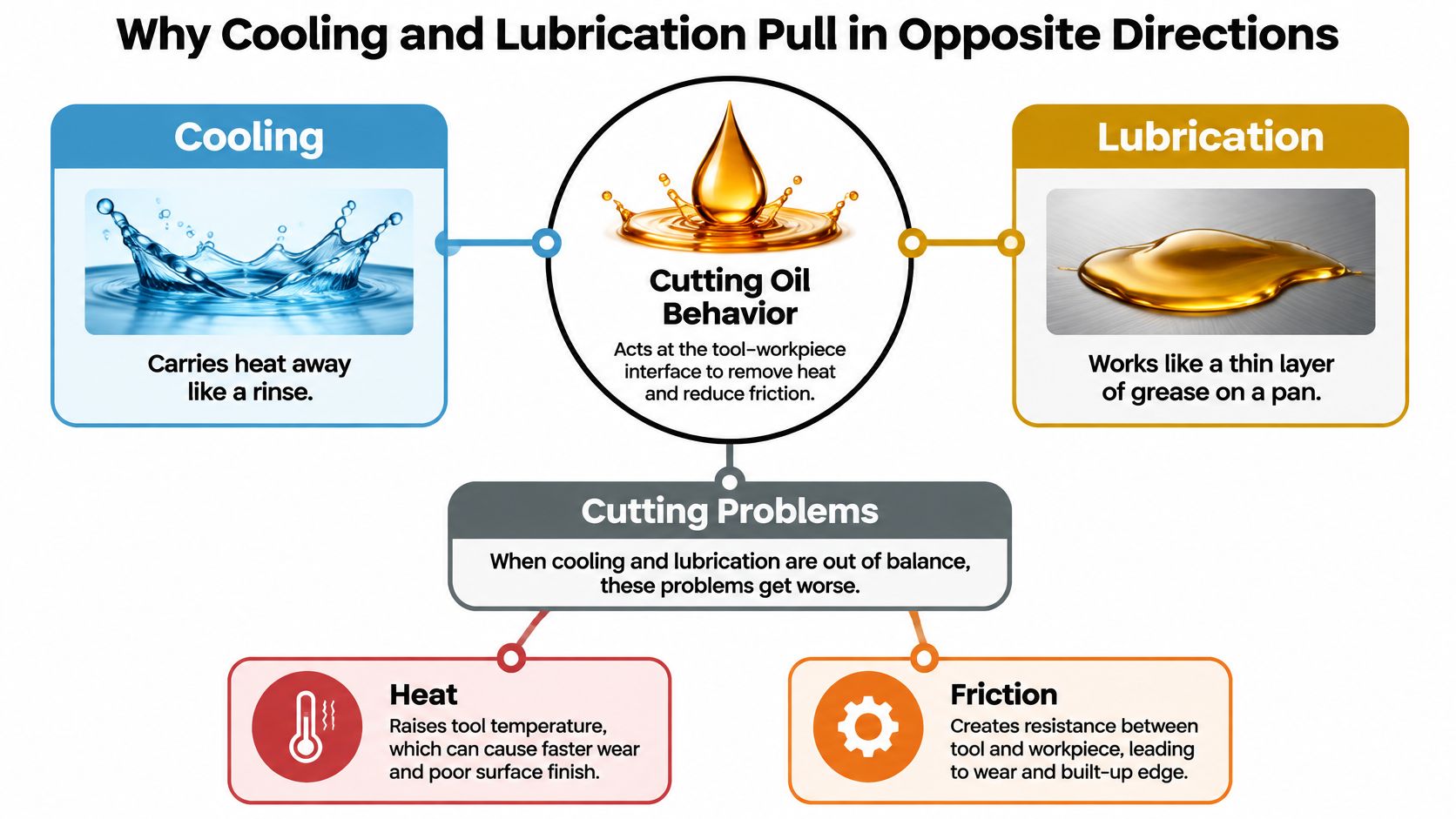
A hot frying pan shows the split. Wipe it with a smear of grease and the surface turns slick while the heat stays in the pan. Run it under the tap and the heat leaves with the water, but the surface is bare. A cutting fluid has to do both jobs with one product, and every family on that shelf sits somewhere along the same line.
Two things go wrong where the tool meets the workpiece: friction and heat. Friction is the tool rubbing, the chip dragging and a built-up edge forming as metal welds to the tip. Heat is everything that follows from the energy going into the cut. A fluid that handles friction isn't automatically good at heat, and the fluid that carries heat away fastest leaves the weakest film behind.
What a lubricating film actually is
Lubrication is a film that keeps the chip from welding to the tool. Neat oil is almost all base oil. The European Agency for Safety and Health at Work classification recorded in OSHA's metalworking-fluid taxonomy describes neat oils as primarily base oil, usually more than 95%, and that concentration is exactly why the film holds under pressure.
Cooling works the other way. Water carries heat out of the cut far faster than oil does, so the fluid that keeps a part cool is the one with the most water in it, which is also the one with the least oil.
One cut where film wins and one where cooling wins
Tap a deep hole in 304 stainless steel and film strength decides the outcome. The alloy work-hardens under the tap, pressure climbs, and a thin fluid lets the chip gall and seize. Neat oil, applied generously and often, keeps the flutes slick and the threads clean.
Run a 12 mm end mill through mild steel at speed and heat becomes the limit instead. The tool stops cutting because the edge is overheating, not because the film broke down. A water-mixed fluid flushed over the cut keeps that edge alive longer.
Rule of thumb: when heat limits the cut, reach for a water-mixed fluid. When tip welding and thread quality limit it, reach for neat oil.
How Each Type Performs on the Shop Floor
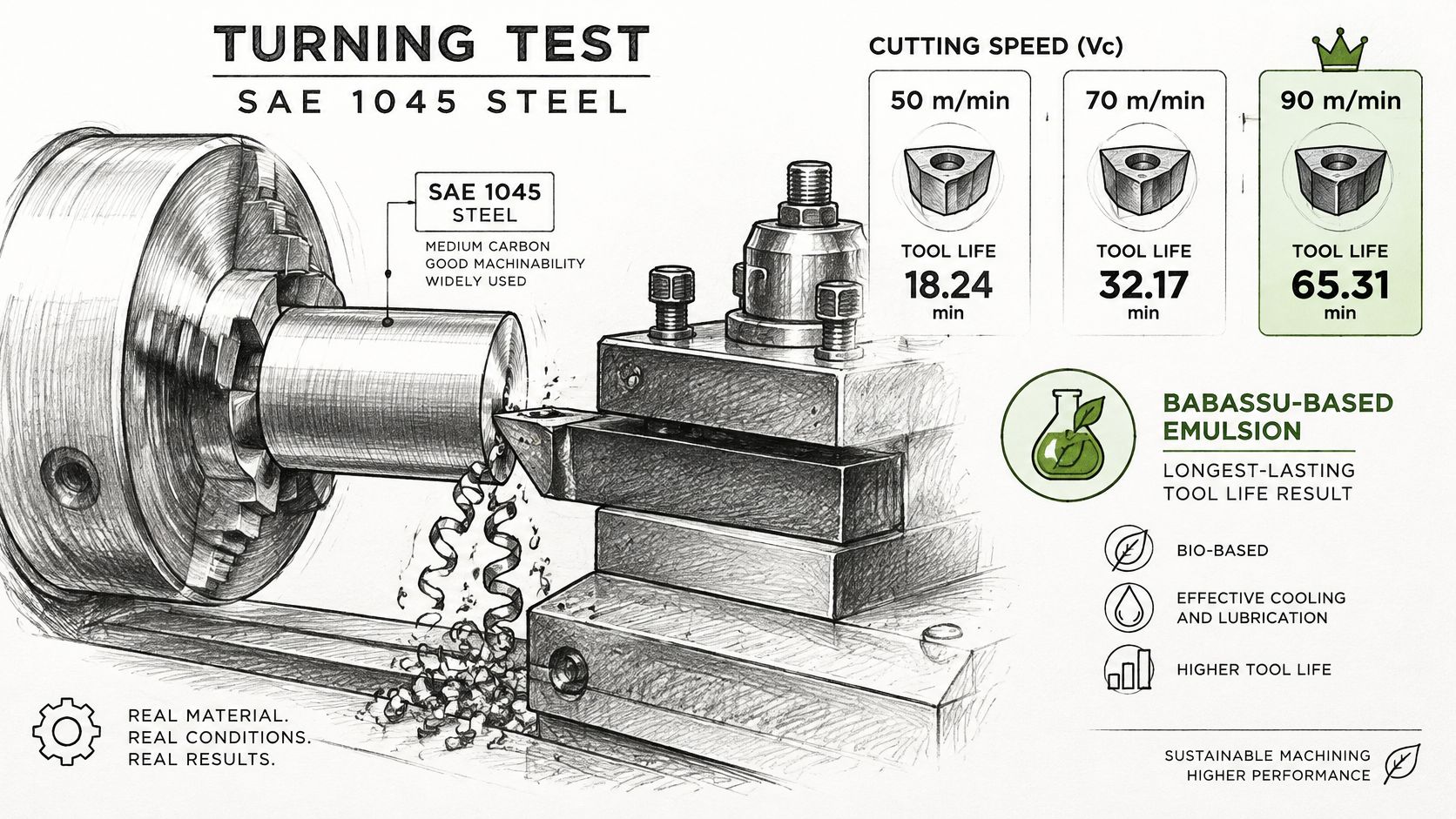
A fluid can extend tool life without producing the best finish. In a turning study on SAE 1045 steel, babassu-, castor- and commercial synthetic-fluid emulsions were run at several cutting speeds. The babassu-based emulsion produced the longest tool life at 65.31 minutes, while the synthetic fluid returned the best surface-roughness values, according to the machining study on biodegradable cutting emulsions.
Tool life results from that turning test, side by side.
When tool life and finish disagree, pick the one your part needs
If a broken tool scraps a costly casting, prioritize tool life. If the part goes to anodising or paint, surface roughness may matter more, even if inserts need changing sooner. One fluid may not lead on both measures.
Tests on AISI 1050 steel comparing vegetable fluid with a mineral-based semi-synthetic illustrate why performance depends on the measure. Thermal and tribological performance, wettability and machining force can favor different fluids. Choose by the result the job requires, not by a blanket claim that one fluid is better.
The costs that never show up in a tool-life chart
Corrosion can appear after machining: a ferrous part left wet with water-mixed fluid may flash rust. Tool-life figures do not capture that cleanup risk.
- Residue must be removed before paint, powder coat or welding. Heavy neat oil generally calls for more degreasing than a synthetic leaves behind.
- Foam in a recirculating sump can point to water hardness, concentration or contamination. Excess foam can interfere with pump delivery.
- Tool wear from a weak film may show as flank wear and a drifting finish over a long run, rather than a sudden failure.
Vegetable and ester-based oils suit jobs where lubricity, biodegradability and wetting matter. Synthetic and semi-synthetic fluids suit work where predictable cooling, finish consistency and sump upkeep are priorities. Concentration, water quality, additives and application method all affect residue, corrosion, foaming and wear, so judge the fluid in the conditions the shop will maintain.
For a shop tapping mounting holes in steel suspension brackets, neat oil can help prevent tap seizure and preserve thread quality. If the brackets go to a welder, oil residue adds a degreasing step. A lighter fluid may reduce that cleanup burden, with a possible trade-off in tap life.
Matching Cutting Oil to Metal and Operation
Choose fluid by matching the metal's surface requirements to the operation, then account for how the fluid will be applied and maintained. The table gives a starting point; verify the fluid's compatibility with the alloy and process before running production parts.
| Metal | Recommended type | Watch for |
|---|---|---|
| Carbon steel | Soluble, semi-synthetic or neat oil for tapping | Neat oil provides a stronger lubricating film |
| Stainless steel | Fluid with additives compatible with the alloy and operation | Check additive compatibility; requirements vary by formulation |
| Aluminum | Soluble or semi-synthetic fluid | Keep fluid clean to limit staining and residue |
| Brass and copper | Light soluble or semi-synthetic fluid | Sulfur-based EP additives can stain |
| Titanium | Fluid specified by the tool supplier | Confirm additive compatibility before use |
| Cast iron | Soluble oil or dry cutting | Control graphite dust and mist |
Where a wrong fluid costs you real money
For stainless steel, focus on additive choice rather than relying on a generic label such as “high performance.” Match the fluid to the alloy and operation, and check the product guidance before use. For a tapping job, use the fluid suited to the tap and hole; this guide to cutting oil for tapping covers that application.
Aluminum cuts readily, but chips can stick and fluid residue can mark the part. Soluble or semi-synthetic fluid can suit the job, provided the fluid stays clean. Check the finished surface after machining, especially when appearance or a later coating process matters.
Brass and copper can stain with sulfur-based extreme-pressure additives. Check the label for compatibility with yellow metals, and choose a lighter fluid when the operation allows it. For titanium, follow the tool supplier's fluid recommendation rather than experimenting with an unconfirmed additive package.
Cast iron adds graphite dust to the work area and fluid. Soluble oil or dry cutting may suit the operation, but manage dust and mist at the source. A fluid choice affects more than cutting performance: application method and sump upkeep also shape worker exposure and the chance of contamination.
The trial that settles it
Before committing to a larger quantity, run a scrap test on the same alloy. Make three cuts with the candidate fluid, then inspect the finish under a bright light, wipe the part with a dry rag to check residue, and examine the tool edge with a loupe. Compare the results, and include fluid cleanliness and upkeep in the choice.
Health and Shop Safety for Each Cutting Oil Type
A high-speed cut can send droplets or fine mist toward the operator, while fluid on a part or tool can reach the skin. The exposure route depends on the fluid and the operation, so shop controls need to address both.
NIOSH's metalworking-fluid exposure report describes metalworking-fluid production and worker exposure in the United States. Health effects associated with poorly managed fluid, listed on OSHA's metalworking fluids health effects page, include skin irritation, allergic dermatitis, eye, nose and throat irritation, bronchitis and asthma.
The exposure limits that apply
The values below are listed in the NIOSH and OSHA material on metalworking-fluid exposure and health and OSHA's metalworking-fluid standards and guidance.
| Limit | Value | Averaging period |
|---|---|---|
| NIOSH total metalworking-fluid particulate | 0.5 mg/m³ | Time-weighted average, 10-hour day in a 40-hour week |
| NIOSH thoracic particulate fraction | 0.4 mg/m³ | Time-weighted average, 10-hour day in a 40-hour week |
| OSHA mineral-oil mist PEL | 5 mg/m³ | 8-hour time-weighted average |
| OSHA particulates not otherwise classified | 15 mg/m³ | 8-hour time-weighted average |
Mist and splash behave differently by type
Neat oils mainly create splash and droplets. At high cutting speeds, they can also smoke as oil heats at the cutting zone. Keep guards in place and provide ventilation around the machine.
Water-mixed fluids can produce fine airborne mist. Dilution does not prevent aerosol formation, so open machines using soluble oil still need ventilation or mist collection.
“Water-based” describes what you mix into the sump, not the fluid's safety. The operator can still inhale mist or get fluid on the skin.
In a small shop, use splash guards and keep them in position. Wear gloves suited to the fluid, replace them if damaged, and wash hands before eating. Keep concentrate containers sealed, and put oily rags in a lidded metal bin. Arrange airflow so mist moves away from your breathing zone.
For disposal and environmental considerations, see this guide to eco-friendly cutting fluids and sustainable machining.
Keeping Water-Mixed Cutting Fluids Clean and Stable
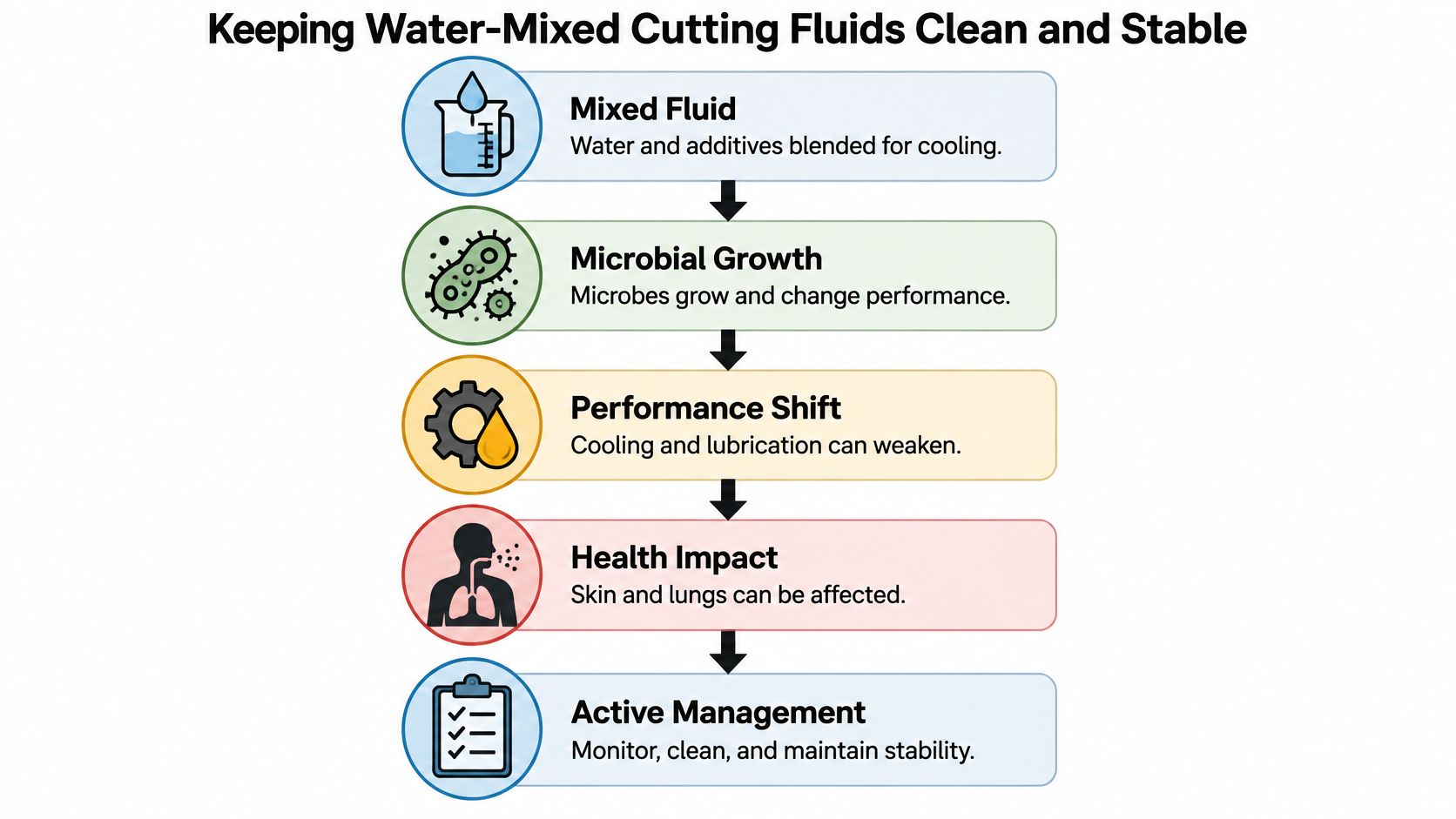
A water-mixed fluid changes as it circulates. Heat, chips, tramp oil and microbial growth can destabilize the emulsion, shift its viscosity, increase corrosion and shorten tool life. Research on microbial contamination in water-based metalworking fluids also links contamination to dermatitis and hypersensitivity pneumonitis among operators.
A sump needs regular attention because microbial load and fluid condition change over time. Neat oils generally do not require the same water-based sump routine.
What happens to a mixed fluid over a few weeks of recirculation.
The weekly routine that keeps a sump alive
- Check concentration with a refractometer. Adjust with concentrate, not water, and use the correction factor printed on the product data sheet.
- Check odour and appearance. A sour, rancid smell or cloudy grey colour calls for investigation. Clear fluid with a faint oily appearance is a useful visual check.
- Skim tramp oil. Way lube and hydraulic oil can collect on the surface. A belt skimmer removes this contamination.
- Filter chips and fines. Swarf collects in the system and can wear the pump.
- Clean the sump on a fixed interval. Top up with premixed fluid rather than plain water.
- Replace the charge when it cannot be restored. If concentration will not hold, odour returns quickly or the emulsion splits, fresh fluid may cost less than continued downtime.
Biocides are not a maintenance plan
A biocide does not remove the need to monitor the sump. A French study reported opportunistic organisms, including Pseudomonas aeruginosa and Klebsiella pneumoniae, in 17% of sampled fluids. Routine checks, skimming, filtration and scheduled clean-outs remain part of sump upkeep.
After machining, clean and lubricate exposed metal surfaces. Water-mixed fluid left on a table or vice can promote rust; wiping the surface and applying a light coat of lubricant helps protect it between jobs.
For a full sump clean-out, the Material Handling USA chemical catalog lists cleaning chemicals for shop use.
Pick Your Cutting Oil Before Your Next Job
Four situations cover most of the buying decisions shops face. Find the one that matches your week.
| Situation | Best-fit type | Why it fits |
|---|---|---|
| Occasional home drilling and tapping | Straight (neat) oil | No sump to manage |
| Small shop, mixed metals | Semi-synthetic fluid | Balances cooling and lubrication |
| Production milling at high speed | Soluble or synthetic fluid | Heat removal and sump control |
| Auto shop tapping and threading | Neat oil with EP additives | Film strength on tough cuts |
The sort that works
Start with volume, then ask whether you're willing to run a sump at all. If the job is low-volume and you don't want a tank to maintain, neat oil is the answer, and it doubles as a bench tapping fluid. If you already run a sump and heat is the limiting factor, soluble or synthetic earns its place because water does the cooling.
For mixed metals on a limited budget, semi-synthetic is the middle path. It won't beat neat oil on a hard tap or a synthetic on a high-speed grind, but it won't stain aluminum or mark a brass fitting either.
What shops buy backs that up. Soluble oils held the largest share of the global metalworking-fluids market in 2024, with semi-synthetic fluids second, according to MarketsandMarkets research reported by Research and Markets. The most popular choice is the compromise.
Read the metals list before you pay. The back label is the manufacturer's own statement of what the fluid suits, and it's the fastest filter you have.
Evo Dyne Cutting Fluid is our multipurpose option for drilling, tapping and milling, and it suits steel, stainless steel, aluminum, brass, copper and most other metals. Apply it directly to the cutting area or the drill bit before and during the operation, and reapply as needed. A 1-pack costs $12.49.
This week, do four things in order: identify the family your job needs, confirm the metals you cut are named on the label, run a test cut on scrap, then buy.
Evo Dyne Products offers a cutting fluid built for the work this guide keeps circling: drilling, tapping and milling in steel, stainless steel, aluminum, brass, copper and most other metals, applied straight to the cutting area and reapplied as the job runs. A single 1-pack runs $12.49, which is a low-cost way to find out whether a neat oil suits your bench before you commit to a pail. Visit Evo Dyne Products to see the fluid, the application notes and the rest of the shop range.