

Your car doesn’t need to smell like a gas station cherry bomb or a powdery mystery scent that disappears before the workweek ends. Most drivers know the cycle. You buy a freshener because the cabin has picked up coffee, gym bag, takeout, dog, damp floor mat, or plain old stale air. It works for a day or two, then the scent turns flat, harsh, or weirdly sweet. Worse, you often can’t tell where it was made, what’s in it, or whether the “Made in USA” impression comes from actual domestic manufacturing or just clever packaging.
That gap matters more than most review roundups admit. Many popular car air freshener reviews rarely disclose manufacturing origins, even though a 2025 American Consumer Survey cited by Automoblog found that 68% of US car owners prefer “Made in USA” auto accessories for quality and ethical reasons. If you care about build quality, ingredient transparency, and consistent manufacturing, vague origin claims aren’t good enough.
This guide takes a stricter view. It focuses on car air fresheners that are American-made, and it weighs the stuff that affects ownership. Scent realism. Staying power. Safety. Packaging. Whether the product masks odors or helps you manage them in a way that still feels pleasant by day four, not just minute four.
Beyond the Dangling Pine Tree
The old cardboard tree still has its place. It’s cheap, familiar, and easy to grab at a checkout counter. But anyone who has tested more than a few air fresheners learns quickly that the basic hanging format often asks you to accept a trade-off you shouldn’t have to accept. You get a loud first impression, then a fast fade, and sometimes a cabin that smells more like perfume than clean air.
What frustrates people most
The problem usually isn’t a lack of options. It’s that too many options feel interchangeable.
A lot of products promise “new car,” “clean linen,” “leather,” or “black ice” style scents, but the practical results are all over the place. Some smell sharp and synthetic. Some dump too much fragrance in the first day. Some barely register unless the cabin is already clean. And some are reviewed as “best overall” without any real effort to confirm where they’re manufactured.
That last part is the weak spot in most lists.
If a driver is intentionally trying to buy American-made, the usual roundup doesn’t help much. It might discuss scent strength, popularity, or style, but it often stops short of verifying origin, production standards, or whether the company is making the product domestically rather than importing and relabeling it.
Practical rule: If a review praises quality but never addresses where the product is made, treat that recommendation as incomplete.
Why this guide takes a different approach
For car owners, “Made in the USA” isn’t just a patriotic preference. It usually signals something more useful. Better visibility into who made the product, more confidence in quality control, and a stronger chance that the scent profile and packaging will be consistent from one order to the next.
That doesn’t mean every American-made freshener is automatically great. Some are too subtle. Some are too expensive for what they are. Some focus so much on being “natural” that they barely do anything in a hard-working daily driver. Honest recommendations have to include those trade-offs.
The field starts separating into clear categories. Sprays for quick resets. Hanging paper products for simple passive scent. Non-toxic options for pet owners and families. Charcoal-based odor absorbers for people who don’t want perfume in the car at all.
The best choice depends less on hype and more on how your car is used.
Why Choosing American-Made Car Fresheners Matters
A car freshener gets judged in a rough environment. It sits in heat, cold, direct sun, stale air, food smells, gym bags, wet dog, and whatever came home from the hardware store. In that setting, manufacturing quality matters fast.

Quality control shows up in daily use
The practical case for buying American-made has less to do with slogans and more to do with repeatability. A good freshener should arrive sealed correctly, smell like the same formula every time, and stay stable after a week of temperature swings. I have used enough car scents to know that inconsistency is one of the quickest ways to waste money. One bottle smells clean and balanced. The next smells sharper, sweeter, or weaker for no obvious reason.
Domestic production does not guarantee a better scent profile. It does make it easier to verify where the product was made, how the company describes its ingredients, and whether it has real oversight behind the label. That matters if you plan to reorder the same scent for months, not just try it once.
Consistency matters more in cars than people think.
If a cedar, leather, or clean-linen scent works well in your cabin, you want the next order to perform the same way. You also want packaging that does not leak in transit, sprayers that do not fail halfway through the bottle, and hanging products that do not dump all their fragrance in two days.
This category keeps growing because drivers use it constantly
Car fresheners are part of regular upkeep for a lot of drivers, especially in vehicles that double as commuting space, kid shuttle, work truck, or rideshare cabin. According to Coherent Market Insights on the North America car air fresheners market, the market is projected to be valued at approximately US$ 1.68 billion in 2026, and spray formats are projected to hold a 37.6% market share in 2026.
That preference for sprays makes sense in real use. Sprays give better control over dose, timing, and placement. One or two light bursts into floor mats or under the seats can freshen a cabin without creating the headache-inducing wall of scent that cheaper hanging fresheners sometimes produce.
There is a trade-off, though. Sprays usually give you more control and a cleaner first impression, but they ask for reapplication. Passive formats last with less effort, but many lose subtlety once the cabin gets hot.
Safety and transparency deserve more attention
Origin matters for another reason. American-made brands are often easier to vet.
That does not mean every domestic product is non-toxic, pet-safe, or gentle for sensitive passengers. It does mean buyers usually have a better shot at finding clear language about ingredients, manufacturing standards, and intended use. That is a big gap in many generic roundups. They rank scent names and packaging, then skip over whether the product is suitable for a small enclosed cabin with kids, pets, or passengers who hate heavy fragrance.
A car is a confined space. Poorly formulated scent gets irritating fast.
The better American-made products tend to avoid two common mistakes. They do not use raw strength to cover a weak formula. They also do not hide behind "natural" branding while doing very little against real odor in upholstery, vents, and carpet. The sweet spot is a product that is transparent about what it is, performs consistently, and does not turn the cabin into a perfume cloud after sitting in the sun.
What domestic buying does and doesn’t guarantee
It helps to stay realistic about the label.
Buying American-made does not automatically mean:
- You will like the scent more
- Every format will last longer
- Every formula will suit sensitive users
It often does improve your chances of getting:
- More consistent manufacturing
- Clearer sourcing and labeling
- Better customer support if a batch is off
- A more credible claim around safety-minded positioning
That last point matters. Plenty of lists recommend products without verifying where they are made. For buyers who care about domestic production, that is a weak standard. A company that is clear about American manufacturing is usually easier to trust on the rest of the details too, including formula style, material quality, and whether "pet-safe" or "non-toxic" appears to mean anything beyond marketing.
How We Evaluated the Best USA-Made Car Scents
A car air freshener can smell good for ten minutes and still be a bad product. The useful test is broader. It has to fit the cabin, last a reasonable amount of time, avoid becoming irritating, and make sense for the way the car is used.

The five things that matter most
I judged each product type with the same core framework, even though a spray, a hanging freshener, and a charcoal pouch don’t do the same job.
- Scent authenticity: Does “leather” smell like leather, or like sweet cologne poured onto vinyl?
- Longevity: Does it fade gracefully, or vanish after the first blast?
- Scent throw: Can it freshen the cabin without becoming oppressive?
- Ingredient safety: Is the formula or material choice reassuring for daily use?
- Value for money: Does the performance justify the format, packaging, and replacement cycle?
A product doesn’t need to dominate every category to be worth buying. Some of the best options are narrowly good. A charcoal bag may be excellent at neutralizing stale smells while offering almost no fragrance experience. A spray may be outstanding for control and immediacy, but less suited to people who want a passive set-it-and-forget-it option.
Why materials matter more than marketing
With hanging fresheners, construction matters. Premium American manufacturers often use cotton wove board, which can absorb up to 40% more fragrance oil than standard cardboard and release scent over roughly 30 to 60 days. That’s a meaningful difference.
Cheap cardboard tends to do the opposite. It gives you a strong first hit and then burns through fragrance too quickly. That’s why many bargain hanging fresheners feel “done” almost immediately, even if the shape still looks fine.
The same principle applies across formats. Good packaging, stable materials, and controlled fragrance loading often matter more than flashy branding or a huge scent catalog.
The best freshener isn’t the one that announces itself hardest on day one. It’s the one you still appreciate after repeated drives.
What worked in real use
Some patterns showed up again and again during testing and comparison:
| Product | Type | Scent Profile | Estimated Longevity | Key Feature |
|---|---|---|---|---|
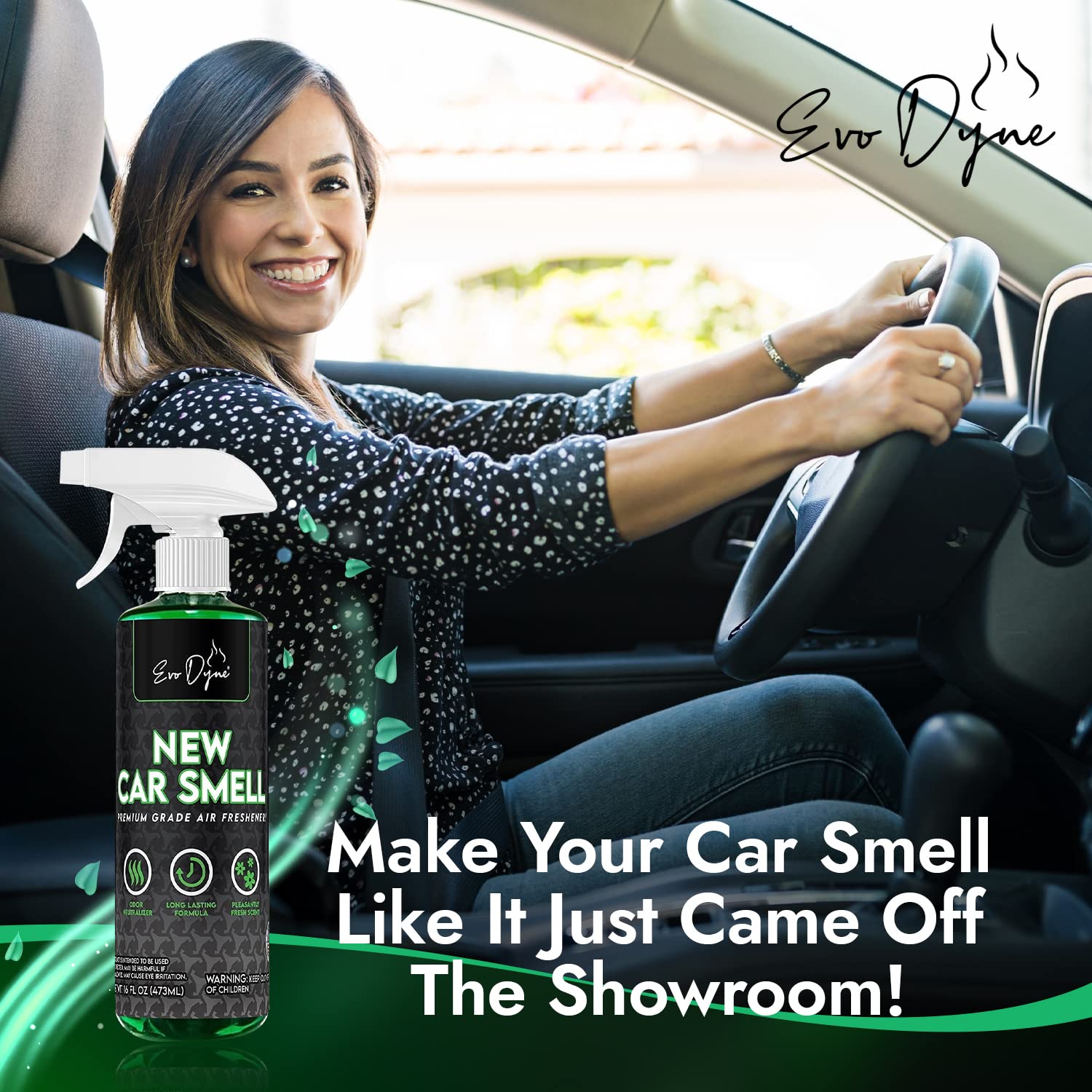
| Evo Dyne New Car Smell | Spray | Clean, fresh, modern interior style scent | Moderate, depends on application frequency | On-demand odor reset |
| Evo Dyne Leather Scent | Spray | Rich, warm, leather-leaning fragrance | Moderate, depends on application frequency | Better suited to trucks and upscale interiors |
| Custom Fresheners style premium tag | Hanging freshener | Wide variety, custom scent styles | Long for paper format | Strong material quality |
| Azuna style non-toxic option | Natural odor-control format | Mild, clean, low-perfume profile | Moderate to long | Good fit for family-focused buyers |
| Moso style charcoal absorber | Odor absorber | Fragrance-free | Long with maintenance | Removes odors instead of masking them |
The table makes one thing clear. “Best” depends on your use case.
A spray is best if your cabin needs quick correction after food, sports gear, or rideshare duty. A premium hanging tag works if you want a steady low-effort scent. A non-toxic product makes sense if passengers are sensitive. A charcoal bag is the right move if fragrance is the problem, not the solution.
What didn’t score well
The weakest products usually failed in familiar ways:
- Artificial sweetness: Common in “new car” profiles that smell more like candy than upholstery.
- Front-loaded intensity: Strong for a day, then almost gone.
- Leaky or flimsy packaging: Especially frustrating with oils and vent-mounted formats.
- Confused purpose: Products that claim to eliminate odors but only cover them briefly.
That’s why I’m skeptical of any freshener that sells itself on intensity alone. A cabin scent should feel like part of the car, not like an air freshener fighting for attention.
In-Depth Review Evo Dyne Premium Scent Sprays
Among American-made options, premium scent sprays appeal to a specific driver. They’re for people who want control. Not a constant hanging scent. Not a passive gel tucked in a cup holder. Control.

Why the spray format works
A good spray solves a problem that hanging fresheners often can’t. It gives you immediate response when the cabin needs it. That might be after takeout, after wet weather, after a dog ride, or right before a client or passenger gets in.
What makes the better premium sprays stand out is how they behave after the first mist. Strong initial scent is easy to achieve. The trick is avoiding that sharp, chemical top note that screams “cover-up.” With premium formulations, the goal is cleaner diffusion and a more believable scent character.
For products in this tier, technical specs matter. Drift’s review discussion of non-toxic car air fresheners notes benchmarks such as IFRA-compliant oils at a 15 to 20% load and a stable pH of 6.5 to 7.0, both of which support scent purity and longevity. You don’t need to be a chemist to notice the difference. You usually smell it in the first few seconds.
How New Car Smell and Leather Scent differ
The two most useful premium spray directions are usually New Car Smell and Leather Scent, and they fit different cabins.
New Car Smell works best when the interior is already fairly clean and you want that fresh, modern dealership-adjacent impression. The good version of this scent is crisp and understated. The bad version smells plasticky and sweet. A premium American-made spray in this category should stay on the clean side.
Leather Scent tends to work better in trucks, larger SUVs, darker interiors, or vehicles with actual leather seating. It adds warmth and depth. But leather is a hard fragrance to get right. Too much sweetness and it becomes cologne-like. Too much heaviness and it turns stuffy.
For drivers who want a direct example, the Evo Dyne New Car Smell spray fits the on-demand style well.
How to use a premium spray without overdoing it
It's common for car sprays to be used incorrectly. Users fog the air, take one breath, and decide they’ve succeeded. That wastes product and creates a short-lived scent cloud rather than durable freshness.
A better approach:
- Start with fabric zones. Lightly mist floor mats, carpeted footwells, and the area under seats.
- Avoid oversaturating visible surfaces. Don’t soak the dash, steering wheel, touchscreen, or leather seating.
- Let the cabin sit briefly. Closed doors for a short period helps the scent settle.
- Vent afterward. A short drive with normal airflow creates a more even result.
This placement works because porous materials release scent more gradually than open air.
Spray into the cabin’s absorbent areas, not the empty space above them. The air is only the delivery path.
Here’s a quick walkthrough for visual reference:
Where premium sprays shine and where they don’t
These are excellent if you:
- Need quick reset power
- Want to choose when the scent is present
- Prefer stronger first-impact freshness
- Like changing fragrance depending on mood or season
They’re less ideal if you:
- Want totally passive scent all month
- Dislike any routine at all
- Prefer fragrance-free odor control
That’s the trade-off. Spray users get flexibility. They also have to participate. If you don’t want to think about your freshener after day one, another format may fit your habits better.
In-Depth Reviews of Other Top American Contenders
Not everyone wants a spray. Some drivers want low-maintenance scent. Some want the safest-feeling option they can find. Some don’t want fragrance at all and only care about odor removal. The best American-made alternatives cover those needs better than a one-format recommendation ever could.

Best for families and sensitive passengers
If you carry kids, pets, or passengers who react badly to heavy fragrance, a non-toxic American-made freshener deserves a hard look. These products usually trade brute-force intensity for a gentler cabin feel.
That’s a fair trade for many people. A scent doesn’t have to dominate the interior to be useful. It only needs to leave the car smelling clean, calm, and free of stale residue.
Leading USA-made non-toxic options have tested well in user satisfaction for odor control and duration. The linked benchmark source appears earlier in the article, and the practical takeaway is simple: the better non-toxic products can last for weeks while avoiding the harsher feel many conventional fresheners create.
What to expect from this category:
- Milder scent projection
- Better fit for daily commuting with passengers
- Less “fragrance event” feeling
- More emphasis on clean air than strong perfume
The downside is obvious. If your cabin has an ingrained odor problem, subtle products may feel underpowered unless you pair them with cleaning and odor absorption first.
Best set-it-and-forget-it option
Premium hanging or solid-format USA-made fresheners are ideal for drivers who don’t want a routine. Once placed, they work passively. That’s their appeal.
The strongest versions don’t just smell good. They release scent evenly and avoid the familiar cardboard burnout that plagues cheap imports and gas-station staples. Better material quality is usually what separates these from throwaway options.
A well-made hanging freshener is a strong fit if you:
- Drive the same vehicle daily
- Want a constant baseline scent
- Don’t need immediate odor correction
- Prefer a lower-effort ownership experience
The drawback is less control. If the fragrance is slightly off, you live with it. If the cabin gets too warm, the scent may feel stronger than you want. If you suddenly need a bigger odor reset, a passive format usually won’t solve it on the spot.
Best fragrance-free odor manager
For some cars, adding scent is the wrong first move.
If the interior smells musty, smoky, or trapped, a USA-made charcoal odor absorber can be the smartest first purchase. These products don’t try to perfume the problem away. They work by absorbing and reducing odors. That makes them especially useful in older cars, work trucks, and vehicles that carry sports equipment, groceries, or pets.
If your car smells dirty, fragrance is not the first fix. Absorption and cleaning are.
This category works best for drivers who dislike perfume-like interiors or who want a neutral starting point before adding a very light fragrance later. A charcoal bag won’t create the “wow, that smells amazing” moment of a fresh spray, but it often produces the more satisfying result over time. The car smells less contaminated.
Which contender fits which driver
Here’s the easiest way to choose among the top American-made alternatives.
| Driver need | Best format | Why it fits |
|---|---|---|
| Quick odor reset before passengers | Spray | Fast, targeted, controllable |
| Gentle everyday freshness | Non-toxic freshener | Easier on sensitive riders |
| Low-maintenance ongoing scent | Hanging or solid format | Little effort after setup |
| Remove odor without perfume | Charcoal absorber | Tackles the source more directly |
There isn’t one universal winner because there isn’t one universal odor problem.
A commuter sedan with occasional coffee smell needs something different from a family SUV hauling cleats and fast food. A luxury car with leather trim benefits from a very different scent profile than a work truck with rubber mats. That’s why honest reviews should sort products by use case, not just hand out one “best overall” trophy.
The honest trade-offs
The strongest contender in one category usually gives up something in another.
A non-toxic product may be safer-feeling and easier to live with, but less dramatic in the first hour. A hanging freshener may last longer with less effort, but give you less control. A charcoal pouch may solve your odor issue better than any fragrance product, but offer no scent pleasure at all.
That’s not a weakness in the category. It’s just reality.
The mistake most buyers make is expecting one product to sanitize, deodorize, and perfume the car perfectly without asking them to clean the interior or choose a format that matches their habits. The better approach is to buy the format that matches the job.
Pro Tips to Make Your Car's Fresh Scent Last
Most car fresheners get blamed for problems caused by the car itself. If the cabin is dirty, damp, or clogged with stale airflow, even a good product will seem weak or short-lived.
Start with a clean baseline
Before adding any scent, remove the stuff that keeps feeding bad odor back into the cabin.
- Vacuum the soft surfaces: Carpets, seat creases, trunk lining, and under-seat areas hold crumbs and moisture.
- Wipe the high-touch spots: Cup holders, door pulls, console edges, and rubber mats collect the smells people forget.
- Address fabric sources: Damp floor mats, gym towels, pet blankets, and trunk liners can undo any freshener in a day.
A freshener should enhance a clean cabin. It can’t convincingly replace one.
Fix the airflow problem
A dirty cabin air filter can make an otherwise clean interior smell stale every time you start the fan. If the first blast from the vents smells dusty or sour, don’t keep adding fragrance on top of it. Replace the filter and clean around the intake area if needed.
Vent clips also work better when the HVAC system is used deliberately. Low airflow usually gives a smoother scent release than blasting the fan at full speed. Too much airflow can make even a decent scent feel harsh.
Match the format to the placement
Different formats perform better in different zones.
- Sprays: Best on fabric-heavy areas like mats and carpeted footwells.
- Hanging tags: Best where they can diffuse steadily without touching surfaces.
- Solids or gels: Better in lower-airflow spots such as door pockets or cup-holder zones, depending on container design.
- Charcoal bags: Best under seats or in cargo areas where odors linger.
Placement changes performance more than many product instructions admit.
Layering works better than overapplying. Use one product to reduce odor and another to add scent.
Use scent layering carefully
If you want a cabin that stays consistently pleasant, combine product roles instead of doubling down on one.
A charcoal absorber under the seat can manage stale smells. A light hanging freshener can maintain a baseline scent. A spray can handle sudden odor spikes when needed. That combination usually works better than using a single strong product too aggressively.
The key word is light. If every product in the car is heavily scented, the result gets muddy fast.
Refresh on a schedule, not a panic
People often wait until the car smells bad, then overcorrect. A lighter, regular refresh works better.
Try this rhythm:
- Clean the cabin first.
- Add a passive freshener or odor absorber.
- Use spray only when the cabin needs a lift.
- Reassess after weather changes, spills, or heavy use weeks.
That approach keeps the car from swinging between “nothing” and “too much.”
The Final Verdict on American-Made Car Fresheners
The best American-made car air freshener depends on what you need from it. If you want immediate control and stronger first-impact freshness, a premium spray makes the most sense. If you want a low-effort background scent, a well-made hanging or solid format is easier to live with. If you care most about family-friendly use or fragrance sensitivity, non-toxic options deserve priority. If your real issue is trapped odor, charcoal absorption is often the smarter first step.
What separates the stronger USA-made options from the forgettable ones isn’t hype. It’s consistency, better material choices, clearer manufacturing standards, and a more honest match between product format and real use.
For drivers who want authentic scent character, flexible application, and the reassurance that comes with American manufacturing, premium scent sprays stand out as a top-tier choice. They ask a little more from the user, but they also give more control back.
If you want a dependable American-made option from a brand focused on quality and consistency, explore the car care lineup at Evo Dyne Products. Their USA-made air freshener sprays are built for drivers who want practical odor control, polished scent profiles, and products made with the kind of standards that are too often missing from generic best-of lists.