


You notice it while fastening your ring before leaving the house. The stone is still there, the setting looks familiar, but the sparkle has disappeared beneath a film of hand lotion, soap, and everyday dust. A necklace may look gray instead of bright, while a watch band can collect grime in places a cloth can't reach. Cleaning gets postponed because a jeweler visit feels like another task to schedule.
A portable jewelry cleaner can make home maintenance more convenient. The right device may help loosen buildup from suitable jewelry without a professional appointment, but it isn't a universal solution for every stone, setting, or antique piece. The important question isn't whether a cleaner is powerful. It's whether the cleaning method matches the materials in front of you.
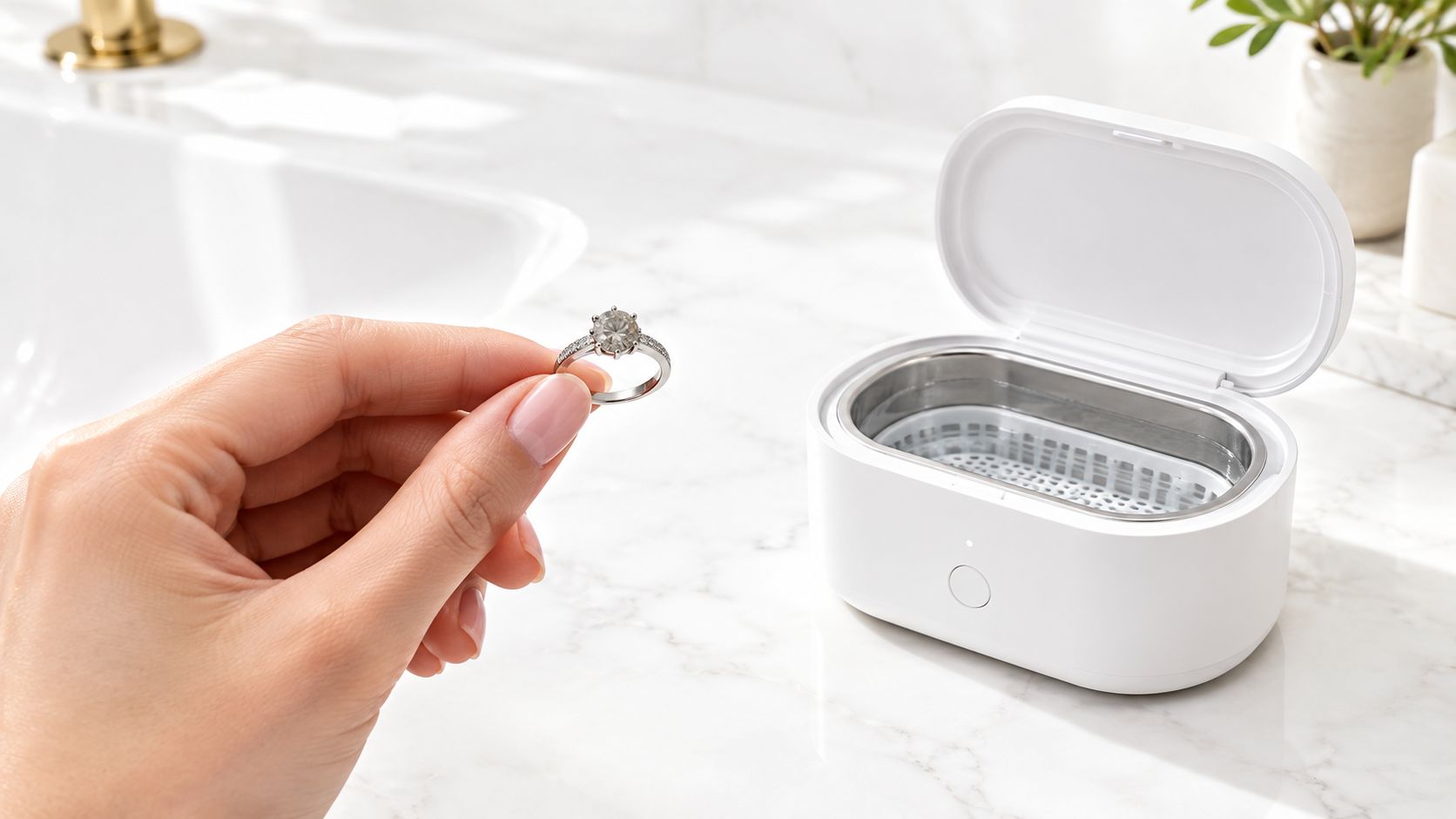
Introduction to Brilliant Jewelry Care at Home
A dull ring often looks damaged even when the main problem is surface buildup. Oils from your skin, lotion, hairspray, sunscreen, and soap can settle around the underside of a stone and inside its setting. The stone hasn't necessarily lost its brilliance. Light is meeting a layer of residue before it reaches the facets.
That makes regular cleaning useful for more than appearance. Handling a piece gives you a chance to notice a loose stone, a bent prong, a worn clasp, or a split chain before the problem becomes harder to manage. A compact cleaner can fit into a routine that otherwise gets skipped, especially for jewelry worn every day.
Convenience without guesswork
Portable models appeal to busy homeowners because they take up less space than larger countertop appliances and can be stored between uses. Some are designed for rings and earrings, while others can accommodate small watch parts, eyeglasses, or compact accessories. That convenience is valuable, but it can also make the devices seem simpler and safer than they are.
Jewelry isn't one material. A diamond ring with a secure gold setting has different needs from a pearl strand, an opal pendant, or a vintage brooch with glued components. The cleaning method must follow the least durable or most vulnerable part of the piece.
Practical rule: Identify the stone, setting, treatment, and construction before choosing a cleaning cycle.
This guide follows that order. You'll learn how portable ultrasonic, steam, and mechanical cleaners work, how their features affect real household use, and how to decide between a device, a wipe, or a soft cloth when you're traveling. You'll also get a safety-first routine for preparing, cleaning, rinsing, drying, and storing jewelry.
For broader advice on handling gifts and mixed jewelry collections, safe jewelry care for gift buyers offers useful background. The central idea is straightforward: the best portable jewelry cleaner is the one you can use confidently on the pieces you own.
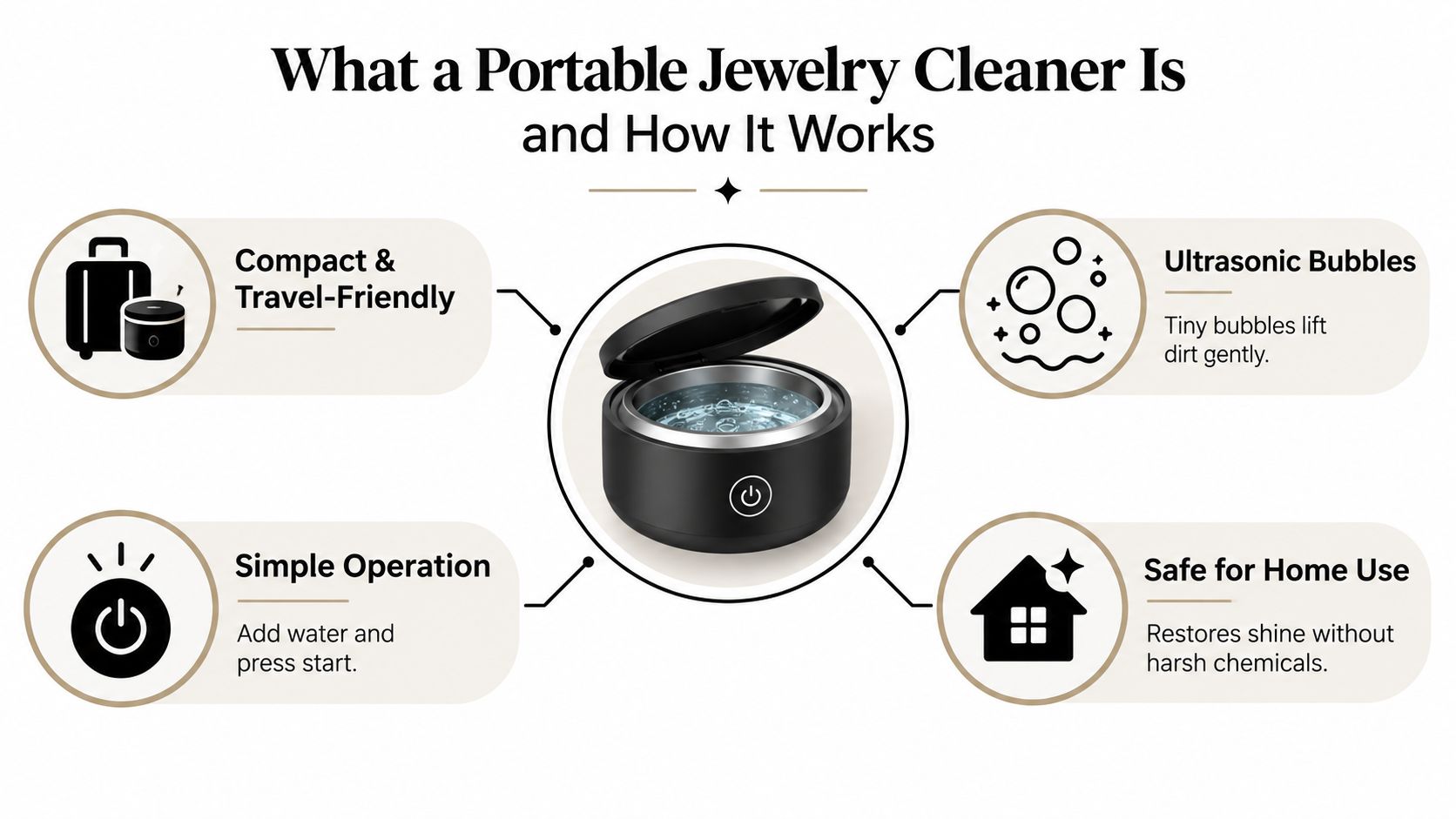
What a Portable Jewelry Cleaner Is and How It Works
A portable jewelry cleaner is a compact cleaning device built for small valuables and limited storage. Ultrasonic versions use a small tank filled with water or an appropriate cleaning solution. Sound energy moves through the liquid and forms microscopic bubbles. As those bubbles collapse, they create tiny bursts of movement that help dislodge grime from narrow spaces.
Think of the bubbles as a crowd of miniature scrub brushes. They can reach the underside of a ring or the spaces around a detailed setting without requiring you to push a brush into every crevice. The action doesn't mean the device is safe for everything. It means the liquid can move in places that are difficult to reach by hand.
Portable models belong to a recognized product category alongside benchtop, residential, and commercial units. The broader ultrasonic jewelry cleaner market was valued at $1.11 billion in 2025 and is projected to reach $2.05 billion by 2034, with a 6.8% CAGR over 2026 to 2034, according to Dataintelo's ultrasonic jewelry cleaner market overview. That forecast identifies portable units as a segment rather than treating portability as a minor accessory feature.
Why compact size matters
A small tank suits the objects people commonly clean at home. Rings, earrings, slim bracelets, watch components, and eyeglasses don't require the capacity of a commercial unit. A portable format can also make occasional maintenance easier in a guest bathroom, bedroom, or travel kit.
The trade-off is that a small device may offer less room for bulky necklaces or several pieces at once. Crowding can block the liquid's movement and make it harder to inspect each item. Portable doesn't automatically mean weak, and larger doesn't automatically mean better. The tank and settings should match your collection.
Ultrasonic action versus other methods
Steam cleaners use heated vapor directed through a nozzle. That can loosen oily residue quickly, but heat and pressure introduce their own concerns, especially around delicate construction. Mechanical or vibration cleaners rely on shaking, brushing, or another physical motion, making them more suitable for light surface upkeep than deep access into intricate settings.
For an accessible explanation of how cleaning solutions support sonic and ultrasonic equipment, Evo Dyne's ultrasonic cleaner guidance for jewelry is a helpful companion. The device supplies the movement, while the solution and jewelry materials determine whether the process is appropriate.
Comparing Portable Jewelry Cleaner Types
Three portable formats deserve separate consideration: ultrasonic, steam, and mechanical or vibration cleaners. They may all promise shine, but they create cleaning action in different ways. Matching the mechanism to the soil and the jewelry matters more than choosing the most forceful-looking device.
An ultrasonic cleaner is the strongest fit for grime tucked into hard-to-reach spaces on suitable jewelry. A diamond stud with lotion around the basket or a plain metal ring with buildup beneath the stone may benefit from liquid movement around those hidden areas. The same action can be unsuitable for a vulnerable gem, a weak setting, or a stone with a treatment.
Steam cleaners direct hot vapor at the piece. They can be fast for dissolving oily residue and refreshing durable jewelry, but the operator needs control over distance, pressure, and exposure. Heat and a concentrated jet aren't ideal defaults for mixed-material collections, and steam equipment may be less convenient when water, power, and safe handling are difficult during travel.
Mechanical cleaners use shaking, brushing, or gentle vibration. Their action is easier to understand because it resembles hand cleaning, though the device may provide more consistent movement. These cleaners can suit light daily polishing or surface dirt, particularly when you want to avoid a liquid tank. They won't necessarily reach every cavity as effectively as ultrasonic action.
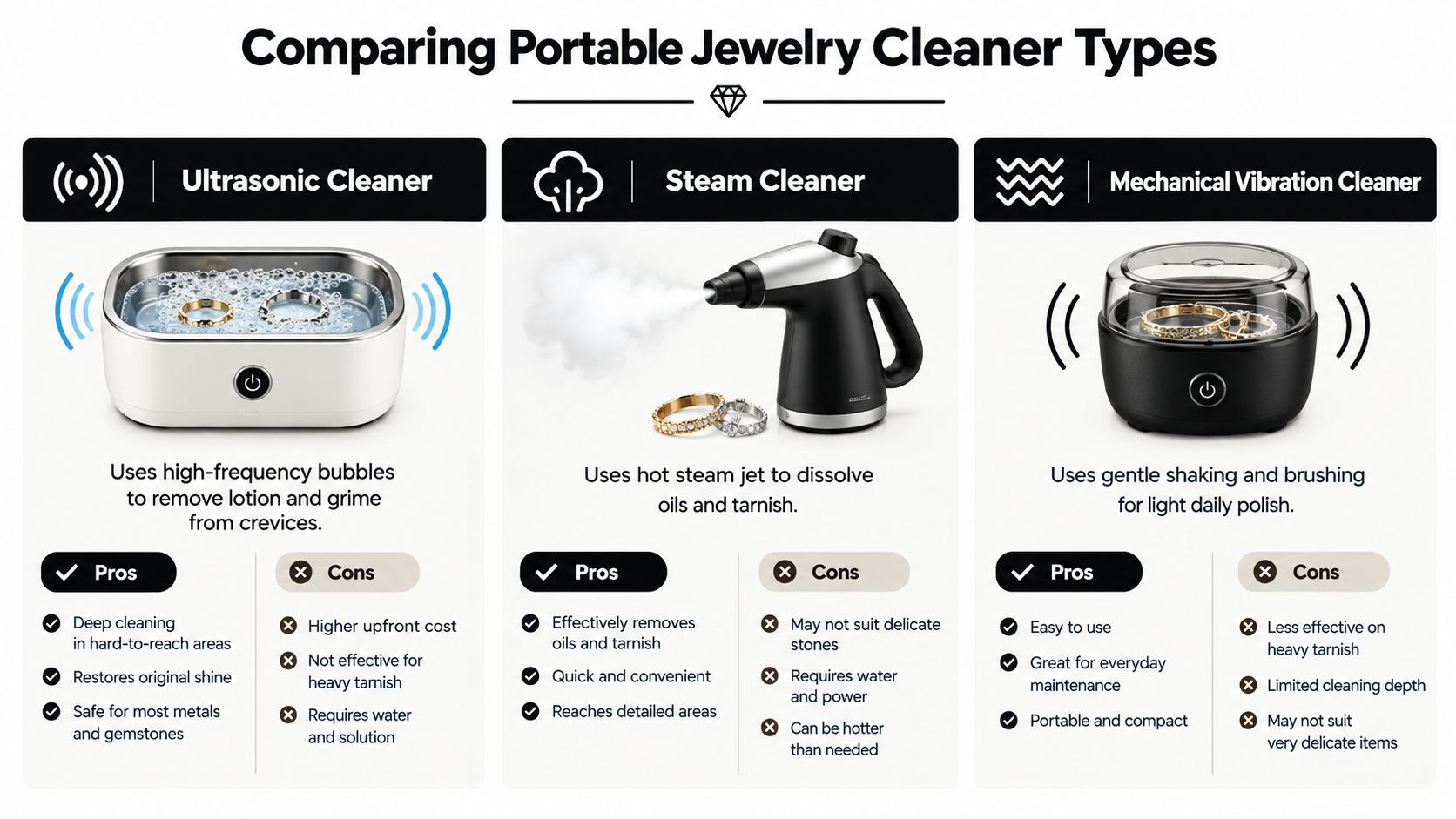
| Cleaner Type | How It Cleans | Best For | Watch Out For |
|---|---|---|---|
| Ultrasonic | Uses high-frequency sound waves to move bubbles through liquid | Suitable durable jewelry with grime in crevices | Pearls, opals, turquoise, emeralds, fracture-filled stones, glued settings, and compromised pieces |
| Steam | Sends a hot vapor jet across the surface | Durable pieces needing fast removal of oily residue | Heat, pressure, delicate construction, and vulnerable materials |
| Mechanical or vibration | Shakes or brushes the item to loosen surface buildup | Light maintenance and pieces that shouldn't enter a tank | Limited reach inside intricate settings and possible contact wear |
The differences become clearer with real objects. A secure diamond stud in a durable setting may suit ultrasonic cleaning, while a vintage brooch with an unknown adhesive should be assessed before any vibration, heat, or immersion. A wipe may be the sensible choice for a quick polish on a plain metal band during a trip.
A video demonstration can help you visualize how ultrasonic movement differs from hand cleaning. Use it as a starting point, not as proof that every piece shown is safe for your collection.
Key Features to Evaluate Before You Buy
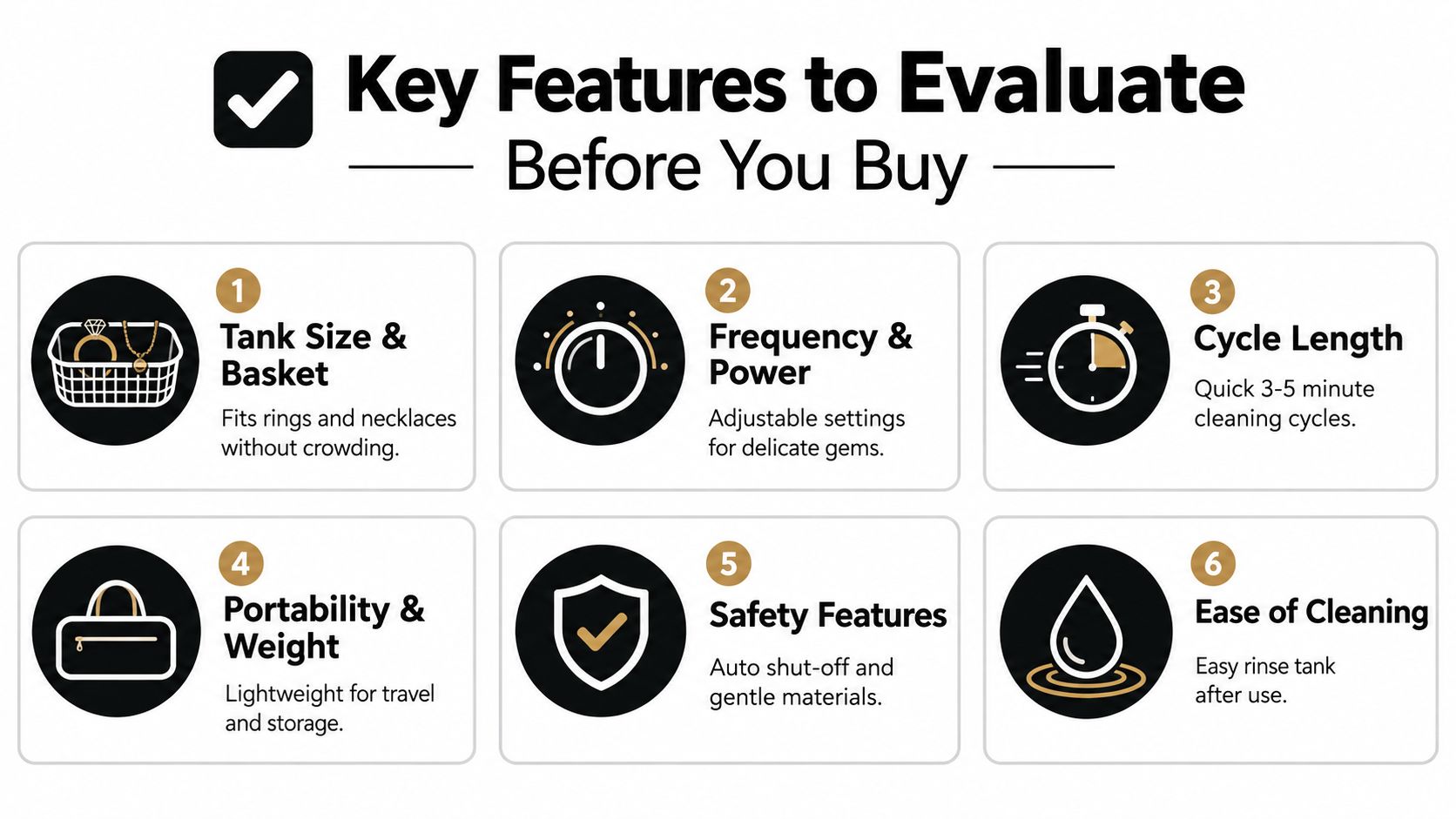
Your jewelry box should guide the purchase. List the pieces you wear often, note any porous or treated stones, and decide whether you need deeper home cleaning or quick upkeep while traveling. A cleaner suited to a sturdy diamond ring may be unsuitable for a collection that includes pearls, vintage jewelry, or pieces with unknown repairs.
Capacity and handling
Choose a tank that holds your usual pieces without crowding. A removable basket lets you lower and lift jewelry without reaching into the solution. Smooth edges, a secure lid, and enough space for rings or earrings to sit apart can reduce scratching and handling problems.
Necklaces need extra attention. Chains can knot, and a small tank may not let them spread out. If you clean longer necklaces regularly, measure the basket and opening before buying. The word “jewelry” does not guarantee that every shape will fit comfortably.
Frequency and intensity
More power is not automatically better. Higher-frequency ultrasonic designs, including models described in the 80 kHz to 120 kHz range, use smaller bubbles and can reach delicate crevices more gently, as discussed in guidance on ultrasonic jewelry safety. The suitable frequency still depends on the material, the piece's condition, and the manufacturer's instructions.
Adjustable settings are useful when one collection contains both durable and delicate items. Use a short, gentle cycle for light residue. A suitable piece with heavier buildup may need another setting, but do not keep extending the cycle because it still looks dull. Dullness may come from residue, tarnish, damage, or a material that should not enter the machine. For a quick trip touch-up, a jewelry wipe may be safer and more practical than carrying a cleaner, especially for items that should not be immersed.
Power and everyday practicality
Battery operation suits hotel rooms, dressing areas, and places without a convenient outlet. Plug-in models remove charging from the routine and may provide steadier operation. Compare the device's weight, lid security, water handling, noise, and storage footprint with your actual habits.
Use this checklist before buying:
- Basket design: Can you remove jewelry without touching hot or dirty water?
- Setting control: Is there a gentle option instead of only maximum intensity?
- Cycle control: Can you stop or shorten a cycle for light maintenance?
- Material guidance: Does the manual identify compatible stones, metals, and solutions?
- Cleaning access: Can you rinse and dry the tank easily after use?
- Travel fit: Will the device, cable or batteries, solution, and drying cloth fit your luggage?
A market forecast from Future Market Insights' market report describes growth in the ultrasonic jewelry cleaning machine market and portable units. Those forecasts describe the market, not whether a particular device matches your jewelry. Material compatibility, cycle control, and the difference between home cleaning and travel wipes should decide the purchase.
How to Use and Maintain Your Portable Jewelry Cleaner Safely
Safe cleaning starts before you add water. Separate the pieces you know are suitable from those with uncertain materials or construction. If you can't identify a stone, treatment, adhesive, or setting condition, pause and ask a qualified jeweler rather than testing it in the machine.
Step one is inspection
Hold each piece under good light. Check for loose stones, moving prongs, stretched links, open seams, damaged clasps, and signs that a stone is held with glue. An ultrasonic cycle can move dirt, but it can also expose a weakness that was already present.
Never place pearls, opals, turquoise, or emeralds in an ultrasonic cleaner as a casual experiment. Fracture-filled stones, glued settings, and organic materials also require special caution. A piece can look sturdy while containing a vulnerable treatment or construction detail that isn't obvious from the front.
Step two is solution and loading
Use the solution specified by the cleaner's manufacturer and choose a fragrance-free, jewelry-appropriate formula. A solution with a chelating action can help bind and lift certain residues, but compatibility still comes first. Don't improvise with bleach, chlorine, acetone, abrasive powders, or household products that may attack the metal or leave a film.
Fill the tank to its marked level. Place jewelry in the basket with enough space for liquid to circulate. Keep chains from forming tight knots, and don't stack stones or metal parts against one another.
Step three is a cautious cycle
Select the gentlest suitable setting and the shortest cycle that addresses the buildup. Follow the device instructions rather than copying a cycle from another model. If the jewelry remains dull, stop and inspect the cause instead of repeatedly increasing intensity.
Before pressing start: A secure setting and a compatible material matter more than a dramatic cleaning setting.
When the cycle ends, lift the basket carefully. Rinse the jewelry with clean water over a secured drain or inside a bowl, then pat it dry with a lint-free cloth. A soft brush can help with residue on suitable pieces, but don't scrub across fragile stones or force bristles under a loose prong.
Step four is tank care
Empty the solution after use unless the manufacturer explicitly says it can be stored. Rinse the tank and basket to remove suspended grime, then dry both before storage. Wipe the exterior, keep the lid clean, and store the device where it won't be knocked onto the floor.
Keep a simple record of pieces that require hand cleaning or professional inspection. That prevents a family member from treating every item as ultrasonic-safe just because one ring cleaned well.
Troubleshooting Common Issues and Travel Versus Wipes Decisions
You run a cycle before dinner, yet the ring still looks dull. That result does not automatically mean the portable jewelry cleaner is faulty. The tank may be crowded, the solution may be unsuitable, the cycle may not match the residue, or tarnish and worn metal may need a different treatment. Remove the piece, rinse it, and inspect it under direct light before changing settings.
If the machine seems weak, check the water level, basket position, lid, power source, and manual. Surface bubbles alone do not show that cleaning is effective. A crowded tank restricts circulation, while a damaged setting or worn finish cannot be restored by liquid movement.
A quick diagnostic
- Residue remains in crevices: Recheck how the piece sits in the basket. Use a soft brush only when the material and setting permit it.
- The surface looks cloudy: Rinse away solution residue and dry with a lint-free cloth before increasing intensity.
- The machine sounds unusual: Stop the cycle. Check the water level, basket, lid, and power supply.
- A stone moves: Stop using the device and ask a jeweler to assess the setting. Repair now matters more than cleaning.
- Tarnish persists: The metal may need a compatible polishing method rather than ultrasonic action.
Material changes the decision. A label that says “safe for jewelry” may still exclude pearls, opals, turquoise, emeralds, fracture-filled stones, glued settings, and organic materials. The guidance in Gilded Cricket on ultrasonic cleaner safety explains why these exceptions matter. For a mixed-material piece, follow the needs of its most vulnerable component, not its hardest stone.
Choosing a travel method
A portable device suits periodic deeper cleaning when you have water and power and already know the jewelry is compatible. It is less practical for a short commute, a quick pre-dinner touch-up, or travel with limited space for solution, cloths, and drying supplies.
Wipes and pre-treated polishing cloths fit light surface maintenance. Research and Markets identifies them as the fastest-growing unit-volume segment, reflecting interest in simple, on-the-go care, as reported in Research and Markets' jewelry cleaner market coverage. For more ways to make jewelry sparkle again, match the tool to the residue and the material. More power is not automatically better. Frequency and cycle length should follow the jewelry, especially when delicate components are present.
Choosing With Confidence and Keeping Jewelry Sparkling
A confident choice follows a simple order. Identify the materials first, choose the cleaning mechanism second, evaluate the tank and settings third, and plan how you'll use the device at home or away. Don't buy maximum intensity for a collection that needs gentle handling.
For suitable durable pieces, an ultrasonic portable jewelry cleaner can reach grime that a cloth misses. Steam can provide fast surface action, while mechanical cleaners and wipes suit lighter maintenance. Pearls, opals, turquoise, emeralds, fracture-filled stones, glued settings, and uncertain vintage pieces belong in a separate care plan.
Keep the routine simple:
- Inspect the jewelry before cleaning.
- Use a compatible, fragrance-free solution.
- Load the basket without crowding.
- Select a gentle, appropriate cycle.
- Rinse, dry, and inspect again.
- Clean the tank and store it dry.
A portable device isn't automatically better than a wipe. It earns its place when it solves a recurring cleaning problem without putting your materials at risk. Consistent, careful maintenance keeps jewelry brighter and helps you notice damage before a treasured piece becomes an emergency repair.
Evo Dyne Products offers ultrasonic jewelry cleaner solutions for use with sonic and ultrasonic machines, including a concentrated two-pack intended for jewelry care. Visit Evo Dyne Products to explore a solution that fits your portable cleaner and build a practical routine for keeping suitable jewelry bright at home or while traveling.