


You wore your pearl necklace to dinner, with lotion on your neck and perfume in the air. The next morning, the strand looks less luminous, and the jar you use for your diamond ring seems like an easy fix. Leave that jar closed until you have checked what can safely touch the pearls, their silk thread, and their settings.
The safest pearl jewelry cleaner is a very soft, clean cloth, with mild dish soap diluted in lukewarm water only when a surface film remains. Pearls mark and dull far more easily than the gold, silver, or diamonds sharing the same jewelry box, so reaching for a stronger cleaner is the wrong goal. Ultrasonic solutions, dips, and polishes belong to metal care. And cleaning is only half the job: how a strand dries, how its silk holds up, and when it needs restringing decide whether it keeps its glow or its shape.
Table of Contents
- Safe Pearl Jewelry Cleaner Options at a Glance
- How to Clean Pearls by Hand
- Why Ultrasonic Cleaners Are Unsafe for Pearls
- Drying Storage and Restringing That Protect the Strand
- Pearl Cleaning Mistakes and How to Fix Them
- Clean the Metal and Leave the Pearl Alone
Safe Pearl Jewelry Cleaner Options at a Glance
A pearl's glow comes from nacre, its layered, iridescent surface. Cleaning should remove what's sitting on that surface without rubbing away or chemically damaging the surface itself.
The Gemological Institute of America's pearl care guidance places pearl hardness at approximately 2.5 on the Mohs scale, recommends a very soft cloth after wearing, and allows warm, soapy water for occasional cleaning. It also warns against polishing because polishing compounds can abrade and discolor nacre.
Hardness describes resistance to scratching, not how securely a pearl is mounted. That distinction matters: a firmly set pearl can still be scratched by grit on a cloth or damaged by a cleaner suitable for the surrounding metal.
Pearl Jewelry Cleaner Methods and Stop Rules
| Method | Safe for pearls | How to use it | Main risk |
|---|---|---|---|
| Soft clean cloth after each wear | Yes | Wipe gently without added product | Grit on a dirty cloth can scratch |
| Mild dish soap in lukewarm water | Yes, occasional | Use a weak dilution on a damp cloth; don't soak silk | Water left in the string |
| Toothpaste, baking soda, or silver polish | No | Don't use | Abrasion and dulling of nacre |
| Ultrasonic cleaner, any cycle length | No | Keep the entire pearl piece out | Damage to nacre and vulnerable drilled areas |
| Steam cleaner | No | Don't use | Heat and forced moisture |
| Ammonia, alcohol, vinegar, bleach, or silver dip | No | Keep off the pearl | Chemical damage to the surface |
| Commercial jewelry concentrate for diamonds and gold | No, unless the label explicitly permits pearl use and a spot test passes | Otherwise keep solution off the pearl | Chemistry intended for other materials |
| Jeweler for peeling, cracks, or a tired strand | Yes | Request inspection and appropriate repair or restringing, not polishing | Home polishing can worsen nacre loss |
Choose by Material, Not Cleaning Strength
A bottle described as gentle still needs a material-specific check. Fragrance-free doesn't automatically mean pearl-safe, and a formula that removes oil or light tarnish from metal isn't necessarily suitable for nacre.
For a closer look at that distinction, our guide to gentle jewelry cleaner helps frame the choice around the jewelry's materials rather than the promise of maximum cleaning power. Avoid using a jewelry cleaner on pearls, opals, and soft or porous stones unless tested first. Even then, a hidden-spot test isn't permission to ignore an exclusion on the label.
Practical rule: Choose the least aggressive method that removes the film. If a clean cloth does the job, stop there.
A diamond-halo pearl earring isn't a diamond-only piece. Its pearl, mounting, and possible adhesive all need consideration. Pick the safe method for the most delicate component rather than the strongest method the hardest gemstone could tolerate.
How to Clean Pearls by Hand
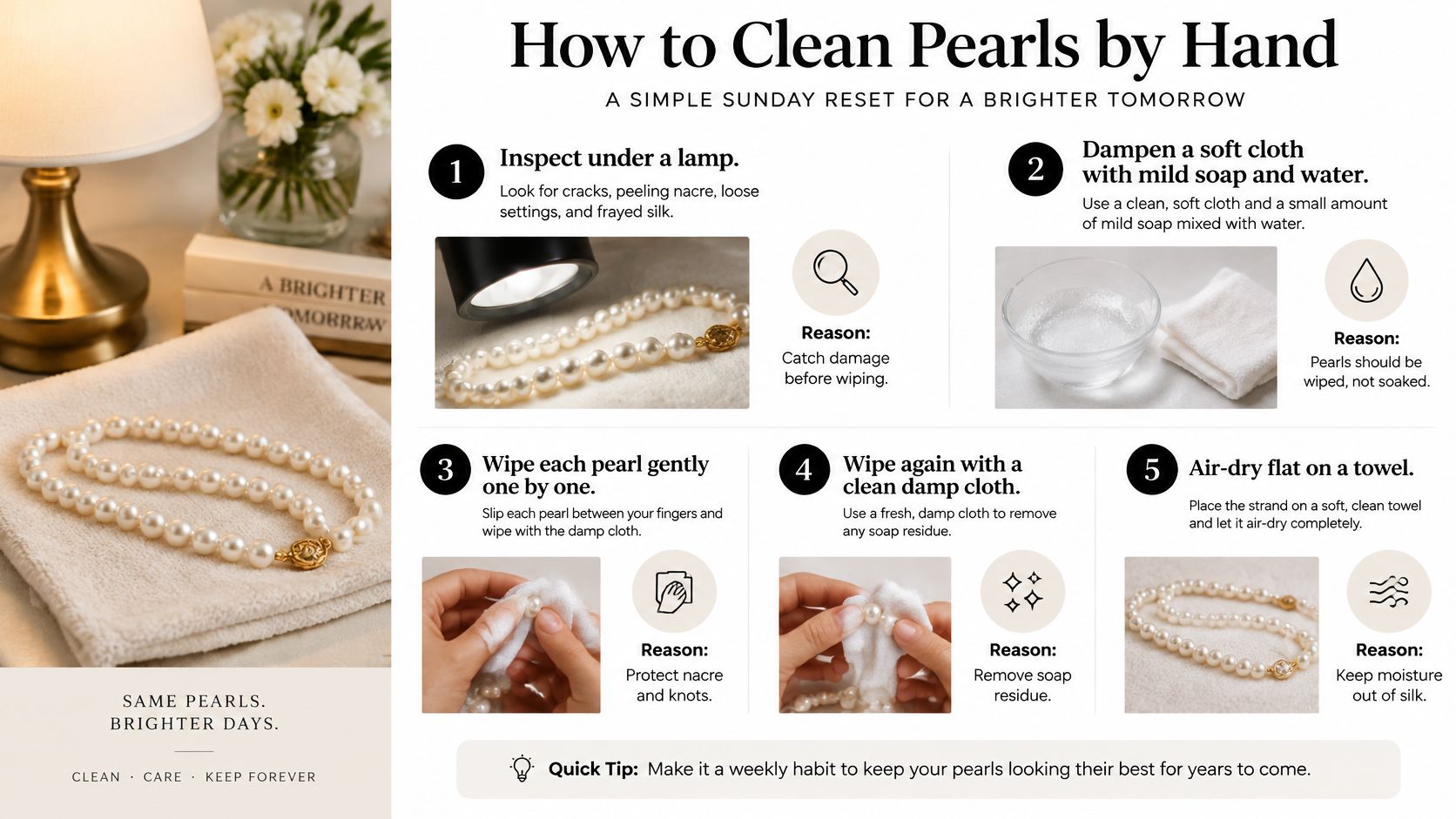
A Sunday reset for a necklace you've worn throughout the week should happen on a towel, not at the bottom of a bowl. Set out a lamp, clean soft cotton or microfiber cloths, a shallow container for mixing water, and a dry towel.
Use plain, untreated cloths, not polishing cloths impregnated with metal-cleaning compounds. Keep a separate cloth for pearls so you don't accidentally transfer silver polish or abrasive residue.
Inspect Before Adding Moisture
- Look under a lamp. Turn the piece gently to check for lifting nacre, cracks, loose settings, frayed silk, and knots that have pulled away from the pearls. If a surface is flaking or a setting moves, set the piece aside for a jeweler instead of cleaning around the problem.
- Spread the towel over a stable table, away from an open sink. Support the whole necklace rather than letting part of it hang over the edge. A soft work surface prevents rolling and keeps you from pulling on the string while handling individual pearls.
- Start dry. Wipe each pearl with a clean section of cloth using light pressure. Don't pinch the strand tightly or drag it through a folded cloth, which can load the thread and pull at the knots.
A dry wipe may be enough. If the pearls look clear and feel free of a slick coating, there's no reason to add soap.
Remove Film Without Bathing the Strand
- Mix a weak solution of mild, fragrance-free dish soap and lukewarm water. Choose a plain formula without abrasive particles, bleach, or added acidic cleaning ingredients. The water should feel comfortably warm, not hot, and the mixture shouldn't leave your fingers heavily coated with detergent.
- Dampen the cloth, not the necklace. Wring it out thoroughly, then support a pearl on the towel while wiping its exposed surface. Rotate gently to reach the other side, keeping the knots as dry as practical.
- Use a separate cloth dampened with plain water to remove the soap. Work carefully around clasps and settings without flooding crevices. Leaving detergent behind can create another dull film and encourage you to clean again unnecessarily.
- Pat and lay flat. Blot visible moisture with a dry cloth, then leave the piece supported on the towel to air-dry. Don't put it on while the thread is damp, and don't close it inside a pouch yet.
Treat studs and rings with the same restraint. A pearl attached to a post may have an adhesive joint or a small recess where water can collect, so wiping is a better home default than rinsing under a tap.
Freshwater, Akoya, and South Sea pearls all need this gentle approach. If pearls are dyed, coated, vintage, or of uncertain treatment, don't experiment with stronger soap or repeated wet cleaning. Ask a pearl-experienced jeweler to assess anything that doesn't respond to a light wipe.
Finished means clean, not newly polished: the surface has an even glow, there's no slippery residue, and the thread and knots are fully dry. A naturally uneven surface doesn't need to be scrubbed smooth.
Why Ultrasonic Cleaners Are Unsafe for Pearls
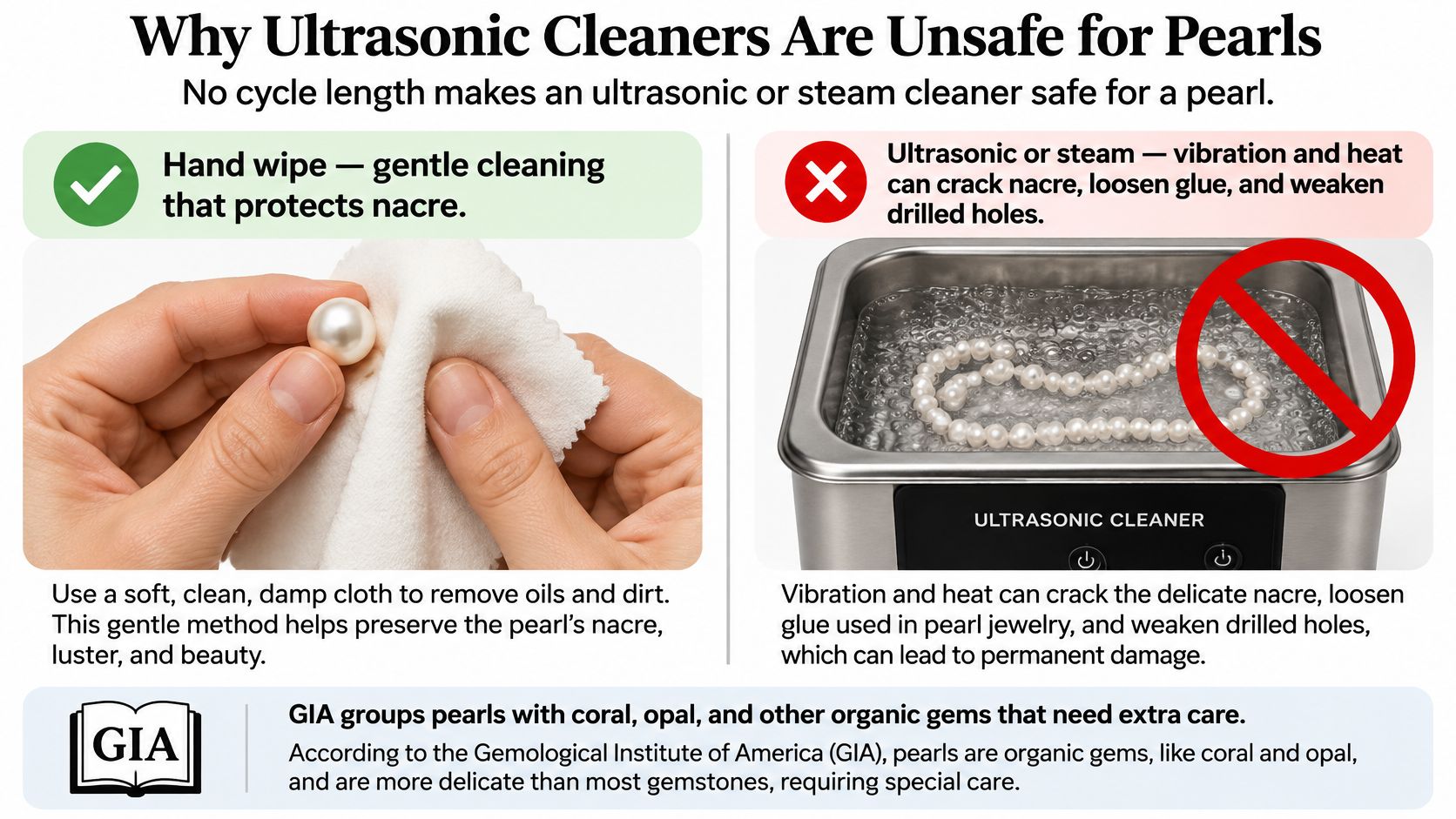
No cycle length makes an ultrasonic cleaner safe for pearl jewelry. A shorter run, plain water, or a delicate setting doesn't change the basic mismatch between the equipment and the material.
The Gemological Institute of America's jewelry care guidance lists pearls with organic materials such as coral, ivory, and amber that shouldn't go into ultrasonic cleaners. It also warns against steam cleaning pearls and exposure to harsh chemicals, including perfume and hairspray.
Why the Machine Is the Problem
An ultrasonic cleaner uses sound energy to create tiny bubbles in liquid. As those bubbles collapse, they dislodge dirt from jewelry surfaces and recesses. That action can be useful for compatible jewelry, but it isn't a gentle cloth wipe translated into a machine.
A pearl has layered nacre, and its drilled areas or existing surface defects can be particularly vulnerable. Aggressive cleaning can worsen damage rather than merely lift dirt. You can't reliably judge that vulnerability by looking at a glossy pearl before the cycle.
Steam creates a different problem. It applies heat and pressurized moisture, neither of which belongs in a home pearl-cleaning routine. A pearl setting may also include adhesive, so the safety question extends beyond the visible nacre.
Cultured pearls aren't imitation pearls with a washable artificial finish. They're pearls formed with human intervention, and their organic, layered structure still requires careful handling. Natural versus cultured doesn't create an exception to the machine-cleaning rule.
A clean-looking result immediately after a cycle isn't proof that the method was safe.
If the Pearls Have Already Been Through a Cycle
Stop the machine and lift the piece out without tugging on the strand. Blot it gently, support it flat, and let it dry before further handling.
- Examine the surface. Look for newly dull patches, flaking, or changes around drilled holes. Don't rub a suspect patch to see whether it comes off.
- Check attachments gently. If a stud pearl appears loose on its post, stop handling it. Don't twist the pearl to test the adhesive.
- Keep the piece aside. Ask a jeweler to inspect any change before wearing it again, especially if the thread or mounting looks compromised.
Don't put the jewelry back through the machine to remove a chalky appearance. Repeating the process can worsen the problem, and polishing isn't a way to rebuild nacre.
Taping over pearls doesn't make mixed jewelry machine-safe either. Liquid can reach underneath, and tape doesn't isolate the pearl from the cleaning action. A pearl-and-diamond earring remains a hand-cleaning or professional-care job.
Drying Storage and Restringing That Protect the Strand
A necklace can look ready to wear while its string still holds moisture. Drying the pearls and drying the strand aren't the same task. Silk passes through drill holes and forms knots where dampness can be harder to notice.
Fink's fine-jewelry care guide emphasizes the broader care routine, including gentle cleaning, protection from chemical exposure, separate storage, and attention to worn string. The thread deserves inspection even when every pearl still looks beautiful.
Let the Thread Dry Without Tension
Leave the necklace flat on a clean, absorbent towel with the strand arranged loosely. If the towel becomes damp, move the piece carefully to a dry area without lifting it by an end.
Don't hang a damp necklace from its clasp. The weight of the pearls places tension on the thread, and hanging isn't needed for drying. Keep the piece away from direct sun, radiators, and hairdryers rather than trying to rush the process.
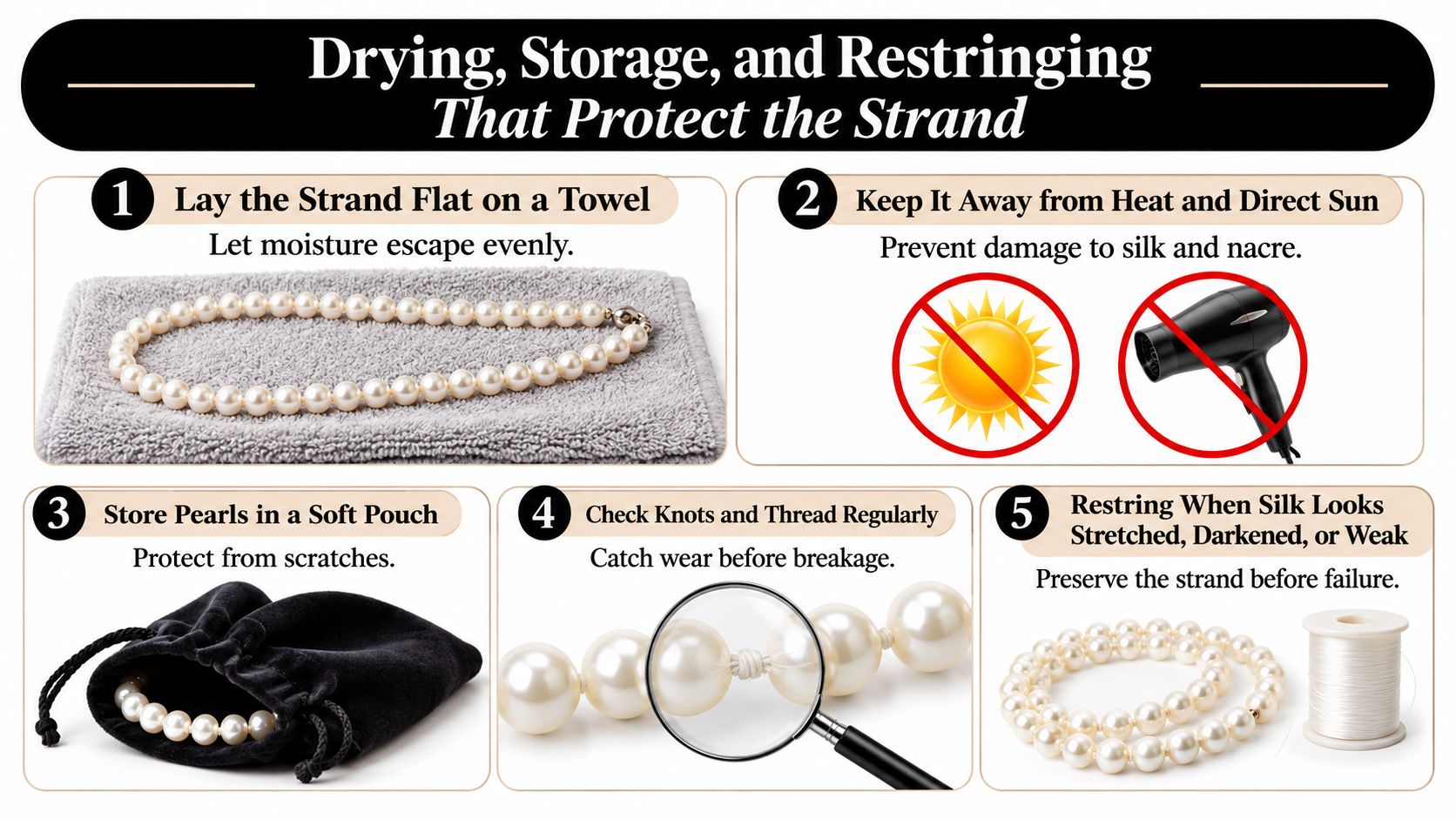
Check the knots and the areas near the clasp before storage. If you're unsure whether the thread is dry, leave it out longer in a protected place. There isn't a dependable universal drying time for every strand and room.
Restring According to Condition and Wear
Don't wait for a break to decide that the silk needs attention. Frequent wear, perspiration, repeated wetting, and handling all make condition checks more important.
- Darkened or gray thread: Ask whether the silk needs replacement rather than trying to bleach it clean.
- Loose knots or growing gaps: Have a jeweler assess stretching and the security of the strand.
- Fraying near the clasp: Stop wearing the necklace until the vulnerable area is inspected.
- A snagging or unreliable clasp: Request a clasp check as part of the same appointment.
A wear-based maintenance plan is more useful than assuming a calendar guarantees safety. Tell the jeweler how often you wear the necklace and whether it has been soaked or exposed to heavy perspiration. Ask for a restringing recommendation based on the actual thread and construction.
Give Dry Pearls Their Own Space
Store the piece in a soft pouch or dedicated fabric-lined compartment, separate from harder gemstones and metal edges. Lay a long strand flat or loosely coiled rather than stretching it around tight corners or hanging it under its own weight.
Avoid hot, very dry storage and places where bathroom sprays can settle on the jewelry. Remove pearls before swimming, showering, or exercise that leaves them wet with perspiration.
Daily habit: Put pearls on after cosmetics and sprays have dried, and take them off before washing or changing clothes.
Use a soapy wipe because you can see persistent film, not because the calendar says it's cleaning day. If you notice peeling during your routine check, set the piece aside for assessment rather than adding another cleaning treatment.
Pearl Cleaning Mistakes and How to Fix Them
You tried to brighten a dull necklace, and now something looks different. Before reaching for another product, separate removable residue from possible surface or structural damage.
An even haze on otherwise smooth pearls may be lotion or soap. A rough, chalky patch after chemical exposure is a different concern. Neither appearance should trigger a stronger cleaner, and an at-home visual check can't establish the cause with certainty.
Match the Symptom to the Next Action
| What you see | Likely cause | Can it be undone | What to do |
|---|---|---|---|
| Even dull film, pearls still smooth | Lotion, soap, or skin oils | Usually, if it's surface residue | Use a soft cloth, then a mild soapy wipe if needed |
| Sharp perfume or spray smell on the strand | Fragrance contact | Residue may lift; surface damage may not | Blot promptly with a clean cloth; don't add alcohol |
| Gray, stiff, or stretching silk | Moisture, perspiration, or accumulated wear | The thread may need replacement even if the pearls are sound | Dry flat; arrange restringing if weakness remains |
| Chalky white patches | Possible chemical or machine damage | Lost nacre can't be restored by cleaning | Stop cleaning and ask a jeweler; don't polish |
| Flaking or a crack at the hole | Nacre failure or damage near drilling | Not with a home cleaner | Stop wear that pulls on the strand; seek assessment |
| Yellow beads but white knots | Pearl color change, treatment change, or residue | Not always; identify the cause first | Don't use peroxide; keep care gentle |
| Snarled knotted strand | Tangling during handling or storage | Often, if the thread and nacre are intact | Ease loops apart on a towel without pulling |
Film Isn't a Reason to Polish
Say your necklace looks hazy after a day of sunscreen and foundation. Try the gentle cloth method and inspect the result under the same light. If the coating lifts and the surface looks even, stop.
If it doesn't lift, don't assume more pressure will help. Repeated rubbing can turn an uncertain cosmetic problem into a scratch problem. Leave persistent marks for a jeweler to identify, especially on treated or inherited pearls.
Perfume contact calls for prompt, gentle removal, not a second solvent. Blot rather than scrub, and use a lightly water-dampened cloth if residue remains. Adding alcohol to remove fragrance exposes the pearl to another unsuitable substance.
Don't Try to Rescue Thread With Chemicals
A soaked necklace may still glow while its silk looks worse. Drying flat is the immediate response, but it doesn't reverse stretching, fraying, or established weakness.
Bleach won't make damaged thread safe. Nor should you try to disguise dark silk with a whitening product. Restringing replaces the worn structural part instead of trying to make it appear sound.
For tangles, place the whole strand on a towel and gently open the loose loops. Don't insert a sharp pin beside the pearls or pull opposing ends tight. If a knot won't release without force, stop.
Residue may be removable; missing nacre isn't. A jeweler may be able to replace a damaged pearl or repair a mounting, but that's repair work, not the result of a better pearl jewelry cleaner.
Clean the Metal and Leave the Pearl Alone
The dirtiest part of a pearl earring may be its post, not its pearl. A necklace may have a tarnished clasp while the beads are already clean. Treating the whole piece with the metal's cleaner creates unnecessary exposure.
First identify exactly what needs attention. Look at the pearl, exposed metal, setting recesses, and any adhesive joint separately. If you can't reach the dirty area without wetting the pearl, professional cleaning is the more controlled option.
Separate the Cleaning Jobs
For an example of mixed-material construction, you can find pearl accented silver studs from Kilts4Less and consider how close the silver sits to the pearl. That proximity is the practical issue: a silver-care method must not spread onto the nacre.
A jewelry cleaner made for diamonds and gold belongs only on compatible hard materials, in a small amount, kept off pearls, opals, and other soft stones. Gold-care instructions don't automatically apply to a pearl mounted in gold.
Our guide to cleaning gold jewelry can help with separate gold pieces. For an assembled pearl piece, don't dip the mounting or let solution run toward the pearl while trying to clean an exposed metal edge.
- Removable earring backs: Clean them separately using a method appropriate to their material, then dry them before reassembly.
- Accessible metal surfaces: Use controlled manual cleaning only where you can keep the pearl completely free of incompatible solution.
- Tight halos and hidden recesses: Leave them to a jeweler if safe access isn't clear.
Use Tools Only Where They Belong
Our Jewelry Cleaner is a professional-strength concentrate for restoring diamond, gold, silver, and compatible gemstone sparkle. It can be applied manually with a soft brush when an ultrasonic machine isn't used, but avoid using it on pearls, opals, and soft or porous stones unless tested first.
For separate, compatible non-pearl jewelry, soft bristles or a clean old toothbrush provide a manual option. An ultrasonic machine isn't required, and it shouldn't become the default for every hard-looking piece: treatments, loose stones, and construction still matter.
For the pearl piece in front of you, make a concrete decision. If it has removable surface film and sound construction, clean gently by hand. If the metal needs chemistry you can't isolate, or the pearl or string has changed, set it aside for professional care.
Return it to its pouch only when it's completely dry. The useful sequence is wipe, dry, inspect, not clean until every sign of age disappears.
Evo Dyne Products offers jewelry-care solutions for compatible diamond, gold, silver, and gemstone pieces, including concentrate that can be used with a soft brush or suitable ultrasonic equipment. Visit Evo Dyne Products to explore care options for your non-pearl jewelry, while keeping your pearls on a gentle cloth-and-water routine.
