

The advice you'll hear most often about jewelry cleaner ingredients is to buy the strongest formula you can find, or to trust any bottle that promises it's safe for gold. Both shortcuts fail for the same reason. Strength measures how aggressively a formula attacks soil, and a claim about gold covers the metal, not the rest of the piece.
The thin rhodium plating on a white gold chain, the epoxy holding a pearl onto a post, the solder at a clasp, the fracture-filled stone in a ring: each is a separate material, and each reacts to chemistry differently. A cleaner that's right for a solid gold band with a diamond is the wrong choice for a plated bracelet with a glued charm, even though both get sold as gold jewelry.
The useful question isn't how strong a cleaner is. It's which ingredient families are inside, what job each one does, and which part of this specific piece is least able to withstand them. Work through that and the buying decision gets much simpler.
Table of Contents
- Common Jewelry Cleaner Ingredients at a Glance
- How Cavitation and Water-Based Chemistry Clean Jewelry
- Matching Ingredients to Metals, Stones and Assemblies
- Common Home Ingredients People Ask About
- Why More Cleaner Does Not Mean Cleaner Jewelry
- Choose a Jewelry Cleaner by Checking Its Ingredients
Common Jewelry Cleaner Ingredients at a Glance
Almost every jewelry cleaner sold for home use is a water-based blend. Water does two jobs: it carries the chemistry and, in an ultrasonic machine, it carries the acoustic energy. The chemistry itself is a small set of ingredient families, and each one handles a single task.
| Ingredient family | Job in the formula | Common examples | Main risk |
|---|---|---|---|
| Surfactants | Lower surface tension so liquid reaches crevices and settings | Dish soap, nonionic detergents | Residue film if not rinsed |
| Chelating agents | Bind mineral and metal ions that cause dullness | EDTA-type and citrate-type chelators | Low risk alone; check plating when combined with other families |
| Alkaline builders | Help break down lotion, oil and fatty soil | Sodium carbonate, borate salts | Dull soft stones and etch some coatings |
| Ammonia | Dissolves grease and light tarnish quickly | Household ammonia solutions | Harms pearls, opals and porous stones |
| Mild acids | Dissolve mineral deposits and scale | Citric acid | Dull or etch some alloys with repeated use |
| Strong acids | Remove heavy scale and deposits | Hydrochloric acid in professional cleaners | Attack copper in alloys and raise hydrogen embrittlement risk |
| Alcohols | Dissolve oils and speed drying | Isopropyl alcohol | Loosen glue and soften some adhesives |
| Abrasives | Lift tarnish mechanically | Baking soda, polishing compounds | Scratch soft stones and polished metal |
Read the table from top to bottom and a pattern appears. The first three families do the everyday work on ordinary soil, and their risks are mostly about technique. The next four solve specific problems and carry specific risks, some of them permanent. A formula loaded with harsh ingredients isn't a more powerful version of a gentle one. It's a different set of trade-offs, and the piece pays for them.
Practical rule: if a label leads with a strong family such as ammonia, hydrochloric acid or alcohol, check that family against your piece's least sturdy component before the bottle touches the jewelry.
A long ingredient list on the front of a bottle is a warning worth reading carefully, not a measure of cleaning power.
How Cavitation and Water-Based Chemistry Clean Jewelry
Think about washing a greasy roasting pan. Detergent loosens the grease and warm water carries it away, and neither does the job alone. An ultrasonic cleaner adds a third force on top of that partnership.
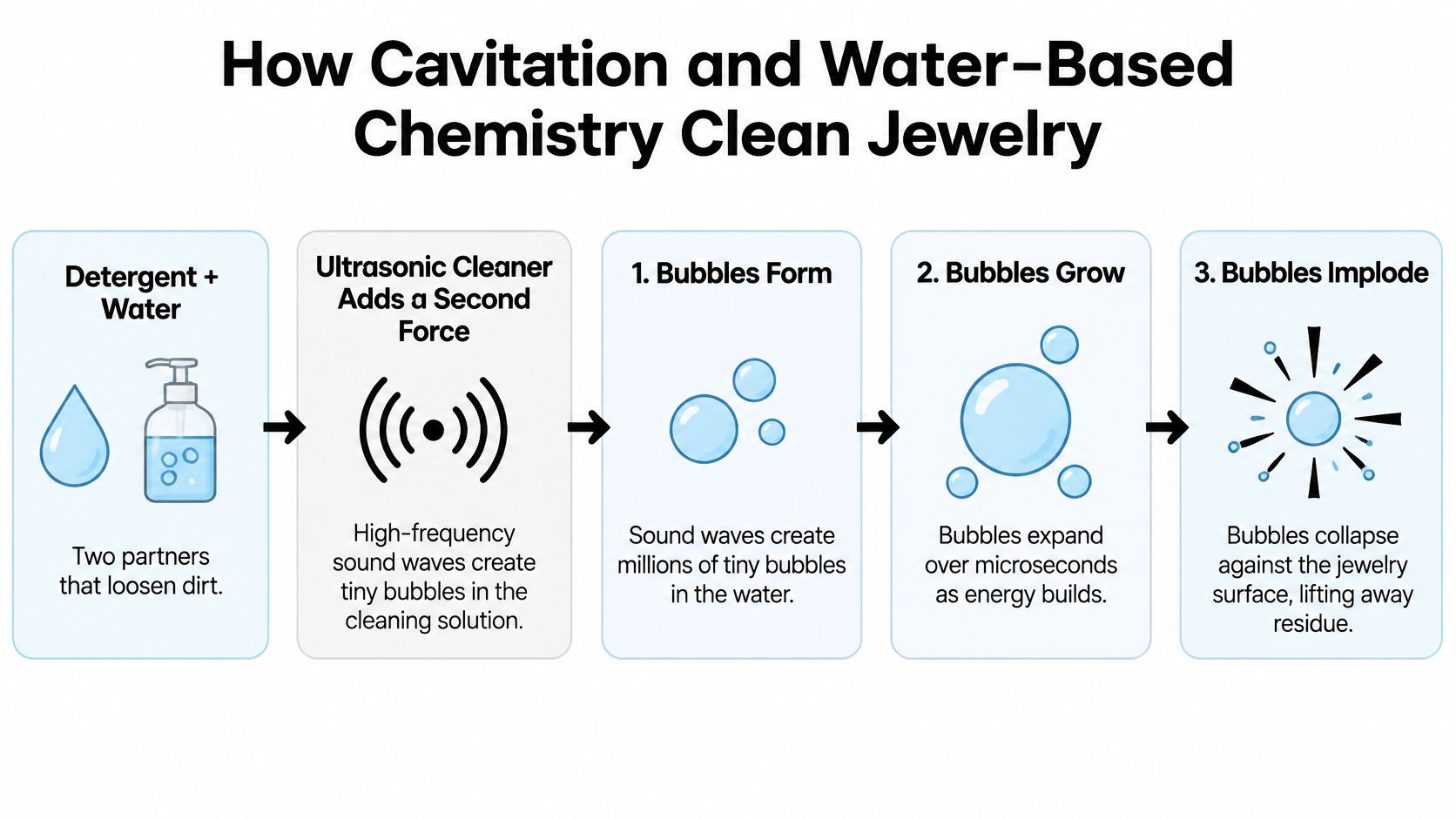
That third force is acoustic cavitation: bubbles form in the liquid, grow, and collapse implosively, and each collapse throws localized liquid jets and shock effects against the metal, lifting oils, polishing compounds and dust out of crevices. Academic reviews of the mechanism place jewelry and metal-cleaning tanks in the 20 to 100 kHz range, with higher frequencies up into the megahertz range reserved for lifting much smaller particles from delicate surfaces such as semiconductor wafers (the sonochemistry review hosted by the University of Illinois).
Scale makes the mechanism worth respecting. Cleaning literature describes practical ultrasonic tanks running from about 20 kHz to 400 kHz, with millions of bubbles roughly 1 to 100 micrometers wide working on the piece (a review of ultrasonic cleaning chemistry published through ScienceDirect). Bubbles that small still carry enough energy to erode a coating when conditions turn aggressive, and high-intensity cavitation is exactly where plated and coated surfaces get into trouble.
What each family does inside the bubble field
Surfactants lower the surface tension of the water so it wets the metal and slips into the gap under a prong. Builders and solvents dissolve or suspend soil so it doesn't settle back onto the piece the moment the machine stops. Chelating agents hold metal ions in solution, which is why a chelator-based soak leaves a mirror finish instead of a dried mineral film.
The same liquid behaves differently against different soils, which is where ingredients meet real life. A ring coated in hand lotion responds to a warm surfactant solution and a couple of minutes of cavitation. A ring packed with leftover polishing compound needs a builder in the mix and a short cycle, because the compound is abrasive grit rather than oil.
The industry learned this the hard way. Early ultrasonic tanks relied on chlorinated solvents such as perchloroethylene, trichloroethylene, 1,1,1-trichloroethane and carbon tetrachloride, chosen because they dissolved grease and transmitted sound energy efficiently. Their environmental and health problems pushed formulators toward water-based, purpose-built cleaners wherever performance allows, which is the shift that produced the concentrates on shelves today.
Cavitation and chemistry are only as gentle as the most fragile component of a piece. That single idea drives every decision that follows.
Matching Ingredients to Metals, Stones and Assemblies
Work the same four steps for every piece and the guesswork disappears.
- Read the stamp. 14K, 18K, 925 and PT950 tell you the base metal before anything else matters.
- Inventory the stones. Any pearl, opal, turquoise, emerald or fracture-filled stone changes the plan completely.
- Find the matching row in the table below.
- Choose the gentlest family that still does the job.
| Material or piece | Usually suitable | Avoid |
|---|---|---|
| Solid karat gold | Mild surfactant, chelator, warm water | Strong acids in long soaks |
| Sterling silver | Chelator-based, low-alkaline cleaner | Abrasive pastes; prolonged alkaline soaks |
| Platinum | Mild surfactant, chelator | Abrasives that scratch the surface |
| Diamonds | Mild surfactant, chelator, short cycles | Ultrasonic cycles on fracture-filled stones |
| Emeralds and included stones | Mild soap and water, soft brush | Ultrasonic, ammonia, strong acids |
| Pearls, opals and porous stones | Plain water and a soft cloth | Ammonia, alkaline cleaners, acids, alcohol, ultrasonic |
| Gold-filled and plated pieces | Mild surfactant, short soak | Acids, ammonia, abrasives, long ultrasonic cycles |
| Soldered or glued settings | Mild surfactant, short soak | Alcohol, strong solvents, ultrasonic |
The top rows are where most jewelry lives. Solid karat gold handles mild surfactants, chelators and warm water without complaint, but a long acid soak buys you nothing and costs you surface. Sterling silver likes a chelator-based, low-alkaline cleaner and hates abrasive pastes, which scratch the very surface you're trying to brighten. Platinum is chemically stubborn and physically soft, so abrasives mark it.
Why a gold-safe label stops short
The rows that surprise people are the bottom two. Gold-filled and plated pieces carry a coating measured in microns, and aggressive alkaline or acidic chemistry can strip it. Soldered and glued settings fail at their joints, where acid attacks solder and alcohol softens adhesive until a stone works loose.
Chemical compatibility has to be checked against the item and the cleaning container together, and a claim of being safe for gold doesn't automatically cover the whole assembly (an independent technical presentation on cleaning compatibility). Hydrochloric acid is the clearest example: it can selectively attack copper in precious-metal alloys and contribute to hydrogen embrittlement in jewelry and in ultrasonic tanks.
Pieces that mix materials show this most clearly. Equestrian jewelry often combines sterling silver with enamel, a plated charm or a glued post, and the silver would shrug off a chelator soak that the enamel and glue wouldn't. This guide to equestrian jewelry symbolism and care is a sensible starting point if you own pieces in that style and want to know how they're built.
Two examples make the decision rule concrete. A gold-plated bracelet with a glued charm gets a mild surfactant, a short soak and no ultrasonic cycle at all. A solid gold ring set with a diamond gets a standard cycle with a chelator-based solution and a thorough rinse.
Match the chemistry and the cycle intensity to the least chemically resistant component of the piece, not to the most expensive one.
When the construction is unclear, spot test on a hidden area: the inside of a clasp, the back of a pendant, the underside of a band. Thirty seconds there tells you more than any label claim. If you're weighing whether a machine belongs in your routine at all, this walkthrough of whether an ultrasonic cleaner suits all jewelry covers machine compatibility piece by piece.
Common Home Ingredients People Ask About
The questions that come up most aren't about store-bought bottles. They're about the cupboard.
Is vinegar safe? It's a mild acid, in the same family as citric acid, so it lifts mineral film from plain sterling silver reasonably well. Repeated soaks dull some alloys, and it's a poor choice for pearls, opals and porous stones, where acidity does damage you can't undo.
Is baking soda a good cleaner? It's an abrasive that lifts tarnish mechanically, which is exactly why it scratches soft stones and polished metal. Keep it as a light paste on hard, untreated metal with no stones set in it.
Is dish soap enough? For most solid metal and hard stones, a mild surfactant rinsed thoroughly does the job. Leftover soap dries into a film that looks like dullness, so rinse under running water and dry with a lint-free cloth.
Three more come up constantly:
- Toothpaste is a no on polished or plated surfaces, because the abrasives in it work the same way sandpaper does.
- Ultrasonic cycles aren't automatically safe for fracture-filled stones, pearls, glued settings and plated pieces, so check compatibility first.
- Bleach and stronger acids don't help. Chlorine attacks copper alloys and coatings, and piling on concentration doesn't buy extra cleaning.
If a dulled silver chain is the problem, this tarnish removal guide from JewelryBuyDirect separates the mechanical routes from the chemical ones and explains when each is worth the effort.
Household rule: if an ingredient would sting a cut or strip a finish off a countertop, assume it can strip a plating too.
Every answer points back to the same table. Vinegar is a mild acid, baking soda is an abrasive, dish soap is a surfactant, and the risk column does the rest. For the full sequence from soak to dry, this at-home jewelry cleaning routine lays out the steps in order.
Why More Cleaner Does Not Mean Cleaner Jewelry
Manufacturing data shows how much of the result comes from conditions rather than from ingredient potency. In a 2025 jewelry-manufacturing study catalogued by RePEc's record of the study, a formulation containing 3% U-type detergent reached 93.890% cleaning efficiency at 60 °C and a flow rate of 5 L/min. The other end of that trial is the part worth remembering: room-temperature pure water with no flow reached only 0.815%, a comparison set out in the published study in Clean Technologies.
Detergent, temperature and flow interact. Detergent lowers surface tension and supports cavitation, warmth softens soil, and moderate flow carries loosened contamination away instead of letting it resettle. Those are industrial conditions with industrial equipment, so the numbers aren't a home recipe. They're a demonstration that the liquid is one variable among several.
Which means adding more cleaner is a poor way to chase a better result. Extra concentration leaves film, raises residue, and increases the odds of corrosion or damage on a piece that was fine at the labelled dilution.
Change one variable at a time
- Start at the labelled dilution and at room temperature.
- Note the cycle time you used, in minutes, so you have a baseline.
- Change one thing only, such as temperature within the limit on the label.
- Rinse thoroughly and dry with a lint-free cloth before judging the result.
- Inspect under good light, then repeat only if the piece still needs it.
Change two variables at once and you learn nothing about which one helped. Change one and you build a routine you can trust on that specific piece.
Test rule: stop warming the solution the moment the piece has glue, pearls or fragile stones in it. Heat is the variable most likely to cause damage you can't reverse.
Ingredient strength is a poor proxy for cleaning quality. Conditions, dilution and time do at least as much work, and the label's instructions exist because someone already ran the trial.
Choose a Jewelry Cleaner by Checking Its Ingredients
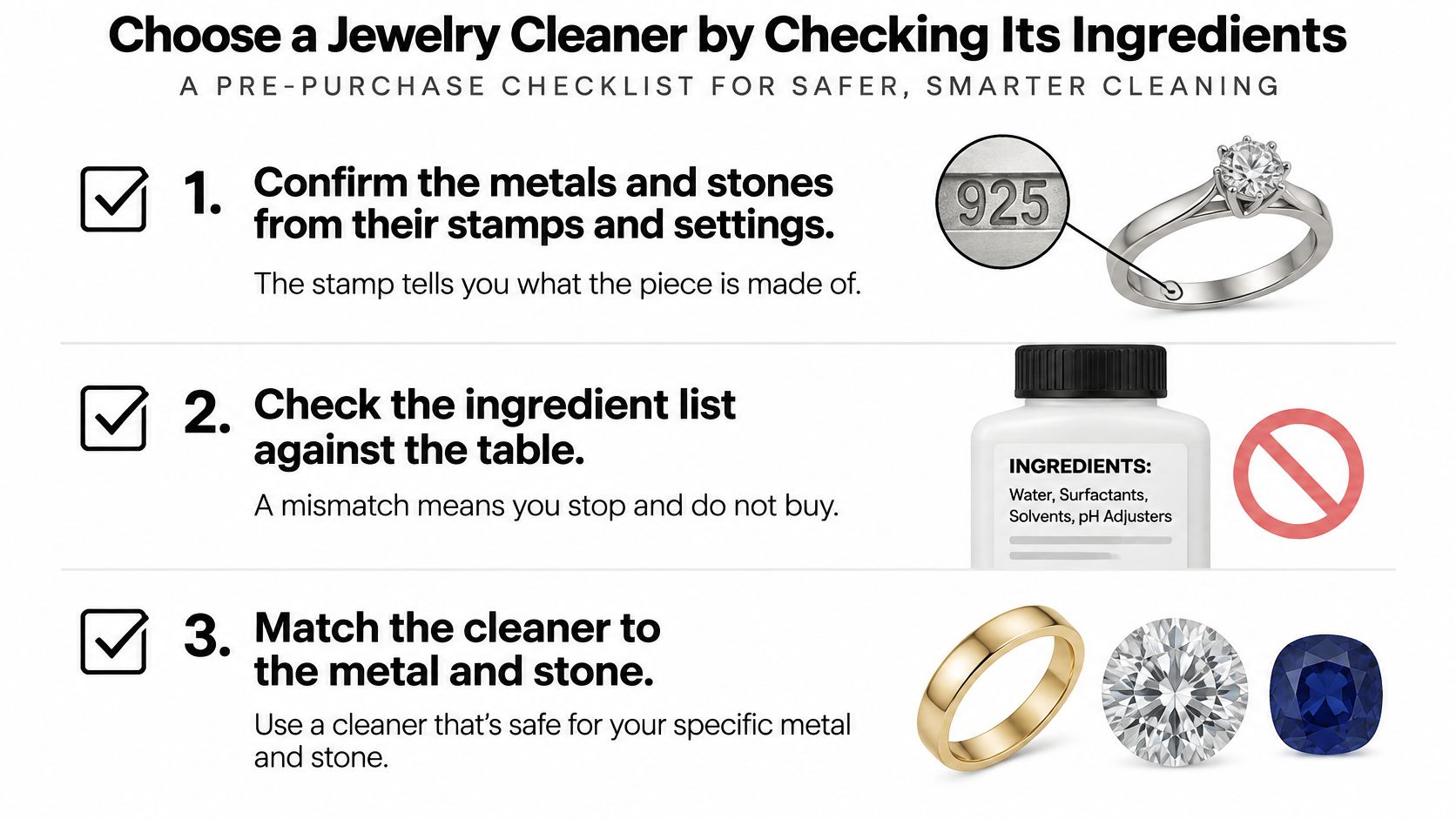
Run this checklist before a bottle goes into your basket, and again before you use one you already own.
- Confirm the metals and stones from the stamps and the settings.
- Screen the ingredient list against the table. Pearls, opals, porous stones, plating or glue means rejecting ammonia, strong acids and chlorinated solvents.
- Check the label for ultrasonic compatibility before using a machine, and skip ultrasonic cycles entirely on fracture-filled stones and glued settings.
- Prefer low-residue, water-based formulas with a named ingredient list and a rinse instruction, not a vague strength claim.
- Start with the shortest cycle and the lowest labelled concentration, then adjust one variable at a time.
- Spot test unclear construction on a hidden area before the whole piece goes in.
Our own ultrasonic jewelry cleaner solution is built around a chelating agent that binds metal ions, and it's formulated specifically for ultrasonic machines. We still repeat the same caution this checklist gives: avoid it on pearls, opals and soft or porous stones unless you've tested it first.
Watching the process once makes the settings and cycle conditions easier to judge.
Sort your collection into three groups and every future decision gets faster:
- Solid metal with hard stones (karat gold, platinum, sterling silver, diamonds, sapphires) can take a mild surfactant or chelator, warm water and a short machine cycle.
- Plated, filled or glued pieces get a mild surfactant, a short soak and no machine, because the coating and the adhesive decide the outcome.
- Pearls, opals and porous stones get plain water, a soft cloth and nothing else.
Diamond rings deserve their own routine, and these at-home diamond ring cleaning tips from Shapiro Diamonds cover the soak, brush and rinse sequence well, including which parts of a setting need the brush most. Accept a brand claim only when the ingredient list supports it, and treat the gentlest group as the default until you know the piece better.
Evo Dyne Products makes a concentrated, unscented ultrasonic jewelry cleaner solution that's safe for gold, silver, platinum, diamonds and most gemstones, with one small capful doing the work for around 36 cleaning sessions per bottle. If you'd rather match a formula to the pieces you own than gamble on a generic bottle, visit Evo Dyne Products and read the compatibility notes before you buy.
