
You've just painted a steel bracket, set it aside to cure, and a week later the coating peels off in a sheet. Or you lay a weld bead that looks solid, then see tiny holes open in it as it cools. In both cases, the metal probably wasn't clean. A film you couldn't see sat between the surface and everything you tried to put on it.
Table of Contents
- What Metal Degreasers Remove and Why It Matters
- Four Types of Metal Degreaser Compared
- Matching Degreaser to Metal and Coating
- Choosing for Machining, Automotive, Jewelry and Ultrasonic Work
- How to Degrease Metal Step by Step
- Fixing Streaks, Residue, Rust and Etching
- Disposing of Spent Degreaser Without Harming Drains
- Degreaser for Metal Questions Homeowners, Hobbyists and Pros Ask
What Metal Degreasers Remove and Why It Matters
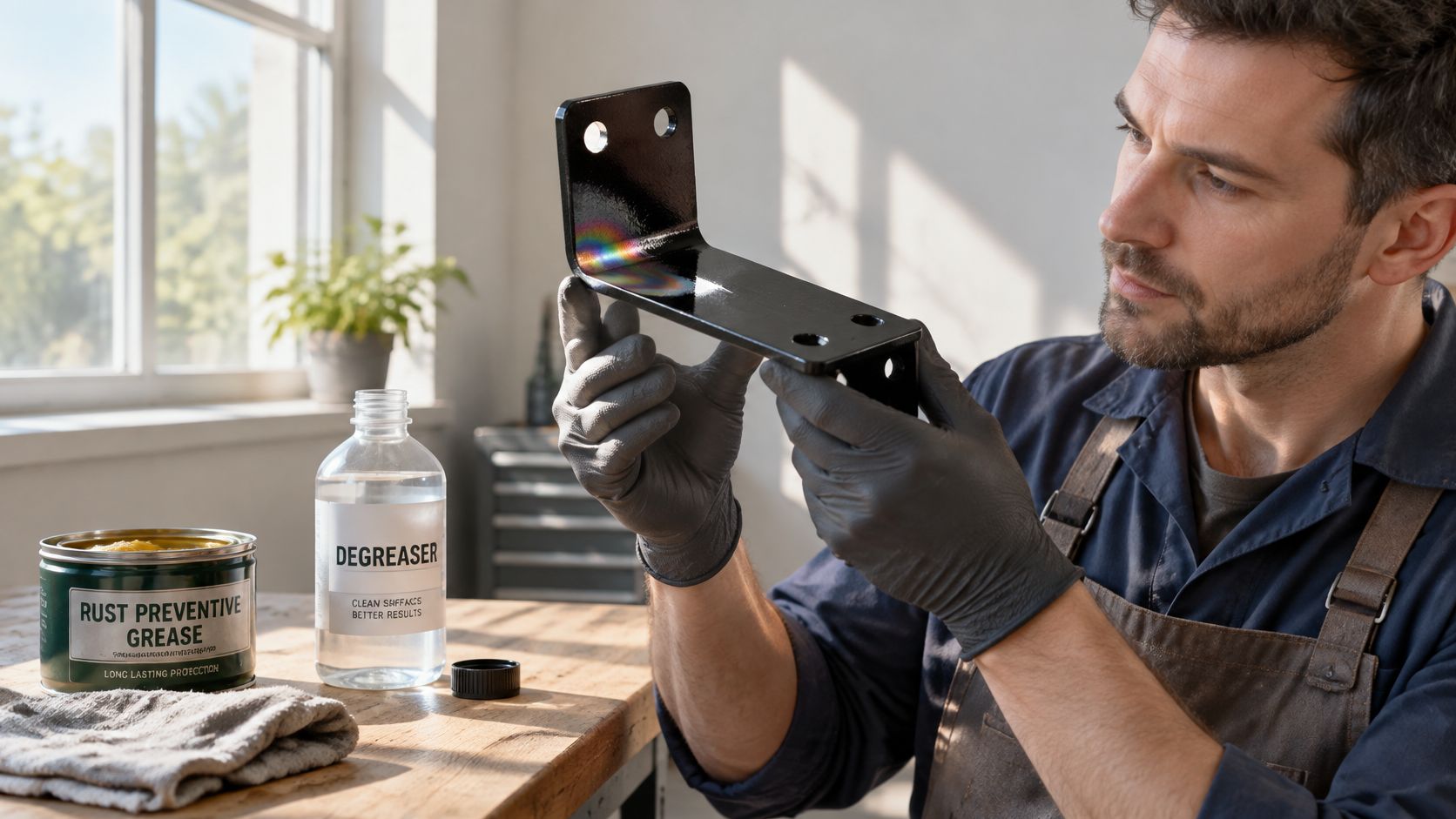
That invisible film is usually cutting oil, rust preventive grease, drawing compound, way oil, wax, carbon fines, polishing compound or fingerprint salts. Paint bonds to whatever it touches first. If it touches oil, it bonds to oil, and oil doesn't bond to steel. Weld metal has the same problem, and oil in the arc turns into gas that leaves porosity in the bead.
A degreaser for metal lifts those soils off so water, paint or plating can wet the surface evenly. Think of dish soap on a greasy pan, except the pan is steel, the grease is machine oil, and the rinse matters more than the scrubbing. If you don't rinse and dry well, you've traded one film for another.
Solvent, alkaline, citrus and water based products remove the same soils by different routes, so choose by three things, the metal, the soil, and the next process. Cleaning power alone isn't the goal. Ventilation, waste and rinsing decide whether a product fits your shop.
This was once an enormous industrial category. An EPA assessment of solvent metal cleaning reported that solvent metal cleaning emitted approximately 725,000 metric tons of organic compounds in 1975. That's why modern selection puts more weight on lower emission products and controlled application.
Four Types of Metal Degreaser Compared
How each one actually works
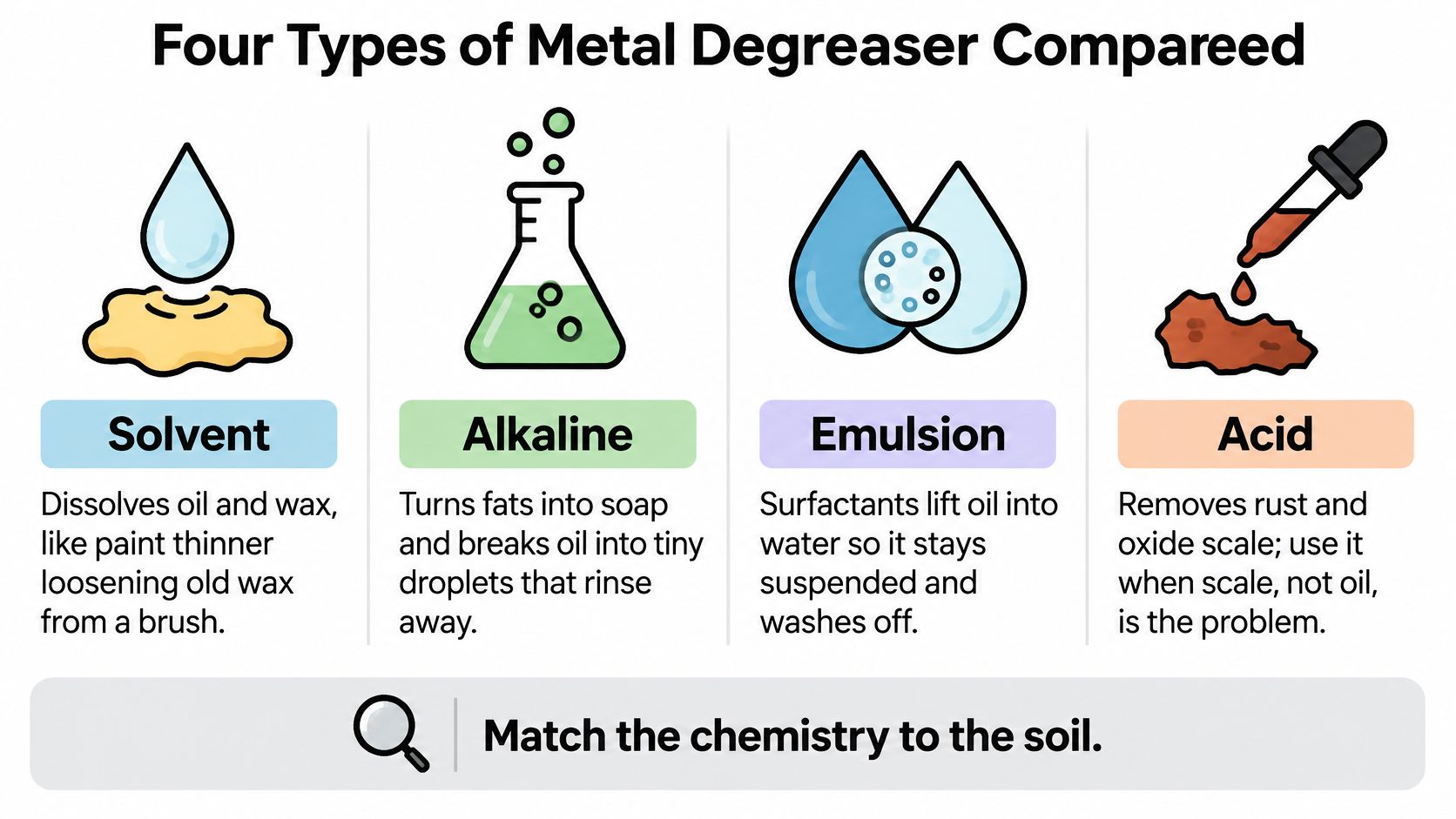
Solvents dissolve oil and wax into themselves, the way paint thinner loosens old wax from a brush. They're fast and leave little behind if the solvent is clean, but they don't remove salts, and a dirty wipe just spreads grease thinner.
Alkaline degreasers work more like laundry detergent. They turn fats into soap and break oil into tiny droplets that water can carry away. Heat and agitation help a lot, which is why a warm alkaline tank cleans parts that a cold spray barely touches.
Citrus degreasers use d-limonene, a terpene from orange peel that dissolves oil. They smell pleasant and feel gentle, and that fools people. They're still solvents, they can be combustible, and they're slow on baked on soil.
Biodegradable water based products rely on surfactants, molecules that pry oil off a surface and hold it suspended in water. They need dwell time and a real rinse, and they struggle with heavy grease, but they're the safest starting point on delicate metals.
The chart below sorts the four families by mechanism so you can match chemistry to soil.
Why older solvents disappeared
Chlorinated solvents once dominated vapor degreasing because they cleaned fast and didn't burn. The tradeoff was exposure. EPA case studies on safer degreasing alternatives reported that in fabricated metal manufacturing, trichloroethylene releases to air fell from approximately 3 million pounds in 2001 to 0.6 million pounds in 2012, a reduction of about 80%. Reporting facilities dropped from 141 to 44 over the same period.
Your takeaway is simple. Read the safety data sheet for the actual solvent in the can. The word solvent on the front label tells you almost nothing about ventilation, exposure or disposal.
Metal degreaser types at a glance
| Type | How it removes grease | Best fit | Main drawback | Disposal note |
|---|---|---|---|---|
| Solvent (hydrocarbon, such as mineral spirits) | Dissolves oil, wax and grease into the solvent | Heavy grease on steel and quick wipe downs | Flammable; vapors need ventilation | Spent solvent is hazardous waste; never pour it down a drain |
| Alkaline (aqueous) | Converts fats to soap and emulsifies oils, helped by heat and agitation | Shop floors, steel parts, prep before paint or plating | Can etch aluminum and zinc; needs a thorough rinse | Check pH and local discharge limits |
| Citrus (d-limonene) | Dissolves oil with a terpene solvent | Hands, tools and light to moderate grease | Slower on baked on soil; can leave an oily film; some are combustible | Usually milder, but check the label and local rules |
| Biodegradable (water based surfactant) | Surfactants lift and suspend oil in water | Delicate metals and workplaces with strict waste rules | Weaker on heavy or baked on grease; needs longer dwell | Biodegradable does not mean drain safe; confirm locally |
Short verdicts help at the shelf. Reach for solvent for heavy grease where you have ventilation, alkaline for shop parts and prep before paint, citrus for hands and light work, and biodegradable products where waste rules are strict.
Matching Degreaser to Metal and Coating
Strongest isn't best. That's the assumption that ruins the most finishes. Maximum alkalinity and long contact time can leave a surface rougher, duller and harder to coat than the oily part you started with, especially on reactive metals.
A 2024 coating study on aluminum pretreatment found that sodium hydroxide can dissolve aluminum's protective oxide layer, form sodium aluminate, release hydrogen and create a porous surface. Concentrations above 5.25% degraded aluminum surface quality, while 37 to 50°C produced better results under the tested conditions.
Shop rule: a cleaner that's safe on steel is not automatically safe on aluminum, zinc or plated parts. Test a hidden spot first, every time you change products.
Degreaser choice by metal or coating
| Metal or coating | Preferred type | Avoid | Reason |
|---|---|---|---|
| Carbon and mild steel | Alkaline or solvent | Acid cleaners unless rust removal is the goal | Tolerates strong alkaline; rinse and dry at once to prevent flash rust |
| Stainless steel | Alkaline or citrus | Chloride heavy cleaners | Chlorides can cause pitting; rinse thoroughly |
| Aluminum | Mild alkaline with short dwell | Strong alkaline above 5.25% | Sodium hydroxide dissolves the oxide layer and leaves a porous surface; 37 to 50°C gave better results in the 2024 study |
| Zinc coated steel | Mild alkaline before paint or galvanizing | Acid pre cleaning used as a degreaser | Degreasing decides whether later pickling and galvanizing wet the surface; acid can release hydrogen and damage coatings |
| Copper and brass | Mild alkaline or citrus | Ammonia based or acid products | Can tarnish, etch or discolor the finish |
| Gold, silver and platinum jewelry | Ultrasonic jewelry solution or mild soap | Solvents on plated pieces | Plating wears and stones can loosen |
| Painted or plated parts | Mild water based | Strong solvents and hot strong alkaline | Can soften paint or strip plating |
| Pearls, opals and porous gems | Gentle soap and soft brush | Ultrasonic and alkaline soaks | Porous stones absorb cleaner and can be damaged |
Walk the rows with your part in mind. Carbon steel forgives strong alkaline but punishes slow drying. Stainless steel tolerates alkaline and citrus, yet chlorides left behind can pit it later. Aluminum needs mild chemistry and short dwell. Zinc coated steel needs clean, even wetting before pickling or galvanizing, and acid used as a shortcut cleaner can damage the coating it carries.
Copper and brass discolor under ammonia and acids. Jewelry metals fail without warning, plating thins and settings loosen. Painted parts soften under strong solvents. Pearls and opals absorb whatever you soak them in.
Before treating a whole piece, check your planned chemistry against a chemical compatibility reference for common materials, then run a patch test. Clean a hidden spot, dry it, and look for staining, dullness or flash rust. Also separate cosmetic cleaning from preparation. A part that only needs to look tidy can carry a light film. A part headed for paint, plating or welding can't.
Choosing for Machining, Automotive, Jewelry and Ultrasonic Work
Different jobs fail in different ways, so it helps to think in cases rather than products.
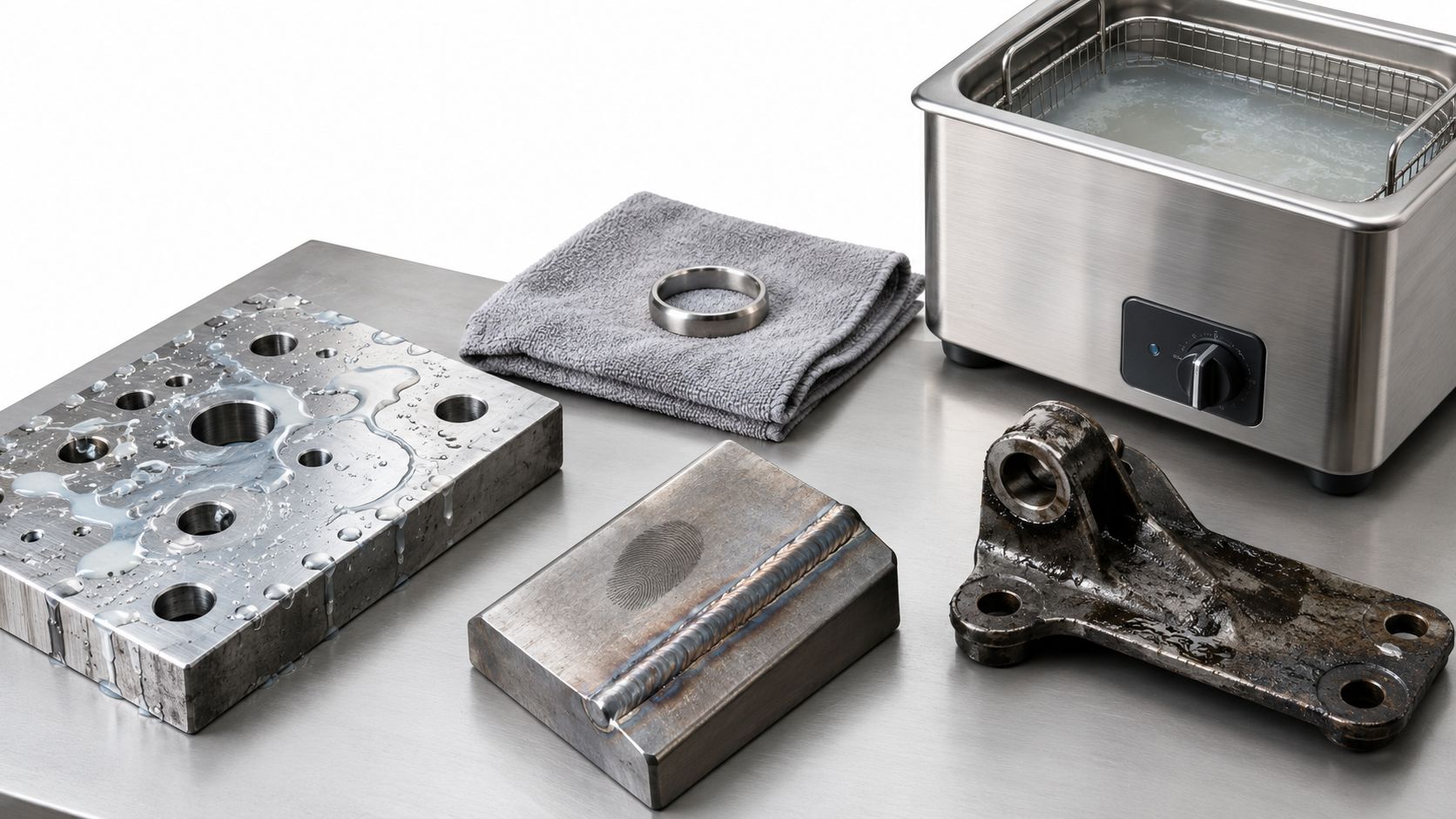
Machining
Say a shop drills and taps steel brackets, then sends them to welding still wet with cutting fluid. The welds come out porous and everyone blames the welder. The actual problem is the belief that cutting fluid cleans. Cutting Fluid is a multipurpose metalworking oil for drilling, tapping, milling, and more, a lubricant that reduces tip welding and prevents pitting and seizure. It belongs on the cutting area during the cut, reapplied as needed, and it has to come off afterward.
The right sequence is degrease the stock if it's oily, cut with the right fluid, then clean the finished part before welding or coating. If your shop also struggles with heat and tool life, these coolant performance tips for CNC shops cover the fluid side of the same problem. The one fix that prevents the most damage here is treating lubricant and cleaner as opposite jobs.
Automotive
An engine bay or brake assembly carries baked on oil mixed with road grit. A warm alkaline bath or a suitable solvent handles that soil, but keep both off painted trim, rubber seals and wiring insulation. Work small areas, agitate with a brush, and rinse before the cleaner dries. Bare steel you've just stripped needs oil or coating soon after, or it'll rust while it sits on the bench. The biggest save is protecting everything around the part before you start.
Jewelry and ultrasonic work
Rings and chains collect lotion, soap and skin oil in settings where a cloth can't reach. In an ultrasonic tank, cavitation does the scrubbing, tiny bubbles collapse against the surface and knock soil loose. The solution still matters. A jewelry cleaner solution that's specifically formulated for ultrasonic machines and contains a chelating agent that binds to metal ions in jewelry helps lift tarnish related film instead of just moving it around.
If you're torn between product types for a tank, this comparison of ultrasonic detergent and degreaser options lays out the tradeoff. Never put solvents in an ultrasonic machine unless the machine is built and rated for them. Keep plated pieces away from harsh chemistry, and keep pearls and opals out of the tank entirely. The one fix here is matching the solution to the machine, not improvising with household sprays.
How to Degrease Metal Step by Step
Start with protection, not product. For volatile solvent systems, OSHA guidance on toxic cleaning solvents emphasizes local exhaust ventilation as the primary engineering control and warns that in enclosed spaces, vapors may be heavier than air and can displace oxygen. It also advises verifying pH, corrosion inhibitors, rinse requirements and compatibility with aluminum, zinc, copper, plated parts and high strength steels before production use.
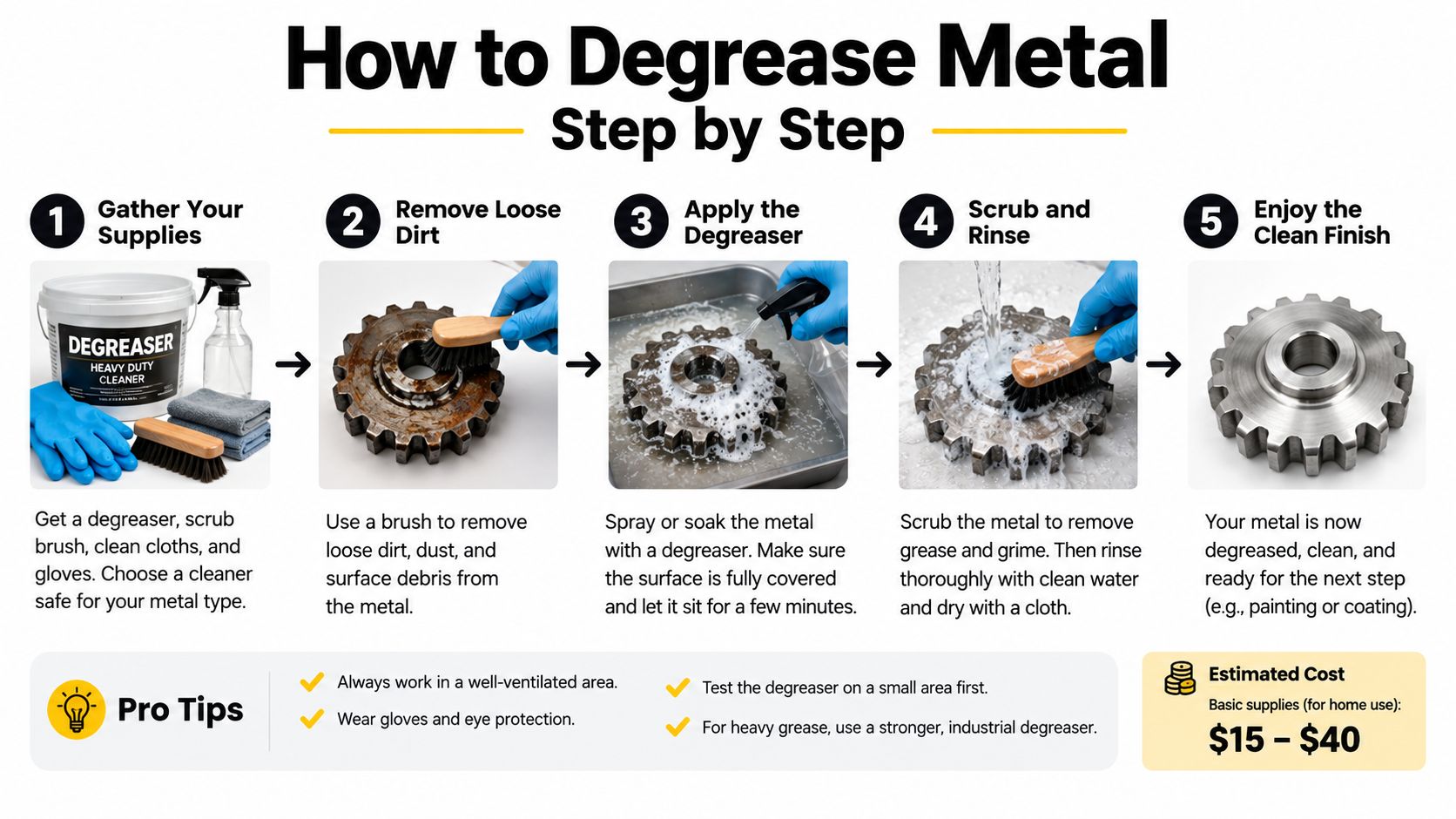
The five stage flow below shows the basic sequence you'll repeat in the numbered steps.
The ten steps
- Gear up. Wear nitrile or solvent rated gloves and eye protection, and set up a fan, open door or local exhaust. Solvent vapor pooling in a pit or tank is the slip people don't notice.
- Remove heavy soil first. Scrape or wipe off thick grease so it doesn't turn your bath into sludge in one shift.
- Dilute by the label. More concentrate isn't better. Overdosed alkaline etches, overdosed surfactant foams and leaves film.
- Apply and agitate. Wipe, spray or immerse, then move the part or brush it so cleaner reaches threads, bores and recesses.
- Hold the contact time. Use the table below. Longer isn't automatically cleaner, and on reactive metals it's often worse.
- Rinse in clean water. Give alkaline products two rinses. A single quick dip leaves chemistry behind to dry as streaks.
- Dry immediately. Use warm air or a lint free cloth. Water sitting on clean steel causes flash rust fast.
- Run a water break test. Mist or dip the part. Water should sheet evenly without beading or pulling back into islands.
- Lubricate or coat bare steel. After use, clean and lubricate metal surfaces to avoid corrosion and loss of performance.
- Validate on one part first. Test a representative part, dry it, and inspect for staining, haze or flash rust before you commit a batch.
If paint is your next step, degreasing is only half the prep. The guide to cleaning and sanding before repainting covers the abrasion and dust removal that follow a successful degrease.
Watch the sequence on a real part before you set up your own bench, paying attention to dwell and drying rather than scrubbing force.
Concentration, contact time and temperature by method
| Method | Concentration | Contact time | Temperature | Rinse |
|---|---|---|---|---|
| Solvent wipe | Undiluted | 30 seconds to 2 minutes | Room temperature | Wipe with clean cloth, then air dry in a ventilated area |
| Citrus spray or wipe | Per label, often 1:10 to 1:20 | 1 to 5 minutes | Room temperature | Wipe with water, then dry |
| Alkaline immersion tank | 2 to 5% for light to moderate soil; stay under 5.25% on aluminum | 5 to 15 minutes | 37 to 50°C for aluminum; higher for steel per label | Two clean water rinses |
| Ultrasonic jewelry bath | Small capful per label | 3 to 5 minutes | Warm water per label | Rinse in clean water and pat dry |
| Biodegradable spray | Per label | 2 to 10 minutes | Room temperature | Water rinse, then dry at once |
Treat those ranges as starting points, then adjust one variable at a time. Change concentration, time and temperature together and you'll never know which one fixed or caused the problem.
Fixing Streaks, Residue, Rust and Etching
The most common complaint is an oily film after drying. The part felt clean in the tank and looked clean wet, then dried greasy. That usually means the bath is spent or the rinse was too short. A loaded bath doesn't hold more oil, so it redeposits what it lifted as the part comes out.
Process control explains most of the rest. EPA guidance on solvent cleaning operations notes that solvent degreasing removes soils through dissolution and physical displacement, and that exposure and carryout depend on bath temperature, agitation intensity, part dwell time, drainage and whether the tank is covered. It adds that when solvent vapor pressure exceeds 4.3 kPa at 38°C, or the solvent is heated above 50°C, additional vapor controls are indicated.
In plain terms, drain parts before you pull them out, keep covers closed when the cleaner sits idle, and don't spray above the vapor zone. A bath contaminated with dragged in water or oil also cleans worse over time and can turn corrosive, so a cleaner that worked last month can start staining parts for reasons that look mysterious until you check the bath.
A dirty bath doesn't fail loudly. It slowly starts putting back what you paid it to remove.
Degreasing symptoms, causes and fixes
| Symptom | Likely cause | Fix |
|---|---|---|
| Oily film after drying | Bath is spent or the rinse was too short | Replace the bath and add a second clean water rinse |
| Streaks or haze on aluminum | Strong alkaline or long dwell etched the surface | Lower the concentration, cut contact time to 2 to 5 minutes and rinse well |
| Orange flash rust on steel within hours | Water left on the surface after rinsing | Dry immediately with warm air, then oil or coat the part |
| Heavy foam in the tank | Surfactant overdose or agitation too strong | Dilute to the label and reduce agitation |
| Cloudy or dull jewelry | Lotion film or old solution | Use fresh solution and repeat 3 to 5 minute cycles for heavy tarnish |
| Sticky residue after solvent wipe | Dirty rags or incomplete evaporation | Wipe with fresh solvent and a clean cloth, and ventilate the area |
| Paint or weld fails | Silicone or degreaser residue left behind | Re clean and run a water break test before coating or welding |
Work the table in order of likelihood. Fresh bath, proper dilution and a second rinse fix most cases the same day. Change chemistry only after you've ruled out bath condition and rinsing, because swapping products into a dirty process gives you the same failure with a new label.
Disposing of Spent Degreaser Without Harming Drains
One rule covers most of the risk. Never pour solvent down a drain or onto the ground. Everything else is sorting what you have into streams and handling each one deliberately.
- Spent solvent: keep it in a sealed, labeled container, away from heat, and take it to a hazardous waste collection point. Don't mix different solvents in one drum unless the collector tells you to.
- Alkaline bath: check the pH and your local discharge limits before anything goes to a sewer. Neutralize only where local rules allow it, and treat settled sludge as industrial waste.
- Rinse water: it carries the same chemistry as the bath, just weaker. Apply the same pH and discharge checks, and collect it for disposal when rules are strict.
- Oily rags: store them in a closed metal container. Piled oily rags can self heat, and a plastic bin in a corner is how shop fires start.
Don't let the word biodegradable do your thinking. It means a product can break down in the environment under the right conditions. It doesn't mean your home drain or shop sewer is an approved route, and the oil you washed off doesn't become harmless because the cleaner was mild.
Good housekeeping cuts waste before disposal is even a question. Covered tanks reduce evaporation loss. Skimming oil off a bath extends its working life. Fewer bath changes mean less spent chemistry to haul away and fewer chances to spill.
When the rules for your stream are unclear, call your local waste authority or water utility and describe exactly what you have, product name, approximate volume and what soil it picked up. That five minute call is cheaper than a blocked drain, a fine or a contaminated septic system.
Degreaser for Metal Questions Homeowners, Hobbyists and Pros Ask
Can I use dish soap instead
For homeowners, yes, within limits. Dish soap handles light oil on steel tools and works for routine jewelry cleaning. But it leaves its own surfactant film, it can't cut heavy machine grease, and it isn't preparation for paint, plating or welding. If the next step has to bond to the metal, use a real degreaser and rinse properly.
Is WD-40 a degreaser
For hobbyists, not really. It's a penetrant and light lubricant. It loosens stuck parts and displaces water, and it leaves an oily residue behind by design. That's useful on a hinge and harmful under paint. Clean with a true degreaser before coating, and save the lubricant for after assembly.
Is citrus safe on aluminum
For pros, usually, but verify it. Citrus products tend to be milder than strong alkaline cleaners, yet formulations differ. Check the pH and label, patch test a hidden spot, keep contact time short and rinse well. Mild on the front label isn't a compatibility guarantee.
How do I know the metal is clean
For pros, use three checks together. Water sheets evenly in a water break test without beading. A clean white cloth wiped across the surface picks up no gray or oily residue. The dried part shows no staining, haze or flash rust. Pass all three and you're ready for the next process.
For jewelry owners using a tank at home, our ultrasonic solution is unscented, non toxic and extra concentrated, and it's tested, developed and manufactured in the USA. Follow its label for dilution rather than guessing, since overdosing any cleaner makes rinsing harder.
Keep one closing rule and most choices get easy. Choose by the next process. Paint or plating calls for a mild alkaline or water based product, rinsed well and dried at once. Heavy machine grease calls for a solvent or alkaline bath with ventilation. Jewelry calls for an ultrasonic solution matched to the machine.
If you're setting up a home ultrasonic tank or restocking a shop bench, Evo Dyne Products offers ultrasonic jewelry cleaner solution made for machine use, plus cutting and lubrication fluids for the metalwork that creates the soil in the first place. Visit the store to compare the options, read the labels before you buy, and pick the product that matches your metal and your next step.