


The usual advice, use oil for lubrication and coolant for cooling, is a useful shortcut, but a poor diagnosis. A snapped tap, an overheated insert, and a drill packed with chips don't need the same fix. Buying a different fluid before identifying the failure can leave you with the same scrap and a harder cleanup.
The practical way to compare cutting oil vs coolant is to ask what's stopping the job from running reliably, then count everything required to keep that fluid working. Purchase price matters, but so do tool changes, sump maintenance, residue, ventilation, and disposal.
Table of Contents
- Cutting Oil and Coolant at a Glance
- Why Oil and Coolant Developed Separately
- Which Fluid Fits Each Machining Operation
- Diagnose the Problem Before You Pick a Fluid
- Cost, Cleanup and Safety Over Time
- Vegetable Oils and Minimum-Quantity Options
- Choose the Right Fluid for Your Next Job
Cutting Oil and Coolant at a Glance
| Property | Straight cutting oil | Water-based coolant |
|---|---|---|
| Base | Mineral or synthetic oil, sometimes vegetable-based | Water with soluble oil, semisynthetic or synthetic additives |
| Lubricity and film strength | High | Moderate, with performance set by additives and concentration |
| Heat removal | Low to moderate | High |
| Chip flushing | Limited in typical manual application | Strong with adequate flow and directed delivery |
| Corrosion protection | Good on bare parts when compatible and clean | Needs concentration and contamination control |
| Typical share of use | Selected demanding operations | Approximately 80%–90% of metalworking-fluid applications, as reported in the University of Northern Iowa manual discussed in this cutting-fluid review |
Straight oil is normally used undiluted. Its advantage is maintaining a lubricating film where the tool presses hard against the workpiece, particularly when cutting speed is low and contact pressure is high.
Water-based coolant combines water's heat-removal ability with additives for lubrication, corrosion control, and system stability. Soluble oils, semisynthetics, and synthetics belong to this broad category, but they aren't interchangeable formulations.
The flushing comparison needs qualification. A drop of oil on a drill can't carry away chips like a directed coolant stream, but a properly engineered oil-delivery system can provide substantial chip evacuation.
Practical rule: Choose the fluid and delivery system that address the dominant failure, not the category with the strongest general reputation.
Before buying, answer these questions:
- What's failing? Separate overheating from rubbing, chip packing, and corrosion.
- What are you cutting? Steel, stainless, titanium, and aluminum place different demands on the fluid and tooling.
- How does the tool engage? Low-speed, high-load contact usually needs a different approach from sustained high-speed cutting.
Our guide to metal-cutting coolant fluid provides additional context on coolant selection. For a specific job, use the operation table below as a starting point, then check the material and delivery requirements.
Why Oil and Coolant Developed Separately
Early metalworking relied on animal and vegetable oils because reducing friction was an immediate, practical need. As machines became more capable during the Industrial Revolution, operators faced a second problem: a lubricant could help the edge slide through metal without removing enough heat to support faster cutting.
Faster cutting needed a different answer
In 1906, Frederick W. Taylor reported that an aqueous sodium-carbonate solution applied at the tool–workpiece interface increased cutting speed by approximately 30%–40%, according to this historical review of cutting-fluid development. The important lesson wasn't the particular solution. It was that effective cooling could change the operating limit of the process.
Oil-in-water emulsions followed as a way to combine cooling with useful lubrication. They became established for heavy cutting because water could remove heat more effectively than straight oil.
Consider the practical problem behind that development. An operator increasing cutting speed might find that the edge deteriorates even though the cut appears well lubricated. Adding more of the same oil doesn't necessarily solve a heat-transfer limitation.
Heavy contact still needed film strength
Another operator might face the opposite problem while broaching or cutting threads. The tool moves relatively slowly, but the contact load is severe, and the freshly cut surfaces tend to seize or tear.
Sulfur- and chlorine-containing cutting oils developed alongside emulsions to provide boundary lubrication and extreme-pressure protection. The two categories weren't competing answers to an identical problem. They addressed different limits on reliable machining.
Oil-free synthetic fluids later expanded the available choices as manufacturers sought alternatives to petroleum-heavy formulations. That development added options without eliminating the underlying trade-off.
Oil earns its place when the contact needs a stronger lubricating film. Water-based coolant earns its place when the process needs more effective heat transfer and flushing.
That distinction still explains why a shop might use straight oil at a tapping station and a water-miscible system on a production mill. Neither operator is choosing incorrectly. Each is matching the fluid to the load, speed, tool geometry, and workpiece.
Which Fluid Fits Each Machining Operation
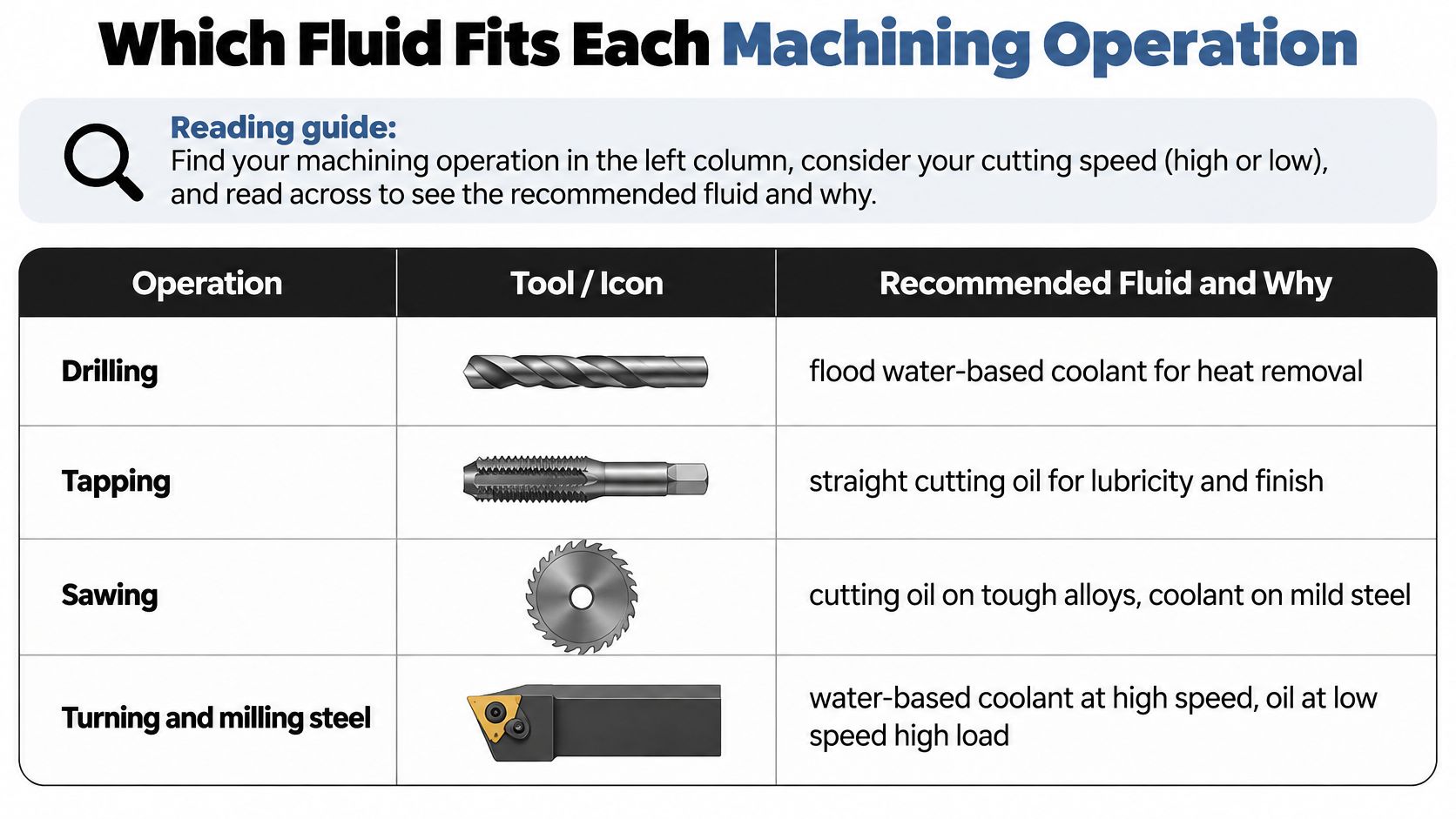
Scan the table by operation, then adjust the recommendation for cutting speed, material, tool design, and the machine's fluid-delivery capability.
| Operation | Usually better fit | Main reason |
|---|---|---|
| Drilling | Flood water-based coolant for sustained cutting; cutting oil for suitable manual work | Balance heat removal with lubrication at the drill lips |
| Tapping | Straight cutting oil | Low speed and high load need film strength |
| Sawing | Water-based coolant for general production; cutting oil for suitable tough-alloy work | Blade cooling and chip removal, with added lubricity where needed |
| Turning or milling steel at speed | Water-based coolant | Heat removal dominates |
| Milling aluminum | Water-based coolant or a suitable light fluid | Chip flushing and staining control |
| Deep-hole drilling | Oil or high-lubricity fluid with high-pressure delivery | Heat control and chip evacuation both matter |
| Broaching and gear cutting | Straight cutting oil | Extreme-pressure and boundary lubrication |
| Stainless steel or titanium | Oil or high-lubricity fluid, verify rating and delivery | Difficult cutting conditions demand both lubrication and heat management |
The main operating choices are summarized visually below.
Where small shops commonly choose wrongly
Drilling and tapping aren't the same lubrication problem. A drill cutting continuously may need substantial cooling, while a tap can fail from friction at the thread flanks even when the workpiece doesn't feel especially hot. For manual work, apply suitable cutting oil at the cutting area before engagement, then stop safely to replenish it rather than reaching toward rotating tooling.
Sawing needs attention to the blade, not just the workpiece. Direct fluid into the cutting zone so it reaches the teeth and helps clear the gullets. A wet table and a dry blade indicate poor delivery, not necessarily the wrong fluid.
At higher steel-cutting speeds, a general-purpose oil isn't an automatic upgrade over coolant. Aluminum introduces a different concern: choose a formulation compatible with the alloy and inspect for staining, residue, and chip adhesion.
Match difficult operations to the machine
Deep-hole drilling requires an escape path for chips. Oil with excellent lubricity won't rescue a hole if chips can't leave it, so check through-tool delivery, filtration, pressure capability, and the drilling cycle before changing chemistry.
Stainless steel needs a sharp edge that cuts rather than rubs. Titanium deserves particular attention to heat at the edge and delivery into the contact zone. Don't assume a fluid suitable for mild steel is automatically the best choice for either material.
Our cutting oil is suitable for steel, stainless steel, aluminum, brass, copper, and most other metals; our cutting fluid can also be used on stainless steel and titanium components. Material suitability still doesn't establish the best speed, feed, or delivery method for a particular machine.
Fabricators combining machining with welded assemblies should keep those processes distinct. EZARC Tools' guide to weld bead cleanup for fabricators addresses abrasive finishing, which requires different decisions from lubricating a cutting tool.
Before a production run, confirm the fluid's material rating and the machine and tool manufacturers' requirements.
Diagnose the Problem Before You Pick a Fluid
Oil or coolant is often the wrong starting question. Cutting fluids perform overlapping jobs: cooling, lubrication, and chip evacuation. Identify which job isn't getting done before replacing the fluid.
Read the failure at the cutting edge
- Overheated tool and changing chip color. Check whether coolant reaches the edge under load. Clear blocked nozzles and filters, verify flow, and consider a water-based formulation where cooling is inadequate. Blue steel chips alone don't prove failure, since chip color must be judged alongside edge wear, dimensions, and the cutting process.
- Built-up edge or galling during tapping. Inspect for workpiece material adhered to the tap and torn thread surfaces. Improve lubricity with an appropriate straight oil or high-lubricity formulation, while checking tap geometry and chip clearance.
- Chips packed in a deep hole. Stop before continuing to force the drill. Correct the evacuation problem with suitable directed or through-tool delivery and a drilling cycle matched to the tool.
- Poor finish without an obvious cause. Inspect the edge for adhesion, wear, and chipping, then check runout, rigidity, and recutting chips. A stronger lubricant won't cure a loose setup, and more cooling won't remove embedded swarf from a dirty system.
- Corrosion after machining. Measure coolant concentration with a refractometer using the product's correction factor. Check contamination, water quality, and how parts are cleaned and dried before concluding that all water-based coolants are unsuitable.
Change delivery before increasing volume
A nozzle aimed at the outside of the chip stream may leave the actual contact poorly supplied. Reposition it safely, verify that the stream stays on target during the toolpath, and check whether the machine can sustain the required delivery.
A review of machining cooling and lubrication strategies reports improved titanium-alloy machining performance with high-pressure coolant compared with flooded cooling and minimum-quantity lubrication, while also describing specific materials where dry machining gave better tool life or finish. Those findings support application-specific selection, not a universal preference for either wet or dry cutting.
More fluid isn't automatically better. Sometimes the useful change is a smaller, accurately directed lubricant supply. In a suitable tool-and-material combination, it may be no liquid at all.
Cost, Cleanup and Safety Over Time
The invoice for a container doesn't tell you what the fluid costs per finished part. A cheap product can become expensive if operators spend extra time clearing chips, replacing damaged taps, cleaning residue, or recovering a neglected sump.
Straight oil and water-based coolant also create different maintenance workloads. Oil avoids dilution management, but that doesn't make it maintenance-free; water-based systems can serve production efficiently, but only when someone owns concentration, cleanliness, and system condition.
Count the work around the cut
- Consumption per job. Include fluid carried out on parts and chips, leaks, overspray, and unnecessary application, not just what goes into the tank.
- Concentration and filtration. Track readings and maintain filters so operators aren't compensating for dirty or incorrectly mixed coolant with extra tool changes.
- Biological stability. Treat persistent odor, visible contamination, or changing fluid condition as maintenance signals. Don't mask a deteriorating sump with fragrance or improvised chemical additions.
- Residue and cleanup. Account for wiping fixtures, washing parts, cleaning enclosures, and preparing surfaces for painting or assembly.
- Waste and recycling. Establish where spent fluid and oily chips will go before generating them. Keep incompatible wastes separate and confirm the recycler's acceptance requirements.
- Exposure control. Include mist extraction, ventilation, splash containment, and suitable skin-contact precautions in the process cost.
Straight oils can produce smoke and require attention to ignition sources, machine suitability, and fire management. Water-based coolant isn't harmless just because it contains water; mist and repeated skin contact still need control.
Make maintenance part of the setup
Use the safety data sheet to select handling precautions, and keep hands away from moving tools. Gloves may be appropriate for handling stopped, contaminated parts, but they can create an entanglement hazard around rotating equipment.
For a recirculating system, assign responsibility for concentration checks, tramp-oil removal, filtration, and cleanouts. Don't pour in unapproved biocides or cleaners to treat a symptom without identifying its cause.
The cheapest fluid per container isn't necessarily the cheapest fluid per accepted part.
Oil's lubricity can justify a heavier cleanup burden when it prevents expensive machining failures. Conversely, a water-based system can become a poor economic choice if the shop lacks the time or discipline to maintain it.
After use, clean and lubricate metal surfaces to avoid corrosion and loss of performance. Include that finishing work in the job estimate rather than treating it as free labor.
Vegetable Oils and Minimum-Quantity Options
A plant-derived oil isn't automatically the best environmental or machining choice. It still has to cut reliably, remain usable in storage, work with the equipment, and enter an appropriate waste stream.
The application point matters as much as the fluid's origin.
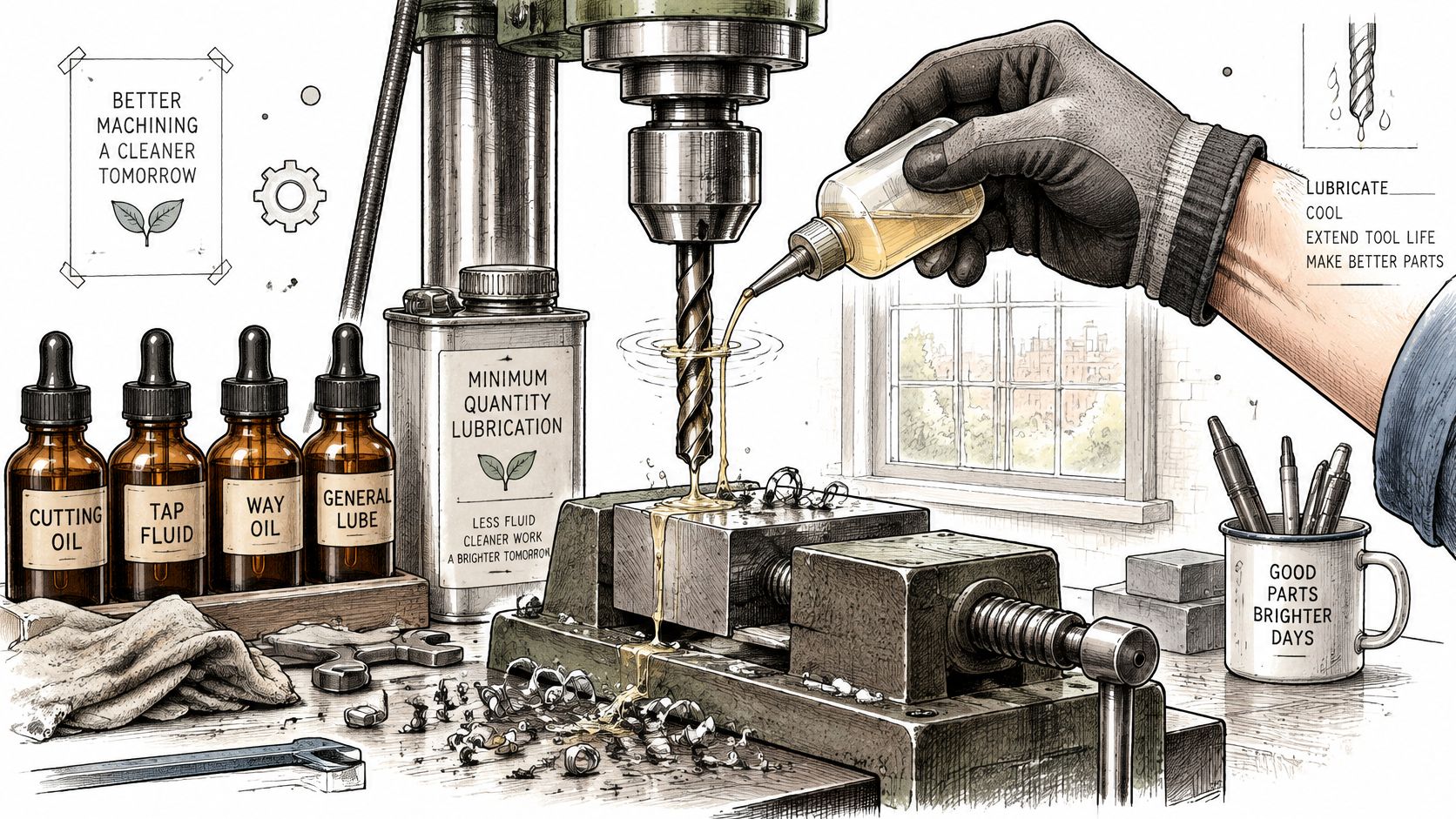
A 2024 review published in an Institute of Physics journal reports that oleic acid typically represents approximately 50%–60% of groundnut oil, contributing to lubrication in vegetable-oil-based cutting fluids. That explains a useful formulation property, not permission to substitute cooking oil for an engineered machining product.
Separate the fluid from the delivery method
Minimum-quantity lubrication, or MQL, is a delivery method, not a new fluid category. It supplies a small, directed lubricant quantity to the cutting zone instead of relying on a conventional flood.
Our guide to eco-friendly cutting fluids and sustainable machining provides context for evaluating these alternatives. Start with the actual process requirements rather than a green label.
A review of sustainable machining strategies discusses plant-derived fluids, MQL, cryogenic cooling, and hybrid systems, including practical barriers involving nozzle design, cryogen logistics, nanofluid stability, scalability, and occupational safety. These aren't interchangeable upgrades, and promising laboratory results don't establish long-term storage stability, microbial control, seal compatibility, or disposal compliance in your shop.
Use the following video as supplementary context while evaluating application methods.
Run a controlled trial
Low-volume precision work can be a sensible place to evaluate directed lubrication, provided the tool doesn't require more cooling or chip transport than the system can supply.
- Check delivery reliability. The nozzle must reach the contact throughout the cut, not just at the starting position.
- Check equipment compatibility. Confirm pump, seal, enclosure, and extraction requirements.
- Check the waste route. Plant-derived doesn't mean drain-safe or exempt from local disposal rules.
Trial the option on a repeatable job before changing an entire production line. Keep the tooling, material, and cutting conditions consistent so you can identify what the fluid changes.
Choose the Right Fluid for Your Next Job
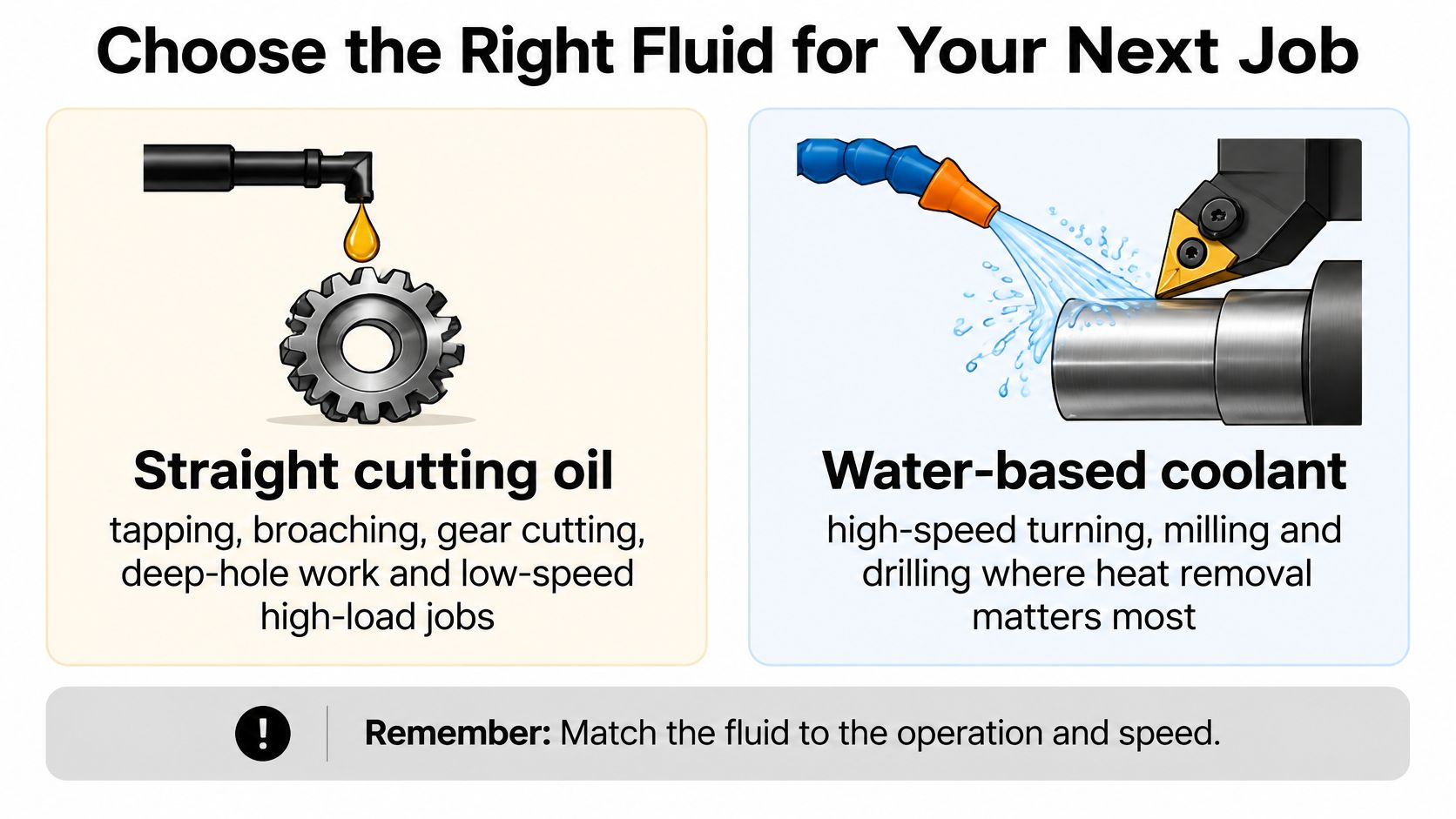
Choose straight cutting oil when low-speed, high-load contact is the main challenge, particularly for tapping, broaching, and gear cutting. Include deep-hole work only with an appropriate evacuation strategy, not because oil offers good lubricity.
Choose water-based coolant for sustained high-speed turning, milling, sawing, and general production where effective cooling and chip transport are central requirements. For titanium and difficult stainless work, evaluate a high-lubricity formulation with delivery capable of reaching the cutting zone.
Use this summary to narrow the choice, not to override tooling or machine requirements.
Where our cutting fluid fits
Evo Dyne Cutting Fluid is a multipurpose metalworking oil for drilling, tapping, milling, and more. It lubricates to reduce tip welding, prevents pitting and metal seizures, and works under extreme pressure.
It's listed as Made in USA, costs $12.49 for a 1-Pack, and is suitable for cutting operations requiring close tolerance, precise fit, and a professional finish. Those features make it an option to evaluate where a lubricating oil fits the process, not a replacement for every high-volume coolant system.
Apply it directly to the cutting area or drill bit before and during operation, replenishing as needed using a safe application method. Don't reach into rotating equipment to apply fluid.
Make the decision measurable
Before committing to a larger change, write down the operation, material, tool, and current failure. Then establish a repeatable baseline rather than relying on whether the cut sounds smoother.
- Match the operation. Select the likely fluid category using the actual engagement and cutting speed.
- Confirm the material. Check compatibility with the alloy and any later coating, cleaning, or assembly process.
- Verify delivery. Make sure the machine can supply the fluid where and when the tool needs it.
- Track accepted parts. Record edge condition, tool changes, finish, dimensional consistency, and cleanup time.
Run a small test on the next suitable job and track tool life and finish over a working week. Keep the option that produces dependable parts with a manageable maintenance burden, even if it isn't the cheapest container on the shelf.
Evo Dyne Products offers cutting and lubrication oils for metalworking alongside practical maintenance guidance. Visit Evo Dyne Products to review our Cutting Fluid, match it to your operation and material, and choose a suitable job for a controlled trial.
