

You're holding a gold filled chain over the sink, toothbrush in one hand, wondering if that scrub will brighten it or wear the color right off. It looks dull from lotion and sweat, so your instinct says hotter water, stronger soap, and harder brushing. That instinct is exactly what thins this kind of jewelry.
Gold filled pieces aren't solid gold and they aren't thin plating either. They're a bonded laminate, real gold over a base metal core. If you clean gold filled jewelry by its construction and its wear points, you preserve that layer. If you clean it by generic gold rules, you shorten its life at the clasp, edges, and seams first.
Table of Contents
- Which Cleaning Method Fits Your Piece
- Hand Cleaning Gold Filled Jewelry Step by Step
- Ultrasonic Cleaning Steps for Sound Pieces
- Cleaning Solutions, Damaging Products and Frequency
- Drying and Storing Pieces Between Wears
- Decide When to Stop and Book a Jeweler Inspection
Which Cleaning Method Fits Your Piece
A bright chain can still be thin at the clasp. Choose the method from condition and construction, not from price, shine, or how sturdy the piece feels in your hand.
Gold filled jewelry is a bonded laminate: gold mechanically applied over a base-metal core. The face you see is real gold, so mild soap handles lotion and light soil. The core is base metal. Abrasion, harsh chemicals, or a long soak that opens a seam or thins an edge lets brass show through. No home cleaner puts that layer back.
A thinner gold-overlay marking means even less gold at edges, jump rings, and solder than standard gold filled. I treat those wear points as the limit of home cleaning, not as solid gold that can take a hard scrub.
Inspect Before You Choose
Hold the piece under bright light, ideally with a 10x loupe or a phone macro lens. Turn it slowly and check clasps, jump rings, solder joints, sharp bends, and stone settings for lifting edges, flaking, exposed brass, loose stones, or a clasp that does not snap shut.
A sound piece can take a short machine cycle. A damaged one should stay dry until it is repaired.
| Piece condition | Recommended method | Why |
|---|---|---|
| Bonded gold intact, no stones | Short ultrasonic cycle or hand wash | The gold layer is sound, so keep cycles short |
| Gemstones set in the piece | Hand wash only, unless a jeweler confirms the stones | Vibration can loosen settings and damage some stones |
| Pearls, coral, amber, opal or other porous stones | Hand wash with a soft brush | These gem types are unsuitable for ultrasonic cleaning |
| Worn edges, flaking gold or exposed brass | Stop home cleaning and see a jeweler | The core metal is already exposed |
| Loose stones, weak solder or broken clasp | Do not clean; repair first | Cleaning can make the damage worse |
| Heavy tarnish on an otherwise sound piece | Several gentle hand washes over multiple sessions | Abrasives remove the bonded gold |
Use ultrasonic cleaning only on sound pieces with no porous or fragile stones. Run the shortest cycle, usually 3 to 5 minutes, then look again under magnification for loosened stones, seam movement, or discoloration. If you are not sure which stones tolerate vibration, read whether you can use an ultrasonic cleaner on all your jewelry before you run anything.
Decision rule: If any inspection item fails, hand clean or stop and book a jeweler. A shorter or gentler machine cycle is still the wrong tool.
Hand Cleaning Gold Filled Jewelry Step by Step
Hand washing is the workhorse method because you control pressure, time, and where water goes. The Rio Grande guide to gold-filled metals describes qualifying material as a mechanically applied gold layer of at least 10-karat fineness representing at least 1/20, or 5%, of the total metal weight, with 14/20 indicating 14-karat gold comprising 5% by weight. Treat that layer as finite. Every step below removes soil without removing surface.
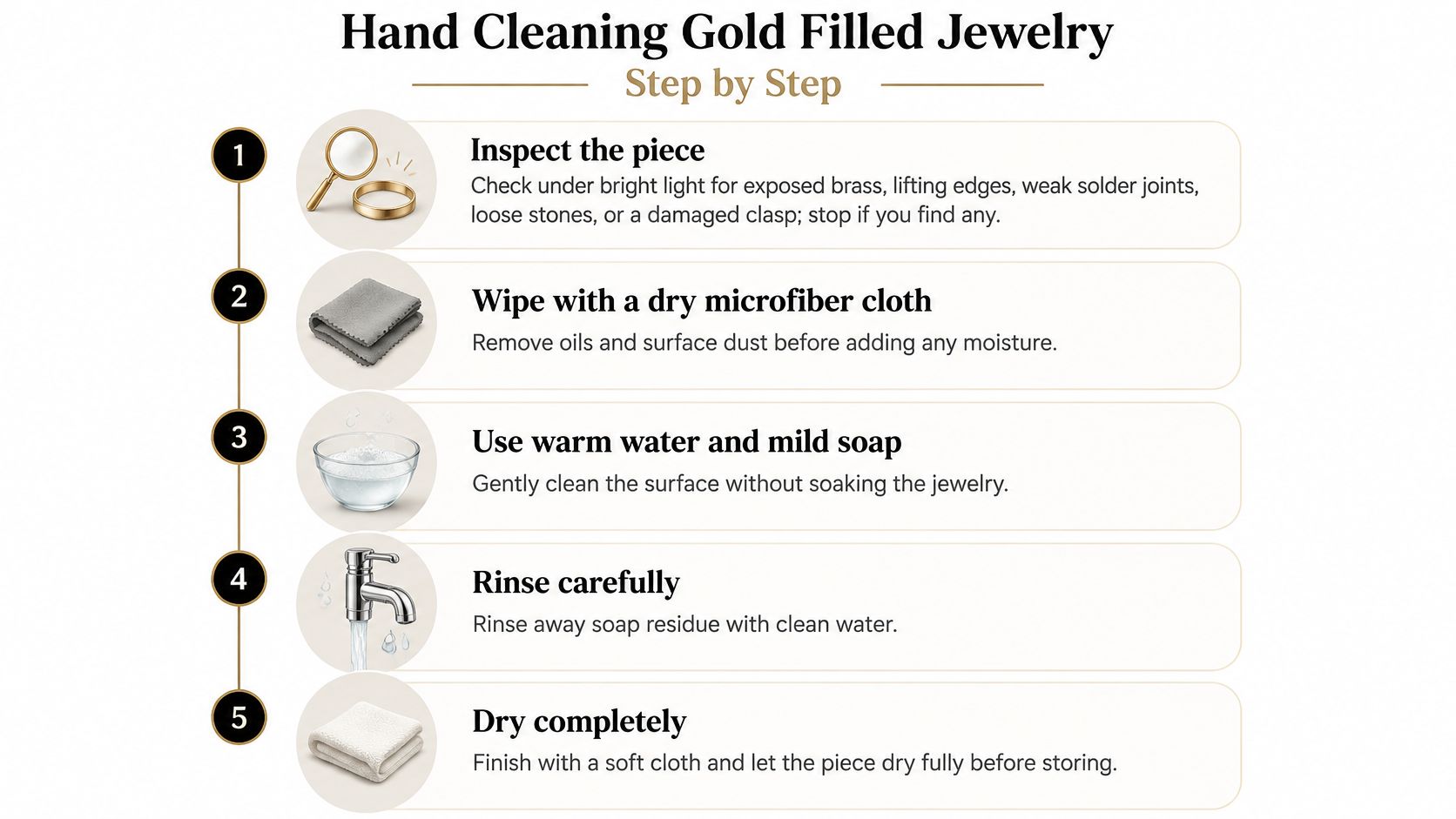
The Six Steps I Use at the Bench
- Inspect under bright light. Look for exposed brass, lifting edges, weakened solder, loose stones, and damaged clasps. If you find any of those, stop here, because water and brushing will work into a gap you can't seal at home.
- Wipe dry first with a microfiber cloth. Skin oil and loose dust come off in seconds when dry. Skipping this step spreads that oily film through the wash water and leaves links looking smeared instead of clean.
- Wash briefly in lukewarm water with mild soap. Use a small bowl, not a running tap over an open drain, and keep the soak to 1 to 2 minutes. Hot water can stress settings and adhesives, and long soaks let moisture creep into seams and hollow components.
- Brush only where grime collects. Use a very soft baby toothbrush or a soft watercolor brush around links, jump rings, and settings. Stroke gently in one direction along the chain rather than scrubbing in circles, which concentrates wear on the high points of each link.
- Rinse thoroughly in clean lukewarm water. Swish the piece in a second bowl of plain water and flex chain links lightly so soap doesn't hide between them. Leftover film is the most common reason a cleaned piece still looks dull, especially around a lobster clasp or under a stone.
- Pat completely dry before you put it away. Press, don't rub, with a soft lint free cloth, then let the piece sit on the cloth while you check crevices. Rubbing a damp chain back and forth adds friction exactly where the gold is thinnest.
Where People Go Wrong
Don't sand, file, or use abrasive pastes to chase a scratch. You're not polishing solid metal, you're shaving a bonded surface, and localized thinning shows as a pale patch that spreads. Chlorine bleach can pit or damage gold alloys, and ammonia based cleaners can be too harsh for delicate stones or older pieces, so neither belongs in the bowl even if a generic gold recipe calls for it.
For gemstone pieces, don't default to ultrasonic cleaning until a jeweler has confirmed the stones, settings, and bond condition are suitable. Organic gems and stones with surface reaching fractures or filled treatments don't belong in that tank.
A properly cleaned piece doesn't look mirror polished. It shows even shine across the links, clear openings in settings with no grey soap line, and a clasp that opens and closes without grit. If one area stays dark after two gentle washes, that's information, not a reason to press harder. Persistent discoloration at an edge often means the core is starting to show.
Clean means soil gone and surface intact. If you have to choose between brighter today and thicker gold next year, choose thicker gold.
Ultrasonic Cleaning Steps for Sound Pieces
I would only machine clean gold filled jewelry that passes inspection twice, once before and once after. The vibration dislodges compacted lotion from chain interiors and under settings faster than a brush reaches, but it also tests every solder joint and prong in the piece. One short cycle on a sound item is reasonable. Repeated cycles to fix heavy buildup is how settings loosen unnoticed.
Run It Like a Test
- Repeat the condition check under magnification. Look for lifting edges, exposed brass, cracked solder, and stones that move when you touch them with a fingertip. Any failure ends the machine plan for that piece.
- Confirm the stones are compatible. Don't use ultrasonic cleaning on pearls, coral, amber, opal, or stones with surface reaching fractures or filled treatments. If you don't know whether a stone is treated, you don't know enough to run it.
- Use the basket and separate pieces. Place one piece in the mesh basket so it doesn't contact the tank wall or another item. Fill with lukewarm water and solution to the level marked on the tank, because pieces bouncing against steel pick up fine scratches.
- Run the shortest setting once. That's usually 3 to 5 minutes. Never run back to back cycles while the water is warm and the piece is already clean enough to inspect.
- Rinse and dry outside the tank. Lift the basket out, rinse the piece in clean lukewarm water in a bowl, and pat dry with a soft cloth. Leaving it sitting in dirty tank water redeposits the soil you just removed.
- Inspect again under magnification. Check for loosened stones, seam movement, new discoloration, or a clasp that feels different. If anything changed, that piece is done with machine cleaning. Switch it to hand washing or take it in.
Dirt that survives one proper cycle is usually packed into a setting a soft brush can reach. It isn't evidence you need a longer cycle. Brush it gently by hand, rinse, and reassess.
Cleaning Solutions, Damaging Products and Frequency
Start with what's already in your kitchen. A few drops of mild dish soap in a cup of lukewarm water cleans most gold filled pieces when you give it a soft brush and a proper rinse. I would use a purpose made gentle jewelry cleaner when you want a consistent solution for ultrasonic use or for pieces with compacted oils. Our jewelry cleaner is safe for gold, silver, platinum, diamonds, and most gemstones, you only need a small capful per use, and it can be applied manually with a soft brush when you aren't using a machine.
| Solution or method | Concentration or amount | How often |
|---|---|---|
| Mild dish soap in lukewarm water | A few drops per cup of water | Monthly, or after heavy wear |
| Commercial ultrasonic jewelry cleaner | One small capful per session, per label | Each ultrasonic session |
| Ultrasonic cycle | About 3-5 minutes on the shortest setting | Only for pieces that pass the checks |
| Soft brush with mild soap (manual) | Same solution as hand washing | When a machine is not used |
| Dry microfiber cloth | No solution; wipe oils off | After every wear |
| Repeated gentle washes for heavy tarnish | Mild solution, several sessions | Until tarnish lifts; then monthly |
Products That Damage the Bond
- Chlorine bleach and pool water: Chlorine pits gold alloys and attacks weak points where the core is near the surface.
- Ammonia based cleaners: They're too harsh for many delicate stones and older soldered pieces, even when diluted.
- Toothpaste, baking soda paste, and polishing compounds: They work by abrasion, so each use removes a little bonded gold and leaves fine scratches that collect soil faster.
- Hot water and long soaks: Heat and extended immersion stress settings and let moisture sit in seams, clasps, and hollow beads.
- Salt water and household chemicals: They discolor metal and erode finishes, particularly at jump rings and worn edges.
Gold doesn't make a piece chemical proof. The alloy on the surface still reacts, and the seams still give liquids a path inward.
A Frequency Rule That Holds
Wipe after every wear, hand clean about once a month or when the piece looks dull, and clean sooner after heavy sweat, sunscreen, or a day when it got wet. For heavy tarnish, repeat gentle washes across separate sessions and let the piece dry fully between them. If tarnish hasn't moved after two or three sessions, stronger chemistry won't restore gold that's already thin.
Drying and Storing Pieces Between Wears
Moisture you leave behind does more harm than the dirt you removed. Water trapped in a clasp spring, inside a hollow bead, or between tight chain links sits against solder and any exposed core metal for hours. That's where dulling starts, and it's why drying belongs inside the cleaning routine rather than after it.
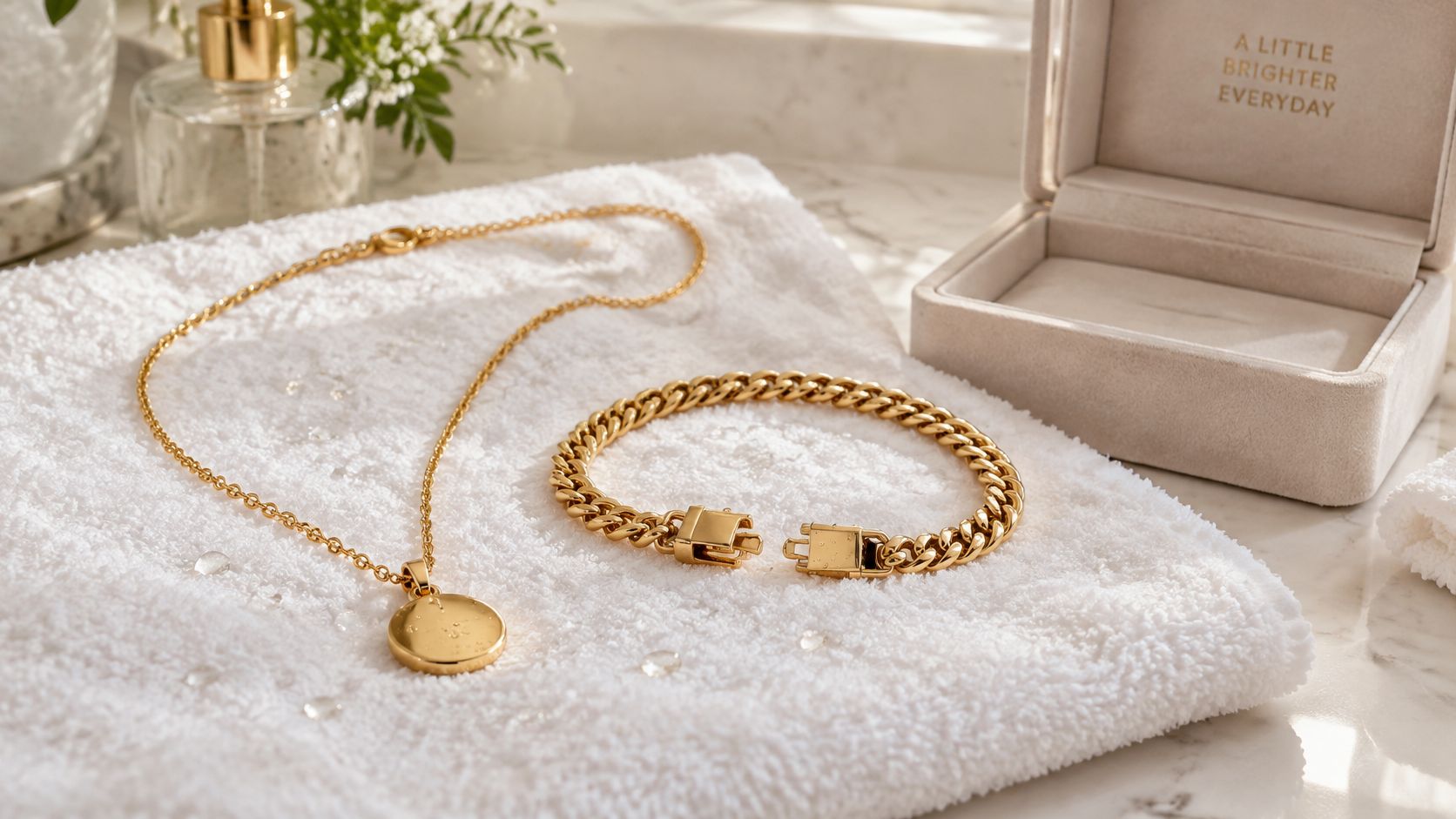
Pat the piece dry, then lay it flat on a soft towel for a few minutes while you check the clasp, jump rings, and the back of any setting. Open and close the clasp once over the towel. If water appears, blot again and wait. Never seal a damp piece inside a pouch or zip bag.
Storage That Prevents Wear
Store each piece separately in a soft pouch or lined compartment. Chains left tangled together saw against each other every time the drawer moves, and that contact wear lands on link edges first. Keep the box in a bedroom drawer rather than a bathroom cabinet, since steam and temperature swings speed up dulling, and keep it out of direct sun from a window.
Habits during wear save more gold than any cleaning schedule. Put jewelry on after lotion, perfume, and hairspray have dried. Take it off before swimming, exercising hard, showering, or cleaning with household chemicals, and before applying hand sanitizer repeatedly over rings and bracelets.
When you take a piece off: Wipe it with a dry microfiber cloth, check the clasp closes cleanly, confirm it's dry to the touch, and store it alone in its pouch.
Follow that four step habit and most pieces need only the monthly hand wash. Skip it, and you're scrubbing off weeks of compacted product each time, which tempts you toward the abrasives that cause real damage.
Decide When to Stop and Book a Jeweler Inspection
Stop home cleaning the moment you see lifting or flaking gold, exposed brass, a loose stone, weak solder, or a failing clasp. Those aren't cleaning problems. They're structural problems that cleaning makes worse, because water, brushing, and vibration all exploit the opening that's already there.
Identification comes first, since similar looking pieces tolerate very different treatment. The FTC jewelry guides comment record defines gold filled as a regulated description tied to the quantity and manner of application of gold, while warning that gold plated or gold washed surfaces can be thin enough to wear away and reveal the underlying metal. Confirm whether your item is gold filled, plated, vermeil, solid gold, or set with glued stones before you choose soaking, brushing, or an ultrasonic cycle.
Look at edges, seams, and solder joints under magnification, where wear appears long before it shows on flat surfaces. Even solid gold alloys can be damaged by chlorine bleach, so don't assume a durable feel means chemical resistance. A gold filled piece can be mechanically strong and still vulnerable at a worn ring shank or clasp tongue.
A jeweler can test stone security, inspect the bond at seams, and tell you whether discoloration is surface soil or core metal showing through. That distinction decides everything. Soil comes off gently. Exposed core means repair or retirement, not harder polishing.
Pieces that pass your checks can be cleaned with the hand or ultrasonic steps that fit their condition. Pieces that fail go in for inspection, ideally in a small pouch so loose components don't get lost. Resume your normal home routine only after the repair is complete and the piece passes inspection again.
When you clean gold filled jewelry at home, our jewelry cleaner at $12.99 gives you a solution safe for gold, silver, platinum, diamonds, and most gemstones, with a concentrated formula that allows up to ~36 cleaning sessions per bottle for ultrasonic or soft brush use. If your piece passes inspection and only needs soil removed rather than repair, visit Evo Dyne Products to get the cleaner and put the short cycle, small capful routine to work.